An SD Card Of Your Own For Microcontroller Projects

If you’ve wiring up a microcontroller and need some kind of storage, it’s likely you’ll reach for an SD card. Compared to other ways of holding data on your project, SD cards are just so much cheaper, resilient to physical and magnetic shocks, and simpler to work with from both a hardware and software perspective. On the other hand, it might seem silly to put a SD card slot on a board that’s never going to see a replacement card. [DIY GUY Chris] wants to advertise a solution for that: a cardless SD card chip by XTX that can act as a drop-in replacement for your projects. 

The XTXD0*G series are NAND flash chips of precisely the sort you’d find in an SD card, except without the SD card. That means you can use your usual SD card access libraries to speed prototyping, but skip the BOM cost of an actual card reader. In his Instructable and the video embedded below [Chris] shows how he used the 4 Gbit version, the XTSD04GLGEAG to make a custom SD-compatible breakout board that is equally happy in your laptop’s card reader or on a breadboard.

To get it plugged into the breadboard, [Chris] is using the standard 2.54 mm headers you can get anywhere; to get it plugged into a card reader, he’s just relying on the PCB being cut to shape. [Chris] notes that you’ll want to have the board built at 0.6 mm thickness if you’re going to plug it in like a micro SD card.

Of course once you’ve gotten used to the little NAND chips, there’s no need to put them on breakouts but this looks like a fun way to test ’em out. You don’t need to keep your flash chip on an SD-card sized PCB, either; we saw something similar used to make modern game cartridges. If you insist on using a standard SD card and don’t want to buy a slot, you can certainly DIY that instead. 

Continue reading “An SD Card Of Your Own For Microcontroller Projects”
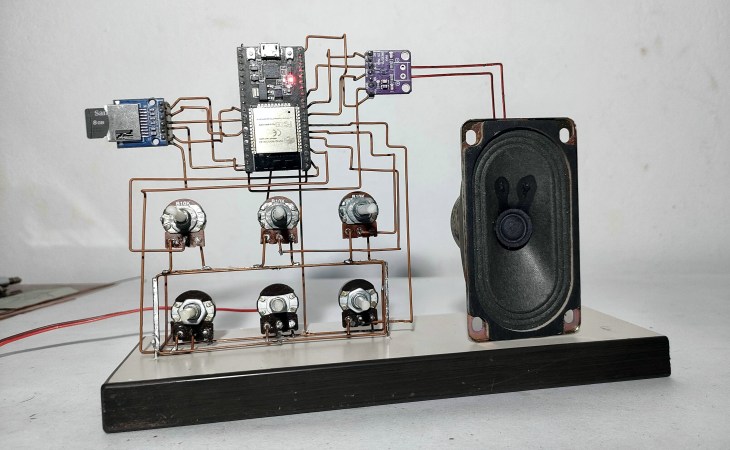
A circuit sculpture designed to help you sleep.

Sweet Sound Sculpture Helps You Sleep Soundly

Have trouble sleeping, or getting to sleep in the first place? You’ve no doubt heard of white noise machines, but know it would be much cooler to make your own. Enter Noise Maker, a DIY sound sculpture by [optimus103733], who wanted to learn something in the process of creating.

The best thing about this sound sculpture aside from the looks is that you can not only play five different sounds (e.g. birds, traffic, water, frog, white noise), you can mix them together into a rich but relaxing cacophony.

As you can probably see from the picture, Noise Maker is based on the ESP32 and uses an SD card module, an amplifier, and five six pots. Be sure to check out the pictures, because there are three layers of copper connections and a lot of careful bending to make it all come together. In the video after the break, you can hear it in action.

It seems [optimus103733] isn’t completely satisfied and wants to make a few improvements in the future, such as a voltage regulator, a power switch, and a timer to automatically stop playback once (we assume) sleep has come. Evidently the ESP32 struggles a little with mixing six audio sources, but hey, lesson learned.

Wait, why do we sleep in the first place?

Continue reading “Sweet Sound Sculpture Helps You Sleep Soundly”

Possibly The Newest ISA Card

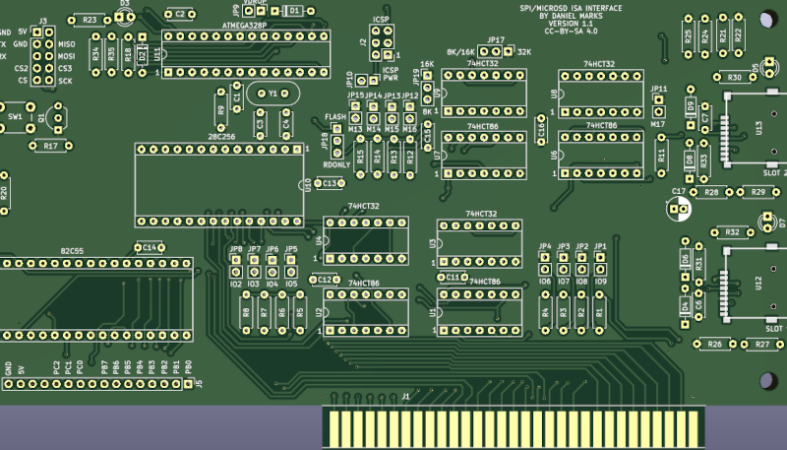
Back when the IBM PC was new, laying out an ISA board was a daunting task. You probably didn’t have a very fast ‘scope, if you had one at all. Board layout was almost certainly done on a drafting table with big pieces of tape. It was hard for small companies, much less hobbyists, to make a new card. You could buy a prototype board and wirewrap or otherwise put together something, but that was also not for the faint of heart. But with modern tools, something like that is a very doable project and [profdc9] has, in fact, done it. The card uses an ATMega328P and provides two SD cards for use as mass storage on an old computer.

The design tries to use parts that won’t be hard to get in the future. At least for a while, yet. There’s capacity for expansion, too, as there is an interface for a Wiznet 5500 Ethernet adapter.

Continue reading “Possibly The Newest ISA Card”

A 3D-printed talking milk jug with a speech bubble that says 'glug'.

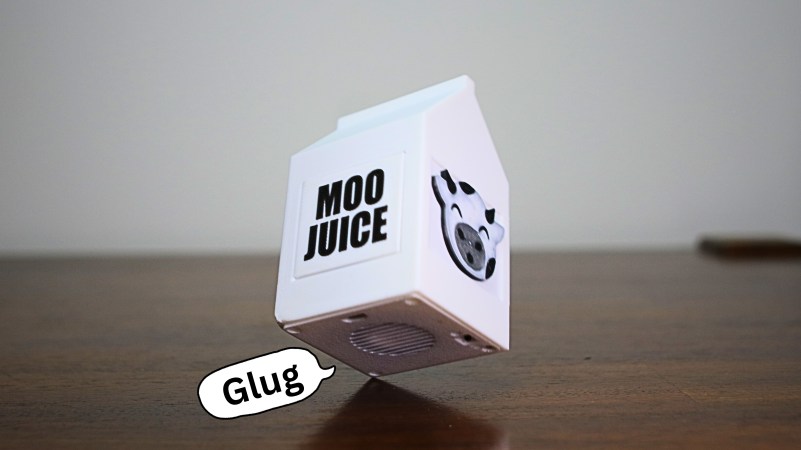
Talking Milk Jug Says Glug-Glug-Glug

Children can be a great source of daily inspiration, especially when they are just beginning to speak in full sentences and starting to let their little personalities show.

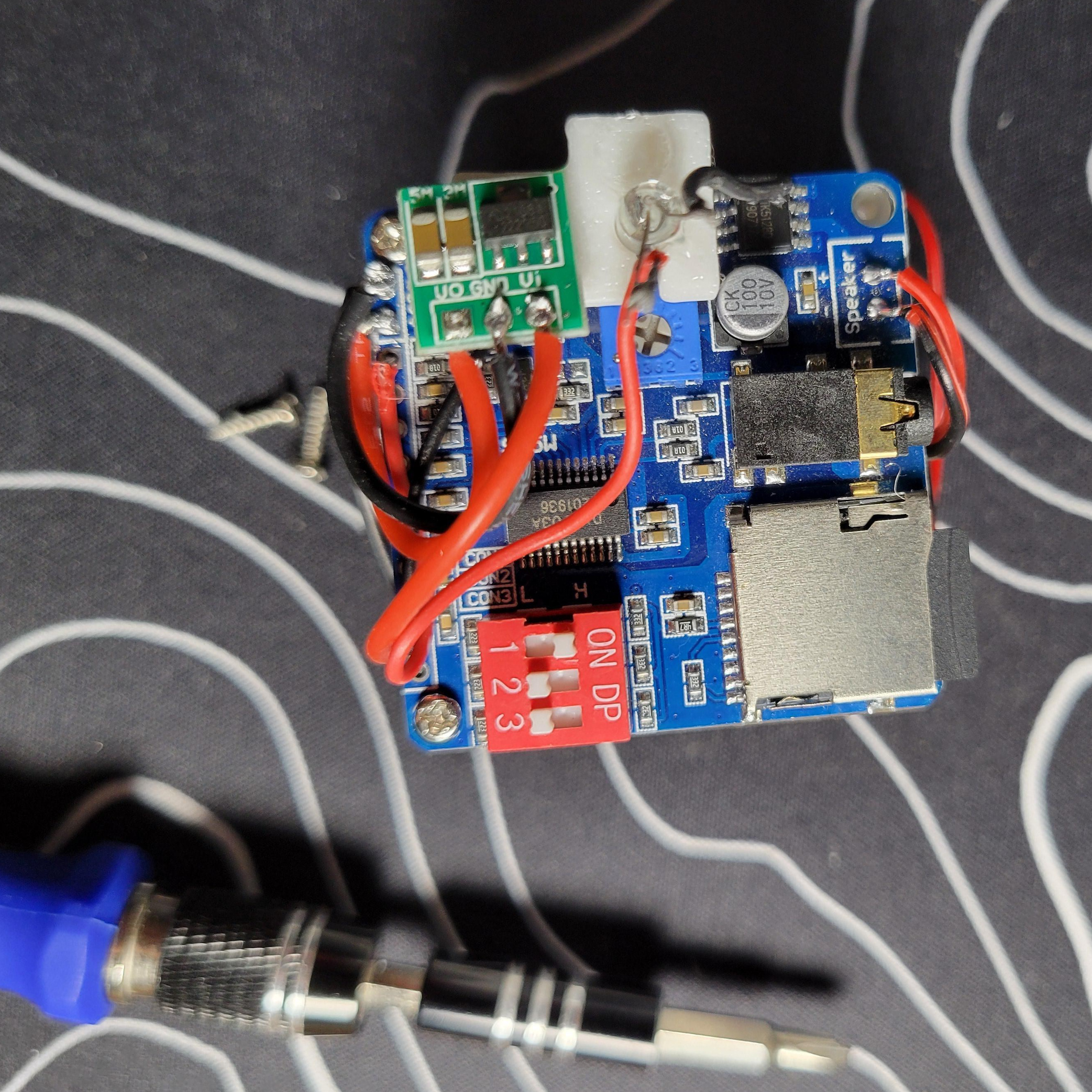
The innards of the milk jug. A sound module with SD card, a tilt switch, a boost converter, and so on. [Franklinstein] has the cutest toddler, and she loves her toy espresso machine, especially the little milk carton that came with it. Well, one day, Daddy made a glug-glug sound that delighted her, and he was inspired to build an entirely new milk jug that would make that special sound whenever it was turned over.

In order to keep the build relatively simple, [Franklinstein] used a sound module with an SD card and a tilt switch to activate it. There’s not much else to the build, really — just the usual suspects like a boost converter, a charging module, and a speaker, of course. In case you couldn’t tell, the enclosure and the internal skid that the electronics assemble onto are 3D printed.

This is really cute, and [Franklinstein]’s daughter seems to love it. Everything is available, including some nice instructions if you want to make one of your own. Be sure to check out the neat build video after the break.

The things we do for kids. Seriously.

Continue reading “Talking Milk Jug Says Glug-Glug-Glug”

Recovering A Physically Broken SD Card

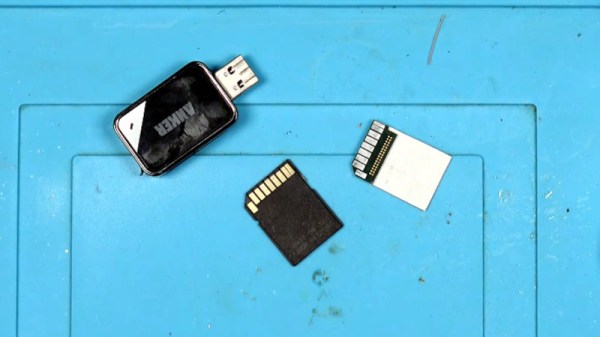
There is much to be found online about recovering data from corrupt SD cards, but [StezStix Mix] had an entirely different problem with his card. He’d filmed an important video to it, then dropped it and ran his office chair over it, snapping it almost in half. He’s put up a couple of videos showing how he recovered the data, and we’ve put them below the break.

A modern SD card is mostly just plastic, as in the decades since the format was created, the size of the circuitry on it has decreased dramatically. So his stroke of luck was that the card circuitry was a tiny PCB little bigger than the contact pad area on a full size SD card. There was a problem though, it wouldn’t be easy to fit in an SD card socket. So in the first video he goes through physically wiring it to a USB card reader, which results in reading the data after a false start in remembering that an SD card activates a switch.

This however is not the end of the story, because he had viewers asking why he didn’t simply attach an SD card shaped bit of cardboard. So the second video below goes through this, trying both card, and an SD to micro SD adapter. We find that making something to fit an SD socket is a lot less easy than it looks, but eventually he manages it.

Meanwhile those of you with long memories may recall this isn’t the first SD surgery we’ve brought you.

Continue reading “Recovering A Physically Broken SD Card”

Upgraded Toy Guitar Plays Music

Getting the finishing details on a Halloween costume completed is the key to impressing friends and strangers alike on the trick-or-treat rounds. Especially when it comes to things like props, these details can push a good Halloween costume to great with the right touches. [Jonathan]’s friend’s daughter will be well ahead of the game thanks to these additions to a toy guitar which is part of her costume this year.

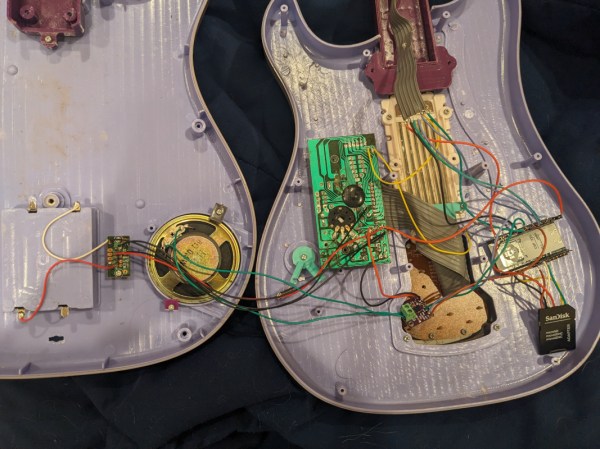
The toy guitar as it was when it arrived had the capability to play a few lackluster sound effects. The goal here was to get it to play a much more impressive set of songs instead, and to make a couple upgrades along the way as well. To that end, [Jonathan] started by dismantling the toy and investigating the PCBs for potential reuse. He decided to keep the buttons in the neck of the guitar despite their non-standard wiring configuration, but toss out the main board in favor of an ESP32. The ESP32 is tasked with reading the buttons, playing a corresponding song loaded on an SD card, and handling the digital to analog conversion when sending it out to be played on the speaker.

The project doesn’t stop there, though. [Jonathan] also did some custom mixing for the songs to account for the lack of stereo sound and a working volume knob, plus he used the ESP32’s wireless capabilities to set the guitar up as a local file server so that songs can be sent to and from the device without any wires. He also released the source code on the project’s GitHub page for anyone looking to use any parts of this project. Don’t forget there’s a Halloween contest going on right now, so be sure to submit the final version of projects like these there!

Continue reading “Upgraded Toy Guitar Plays Music”

Remote Water Quality Monitoring

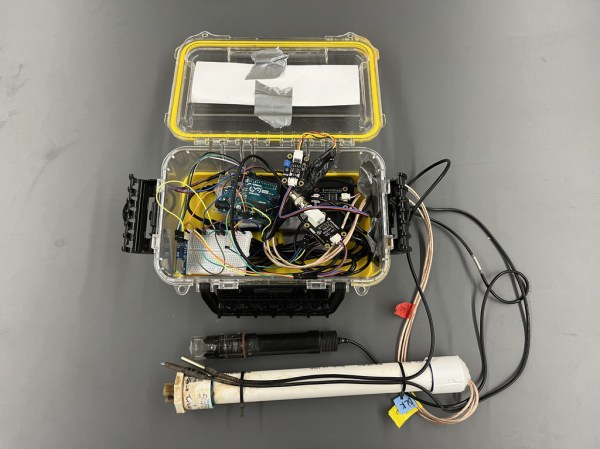
While it can be straightforward to distill water to high purity, this is rarely the best method for producing water for useful purposes. Even drinking water typically needs certain minerals in it, plants may need a certain pH, and wastewater systems have a whole host of other qualities that need to be measured. Measuring water quality is a surprisingly complex endeavor as a result and often involves a wide array of sensors, much like this water quality meter from [RowlesGroupResearch].

The water quality meters that they are putting to use are typically set up in remote locations, without power, and are targeting natural bodies of water and also wastewater treatment plants. Temperature and pH are simple enough to measure and grasp, but this device also includes sensors for total dissolved solids (TDS) and turbidity which are both methods for measuring various amounts and types of particles suspended in the water. The build is based around an Arduino so that it is easy for others to replicate, and is housed in a waterproof box with a large battery, and includes data logging to an SD card in order to make it easy to deploy in remote, outdoor settings and to gather the data at a later time.

The build log for this device also goes into detail about all of the steps needed to set this up from scratch, as well as a comprehensive bill of materials. This could be useful in plenty of professional settings such as community wastewater treatment facilities but also in situations where it’s believed that industrial activity may be impacting a natural body of water. For a water quality meter more focused on drinking water, though, we’d recommend this build that is trained on its own neural network.