At one point or another, we’ve probably all wished we had a VR headset that would allow us to fly around our designs. While not quite the same, thing, [manahiyo831] has something that might even be better: a VR spectrum analyzer. You can get an idea of what it looks like in the video below, although that is actually from an earlier version.
The video shows a remote PC using an RTL dongle to pick up signals. The newer version runs on the Quest 2 headset, so you can simply attach the dongle to the headset. Sure, you’d look like a space cadet with this on, but — honestly — if you are willing to be seen in the headset, it isn’t that much more hardware.
What we’d really like to see, though, is a directional antenna so you could see the signals in the direction you were looking. Now that would be something. As it is, this is undeniably cool, but we aren’t sure what its real utility is.
What other VR test gear would you like to see? A Tron-like logic analyzer? A function generator that lets you draw waveforms in the air? A headset oscilloscope? Or maybe just a giant workbench in VR?
The origin story for many who’d call themselves a member of the hacker community usually starts with taking things apart as a child just to see how they worked. For [Radoslav], that trend doesn’t seem to have slowed down, and he’s continued taking toys apart. Although since it’s his daughters little radio controlled car, he stuck to a non-destructive teardown. The result? He’s able to control the car with his laptop through a HackRF One SDR transceiver as shown in the video below the break.
[Radoslav] is no stranger to reverse engineering embedded devices, IoT gadgets, and probably more. So he started with what information was publicly available about the radio control interface in use. Many electronic devices sold in the US must be certified by the FCC (Federal Communications Commission) and prominently display their ID number, and this toy was no exception. The FCC database gave [Radoslav] enough information to know that the communication protocol is modulated with GFSK, a type of Frequency Shift Keying.
He fired up his favorite radio signal analysis tool and and got to work on the protocol itself. Along the way he found that communication between the car and controller is bidirectional but also very easy to get around. The result is that he can drive the car around with his laptop- definitely a cool hack, but for this one, the journey was surely the goal, not the destination.
Tesla vehicles have a charging port that is under a cover that only opens on command from a charging station. Well, maybe not only. [IfNotPike] reports that he was able to replay the 315MHz signal using a software defined radio and pop the port open on any Tesla he happened to be near.
Apparently, opening the charging port isn’t the end of the world since there isn’t much you can do with the charging port other than charging the car. At least, that we know of. If history shows anything, it is that anything you can get to will be exploited eventually.
[Oleg Kutkov] decided to build a wideband SDR – for satellite communication research and monitoring, you know, the usual. He decided on a battery of HackRF boards – entire eight of them, in fact. Two 1×4 and one 1×2 RF splitters and an LNA on their combined RF input made for a good start to the project, and from there, it only got more complex.
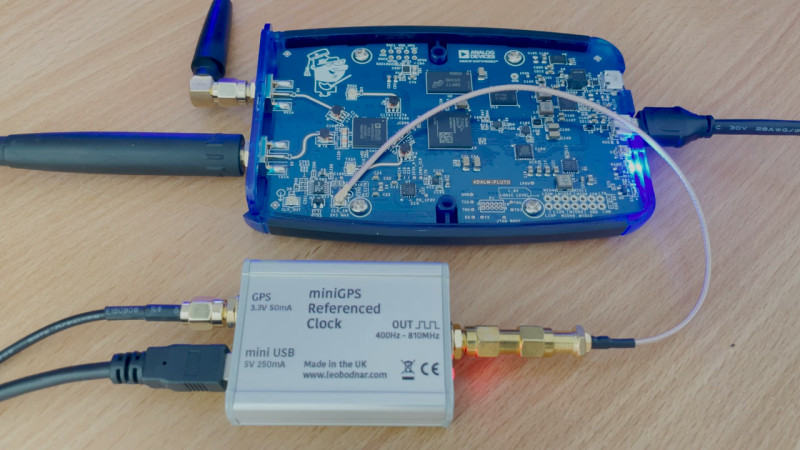
HackRF boards can be synchronized with a separate clock source, but you can’t just pull a single clock line to all of them in a star configuration. Thus, he’s built a clock distribution and amplifier board, with 4 ns propagation delay at 1 PPS, and only 10 ns delay at 10 MHz. Then, he integrated that board with the HackRF setup, adding a case, wiring up a purpose-built cable and dealing with the reflections that occurred.
HackRF boards are USB 2.0 and able to generate a stream of data up to 320 MB/s, and there’d be no viable way to aggregate eight 2.0 links into one. To solve that, he’s used eight separate PCI-E to USB 3.0 cards, each of them with one HackRF plugged in, all connected to an AMD Ryzen 9-powered PC through PCI-E risers we typically see used for mining purposes. To tie it all together, he created a gnuradio flowgraph and patched the osmocom source block to enable the external clock synchronization mechanisms he decided to use.
Each HackRF is connected to its own PCIe USB card.
In the end, [Oleg] shows us some promising results – two DVB-S transceivers visible on the waterfall display of the spectrum capture. The work is not over here, to be clear – he’s ran into a few roadblocks. The gnuradio flowgraph doesn’t lend itself well to multi-threading, even on a Ryzen 9 machine, and [Oleg] pledged to rewrite the capture mechanisms in C++ which can be nicely allocated to separate physical CPU cores, something gnuradio is apparently not quite good at.
More importantly, the spectrum captured is not continuous, and [Oleg] questions whether it can be demodulated properly. He had to resort to frequency overlaps due to upsampling, and he’s not quite sure how to compensate for that. Overall frequency stability is also in question. However, from here, seems like most of the work towards building a wideband receiver is done!
[Oleg] is typically seen on Twitter, lately doing some heavy tinkering with Starlink – as Kyiv, the city he’s currently in, is under bombardment of Russian Armed Forces. We can only respect and appreciate the dedication. In January, we’ve covered his work on an USA-imported Tesla LTE modem replacement to fix LTE band incompatibilities in Ukraine, and his blog is a treasure trove of experiments that we are yet to properly comb through, from astrophysics and satellite work to RS485 networks and Linux driver writing.
Ham radio operators can be pretty selective about their gear. Some are old-school tube purists who would never think of touching a rig containing transistors, and others are perfectly happy with the small Software Defined Radio (SDR) hooked up to their PC. The vast majority, though, of us are somewhere in between — we appreciate the classic look and feel of vintage radios as well as the convenience of modern ones. Better yet, some of us even like to combine the two by adding a few modern bells and whistles to our favorite “boat anchor.”
[Scott Baker] is one such Ham. He’s only had his license for a few months now and has already jumped into some great projects, including adding a panadapter to an old Drake R-4B Receiver. What’s a panadapter, you may ask? As [Scott] explains in his excellent writeup and video, a panadapter is a circuit that grabs a wideband signal from a radio receiver that typically has a narrowband output. The idea is that rather than just listen to somebody’s 4kHz-wide transmission in the 40m band, you can listen to a huge swath of the spectrum, covering potentially hundreds of transmissions, all at the same time.
Well, you can’t actually listen to that many transmissions at once — that would be a garbed mess. What you can do with that ultrawide signal, however, is look at it. If you take an FFT of the signal to put it in the frequency domain (by using a spectrum analyzer, or in [Scott]’s case, an SDR), you can see all sorts of different signals up and down the spectrum. This makes it a heck of a lot easier to find something to listen to — rather than spinning the dial for hours, hoping to come across a transmission, you can just see where all of the interesting signals are.
This isn’t the first (or even the twentieth) time that [Scott]’s work has graced our pages, so make sure to check some of his other incredible projects in our archives!
In the cyberdeck world, some designs are meant to evoke a cyberpunk vibe, an aesthetic that’s more lighthearted than serious. Some cyberdecks, though, are a little more serious about hardening their designs against adverse conditions. That’s where something like the ARK-io SurvivalDeck comes into play.
Granted, there does seem to be at least a little lightheartedness at play with the aptly named [techno-recluse]’s design. It’s intended to be an “Apocalypse Repository of Knowledge”, which may be stretching the point a bit. But it does contain an impressive amount of tech — wide-band software defined radio (SDR) covering HF to UHF, GPS module, a sensor for air pressure, temperature, and humidity, and a Raspberry Pi 3B running Kali Linux. Everything is housed in a waterproof ammo can; a 3D printed bezel holds an LCD touchscreen and a satisfying array of controls, displays and ports. The lid of the ammo can holds a keyboard, which was either custom-made to precisely fit the lid or was an incredibly lucky find.
There’s a lot to like about this build, but our favorite part is the external dipole for receiving NOAA weather satellite imagery. The ability to monitor everything from the ham bands to local public service channels is a nice touch too. And we have no complaints about the aesthetics or build quality either. This reminds us of an earlier cyberdeck with a similar vibe, but with a more civilian flavor.
Modern ham radio operators often face restrictions on antennas. This has made small antennas more popular, despite some limitations. [Tech Minds] reviews the GA-450 indoor active HF loop antenna and finds it better than expected. You can see the video review below.
You can’t expect a little antenna to perform as well as giant skyhook. However, for such a small loop covering 3 to 30 MHz, the antenna seems to perform very well. We like that the active part of it has a rechargeable battery. Obviously, you will only want to use this antenna for receiving, but it would be a great pairing for an HF-capable software defined radio (SDR). Even just in the window sill with half gain, it was able to pick up quite a bit of signal on the 40 meter and 20 meter ham bands. According to the video, performance below 7 MHz was lackluster, but it worked nicely at higher frequencies.
The loop is directional and you can rotate the loop on the base to zero in on a particular signal. Of course, if the antenna were up in the air, it might be harder to rotate unless you work out something with a motor. If all you want to do is receive and you have a budget of under $100, this looks like it would be a nice portable option.