SMD LED Matrix

3573544803_03000843fc

Everyone loves a good LED matrix hack, and we’ve seen our fair share, but never a 16 by 24 hand soldered SMD one. [bear24rw] and his team needed a project reflecting the interests of one of his classes, being an EE major, an LED matrix was just the ticket. Based on this instructable, he was able to cobble together a driver board; the code however was unacceptable, and he came up with a double buffer array solution. You can grab the eagle file and source code here, while you’re at it check out a quick video after the break.

Continue reading “SMD LED Matrix”

Making Cool Looking PCBs

pretty_pcb

[Mike] has posted an instructable on making cool looking PCBs. He does it a little differently than we do. He uses soda cans for the stencils and combines the solder mas and silk screen steps. Also, a bit of extra cooking gives him this cool gradient of color. He has managed to get some really fine etching. It isn’t as fine as a laser etching, but this should be able to handle the smallest stuff you can throw at it. We’re a bit curious what exactly he’s building. There’s a color picture after the break to show you what we mean.

Continue reading “Making Cool Looking PCBs”

Hackit: Xbox 360 Hardware Failures On The Rise?

e74xbox

Joystiq has been tracking the new starlet of Xbox 360 failures: the E74 error. It appears as the lower right light on the console turning red and an on-screen message telling the user to contact support with the error E74. The number of reported E74 errors seems to have risen since August 2008 and people are wondering if the more recent increase in errors are related to the release of the New Xbox Experience (NXE) Dashboard update. Did Microsoft reclass Red Ring of Death (RROD) failures as E74 to avoid warranty replacements? Continue reading “Hackit: Xbox 360 Hardware Failures On The Rise?”

SparkFun Stencil And Solder Paste Class Notes

stencil

Hobby electronics manufacturer SparkFun has started offering various classes at their Boulder, CO facility. [Landon] has been attending as many as possible and posted about his experience during their Stencil and Solder Paste class. Solder paste is used when manufacturing boards with a reflow oven. He took quite a few pictures of the process and posted notes and audio. He says it’s definitely something you’d have to learn hands-on, but his numerous photos give you an idea of what’s involved. Below, you can watch a video of the paste clean-up pass and stencil removal.

Continue reading “SparkFun Stencil And Solder Paste Class Notes”

Tools: Smart Tweezers

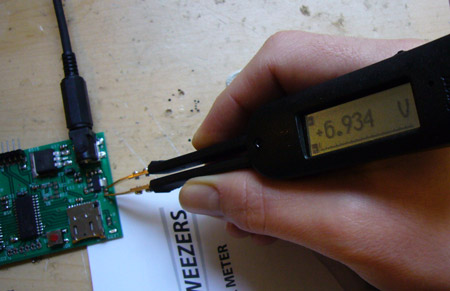
We’re big fans of surface mount parts. SMD components are cheaper, take less board space, and don’t require drilling; all the coolest new parts are only available in SMD packages.

Smart Tweezers are an advanced multimeter tool specifically designed to test and troubleshoot SMD circuits. It automatically identifies resistors, capacitors, and inductors, and displays the relevant measurements. Advanced Devices sent us a pair of Smart Tweezers to review. We used them while building our last few SMD projects, read about our experience with this tool after the break.

Continue reading “Tools: Smart Tweezers”

Surface Mount Soldering In Depth

smd

[doctek] wants to help ease any fear you may have of surface mount design. He has written this extremely in depth explanation of how to design and build an LED driver composed of surface mount parts. While there has been plenty of surface mount instruction floating around for a while, he feels that they skimp on the details, especially when it comes to really tiny parts who’s pads are unreachable with a soldering iron.  The method he uses is the “hot plate” method we’ve seen before. There’s enough information to build your own tiny LED driver with pulse width modulation, as well as tons of references to explain how and why he does things the way he does. Great job [doctek].

If you’re going to be doing a lot of soldering, you should check out our soldering station how to.

N8VEM Single Board Z80 Computer

n8vem

The N8VEM is a homebrew computer project based on the classic Z80 microprocessor. It’s designed to be easy to build using large TTL DIP components instead of SMD devices. It runs the CP/M operating system and all drives are virtual in RAM/ROM. While the base hardware is interesting, we really like the potential for expansion using a backplane. Have a look at the project’s Hardware Overview to see extra boards like the bus monitor and the prototyping board. We found out about this project on [Oldbitcollector]’s blog; he’s using a Parallax Professional Development Board to create a VT100 terminal for the N8VEM.