Nintenduo Stuffs An NES And SNES In The Same Case

[lovablechevy] loves her Retro Duo console, especially since it takes up less space than the NES and SNES it has replaced. There’s a small problem though: the Retro Duo isn’t 100% compatible with her old Nintendo cartridges. Battletoads is a deal breaker for her, so she built Nintenduo, an NES/SNES console that uses all original Nintendo hardware.

The Queen of Bondo began her project with a top-loading NES and the smaller revision of the SNES. There’s a Photobucket gallery showing the innards lovingly placed in their new plastic home.

Not only can [lovablechevy] play classics like Paperboy, Donkey Kong Country, and the Super Mario RPG that are incompatable with the Retro Duo, all the accessories like the Zapper and Power Pad now work.

The finished build is very small; not much bigger than an SNES 2, and is nearly dwarfed by the gigantic NES cartridges. She posted a video of herself trying not to shoot the stupid Duck Hunt dog with her Nintenduo. Check it out after the break.

Continue reading “Nintenduo Stuffs An NES And SNES In The Same Case”

Upgrading An Old Super Scope

rechargeable_super_scope

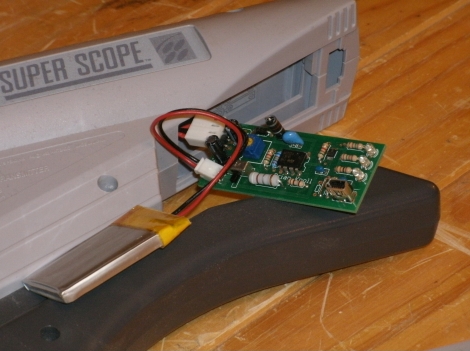
[Brian Knoll] still uses his Super Nintendo with relative frequency, and he just can’t get enough Super Scope action. If you never owned one, the Super Scope can be a ton of fun, but it’s also an incredible battery hog. It eats through AA batteries by the caseful, so [Brian] wanted to make the switch to rechargeable cells. Since NIMH AA batteries just don’t cut it in the Super Scope, he put together a rechargeable solution of his own.

He started off by calculating what sort of battery he would need for 8 hours of game play, then he started work on designing his circuit. The board he built contains both a DC/DC converter to provide the 9V required by the Super Scope, as well as built-in LiPo charger. He had his board made by BatchPCB, and after working through a small production error, he put everything together and gave his revamped scope a shot.

Things worked great, and while he says that he really should have built a low-voltage shutoff into his circuit, he is very happy with the results.

SNES Gamepad Coversion To USB

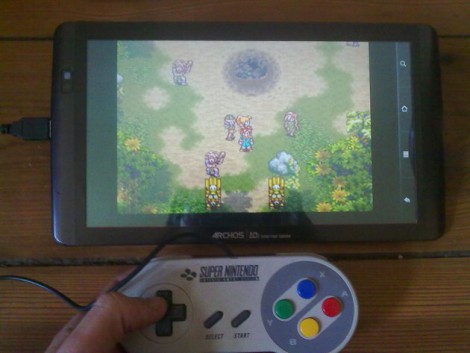
[Kekszumquadrat] wanted to use a classic controller to play emulator games on his Android tablet so he set out to convert an SNES gamepad to connect via USB. He found an old USB keyboard at a yard sale for about 3 Euros. He knew that the emulator he prefers has the option of remapping all the inputs to keyboard keys which means a USB keyboard has all of the electronics he would need to pull this off.

Once he had separated the keyboard circuitry from the case [Kekszumquadrat] plugged it into his Linux box and used Xev to establish how the keyboard matrix is set up. Xev is a common package that opens up an active window on the X desktop. When run from command line, any events that happen to the window will be echoed along with verbose data about that event. When it comes to keypresses, you’ll get the keycode you need. He simply shorted columns and rows until he found the desired mapping, then it was on to soldering.

The SNES controllers are very simple devices. As we’ve seen with previous projects, they use a serial-to-parallel shift register to gather button data and send it to the console. [Kekszumquadrat] simply soldered between button traces and keyboard matrix contacts. Once he finished, the keyboard parts were tucked inside of the controller case and he’s left with a USB controller that appears to be unaltered.

Using Classic Game Controllers With A Wii

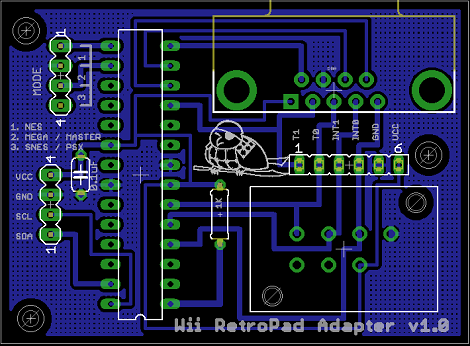
[Bruno]’s Wii RetroPad Adapter was sent into the tip line, and we’re loving the possibility of using Playstation 2, Genesis, NES and SNES controllers with our Wii.

While there are commercial solutions that connect an NES or SNES controller to a Wii, everything connects to the GameCube port and there is no adapter for Sega or Playstation controllers. For his build, [Bruno] used an ATmega168 to read data from the classic controllers and translate that to the Wiimote I2C bus. Think of it as a new classic controller with the same form factor your 8-year-old self knew and loved.

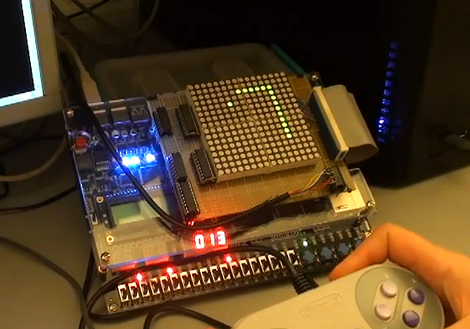
The schematic for the build is very simple and [Bruno] has all the software out in the open. Even the PCB is single sided and looks like it would be a great candidate for a homebrew PCB. There’s no indication [Bruno] is trying to monetize his creation, so he’s either doing right, or so very wrong. Check out the Dualshock 2/Mario 3 demo of this board after the break.

Continue reading “Using Classic Game Controllers With A Wii”

Update: Bluetooth Super Nintendo Controller For Android

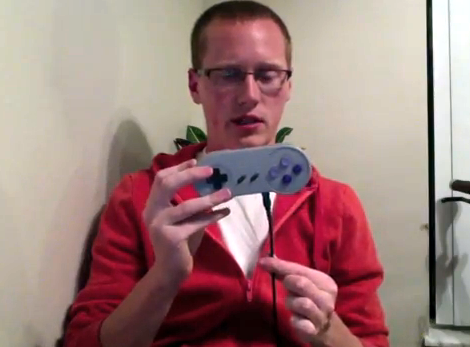
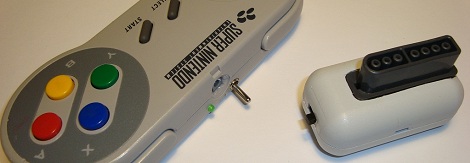
[Rich’s] newest version of a Bluetooth connected Super Nintendo controller takes what was already good and makes it better. We looked at the original version back in May, which is built into a knockoff controller  — [Rich] mentions that he got a lot of flack for defacing retro equipment and wants to set the record straight. The most notable difference between the two controllers is that the batteries are now housed inside the case. He switched over to an 850 mAh Lithium Ion battery, which takes much less room than the four AA batteries did. There is an integrated charger which connects via a mini USB jack as seen in the image above. Bother versions of the controller can be used to play emulators without rooting your Android device.

Unfortunately you won’t get to look inside the case. What we can tell you is that the build no longer uses a BlueSMiRF board , opting for a less expensive Bluetooth solution. We also know that the build is still Arduino compatible, sporting an ATmega328 chip running the bootloader. The lack of detail is because [Rich] is working to market the controller with a limited-quantity preorder. Check out his video presentation of the new version after the break.

Continue reading “Update: Bluetooth Super Nintendo Controller For Android”

Arcade Controller In A Box

[Alex] wanted to play video games with an arcade stick and buttons, but got sticker shock after seeing the price of commercially available controllers that connect to a computer via USB. He set out to build his own and ended up with the controller-in-a box that you see above.

At first he tried using an mbed microcontroller board but was unhappy with the latency built into the system that detected a button press, sent it via USB as a keyboard press, which was then interpreted as input by the game. He ditched the microcontroller completely and picked up a couple of 4021 parallel-to-serial shift registers. He had previously used this method to make his own SNES controller. The SNES uses two 8-bit shift registers to generate an 16-bit serial packet to send to the console. [Alex’s] reused that system, adding an SNES controller plug to his arcade box, and using the SNES to USB converter he already had to connect to the computer. Now he’s got a portable controller for the cost of three buttons, the stick, and two IC’s.

He explains the project himself in the clip after the break.

Continue reading “Arcade Controller In A Box”

Playing SNES With An R/C Controller

Normally when we see an R/C transmitter used in a build we’re prepared for robots, quadcopters, or UAVs. [Alex] found a new use for his Futaba radio – hooking it up to his Super Nintendo.

We’ve seen a lot of builds using game controllers as interfaces to other hardware. The N64 media remote comes to mind, as does the NES iPod dock. Outside of a few builds to automatically win in-game currency for you, we haven’t seen much of anything to control a video game with additional electronics. [Alex]’s build happily bucks that trend, and technically gives the SNES an analog controller.

The build uses an mBed microcontroller to capture the radio’s button and stick positions. This is sent through a two shift registers to produce the 16-bit packet required of the SNES controller protocol. [Alex] posted all the software for his build, and from the looks of it the code seems pretty portable. [Alex] says he’s working on getting his Sega Saturn running with his Futaba, so we can’t wait to see some Panzer Dragoon action. Check out [Alex] demoing his controller with Gradius III after the break.

Continue reading “Playing SNES With An R/C Controller”