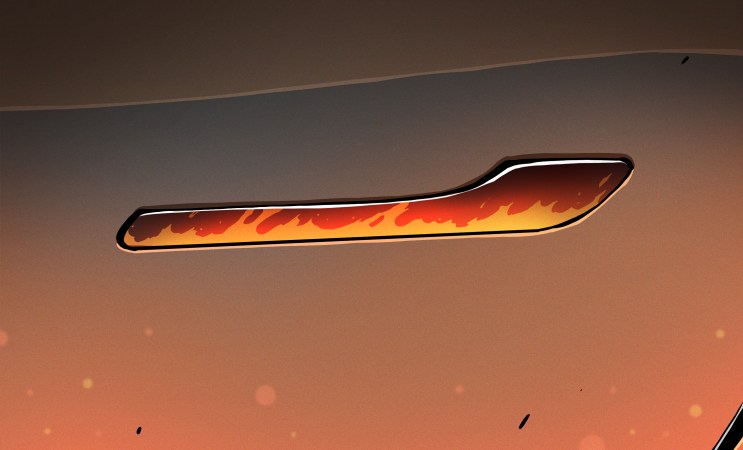
Chinese Regulators May Kill Retractable Car Door Handles That Never Should Have Existed

Headlights. Indicators. Trunk releases. Seatbelts. Airbags. Just about any part of a car you can think of is governed by a long and complicated government regulation. It’s all about safety, ensuring that the car-buying public can trust that their vehicles won’t unduly injure or maim them in regular operation, or in the event of accident.

However, one part of the modern automobile has largely escaped regulation—namely, the humble door handle. Automakers have been free to innovate with new and wacky designs, with Tesla in particular making waves with its electronic door handles. However, after a series of deadly incidents where doors wouldn’t open, regulators are now examining if these door handles are suitable for road-going automobiles. As always, regulations are written in blood, but it raises the question—was not the danger of these complicated electronic door handles easy to foresee?

Continue reading “Chinese Regulators May Kill Retractable Car Door Handles That Never Should Have Existed”

Hackaday Links Column Banner

Hackaday Links: November 9, 2025

We’re always a wee bit suspicious about articles that announce some sort of “World’s first” accomplishment. With a couple of hundred thousand years of history, most of which wasn’t recorded, over which something like 117 billion humans have lived, any claims of primacy have to be taken with a grain of salt. So when the story of the world’s first instance of a car being hit by a meteorite came across our feed, we had to check it out. The car in question, a Tesla, was being driven in South Australia by veterinarian Andrew Melville-Smith when something suddenly crashed into its windshield.

Continue reading “Hackaday Links: November 9, 2025”

Hackaday Links Column Banner

Hackaday Links: September 7, 2025

Two weeks ago, it was holographic cops. This week, it’s humanoid robot doctors. Or is it? We’re pretty sure it’s not, as MediBot, supposedly a $10,000 medical robot from Tesla, appears to be completely made up. Aside from the one story we came across, we can’t find any other references to it, which we think would make quite a splash in the media if it were legit. The article also has a notable lack of links and no quotes at all, even the kind that reporters obviously pull from press releases to make it seem like they actually interviewed someone.

Continue reading “Hackaday Links: September 7, 2025”

Hackaday Links Column Banner

Hackaday Links: June 15, 2025

Are robotaxis poised to be the Next Big Thing™ in North America? It seems so, at least according to Goldman Sachs, which issued a report this week stating that robotaxis have officially entered the commercialization phase of the hype cycle. That assessment appears to be based on an analysis of the total ride-sharing market, which encompasses services that are currently almost 100% reliant on meat-based drivers, such as Lyft and Uber, and is valued at $58 billion. Autonomous ride-hailing services like Waymo, which has a fleet of 1,500 robotaxis operating in several cities across the US, are included in that market but account for less than 1% of the total right now. But, Goldman projects that the market will burgeon to over $336 billion in the next five years, driven in large part by “hyperscaling” of autonomous vehicles.

Continue reading “Hackaday Links: June 15, 2025”

Hackaday Links Column Banner

Hackaday Links: February 2, 2025

All things considered, it was a very bad week for aviation here in the United States. Three separate crashes, two of which involved US military aircraft, have left over 70 people dead. We’ll spare you the details since there are plenty of other places to get news like that, but we did want to touch on one bright spot in this week’s aviation news: the first successful supersonic flight by a US-made civilian aircraft. There are a lot of caveats to that claim, but it’s clear that Boom Supersonic is on a path to commercializing supersonic air transportation for the first time since the Concorde was retired. Their XB-1 “Baby Boom” test aircraft managed three separate supersonic runs during the January 28 test flight over the Mojave test range. As usual, Scott Manley has excellent coverage of the test flight, including a look at how Boom used a Starlink terminal and an iPhone to stream cockpit video.

Continue reading “Hackaday Links: February 2, 2025”

This Week In Security: Apple Backdoors Curl, Tor’s New Bridge, And GhostRace

OK, that headline is a bit of a cheap shot. But if you run the curl binary that Apple ships, you’re in for a surprise if you happen to use the --cacert flag. That flag specifies that TLS verification is only to be done using the certificate file specified. That’s useful to solve certificate mysteries, or to make absolutely sure that you’re connecting to the server you expect.

What’s weird here is that on a MacOS, using the Apple provided curl binary, --cacert doesn’t limit the program to the single certificate file. On an Apple system, the verification falls back to the system’s certificate store. This is an intentional choice by Apple, but not one that’s aimed particularly at curl. The real magic is in Apple’s SSL library, which forces the use of the system keychain.

The current state of things is that this option is simply not going to do the right thing in the Apple provided binary. It’s documented with the note that “this option is supported for backward compatibility with other SSL engines, but it should not be set.” It’s an unfortunate situation, and we’re hopeful that a workaround can be found to restore the documented function of this option. Continue reading “This Week In Security: Apple Backdoors Curl, Tor’s New Bridge, And GhostRace”

Hackaday Links Column Banner

Hackaday Links: February 4, 2024

Things may not have gone as planned last week for the flying cellphone on Mars, but just because Ingenuity‘s flying career is over doesn’t mean there’s no more work to do. NASA announced this week that it’s going to try a series of “wiggle” maneuvers on Ingenuity‘s rotors, in an attempt to get a better look at the damage to the blade tips and possibly get some clues as to what went wrong. The conjecture at the moment seems to be that a large area of relatively featureless terrain confused the navigation system, which uses down-facing cameras to track terrain features. If the navigation program couldn’t get a bead on exactly how far above the ground it was, it’s possible the copter came in too hard and caused the rotor tips to dig into the regolith. There seems to be some photographic suggestion of that, with what looks like divots in the ground about where you’d expect the rotor tips to dig in, and even scraps of material that look out of place and seem to be about the same color as the rotor blades. All this remains to be seen, of course, and we’re sure that NASA and JPL are poring over all available data to piece together what happened. As much as we hate to say goodbye to Ingenuity, we eagerly await the post-mortem.

Continue reading “Hackaday Links: February 4, 2024”