Spring Clamp Is Completely 3D Printed

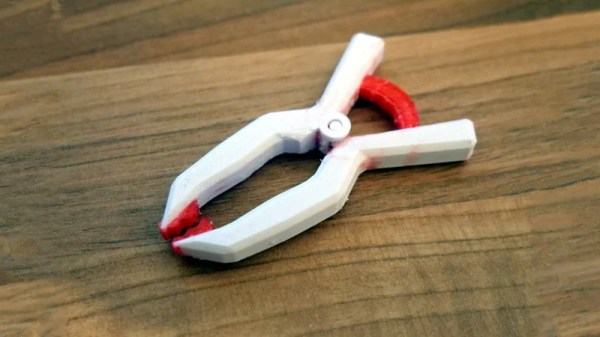
Dual-filament printers may seem like a gimmick to the uninitiated, but they open up some powerful options for advanced designs. [Darren Tarbard] shows this off with a nifty spring clamp that is 3D printed in a single operation.

The clamp is similar to one you’d find at any hardware store. Standard PLA or ABS filaments can be used for the main body of the clamp, which has an integrated hinge. However, instead of having a typical metal spring, the element is instead 3D printed. The spring is created out of TPU filament, and printed in place. Different in-fill percentages on the spring component can vary the characteristics of the spring, making for a softer or firmer grip.

It’s a tidy example of the applications of dual-filament printing – and far more useful than using it to print bi-color Pikachus. 3D printers have much to offer in the world of tooling; they can even turn a bench vice into an effective press brake. Video after the break.

Continue reading “Spring Clamp Is Completely 3D Printed”

Build Your Own Tools For More Power

Building something on your own usually carries with it certain benefits, such as being in full control over what it is you are building and what it will accomplish, as well as a sense of pride when you create something that finally works just the way you want it. If you continue down that path, you may eventually start making your own tools to help build your other creations, and if you also have some CAD software you can make some very high quality tools like this belt grinder.

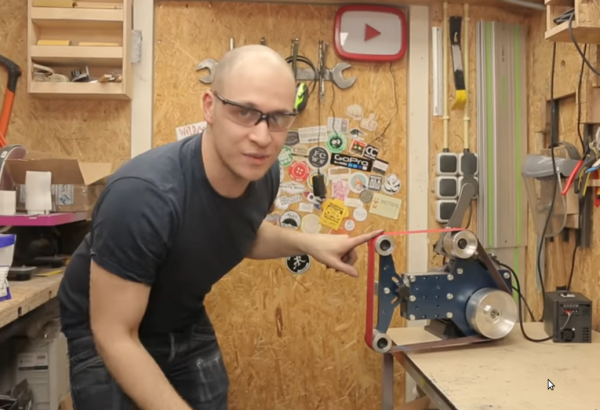
This build comes to us from [Emiel] aka [The Practical Engineer] who is known for his high quality solenoid engines. His metal work is above and beyond, and one thing he needed was a belt grinder. He decided to make a 3D model of one in CAD and then build it from scratch. The build video goes through his design process in Fusion 360 and then the actual build of this beast of a machine. The motor is 3.5 horsepower which, when paired with a variable frequency drive, can provide all of his belt grinding needs.

[Emiel]’s videos are always high quality, and his design process is easy to follow as well. We’re always envious of his shop as well, and it reminds us a lot of [Eric Strebel] and his famous designs.

Continue reading “Build Your Own Tools For More Power”

Tools, You Can’t Take Them With You

When I die I hope be buried in the English rural churchyard that has been my responsibility as churchwarden, after a funeral service that has been a celebration of my life. I am neither an Egyptian pharaoh nor a Viking queen though, so my grave will not contain all my tools and equipment to serve me in the afterlife. Instead aside from my mortal remains it will contain only a suitably biodegradable coffin, and my headstone will be a modest one bearing perhaps a technical puzzle to entertain visitors to the churchyard.

My workshop, my bench, and my tools will be the responsibility of my nearest and dearest, and I hope I will have suitably equipped them for the task of their dispersal. But for anyone who has a sizeable collection of gear, have you thought of what would happen if someone else had to clean it all out? What is profession for some and hobby for others, we deal in specialization that might as well be tools of arcane magic to the uninitiated.

Continue reading “Tools, You Can’t Take Them With You”

Hacked Calipers Make Automated Measurements A Breeze

Now, digital calipers with wired interfaces to capture the current reading are nothing new. But the good ones are expensive, and really, where’s the fun in plugging a $75 cable into a computer? So when [Max Holliday] was asked to trick out some calipers for automating data capture, he had to get creative.

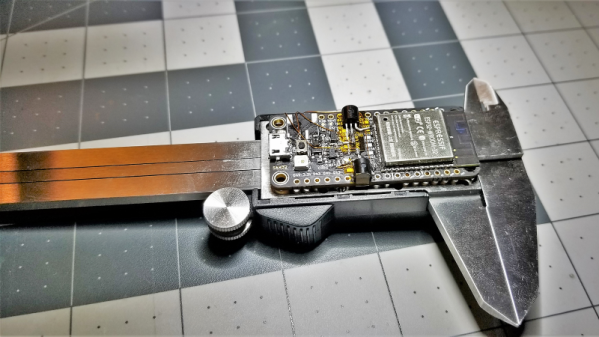
[Max] found that cheap Harbor Freight digital calipers have the telltale door that covers a serial connector, making them a perfect target for hacking. A little Internet sleuthing revealed the pinout for the connector as well as some details on the serial protocol used by most digital calipers: 24-bit packets is six four-bit words. [Max] used his SAM32, a neat open-source board with both a SAMD51 and an ESP32 that can run CircuitPython. An inverting buffer interfaces the serial lines to the board, which is just the right size to mount on the back of the caliper head. It’s hard to tell how [Max] is triggering readings, but the SAM32 is mounted as a USB device and sends keystrokes directly to a spreadsheet – yes, with the ESP32 it could have been wireless, but his client specifically requested a wired setup. Taking multiple readings is easy now that the user never has to swap calipers for a pen.

Cheap calipers like these are pretty hackable – you can add Bluetooth, turn them into DROs for a milling machine, or even make them talk.

Automatic Cut-Off Saw Takes The Tedium Out Of A Twenty-Minute Job

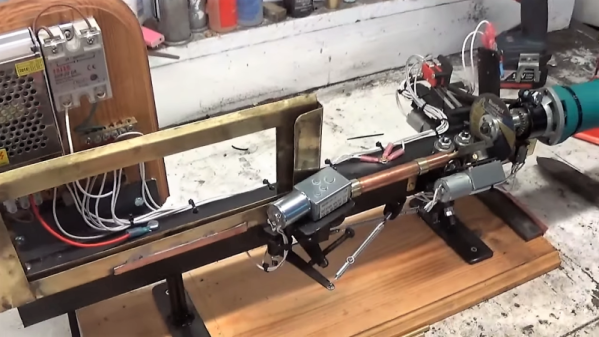
For [Turbo Conquering Mega Eagle], the question was simple: Do I spend 20 minutes slaving away in front of a bandsaw to cut a bunch of short brass rods into even shorter pieces of brass rod? Or do I spend days designing and building an automatic cutoff saw to do the same job? The answer is obvious.

It’s only at the end of the video below that [TCME] reveals the need for these brass bits: they’re for riveting together the handles of knives he makes and sells. That makes the effort that went into his “Auto Mega Cut-O-Matic” a little easier to swallow, although we still think he ran afoul of this relevant XKCD. The saw is built out of scraps and odd bits using angle iron as a base and an electric die grinder to spin a cut-off wheel. A small gear motor feeds the brass rod down a guide tube until it hits a microswitch stop, which starts the cut cycle. Another motor swivels the saw to make the cut then moves it out of the way so the stock can advance. The impressive thing is that the only control mechanism is a series of microswitches, cams, levers, and springs  – no Arduino needed. Heck, there’s not even a 555, which we find a refreshing change.

Yes, it’s overkill, but he had fun and made something pretty ingenious. [Turbo Conquering Mega Eagle] always has something interesting going on in the shop, and we couldn’t help but notice him using his aluminum-melting tea kettle to make some parts for this build.

Continue reading “Automatic Cut-Off Saw Takes The Tedium Out Of A Twenty-Minute Job”

Tiny Forklift Makes Unusable Space Usable

Houses with crawlspaces are fairly common in some geographic regions. The crawlspace can make it easier to access things like plumbing and electrical wiring, and can even be used as storage in homes that don’t (or can’t) have a basement. Along with improved building ventilation, these some of the perks compared to homes built on a solid slab of concrete. These crawlspaces aren’t exactly easy to get around in, though, but [Dave] has an easier way to get stuff in and out of these useful, but small, spaces.

Enter the crawl space forklift. Made with largely off-the-shelf components, the robot includes a few standard motors and linear actuators to move around and operate the front fork. That’s all pretty standard, but this build really shines with its use of FPV camera, monitor, and transmitter that allow the pilot to navigate the robot in the small space using remote control. For those safety-conscious among us, there is also a fire extinguisher ball on board which self-activates in case the robot catches on fire under his house.

This is a great, high-quality build that shows how common parts can make something revolutionary with the right idea. Identifying a problem and then building a solution, while not forgetting to spring for some safety equipment, can really make a difference even with something as simple as unoccupied space in a home. They can tackle tasks around the home, too.

Continue reading “Tiny Forklift Makes Unusable Space Usable”

Printed It: Parametric Hex Key Holder

Desktop 3D printing is an incredible technology to be sure, but it’s not a cure-all. If you’re interested in making something in large numbers, or if production speed is a concern, 3D printing probably isn’t what you’re looking for. But on the flip side, if you want to make a few highly specialized or customized objects, desktop 3D printing represents an absolute revolution in capability for the individual hacker and maker.

In our ongoing mission to prove that desktop 3D printing isn’t just a novelty, we keep a close eye out for printable objects which play to the strengths of the technology. You won’t find any benchmarks or dust collectors here; everything featured in Printed It is a bona fide practical object. An ideal entry into this series is something that you wouldn’t need to print more than a few times, isn’t easily sourced or made via traditional means, and if possible, offers some form of customization which makes it more suitable to the individual’s needs than what’s commercially available.

Not every object we feature hits all of these marks, but this parametric hex key holder designed by [Daniel Leitner] absolutely does. This object was created to address a problem that we imagine most Hackaday readers share: taming an ever-growing collection of hex keys. What’s more, this design is something of an open source success story. It’s an idea that passed through the hands of multiple community members, becoming more refined and functional as it went. Even if you don’t personally need to wrangle some unruly hex keys, this object is a fascinating look at how 3D printing and the community that has sprouted up around it is truly evolving the process of going from concept to execution.

Continue reading “Printed It: Parametric Hex Key Holder”