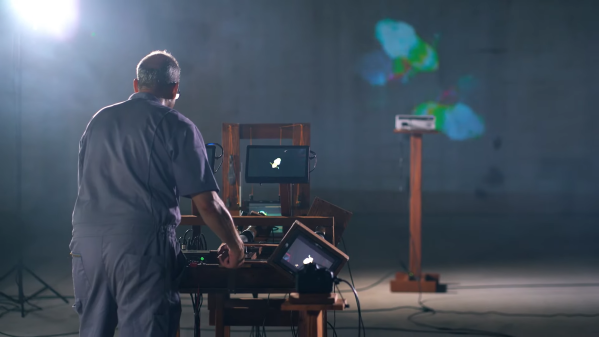
Video feedback is perhaps best known for its appearance in the film clip to Bohemian Rhapsody. It’s not a particularly popular effect that you see too often, as it’s rather messy to set up what with cameras filming screens and what not. Regardless, the effects possible are glorious, as demonstrated by [Dave Blair] and his amazing video feedback kinetic sculpture.
No computer is involved at all in the process – it’s just classic, old school video feedback. It’s produced by pointing a camera at a screen and feeding the image back to that same screen. Three cameras are combined with twin video switchers and a beam-splitting pane of glass, along with a source image via an HDMI input.
By turning and spinning the various cameras, [Dave] is able to generate beautiful curving fractal-like effects using the source imagery, with a rainbow of color melting and warping together as he interacts with the sculpture. It’s a beautiful effect and something we’re surprised we don’t see more of in the video industry.
Hopefully [Dave] is enlisted to put his machine to work on the next [Doja Cat] film clip so we can get more of this goodness. Video after the break.
Tell the world that something is in short supply, and you can bet that people will start reacting to that news in the ways that make the most sense to them — remember the toilet paper shortage? It’s the same with the ongoing semiconductor pinch, except that since the item in short supply is (arguably) more valuable than toilet paper, the behavior and the risks people are willing to take around it are even more extreme. Sure, we’ve seen chip hoarding, and a marked rise in counterfeit chips. But we’d imagine that this is the first time we’ve seen chip smuggling quite like this. The smuggler was caught at the Hong Kong-Macao border with 256 Core i7 and i9 processors, valued at about $123,000, strapped to his legs and chest. It reminds us more of “Midnight Express”-style heroin smuggling, although we have to say we love the fact that this guy chose a power of 2 when strapping these babies on.
Speaking of big money, let’s say you’ve pulled off a few chip heists without getting caught, and have retired from the smuggling business. What is one to do with the ill-gotten gains? Apparently, there’s a big boom in artifacts from the early days of console gaming, so you might want to start spreading some money around there. But you’d better prepare to smuggle a lot of chips: last week, an unopened Legend of Zelda cartridge for the NES sold for $870,000 at auction. Not to be outdone, two days later someone actually paid $1.56 million for a Super Mario 64 cartridge, this time apparently still in the tamperproof container that displayed it on a shelf somewhere in 1996. Nostalgia can be an expensive drug.
And it’s not just video games that are commanding high prices these days. If you’ve got a spare quarter million or so, why not bid on this real Apollo Guidance Computer and DSKY? The AGC is a non-flown machine that was installed in LTA-8, the “lunar test article” version of the Landing Module (LM) that was used for vacuum testing. If the photos in the auction listing seem familiar, it’s with good reason: this is the same AGC that was restored to operating condition by Carl Claunch, Mike Stewart, Ken Shiriff, and Marc Verdiell. Sotheby’s estimates the value at $200,000 to $300,000; in a world of billionaire megalomaniacs with dreams of space empires, we wouldn’t be surprised if a working AGC went for much, much more than that.
Meanwhile, current day space exploration is going swimmingly. Just this week NASA got the Hubble Space Telescope back online, which is great news for astronomers. And on Mars, the Ingenuity helicopter just keeps on delivering during its “operations demonstration” mission. Originally just supposed to be a technology demonstration, Ingenuity has proven to be a useful companion to the Perseverance rover, scouting out locations of interest to explore or areas of hazard to avoid. On the helicopter’s recent ninth flight, it scouted a dune field for the team, providing photographs that showed the area would be too dangerous for the rover to cross. The rover’s on-board navigation system isn’t great at seeing sand dunes, so Ingenuity’s images are a real boon to mission planners, not to mention geologists and astrobiologists, who are seeing promising areas of the ancient lakebed to explore.
And finally, most of us know all too well how audio feedback works, and all the occasions to avoid it. But what about video feedback? What happens when you point a camera that a screen displaying the image from the camera? Fractals are what happens, or at least something that looks a lot like fractals. Code Parade has been playing with what he calls “analog fractals”, which are generated just by video feedback and not by computational means. While he’d prefer to do this old school with analog video equipment, it easy enough to replicate on a computer; he even has a web page that lets you arrange a series of virtual monitors on your screen. Point a webcam at the screen, and you’re off on a fractal journey that constantly changes and shifts. Give it a try.
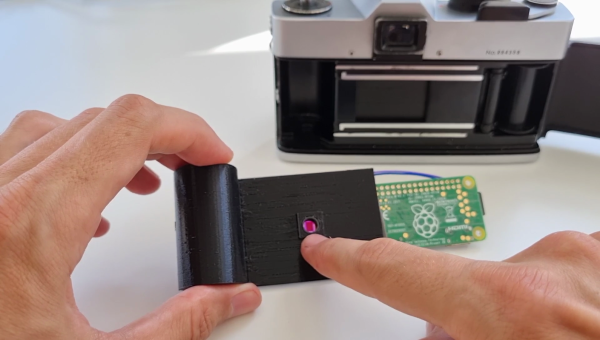
The digital camera revolution swept through the world in the early 2000s, and aside from some unique situations and a handful of artists still using film, almost everyone has switched over to digital since then. Unfortunately that means that there’s a lot of high quality film cameras in the world that are gathering dust, but with a few pieces of equipment it’s possible to convert them to digital and get some more use out of them.
[befinitiv]’s latest project handles this conversion by swapping in a Raspberry Pi Zero where the film cartridge would otherwise be inserted into the camera. The Pi is attached to a 3D-printed case which mimics the shape of the film, and also houses a Pi camera right in front of the location where the film would be exposed. By removing the Pi camera’s lens, this new setup is able to take advantage of the analog camera’s optics instead and is able to capture images of relatively decent quality.
There are some perks of using this setup as well, namely that video can be broadcast to this phone over a wireless connection to a computer via the Raspberry Pi. It’s a pretty interesting build with excellent results for a remarkably low price tag, and it would be pretty straightforward to interface the camera’s shutter and other control dials into the Raspberry Pi to further replicate the action of an old film camera. And, if you enjoy [befinitiv]’s projects of bringing old tech into the modern world, be sure to check out his 80s-era DOS laptop which is able to run a modern Linux installation.
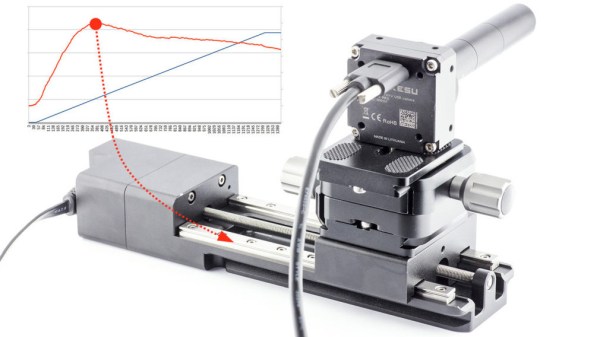
Here’s an interesting experiment that attempts to measure the quality of a linear rail by using a form of visual odometry, accomplished by mounting a camera on the rail and analyzing the video with open-source software usually used to stabilize shaky video footage. No linear rail is perfect, and it should be possible to measure the degree of imperfection by recording video footage while the camera moves down the length of the rail, and analyzing the result. Imperfections in the rail should cause the video to sway a proportional amount, which would allow one to characterize the rail’s quality.
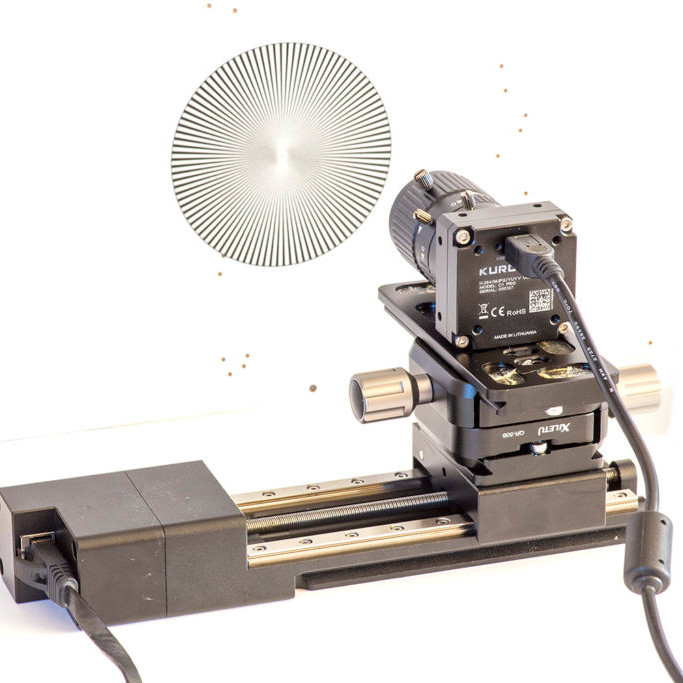
To test this idea, [Saulius] attached a high-definition camera to a linear rail, pointed the camera towards a high-contrast textured pattern (making the resulting video easier to analyze), and recorded video while moving the camera across the rail at a fixed speed. The resulting video gets fed into the Deshaker plugin for VirtualDub, of which the important part is the deshaker.log file, which contains X, Y, rotate, and zoom correction values required to stabilize the video. [Saulius] used these values to create a graph characterizing the linear rail’s quality.
It’s a clever proof of concept, especially in how it uses no special tools and leverages a video stabilizing algorithm in an unusual way. However, the results aren’t exactly easy to turn into concrete, real-world measurements. Turning image results into micrometers is a matter of counting pixels, and for this task video stabilizing is an imperfect tool, since the algorithm prioritizes visual results instead of absolute measurements. Still, it’s an interesting experiment, and perfectly capable of measuring rail quality in a relative sense. Can’t help but be a bit curious about how it would profile something like these cardboard CNC modules.
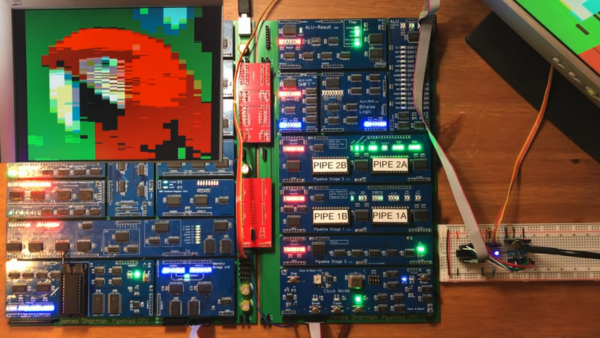
[James Sharman] has built an impressive 8-bit homebrew computer. Based on TTL logic chips, it has a pipelined design which makes it capable of Commodore-level computing, but [James] hasn’t quite finished everything yet. While it is currently built on its own custom PCB, it has a limiting LCD display which isn’t up to the standards of the rest of the build. To resolve this issue, he decided to implement VGA from scratch.
This isn’t a bit-bang VGA implementation, either. He plans for full resolution (640×480) which will push the limits of his hardware. He also sets goals of a 24-bit DAC which will allow for millions of colors, the ability to use sprites, and hardware scrolling. Since he’s doing all of this from scratch, the plan is to keep it as simple as possible and make gradual improvements to the build as he goes. To that end, the first iteration uses a single latching chip with some other passive components. After adding some code to the CPU to support the new video style, [James] is able to display an image on his monitor.
While the image of the parrot he’s displaying isn’t exactly perfect yet, it’s a great start for his build and he does plan to make improvements to it in future videos. We’d say he’s well on his way to reproducing a full 8-bit retrocomputer. Although VGA is long outdated for modern computers, the standard is straightforward to implement and limited versions can even be done with very small microcontrollers.
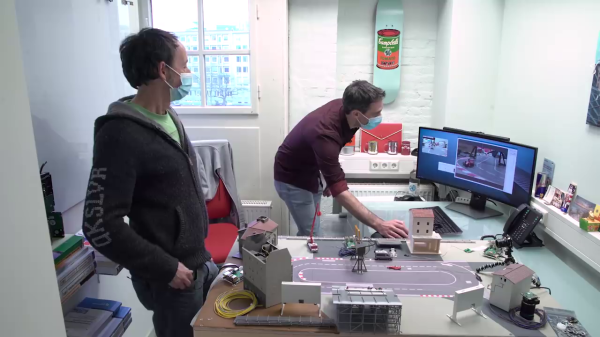
[Gerrit Braun], co-founder of the [Miniatur Wunderland] model railway and miniature airport attraction in Hamburg, takes his model building seriously. For more than five years, he and his team have been meticulously planning, testing, and building a 1:87 scale of Formula 1’s Monaco Grand Prix. Models at the Wunderland are crafted to the Nth detail and all reasonable efforts, and some unreasonable ones, are taken to achieve true-to-life results. In the video down below, part of Gerrit’s diary of the project, he discusses the issues and solutions to simulating realistic television broadcasts (the video is in German, but it has English language subtitles).
The goal is to model the large billboard-sized monitor screens set up at viewing stands. In real life, these displays are fed with images coming in from cameras located all over the circuit, the majority of which are operated by a cameraman. The miniaturization of cameras has come a long way in recent years — the ESP32-CAM module or the Raspberry Pi cameras, for example. But miniaturizing the pan-and-tilt actions of a cameraman, while perhaps possible, would not be reliable over the long time (these exhibits at Wunderland are permanent and operate almost daily). Instead, the team is able to use software to extract a cropped window from high-resolution video, and moving the position of this cropped window simulates the pointing of the camera. More details are in the video.
The skill and creativity of [Gerrit] and his team is incredible. Other videos on this project cover topics like the sound system, PCB techniques used for the roads, and the eye-popping use of an electric standing desk to lift an entire city block so workers can gain access to the area. Fair warning — these are addictive, and the video below is #76 of an unfinished series. We wrote about Wunderland back in 2016 when [Gerrit] and his twin brother [Frank] teamed with Google Maps to make a street view of their replica cities. Thanks to [Conductiveinsulation] who sent us the tip, saying that the discussion about interconnected triangular PCB tiles on this week’s Podcast #122 reminded him of this for some reason. Have any of our readers visited Miniatur Wunderland before? Let us know in the comments below.
[Miroslav Nemecek] really pushes the limits of the Pico with his PicoVGA project, which packs a surprising number of features. His main goal with this library is to run retro games which can fit within the limited RAM and processing power of the Pico, but the demo video below shows a wide array of potential applications.
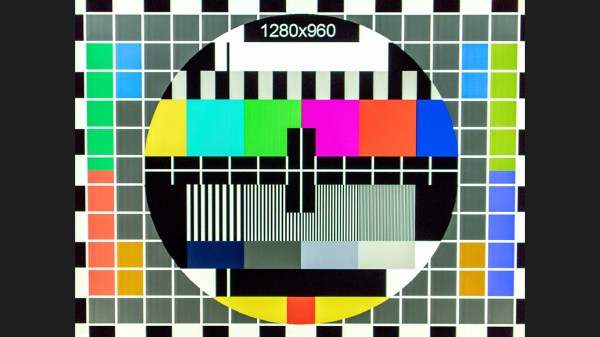
The library provides a whole slew of features, including frame buffering, sprites, overlays, and resolutions up to 1280×960 in either NTSC or PAL timings. A PWM-driven audio output channel is also included in the package. His library takes full advantage of the programmable I/O module functionality and uses the second core which is dedicated to video processing. However, with care, the second core can perform application tasks in certain circumstances. The VGA analog output signals are provided by resistor ladders, and pixel color is 8-bit R3G3B2 format. To be clear, [Miroslav] does cheat a little bit here in one regard — he overclocks the processor up to 270 MHz to meet the timing demands in some of the resolutions.
[Miroslav] has developed these tools using ARM-GCC on Windows, but he lacks the experience to make a Linux build. He welcomes help on that front from anyone familiar with Linux. And stay tuned — there may be more coming from [Miroslav] in the future. He notes that the PicoVGA library was created as part of a retro gaming computer project which is still under development. We look forward to hearing more about this when it gets released.
A couple of weeks ago we wrote about a monochrome VGA version of Pong for the Pico by [Nick Bild]. It’s exciting to see these projects which are exploring the limits of the Pico’s capabilities. Have you seen any boundary-pushing applications for the Pico? Let us know in the comments below. Thanks to [Pavel Krivanek] for sending this project to our tip line.