Watch A Recording Lathe From 1958 Cut A Lacquer Master Record

Most of us are familiar with vinyl LPs, and even with the way in which they are made by stamping a hot puck of polyvinyl chloride (PVC) into a record. But [Technostalgism] takes us all the way back to the beginning, giving us a first-hand look at how a lacquer master is cut by a specialized recording lathe.
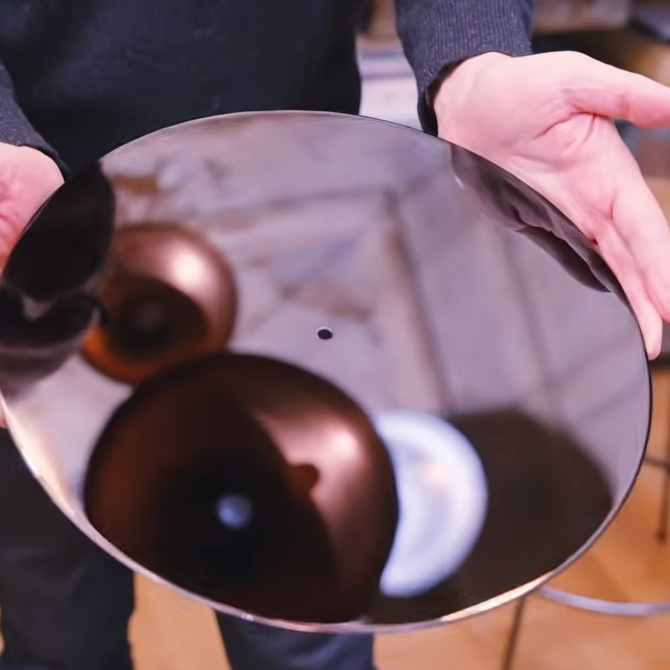
An uncut lacquer master is an aluminum base coated with a flawless layer of lacquer. It smells like fresh, drying paint.

Cutting a lacquer master is the intricate process by which lacquer disks, used as the masters for vinyl records, are created. These glossy black masters — still made by a company in Japan — are precision aluminum discs coated with a special lacquer to create a surface that resembles not-quite-cured nail polish and, reportedly, smells like fresh paint.

The cutting process itself remains largely unchanged over the decades, although the whole supporting setup is a bit more modernized than it would have been some seventy years ago. In the video (embedded below), we get a whole tour of the setup and watch a Neumann AM32B Master Stereo Disk Recording Lathe from 1958 cut the single unbroken groove that makes up the side of a record.

The actual cutting tool is a stylus whose movement combines the left and right channels and is heated to achieve the smoothest cuts possible. The result is something that impresses the heck out of [Technostalgism] with its cleanliness, clarity, and quality. Less obvious is the work that goes into arranging the whole thing. Every detail, every band between tracks, is the result of careful planning.

It’s very clear that not only is special equipment needed to cut a disk, but doing so effectively is a display of serious craftsmanship, experience, and skill. If you’re inclined to agree and are hungry for more details, then be sure to check out this DIY record-cutting lathe.
Continue reading “Watch A Recording Lathe From 1958 Cut A Lacquer Master Record”
DIY Record Cutting Lathe Is Really Groovy

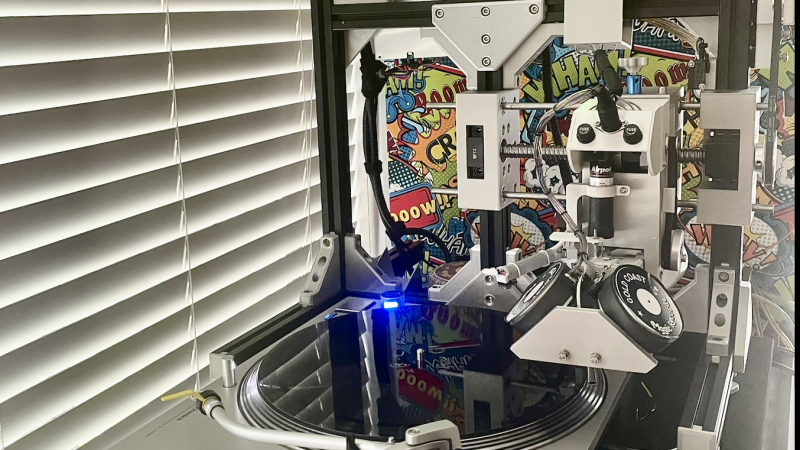
Back in the day, one of the few reasons to prefer compact cassette tape to vinyl was the fact you could record it at home in very good fidelity. Sure, if you had the scratch, you could go out and get a small batch of records made from that tape, but the machinery to do it was expensive and not always easy to come by, depending where you lived. That goes double today, but we’re in the middle of a vinyl renaissance! [ronald] wanted to make records, but was unable to find a lathe, so decided to take matters into his own hands, and build his own vinyl record cutting lathe.

photograph of [ronald's] setup
[ronald’s] record cutting lathe looks quite professional.
It seems like it should be a simple problem, at least in concept: wiggle an engraving needle to scratch grooves in plastic. Of course for a stereo record, the wiggling needs to be two-axis, and for stereo HiFi you need that wiggling to be very precise over a very large range of frequencies (7 Hz to 50 kHz, to match the pros). Then of course there’s the question of how you’re controlling the wiggling of this engraving needle. (In this case, it’s through a DAC, so technically this is a CNC hack.) As often happens, once you get down to brass tacks (or diamond styluses, as the case may be) the “simple” problem becomes a major project. Continue reading “DIY Record Cutting Lathe Is Really Groovy”

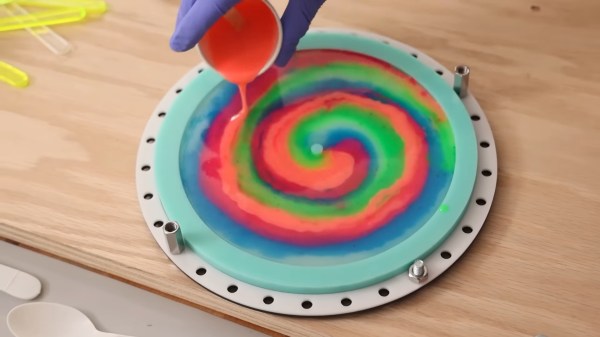
A hand holding a paper cup pours orange resin into a mold. There are several different colors in a spiral inside a circular mold on a circular platform with holes around its perimeter sitting on a wooden table.

Reproducing Vinyl Records In Resin

While most are just plain, vinyl records can be found in a variety of colors, shapes, and some even glow in the dark. [Evan and Katelyn] decided to spruce up a plain old record by replicating it in bright, glow-in-the-dark resin.

By first making a silicone mold of the vinyl record and then pouring several different colors of resin into the resulting mold, [Evan and Katelyn] were able to make a groovy-looking record that still retained the texture necessary to transmit the original sounds of the record. The resulting piece has some static, but the music is still identifiable. That said, audiophiles would probably prefer to leave this up on the wall instead of in their phonograph.

Acrylic rings were laser cut and bolted together to build the form for the silicone mold with the original record placed at the bottom. To prevent bubbles, the silicone was degassed in a vacuum chamber before pouring over the record and the resin was cured in a pressure pot after pouring into the resulting mold.

If you’re interested in how records were originally made, check out this installment of Retrotechtacular. A more practical application of resin might be this technique to reproduce vintage plastic parts.

Continue reading “Reproducing Vinyl Records In Resin”

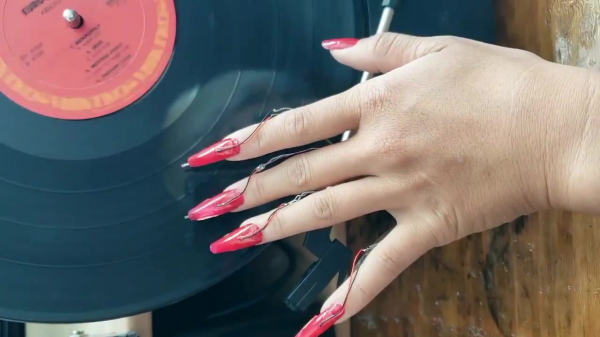
Glue-on nails with vinyl record pickups pierced through them that are used on a vinyl record

The Sound Of Nails On Black Vinyl Records

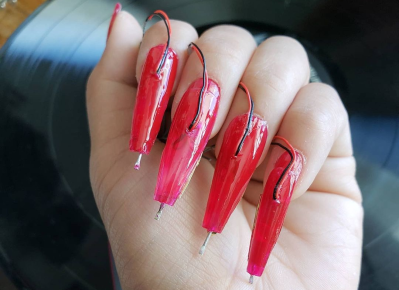
[Victoria Shen] modifies glue-on nails to give her the ability to play vinyl records with her fingers. Details are light but from the many glamour pictures, it looks like she pushes record player needles through glue-on nails with thin pickup wire that then presumably goes to an audio jack for amplification.

Photograph of hand with record needs through glue-on nails

[Victoria] experiments with novel musical tools for use in her art and performances. Be sure to check out the videos of the nails in action. The combination of “scratching” and ability to alter the speed of vinyl with the free fingers creates a weird and eerie experience.

Using her “Needle Nails”, [Victoria] has found she’s able to play multiple records simultaneously (Nitter). Thanks to the different diameters of 33, 78 and 45 vinyls, she’s able to stack them up while still keeping her fingers on them.

Glove like musical instruments are nothing new but the novel use of fashion, glamour and technology allow [Victoria Shen] the freedom to create something uniquely weird and cool, so much so that Beyonce used it in a video shoot for Vogue (Nitter).

Continue reading “The Sound Of Nails On Black Vinyl Records”

DIY LEGO Record Cleaner Is Revolutionary

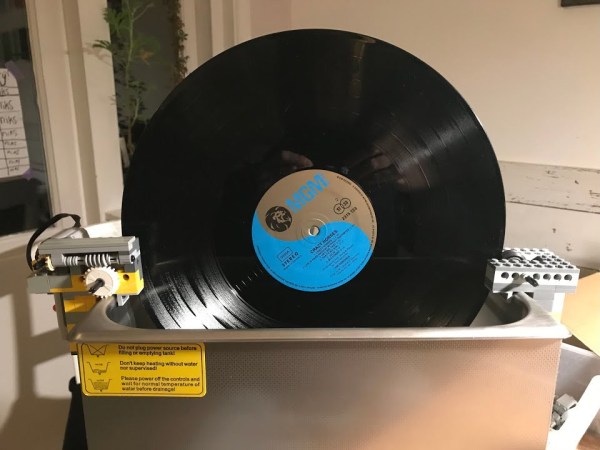
There are many schools of thought when it comes to keeping vinyl records clean. It’s a ritual that’s nearly as important as the one that comes after it — queuing up the record and lowering the needle. We’ve seen people use everything from Windex and microfiber towels to ultrasonic cleaning machines that cost hundreds or even thousands. In the midst of building a beefier ultrasonic record cleaner and waiting for parts, [Baserolokus] looked around at all the LEGO around the house and decided to build a plastic prototype in the interim.

The idea behind ultrasonic cleaning is simple — high-frequency sound waves pumped through distilled water produce tons of tiny bubbles. These bubbles gently knock all the dirt and grime out of the grooves without using any brushes, rags, or harsh cleaners. [Baserolokus] built two pieces that hang on the edge of a washtub. On one side, a Technic motor spins the record at just under one RPM, it spins against a 3D printer wheel embedded in the other side. Check it out in action after the break.

Cleaning your vinyl is a great first step, but you might be ruining your records with a sub-par turntable. Take a deep dive with [Jenny List]’s thorough primer on the subject.

Continue reading “DIY LEGO Record Cleaner Is Revolutionary”

Magic Record Stand Can Play Your Records For You

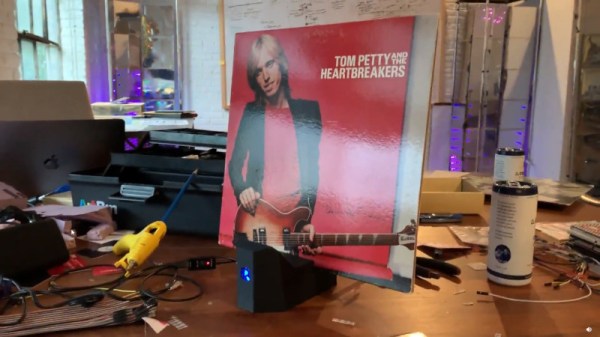
Vinyl remains a popular format, despite taking a huge hit in popularity for a couple decades while CDs ruled the roost. It has a charm that keeps it relevant, and likely will continue to do so until everyone who grew up with a record player dies out. In the meantime, [sp_cecamp] has come up with a great way to experience your collection, with the magic of modern technology. It goes by the name of Plynth.

Fundamentally, it’s a small record stand with an excellent party trick. The prototype consists of a 3D-printed body, which holds a record sleeve at an attractive angle for display. A camera built into the base then images the artwork. The first image taken is run through the Google Vision API, and further images are then run through OpenCV to identify the record. This data is then passed to the Spotify API to play the track. The whole process takes a couple of seconds, and the music is then pumped out of whatever streaming device is connected to the rig.

It’s a fun way to play your old records, and would be a welcome change to those tired of screaming at Siri to play Weezer (Blue Album), not Weezer (Green Album). For those interested, [sp_cecamp] has thrown up a site to gauge interest in the project, and may make a limited production run in future.

Of course, you could instead just go about building your own turntable. To each their own!

GE Record Player and TV 1600x900

VinylVideo Is Literally Video On Vinyl

It’s often said that the music etched into a vinyl record takes on a transcendent quality that you simply can’t find in a digital recording, but does that still apply when you add motion picture? The collaboration of [Sengmüller and Diamant] sure think so, because they are offering a new experience for the turntable with the introduction of their VinylVideo pre-amplifier. No tape reels here, this project shows the extend of what is possible through analog video.

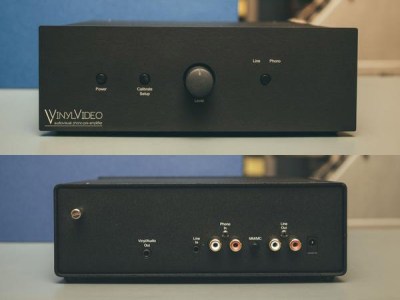
Vinyl Video Amp

While all record players capable of playing back 7 in. 45 RPM are compatible with the system, the VinylVideo records themselves specially cut in order to generate the video signal. Each of the custom records has room for a 4-minute music video on the A-side, and the single on the B-side. Videos play back in black & white, sub-standard definition with mono audio, and run around 12 frames per second. The pre-amp takes in the analog signal from regular audio cables via RCA jacks or 3.5mm headphone jack, and then a Raspberry Pi model A+ handles the analog-to-digital conversion. Video out options include HDMI and composite video via a 3.5mm TRSS jack.

The current VinylVideo pre-amp is actually a refinement of the original project from the mid ’90s where it was a part of folk art exhibits. The legacy website (circa 1999) is still live, so you can give it a visit. However, for the most authentic experience you may want to fire-up a virtual machine with Netscape Navigator and Real Player installed.

For a more in-depth look at the VinylVideo in action there is a great video below from [Techmoan]:

Continue reading “VinylVideo Is Literally Video On Vinyl”