Easy touch capacitance

posted Oct 17th 2009 7:24am by Jakob Griffith
filed under: news, peripherals hacks

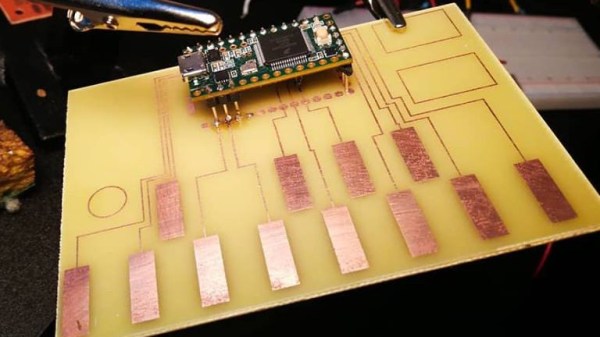
[Humberto] from NerdKits is one of our favorite tipsters. We like how he can take a concept that seems so extremely complicated, in this case touch capacitance sensing, and present it in a clear and concise manner thats impossible to not love. As previously mentioned the most recent NerdKits hack is on touch capacitance; by using a resistor capacitor pair and some clever switch timing, anyone is able to detect the presence of a human limb. Now who’s going to be the first to adapt this concept further in their own hack?

Touchpad and VFD hacking

posted Jul 20th 2009 6:14am by Caleb Kraft
filed under: peripherals hacks

p2 (Custom)

[Agent420] brought up this touchpad and VFD hack in the comments on our capicitive sensor guide post. He had broken dell laptop from which he harvested the touchpad and an HP laserjet that contributed the VFD. Though the touchpad communicates using standard PS2 protocol, he wanted to use it with his Atmel 8535 AVR which required him to write some custom code. In the picture above, you can see the VFD displaying the coordinates of his finger. You can download his code as well as the spec sheets for the different pieces on the project thread.


iPhone Linux

posted Nov 28th 2008 7:11pm by Eliot Phillips
filed under: cellphones hacks, iphone hacks, macs hacks, news

Embedded above is a demo video of an iPhone running a Linux 2.6 kernel. The iphone-dev team has created a new bootloader called OpeniBoot. The bootloader lets you boot into a Linux console, which you can talk to over a USB serial device. They’ve got busybox working, but there is no touchscreen support yet. The instructions are not that difficult and include how to back up your settings. It works on first and second gen iPhones and first gen iPod Touch. This is a very early port, but the future is wide open… Android iPhone?

Waterproof iPod Touch video boombox

posted Aug 23rd 2008 4:30pm by Eliot Phillips
filed under: classic hacks, portable video hacks


Popular Mechanics contributor [Anthony Veducci] wanted a virtually indestructible video player that he could use anywhere. Not finding a commercial solution, he decided to build his own. He already had a large waterproof case and another for the iPod Touch. The 8″ display came from an iPod accessory. Unfortunately it was developed before Apple implemented their stupid accessory locking, so he had to use an Apple approved video cable through several adapters to get it to work. The speakers were also salvaged parts. The case was assembled using a jigsaw and a whole lot of epoxy. The speaker openings are covered with latex from a pair of gloves and everything is sealed with silicone. We’re usually trying to escape technology when we head outside, but we’ll be looking back at this the next time we need to ruggedize something.

[via Gizmodo]

Mac tablets made by fans

posted Jul 14th 2008 3:30pm by Caleb Kraft
filed under: laptops hacks, macs hacks, tablet pcs hacks


Macintosh makes a lot of wonderful pieces of technology, but they do not make a tablet. Pictured above is the Modbook, the closest you can currently get to a Mac tablet. Though not officially built by Apple, they are an Apple Premier Developer and that isn’t too shabby.

Several people have taken it upon themselves to fashion Mac tablets of their own, varying from extremely professional looking finishes down to duct tape and wire. Lets take a look at some of the more popular ones out there.

Read the rest of this entry »


HandUSB data gloves interface

posted Jul 12th 2008 6:50pm by Benjamin Eckel
filed under: misc hacks

Following today’s earlier post on data gloves, HandUSB is a glove interface designed to relay fingertip touch data to a computer via USB. Although the gloves themselves are not extremely interesting or useful for your average hacker, the project has some good documentation. The electronics are all open source and he has links to the EAGLE files and the AVR Libc code. You can also find a demo program written for DOS. This project uses AVR-USB by Objective Development so if you are looking to move on from your USB-serial chips, this project would be a good resource to study.

[via YourlTronics]

Haptic feedback roundup

posted May 23rd 2008 9:40pm by Sean Percival
filed under: peripherals hacks

Haptic feedback (sometimes referred to as tactile or force feedback) offers what some might call a brave new world of interaction and immersion. The 1932 book of the same name was probably the first introduction many people got to the idea of computer generated touch sensations. In the book, movies are replaced with what are called “feelies”; patrons sit in chairs that provide feedback throughout the screening.

While we don’t see this coming to your local megaplex any time soon, we are starting to see the technology creep into our lives. After the break lets take a look at some examples, talk about projects we’ve covered before, and how you can get started developing your own.

Read the rest of this entry »

Multitouch rear projection TV

posted May 20th 2008 3:45am by Eliot Phillips
filed under: classic hacks, home entertainment hacks, multitouch hacks


[Christopher Jette] did a amazing job converting a 56″ rear projection television into a multitouch display. His original inspiration came from this drafting table project. The screen is a large sheet of 1/2″ acrylic with a screen material attached to the back side. The screen edge is surrounded by 168 IR LEDs. When a finger tip touches the surface it scatters the LEDs’ IR light. A webcam sees this scattered light and determines where the fingers are. Inside the box is a standard video projector. This is a great reuse of old equipment and we love to see a hobbyist making up ground where manufacturers aren’t. For more info on multitouch projects, we suggest the Natural User Interface Group. Here’s a video of [Christopher]’s display in action:

Read the rest of this entry »


Hack a Day serves up fresh hacks each day, every day from around the web and a special How-To hack each week.

Send us your hacks