Warm Tube Clock, Take 2

warm_nixie_v2

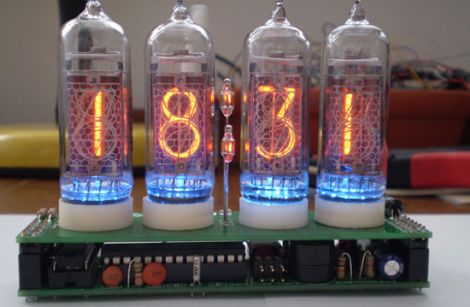
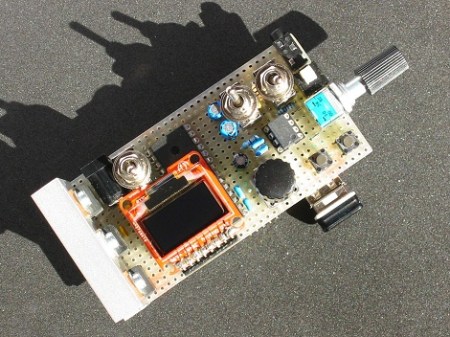
[Mure] wrote in to let us know he has put the finishing touches on the second iteration of his Warm Tube Nixie clock. We featured his original creation here last year, and while many things remain the same, he has still found a few things that he was able to improve on.

The first notable feature is the new real time clock. Instead of using a discrete crystal to keep time and a temperature sensor for compensation, he has opted to use a DS3231 RTC IC. It is far more accurate than the crystal, and it features a built-in temperature sensor as well. The alarm functionality has been simplified too, moving the controls into firmware rather than having to use a sliding switch to do so.

With the mainboard redesign, it would have been easy to leave behind the nixie “shields” he created for his first clock, but with a focus on interoperability, he chose to make this clock fully compatible with version one’s shields and vice versa.

While the changes aren’t groundbreaking, it’s nice to see a project like this undergo continued refinements. If you want to build a clone of this clock, [Mure] has made sure that all of the schematics and source code are available on his site.

Continue reading to see a brief video demo of the clock in action.
Continue reading “Warm Tube Clock, Take 2”

Portable SID Plays Chiptunes

[Markus] on the DangerousPrototypes forum came up with a great little SID player.

The SID was (is?) the awesome sound generation chip inside the Commodore 64, and along with Game Boys and NESs laid the foundation for the chiptune scene. We’re happy to finally see a small SID player that doesn’t resort to SID emulation or a relatively huge MIDIbox.

The SID player itself is a shield on a CUI32 PIC dev board. The PIC32 emulates the 6510 and 6526 CPU and CIA chips found in the Commodore 64. A small USB memory stick stores the High Voltage SID Collection and the file system is navigated with an OLED screen. [Markus] says that the player draws 370 mA, so he runs it off a small wall wart. Still, we’re wondering if it’s possible to run this off of an SD card with a SwinSID so power draw can be reduced and a fully portable SID player can be realized.

We’ve got a touch of nostalgia for chiptune and demoscene music right now, so we’re going to listen to some [Nelly Furtado] [Janne Suni] right now, but you can check out the video demo [Markus] posted after the break.
Continue reading “Portable SID Plays Chiptunes”

Kinect-driven Cart Makes Shopping A Snap

wi_go

[Luis de Matos] is working on a neat Kinect project called Wi-GO that aims, as many do, to enhance the lives of individuals with disabilities. While the Wi-GO project is geared towards disabled persons, it can be quite helpful to the elderly and pregnant women as well.

Wi-GO is a motorized shopping cart with a Kinect sensor mounted on the back. The sensor interfaces with a laptop and functions much as you would as you would expect, scanning the area in front of the cart for objects and people. Once it identifies the individual it is meant to help, the cart diligently follows behind as the person goes about their typical shopping routine. The robot keeps a safe distance to avoid collisions, but remains within reach so that it can be used to carry goods.

If you take a look a the video below, you can see Wi-GO in action. It starts off by showing how difficult it would be for an individual in a wheel chair to use a shopping cart alone, and follows up by showing how much easier things are with Wi-GO in tow.

While the project is only in prototype form at the moment, we suspect that it will only be a matter of time until you see devices like Wi-GO in your local supermarket.

Continue reading “Kinect-driven Cart Makes Shopping A Snap”

Precision Frequency Measurement Library For 8-bit Microcontrollers

[Paul] has been working on porting over Arduino libraries for use with the Teensy microcontroller platform. This tends to be pretty simple since they both use the same Atmel chip architecture. But once in a while he finds the Arduino libraries are not what they’re cracked up to be. When looking to port over a frequency measurement library he ended up writing his own that works better and is much more portable.

He had two big beefs with the Arduino Frequency Counter Library. The first is that it required the compensation factor the be calibrated using an accurate frequency counter. That’s a chick-and-egg problem since many people who build a frequency counter with an Arduino are doing so because they don’t already have a standalone tool. The second problem is that the Arduino library was hardcoded for ATmega168 or ATmega328 chips.

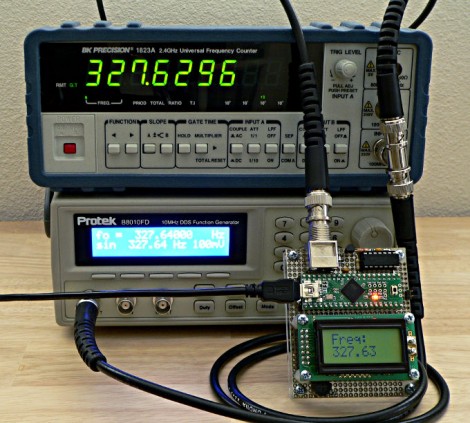
This new library fixes both issues with just one trade-off. Your hardware setup must be using a crystal oscillator. You can see above in the image above that the frequency measurement is quite accurate with this method. The package also uses a thin abstraction layer which will make it easy to port to any 8-bit microcontroller which is programmed in C.

I Am Root! – IP Camera Shell Access

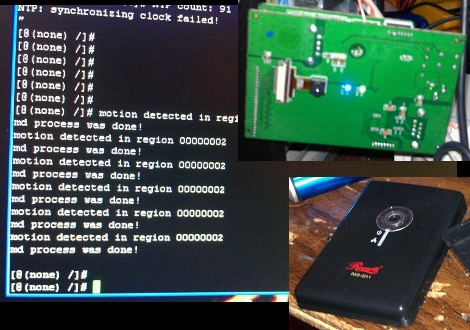
[Shawn] emailed us some pictures and a description of his latest hack. He cracked open a Rosewill RXS-3211 IP Camera because the output of the web interface made him certain that it was running Linux and he wanted to unlock some more potential from the device. These cameras are used for security, and offer a browser-based interface via a WiFi connection. After studying the circuit board he started poking around an unpopulated set of four pads and managed to get a serial connection up and running. The device’s serial terminal operates at 115200 baud using eight data bits, one stop bit, and even parity.

He wonder where to go from here and we have a few ideas. You can see in the terminal readout above that it announces when motion is detected. We think this motion detection would be quite useful with a small rover while adding live video broadcasting at the same time. An embedded Linux system should be able to interface with the device and we think that a bit of creative coding would open up the WiFi connection for other use as well. Not bad for a module that can be had for as little as $29. We’ve included all the images [Shawn] sent us after the break and we’d love to hear your thoughts on what you’d use this for in the comments.

Continue reading “I Am Root! – IP Camera Shell Access”

DIY Inkjet Printer Begs To Be Hacked

diy_inkjet

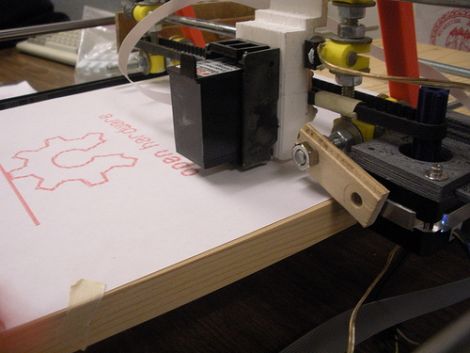
[Nicholas C Lewis, Patrick Hannan, Jared Knutzen, and Joy Markham], students from the University of Washington, have recently taken the wraps off a project which they have been collaborating on, a DIY inkjet printer. The group set out to construct a low cost, open source inkjet printer for personal use that utilizes standard inkjet technology. Their working prototype, pictured above, satisfies all of those requirements, making it an ideal device for the at-home hobbyist.

The printer was constructed from easy to obtain components such as steel rods and stepper motors, along with other parts that can be printed using a RepRap or similar machine. An Arduino Mega manages the steppers and repurposed print head, recreating whatever Processing-generated image it has been given.

The printer is quite a hit so far, and people are already talking about adapting the design to print on spherical objects (think EggBot), to create direct etch resist PCBs, and more. We think it would make a great direct to garment printer with just a few small tweaks.

Check out the short video embedded below to see the printer in action.

[via Make]

Continue reading “DIY Inkjet Printer Begs To Be Hacked”