Lessons In Small Scale Manufacturing From The Othermill Shop Floor

Othermachine Co. is not a big company. Their flagship product, the Othermill, is made in small, careful batches. As we’ve seen with other small hardware companies, the manufacturing process can make or break the company. While we toured their factory in Berkeley California, a few interesting things stood out to us about their process which showed their manufacturing competence.

It’s not often that small companies share the secrets of their shop floor. Many of us have dreams of selling kits, so any lessons that can be learned from those who have come before is valuable. The goal of any manufacturing process optimization is to reduce cost while simultaneously maintaining or increasing quality. Despite what cynics would like to believe, this is often entirely possible and often embarrassingly easy to accomplish.

Lean manufacturing defines seven wastes that can be optimized out of a process.

  1. Overproduction: Simply, making more than you currently have demand for. This is a really common mistake for first time producers.
  2. Inventory: Storing more than you need to meet production or demand. Nearly every company I’ve worked for has this problem. There is an art to having just enough. Don’t buy one bulk order of 3,000 screws for six months, order 500 screws every month as needed.
  3. Waiting: Having significant delays between processes. These are things ranging from running out of USB cables to simply having to wait too long for something to arrive on a conveyor belt. Do everything you can to make sure the process is always flowing from one step to another.
  4. Motion: If you have a person walking back and forth between the ends of the factory to complete one step of the manufacturing process, this is wasted motion.
  5. Transport: Different from motion, this is waste in moving the products of each individual process between sections of the assembly.
  6. Rework: Get it right the first time. If your process can’t produce a product that meets specifications, fix the process.
  7. Over-processing: Don’t do more work than is necessary. If your part specifies 1000 hours of runtime don’t buy a million dollar machine to get 2000 hours out of it. If you can find a way to do it with one step, don’t do it with three.

IMG_0371

The first thing that stuck out to me upon entering Othermachine Co’s shop floor is their meticulous system for getting small batches through the factory in a timely manner. This allows them to scale their production as their demand fluctuates. CNCs and 3D printers are definitely seasonal purchases; with sales often increasing in the winter months when hackers are no longer lured away from their workstations by nice weather.

As the seven sins proclaim. It would be a bad move for Othermachine Co. to make too many mills. Let’s say they had made an extra 100 mills while demand was at a seasonal low. If they found a design or quality problem from customer feedback they’d have to commit to rework, potentially throwing away piles of defective parts. If they want to push a change to the machine or release a new model they’d either have to rework the machines, trash them, or wait till they all sold before improving their product. Even worse, they may find themselves twiddling their thumbs waiting for their supply to decrease enough to start manufacturing again. This deprives them of opportunities to improve their process and leads to a lax work environment.

One way to ensure that parts are properly handled and inventory is kept to a minimum is with proper visual controls. To this end, Othermachine Co has custom cardboard bins made that perfectly cradle all the precision parts for each process in their own color coded container. Since the shop floor is quite small, it lets them focus on making spindle assemblies one day and motion assemblies another without having to waste time between each step. Also, someone can rekit the parts for a recently completed step easily without interrupting work on the current process going on.
IMG_0373

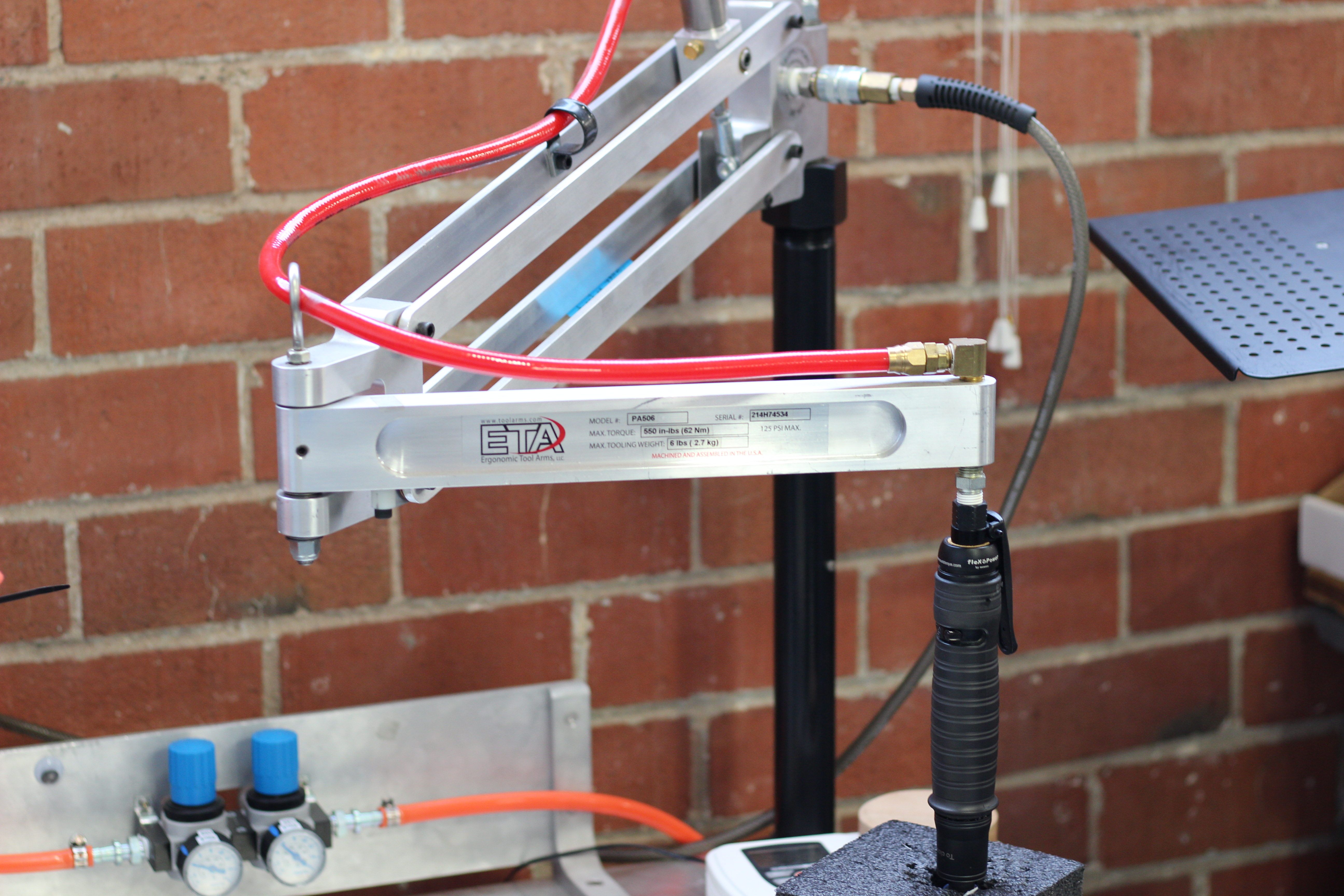
It’s hard to define what’s over processing and what isn’t. My favorite example of what isnt, and something I’ve fought for on nearly every factory floor I’ve worked on is proper torque limiting screwdrivers. They’re a little expensive, but they are a wonderful tool that helps to avoid costly rework and over processing. For example, let’s say you didn’t have a torque limiting screwdriver. Maybe your customers would complain that occasionally a screw came loose. Now, one way to solve this would be the liberal application of Loctite. Another way would be an additional inspection step. Both of these are additional and completely uneccessary steps as most screws will hold as long as they are torqued properly.

In one factory I worked in, it was often a problem that a recently hired worker would overtorque a screw, either stripping it or damaging the parts it was mating together. A torque limiting screwdriver takes the worker’s physical strength out of the equation, while reducing their fatigue throughout the day. It’s a win/win. Any time a crucial step can go from unknown to trusted with the application of a proper tool or test step it is worth it.

Another section where Othermachine Co. applied this principle is with the final machining step for the CNC bed. The step produces a large amount of waste chips. Rather than having an employee waste time vacuuming out every Othermill after it has gone through this process, they spent some time designing a custom vacuum attachment. This essentially removed an entire production step. Not bad!
IMG_0396 (2)

With the proper management of waste it is entirely possible to save money and improve a process at the same time. It takes a bit of training to learn how to see it. It helps to have an experienced person around in order to learn how to properly respond to them, but with a bit of practice it becomes a skill that spreads to all areas of life. Have any of you had experience with this kind of problem solving? I’ve really enjoyed learning from the work stories posted in the comments.


Bluetooth HID Gamepad And HC-05 Serial Hack

“Which came first, the chicken or the egg?” Don’t bother us with stupid questions, they both co-evolved into the forms that we now serve up in tasty sandwiches or omelets, respectively. “Which came first, the HC-05 serial-flash-hack, or the wireless Bluetooth Gamepad?” Our guess is that [mitxela] wanted to play around with the dirt-cheap Bluetooth modules, and that building the wireless controller was an afterthought. But for that, it’s a well-done afterthought! (Video below the break.)

It all starts with the HC-05 Bluetooth module, which is meant to transfer serial data, but which can be converted into a general-purpose device costing ten times as much with a simple Flash ROM replacement. The usual way around this requires bit-banging over a parallel port, but hackers have worked out a way to do the same thing in bit-bang mode using a normal USB/Serial adapter. The first part of [mitxela]’s post describes this odyssey.

Continue reading “Bluetooth HID Gamepad And HC-05 Serial Hack”

Star Track: A Lesson In Positional Astronomy With Lasers

[gocivici] threatened us with a tutorial on positional astronomy when we started reading his tutorial on a Arduino Powered Star Pointer and he delivered. We’d pick him to help us take the One Ring to Mordor; we’d never get lost and his threat-delivery-rate makes him less likely to pull a Boromir.

As we mentioned he starts off with a really succinct and well written tutorial on celestial coordinates that antiquity would have killed to have. If we were writing a bit of code to do our own positional astronomy system, this is the tab we’d have open. Incidentally, that’s exactly what he encourages those who have followed the tutorial to do.

The star pointer itself is a high powered green laser pointer (battery powered), 3D printed parts, and an amalgam of fourteen dollars of Chinese tech cruft. The project uses two Arduino clones to process serial commands and manage two 28byj-48 stepper motors. The 2nd Arduino clone was purely to supplement the digital pins of the first; we paused a bit at that, but then we realized that import arduinos have gotten so cheap they probably are more affordable than an I2C breakout board or stepper driver these days. The body was designed with a mixture of Tinkercad and something we’d not heard of, OpenJsCAD.

Once it’s all assembled and tested the only thing left to do is go outside with your contraption. After making sure that you’ve followed all the local regulations for not pointing lasers at airplanes, point the laser at the north star. After that you can plug in any star coordinate and the laser will swing towards it and track its location in the sky. Pretty cool.

Continue reading “Star Track: A Lesson In Positional Astronomy With Lasers”

Hackaday Prize Entry: Non-Computational Fluid Dynamics

Computational Fluid Dynamics, or CFD, and is applied to everything from aircraft design to how good of a wing a new skyscraper will be. Of course, the science of building airfoils is much older than CFD, leading to the question of how airfoil design was done before computers.

The answer, of course, is a wind tunnel. Walk around a few very good air museums, and you’ll find wind tunnels ranging from the long wooden boxes built by the Wright brothers to fantastic plywood contraptions that are exceptionally interesting to woodworkers.

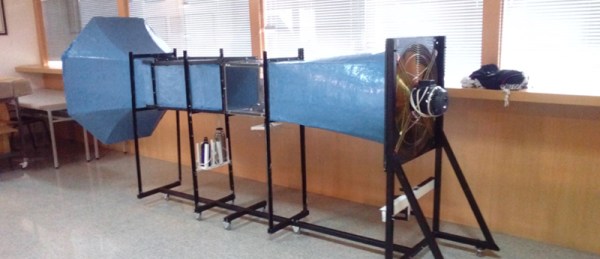
[Joel] needed final project as an upcoming aeronautical engineer, but he wanted his project to be something physical, and a tool that could be used again. He decided to build a wind tunnel that’s also his entry for The Hackaday Prize.

This wind tunnel isn’t a gigantic device the size of a building. The very first wind tunnels were simple devices just a few meters long. With a fan at one end, a section to stabilize the wind, a chamber, and a place for the air to go, it’s also a very simple device. Just because something is simple doesn’t mean anyone has built one recently, though: [Joel] couldn’t find anyone who built a wind tunnel with step-by-step instructions. This project is just that – an Open Source wind tunnel.

The design of this wind tunnel is simple enough, built out of fiberglass with relatively simple molds. The design can be adapted to various electric fans, and the most fun part of the build – the smoke machine – is already complete.

Remote-Operated Gate On A Budget

Sometimes, a simple fix is the best solution. Lacking extra funds for a proper remote-controlled gate-opener after the recent purchase of their farm, redditor [amaurer3210] built one as a birthday gift for his wife.

Supported on pillow block housings, a 10″ wheel is connected to the motor by via a 3D printed pulley and a timing belt turned inside-out to allow for slippage — in case of obstacles or manual opening of the gate. If you’ve ever worked with belts in your builds, [amaurer3210] adds that during sizing he uses a few layers of fiberglass tape as a stand-in for the belt to avoid frustration over final belt size and tension.
Continue reading “Remote-Operated Gate On A Budget”

Unexpected Betrayal From Your Right Hand Mouse

Some people really enjoy the kind of computer mouse that would not be entirely out of place in a F-16 cockpit. The kind of mouse that can launch a browser with the gentle shifting of one of its thirty-eight buttons ever so slightly to the left and open their garage door with a shifting to the right of that same button. However, can this power be used for evil, and not just frustrating guest users of their computer?

We’ve heard of the trusted peripheral being repurposed for nefarious uses before. Sometimes they’ve even been modified for more benign purposes. All of these have a common trend. The mouse itself must be physically modified to add the vulnerability or feature. However, the advanced mice with macro support can be used as is for a vulnerability.

The example in this case is a Logitech G-series gaming mouse. The mouse has the ability to store multiple personal settings in its memory. That way someone could take the mouse to multiple computers and still have all their settings available. [Stefan Keisse] discovered that the 100 command limit on the macros for each button are more than enough to get a full reverse shell on the target computer.

Considering how frustratingly easy it can be to accidentally press an auxiliary button on these mice, all an attacker would need to do is wait after delivering the sabotaged mouse. Video of the exploit after the break.

Continue reading “Unexpected Betrayal From Your Right Hand Mouse”

The First Evil Maid-Proof Computer

It doesn’t matter how many bits your password has, how proven your encryption is, or how many TrueCrypt volumes are on your computer. If someone wants data off your device, they can get it if they have physical access to your device. This is the ‘evil maid’ security scenario, named after hotel maids on the payroll of a three-letter agency. If someone has physical access to a laptop – even for an hour or two – the data on that laptop can be considered compromised. Until now, there has been no counter to this Evil Maid scenario, and for good reason. Preventing access to data even when it is in the possession of an Evil Maid is a very, very hard problem.

Today, Design Shift has released ORWL (as in George Orwell), the first computer designed with physical security in mind. This tiny disc of a computer is designed to defeat an Evil Maid through some very clever engineering on top of encryption tools we already use.
Continue reading “The First Evil Maid-Proof Computer”