Finding The Linear In A Laser

If your path has taken you through any work with hi-fi audio, you will be aware of the effects of distortion on sound quality. The tiniest non-linearity in a component can ruin the result, and people who work at the extreme end of the hi-fi spectrum will go to impossible lengths to chase the tiniest percentages of distortion that no human could possibly hear.

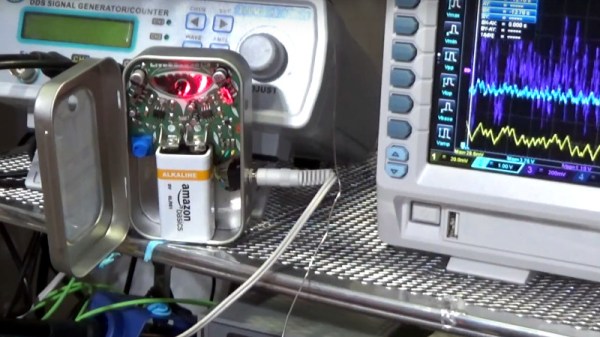
[Monta Elkins] has a Boldport kit, the Lite2Sound, which as its name suggests translates a light level to an audio signal. Given a laser diode and a source of country music from his Amazon Echo then, perhaps he could transmit the sound across a beam of laser light. And given that the Lite2Sound is an all-analogue device so unless it incorporates a low-pass filter it might struggle with PWM, to achieve that feat he would have to modulate the country music directly onto the laser light.

In the video below he shows us how he characterised his laser diode by plotting its VI curve on an oscilloscope, and identified its most linear region. He was then able to supply a voltage in the middle of that region, and simply overlay the line level audio from the Echo through an RC network. The result is a successful transmission of music via laser that sounds OK, though we’d find it interesting to see what an audio analyser would make of it. We’d also be interested to know whether the VI curve also maps to the same profile in the light intensity, we suspect the answer would be “close enough”.

So laser wireless audio can be done, and anyone who points out that the same feat could have been achieved with Bluetooth is spoiling the fun. After all, what’s a hi-fi without Frickin’ lasers!

Continue reading “Finding The Linear In A Laser”

Measuring Energy Consumption

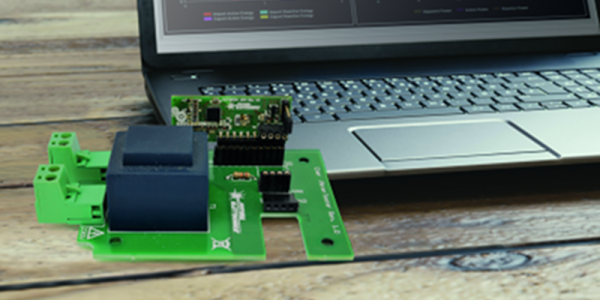
You would think that measuring a lot of sophisticated AC power parameters such as active and reactive power, RMS voltage and current, and line frequency would be a big job. As it turns out in so many cases, there’s a chip for that. The Microchip MCP39F511 can do all of that, but needs a little help from a few transformers. [Boris Landoni] has a two-part post that not only shows such a meter built with the chip but also has a very detailed description of the operation of the IC and how it works. The set-up takes two transformers. One to step the voltage down and another to measure the current.

Maybe it was just us, but we found the two schematics to be a little confusing. The schematic with two ICs on it is the actual board with the MCP39F511 (the other IC is a voltage regulator). The schematic with the transformer on it appears to have a single IC, U1, but that’s not really the case at all. U1 on that schematic is the entire circuit board from the first schematic. The “IC” pin numbers on the second schematic are the CN2 pins on the first schematic. The CN1 and CN2 on the two schematics are not related at all other than U1 is the actual board from the first schematic.

Continue reading “Measuring Energy Consumption”

Computer Programming Unplugged For Kids

There was a time when computers were far too expensive to let mere students use them. In those days, we wrote fake programs for fictitious machines and checked them by hand. That wasn’t fun, but it did teach you to think about the algorithm. You weren’t worried about how many tabs to indent code in the editor, or checking your social media feed, or changing the track on your Spotify playlist. Maybe that was the idea behind Computer Science Unplugged. The site is aimed at educators and gives them lesson plans to teach kids about computer concepts through activities that don’t use a computer.

The target ages are from 5 to 14 and topics range from binary numbers, sorting, searching, error detection, and robotics. For example, one exercise has students line up to be bits in a binary number. Each kid holds a card that is blank on one side or has the right number of dots on the other (for example, bit 0 has 1 dot, bit 2 has 4 dots, and so on).

Continue reading “Computer Programming Unplugged For Kids”

Six Wheels (En)rolling: Mars Rovers Going To School

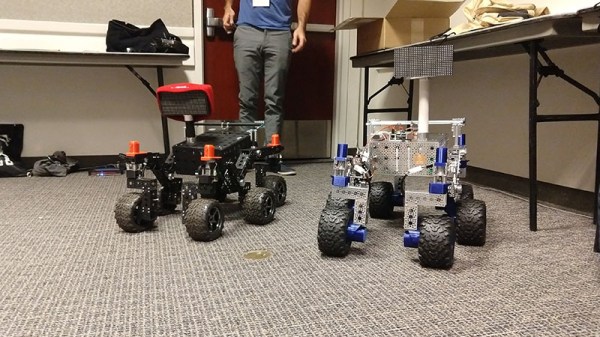
Few things build excitement like going to space. It captures the imagination of young and old alike. Teachers love to leverage the latest space news to raise interest in their students, and space agencies are happy to provide resources to help. The latest in a long line of educator resources released by NASA is an Open Source Rover designed at Jet Propulsion Laboratory.

JPL is the birthplace of Mars rovers Sojourner, Spirit, Opportunity, and Curiosity. They’ve been researching robotic explorers for decades, so it’s no surprise they have many rovers running around. The open source rover’s direct predecessor is ROV-E, whose construction process closely followed procedures for engineering space flight hardware. This gave a team of early career engineers experience in the process before they built equipment destined for space. In addition to learning various roles within a team, they also learned to work with JPL resources like submitting orders to the machine shop to make ROV-E parts.

Once completed, ROV-E became a fixture at JPL public events and occasionally visits nearby schools as part of educational outreach programs. And inevitably a teacher at the school would ask “The kids love ROV-E! Can we make our own rover?” Since most schools don’t have 5-axis CNC machines or autoclaves to cure carbon fiber composites, the answer used to be “No.”

Until now.

Continue reading “Six Wheels (En)rolling: Mars Rovers Going To School”

Voltage Monitor Relay Is More Than Meets The Eye

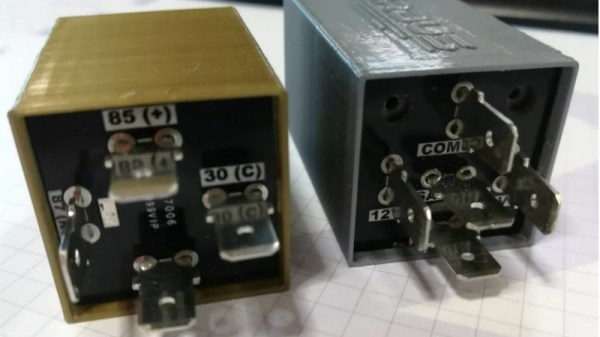
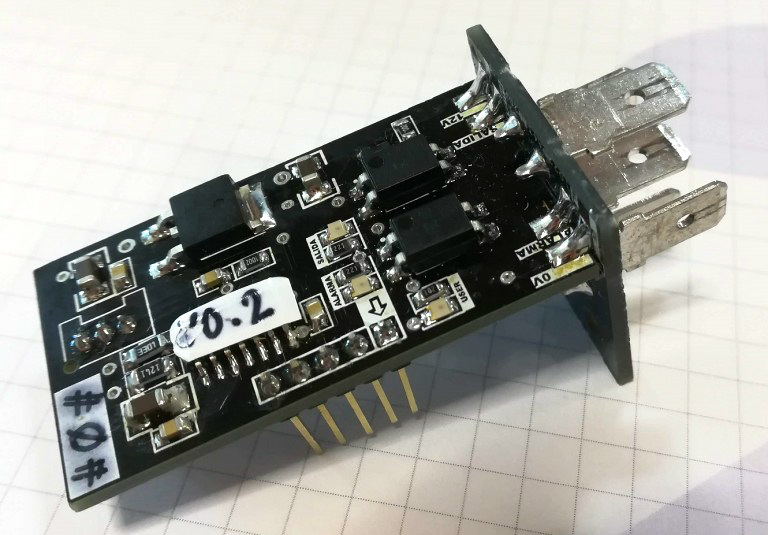
Automotive components that have a hidden secondary function are usually limited to cartoons and Michael Bay movies, but this project that [Jesus Echavarria] created for a client is a perhaps as close as we’re likely to get in the near future. The final product certainly looks like a standard automotive relay, but a peek inside the 3D printed case reveals a surprisingly complex little device. It’s still technically a relay, but it uses a PIC microcontroller to decide when it should activate.

[Jesus] was given the task of creating a device that would fit into the relay box of a vehicle, and serve as a battery monitor to fire off at different voltage set points. The client also wanted the ability to configure such things as how long the device would wait before enabling and disabling the alarms once the voltage threshold has been passed. After showing the client an oversize prototype using a PIC16F88 and switching regulator, he got the OK to move on to a smaller and more cost-effective version.

The final hardware makes use of a 78M05 500 mA linear regulator, a PIC16F1824 microcontroller, and a pair of AQY211EH solid state relays. The standard five pin layout used for automotive relays allows the monitor to get power from the vehicle’s battery while providing two output channels that can be switched on and off from the microcontroller. [Jesus] says an agreement with the client prevents him from sharing some elements of the project (like the firmware source code), but he gives enough information that it shouldn’t be too hard to spin up your own version.

With the addition of something like an ESP8266, this could be an easy way to retrofit an older vehicle with “smart” features. As an example, it could potentially allow for controlling the car’s headlights and horn over Wi-Fi. Or you could hack together a theft deterrent system that refuses to power on the starter or fuel pump unless your smartphone enables the relay first.

Intuitive Musical Books Accompany Alzheimer’s Patients’ Memories

If you have a loved one with Alzheimer’s, you know how difficult it can be to hold a conversation with them that doesn’t constantly go in circles. A good way to keep them focused is to use conversation pieces like pictures and familiar objects from their past. Something particularly poignant might uncork a flood of memories.

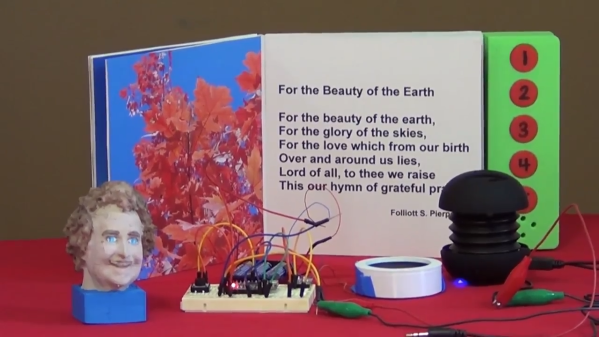
Adding familiar music to these images can be doubly beneficial. [Annelle] found this out when she showed her mother a musical children’s book that plays nursery rhymes. Her mother’s face lit up with joy when she heard those well-known tunes, and her reaction inspired [Annelle] to explore the idea.  After a fruitless search for more mature musical books, [Annelle] and her husband [Mike] got to work making their own using hymns, spirituals, and pictures from [Annelle]’s travels with her mother.

Alzheimer’s is a pretty tough test for intuitive interfaces. Because of this, [Annelle] and [Mike] designed around the constraints of buttons and switches. Instead, the book uses light-dependent resistors mounted inside the back cover, and an increasing number of holes in each page. These photo cells are all wired to an Adafruit sound board, which figures out the active page based on the input voltage and plays the corresponding song.

Tilt switches inside the 3D-printed enclosure negate the need for a power button. The book is turned off when lying flat on a table, but it’s ready to rock in any other position. Turn past the break for an overview video and another that covers the page detection scheme.

Continue reading “Intuitive Musical Books Accompany Alzheimer’s Patients’ Memories”

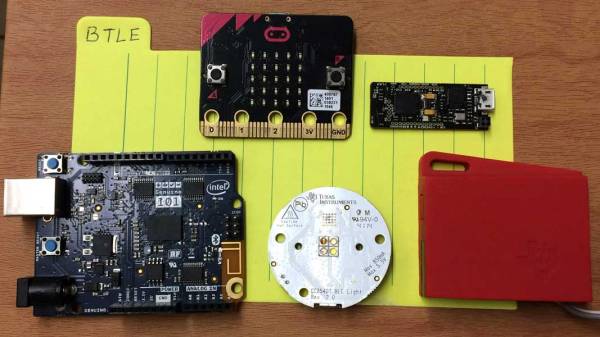
Beginning BLE Experiments And Making Everything Better

Successfully connecting things without physical wires has a profound effect on the maker brain. Machines talking to each other without any cables is as amazing today as it was a decade ago. When Bluetooth came out, it was a breakthrough since it offered a wireless way to connect cellphones to a PC. But Bluetooth is a complicated, high-bandwidth power hog, and it didn’t make sense for battery-powered devices with less demanding throughput requirements to pay the energy price. Enter Bluetooth LE (BLE), with power requirements modest enough to enable a multitude of applications including low power sensor nodes and beacons.

Over the years, a number of gadgets with BLE have popped up such as the LightBlue Bean, BLE Beacons as well as quadcopters like the FlexBot that rely on BLE for communication. Android or iOS apps are the predominant method of talking to these wonderful gadgets though there are alternatives.



This is the first in a two part series on building with BLE devices. First, I’ll survey some BLE devices and how to get started with BLE from the Linux command line. Later, we will go into describing the process of making a NodeJS cross-platform app that will leverage the BLE capabilities and connect it to the Internet.
Lets get started.
Continue reading “Beginning BLE Experiments And Making Everything Better”