A Tesla Coil From PCBs

While at the Hacker Hotel camp in the Netherlands back in February, our attention was diverted to an unusual project. [Niklas Fauth] had bought along a Tesla coil, but it was no ordinary Tesla coil. Instead of the usual tall coil and doughnut-shaped capacity hat it took the form of a stack of PCBs with spacers between them, and because Tesla coils are simply cooler that way, he had it playing music as an impromptu MIDI-driven plasma-ball lousdpeaker. Now he’s been able to write up the project we can take a closer look, and it makes for a fascinating intro not only to double-resonant Tesla coils but also to Galium Nitride transistors.

The limiting factor on Tesla coils comes from the abilities of a transistor to efficiently switch at higher frequencies. Few designs make it above the tens of kHz switching frequencies, and thus they rely on the large coils we’re used to. A PCB coil can not practically have enough inductance for these lower frequencies, thus Niklas’ design employs a very high frequency indeed for a Tesla coil design, 2.6 MHz with both primary and secondary coils being resonant. His write-up sets out in detail the shortcomings of conventional MOSFETS and bipolar transistors in this application, and sets out his design choices in using the GaN FETs. The device he’s using is the TI LMG5200 GaN half-bridge driver, that includes all the necessary circuitry to produce the GaN FET’s demanding drive requirements.

The design files can be found in a GitHub repository, and you can see a chorus of three of them in action in the video below. Meanwhile [Niklas] is a prolific hardware hacker whose work has appeared on these pages in the past, so take a look at his ultrasonic phased array and his x-ray image sensor work.

Continue reading “A Tesla Coil From PCBs”

Retrotechtacular: Balloons Go To War

To the average person, the application of balloon technology pretty much begins and ends with birthday parties. The Hackaday reader might be able to expand on that a bit, as we’ve covered several projects that have lofted various bits of equipment into the stratosphere courtesy of a high-altitude balloons. But even that is a relatively minor distinction. They might be bigger than their multicolored brethren, but it’s still easy for a modern observer to write them off as trivial.

But during the 1940’s, they were important pieces of wartime technology. While powered aircraft such as fighters and bombers were obviously more vital to the larger war effort, balloons still had numerous defensive and reconnaissance applications. They were useful enough that the United States Navy produced a training film entitled History of Balloons which takes viewers through the early days of manned ballooning. Examples of how the core technology developed and matured over time is intermixed with footage of balloons being used in both the First and Second World Wars, and parallels are drawn to show how those early pioneers influenced contemporary designs.

Even when the film was produced in 1944, balloons were an old technology. The timeline in the video starts all the way back in 1783 with the first piloted hot air balloon created by the Montgolfier brothers in Paris, and then quickly covers iterative advancements to ballooning made into the 1800’s. As was common in training films from this era, the various “reenactments” are cartoons complete with comic narration in the style of W.C. Fields which were designed to be entertaining and memorable to the target audience of young men.

While the style might seem a little strange to modern audiences, there’s plenty of fascinating information packed within the film’s half-hour run time. The rapid advancements to ballooning between 1800 and the First World War are detailed, including the various instruments developed for determining important information such as altitude and rate of climb. The film also explains how some of the core aspects of manned ballooning, like the gradual release of ballast or the fact that a deflated balloon doubles as a rudimentary parachute in an emergency, were discovered quite by accident.

When the film works its way to the contemporary era, we are shown the process of filling Naval balloons with hydrogen and preparing them for flight. The film also talks at length about the so-called “barrage balloons” which were used in both World Wars. Including a rather dastardly advancement which added mines to the balloon’s tethers to destroy aircraft unlucky enough to get in their way.

This period in human history saw incredible technological advancements, and films such as these which were created during and immediately after the Second World War provide an invaluable look at cutting edge technology from a bygone era. One wonders what the alternative might be for future generations looking back on the technology of today.

Continue reading “Retrotechtacular: Balloons Go To War”

Sound Card ADCs For Electrocardiograms

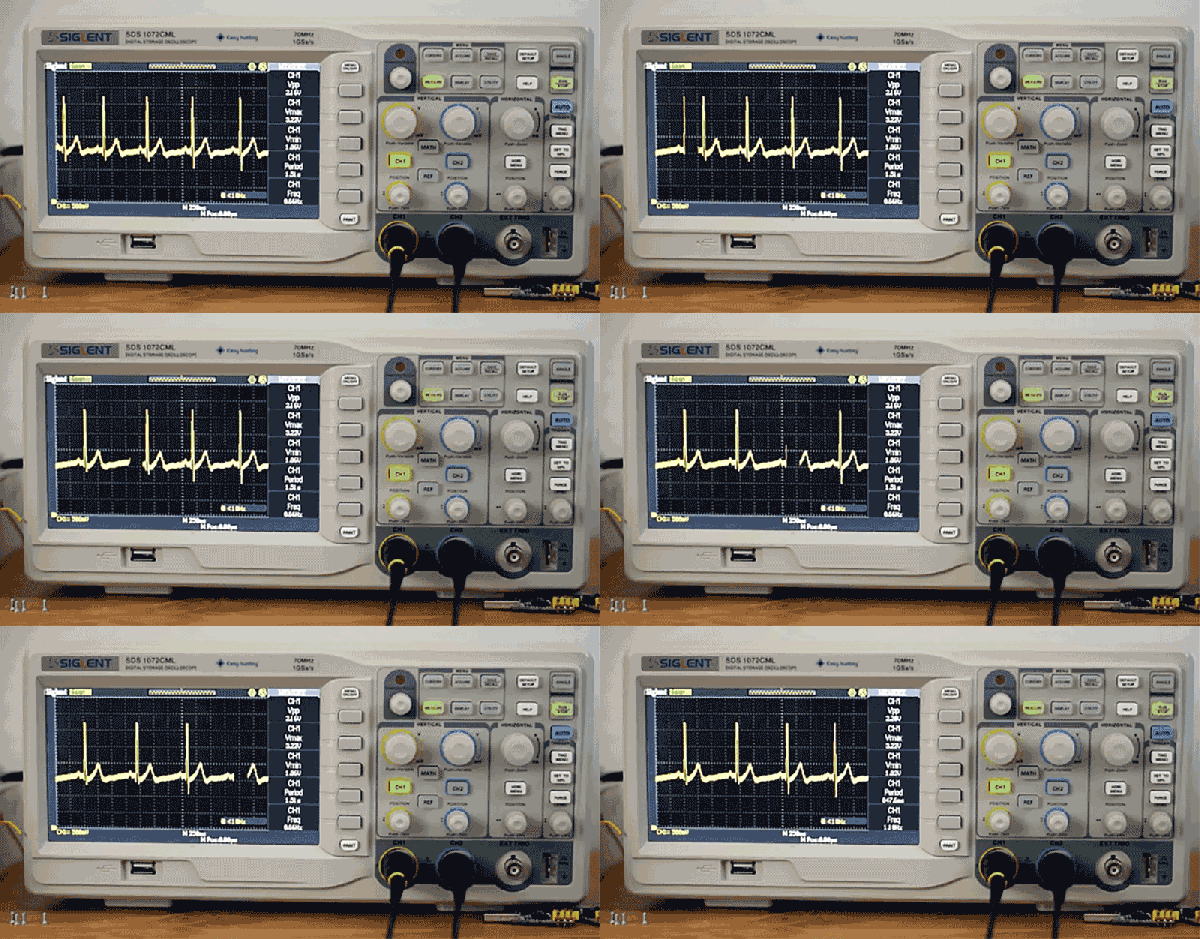
Every few years, or so we’re told, [Scott] revisits the idea of building an electrocardiogram machine. This is just a small box with three electrodes. Attach them to your chest, and you get a neat readout of your heartbeat. This is a project that has been done to death, but [Scott]’s most recent implementation is fantastic. It’s cheap, relying on the almost absurd capability for analog to digital conversion found in every sound card, and the software is great. It’s the fit and finish that makes this project shine.

The hardware for this build is simply an AD8232, a chip designed to be the front end of any electrocardiogram. This is then simply connected to the microphone port of a sound card through a 1/8″ cable. For the exceptionally clever, there’s a version based on an op-amp. It’s an extraordinarily simple build, but as with all simple builds the real trick is in the software. That’s where this project really shines, with custom software with graphics, and enough information being displayed to actually tell you something.

We’ve seen a number of sound card ADCs being used for electrocardiograms in the past, including some from the Before Times; it makes sense, sound cards are the cheapest way to get a lot of analog data very quickly. You can check out [Scott]’s demo video out below.

Continue reading “Sound Card ADCs For Electrocardiograms”

The $50 Ham: Dummy Loads

This is an exciting day for me — we finally get to build some ham radio gear! To me, building gear is the big attraction of amateur radio as a hobby. Sure, it’s cool to buy a radio, even a cheap one, and be able to hit a repeater that you think is unreachable. Or on the other end of the money spectrum, using a Yaesu or Kenwood HF rig with a linear amp and big beam antenna to work someone in Antartica must be pretty cool, too. But neither of those feats require much in the way of electronics knowledge or skill, and at the end of the day, that’s why I got into amateur radio in the first place — to learn more about electronics.

To get my homebrewer’s feet wet, I chose perhaps the simplest of ham radio projects: dummy loads. Every ham eventually needs a dummy load, which is basically a circuit that looks like an antenna to a transmitter but dissipates the energy as heat instead of radiating it an appreciable distance. They allow operators to test gear and make adjustments while staying legal on emission. Al Williams covered the basics of dummy loads a few years back in case you need a little more background.

We’ll be building two dummy loads: a lower-power one specifically for my handy talkies (HTs) will be the subject of this article, while a bigger, oil-filled “cantenna” load for use with higher power transmitters will follow. Neither of my designs is original, of course; borrowing circuits from other hams is expected, after all. But I did put my own twist on each, and you should do the same thing. These builds are covered in depth on my Hackaday.io page, but join me below for the gist on a good one: the L’il Dummy.

Continue reading “The $50 Ham: Dummy Loads”

The Galaxy Fold, Or Why Flexible OLED May Not Yet Be Ready For Prime Time

Samsung’s fancy new high-end smartphone with a flexible, foldable OLED display has been failing in worrying numbers for the first reviewers who got their hands on one. Now iFixit has looked into the issue using their considerable amount of smartphone tear-down experience to give their two cents. They base many of their opinions on the photos and findings by the Verge review, who were one of the (un)lucky ones to have their unit die on them.

The Galaxy Fold was supposed to be this regular smartphone sized phone which one can open up fully to reveal a tablet-sized display inside. The use of a flexible OLED display was supposed to create a seamless display without the annoying center line that having two individual displays would produce. Unfortunately it’s this folding feature which produces issues.

As iFixit notes, OLEDs are rather fragile, with their own tear-downs of regular OLED-equipped devices already often resulting in the damaging of the display edges, which spells doom for the internals of them as oxygen and other contaminants can freely enter. This means that maintaining this barrier is essential to keep the display functioning.

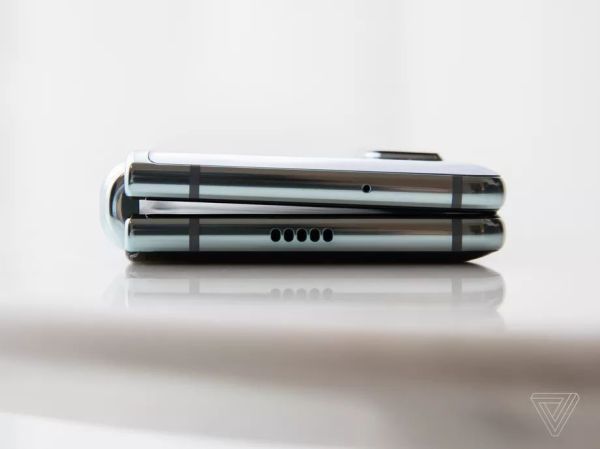
This is probably the reason why Samsung chose to install a screen protector on the display, which unfortunately was mistaken for a protective foil as found on many devices. The subsequent removal of this protector by some reviewers and the mechanical stress this caused destroyed some screens. Others had debris trapped in the fold between both halves of the display, which caused visible bumps in the display when opened.

The relatively massive spacing between the hinge and the display seems almost purposefully engineered to allow for the ingress of debris. This combines with the lack of any guiding crease in the center of the display and the semi-random way in which humans open and close the Fold compared to the perfectly repeating motion of the folding robots Samsung used to test the display. It seems that Samsung and others still have some work to do before they can call folding OLED displays ready for production.

Finally, have a look at this video of Lewis from UnboxTherapy pulling a folding robot with opening and closing a Fold one-thousand times:


This GPS Speedometer Hangs Off Your Handlebars

If you can ride a bike with no handlebars, no handlebars, no handlebars, you can do just about anything. You can take apart a remote control, and you can almost put it back together. You can listen in on a two meter repeater and you can build a GPS module speedometer. That’s what [Jeremy Cook] did with just a few parts, a little 3D design, and some handy zip ties to hold it onto the handlebars, the handlebars.

The electronics for this build are relatively simple, based on an Arduino Pro Mini because that’s just about the smallest readily available development board you’ll be able to find. To this is a LiPo, a LiPo charging circuit, a GPS module, and a single RGB LED. The code gets some data from the GPS module and figures out a speed. This is then translated into a color — red, yellow, or green depending on whether you’re stationary, below 5 km/h, or above 5 km/h.

All these electronics are stuffed into a 3D-printed enclosure. The majority of the enclosure is printed in black, with a translucent top that serves as a great diffuser for the LED. Just two zip ties hold this GPS speedometer onto the handlebars, and from the video below, everything looks great. The GPS module does take some time to get data at first, but that’s a common problem with GPS units that have been powered off for a few days. If only someone made a GPS module that could keep time with no metronome, with no metronome.

Continue reading “This GPS Speedometer Hangs Off Your Handlebars”

House Training A Military TA-1024A Field Telephone

After spotting some interesting military phones at a museum, [CuriousMarc] wondered what it would take to retrofit these heavy duty pieces of telecom equipment for civilian use. He knew most of the internals would be a lost cause, but reasoned that if he could reverse engineer key elements such as the handset and keypad, he might be able to connect them to the electronics of a standard telephone. Luckily for us, he was kind enough to document the process.

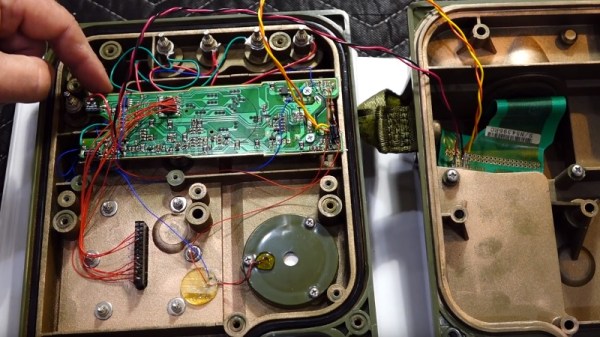
There were a number of interesting problems that needed to be solved, but the first and perhaps largest of them was the unusual wiring of the keypad. It wasn’t connected in the way modern hackers like us might expect, and [CuriousMarc] had to end up doing some pretty significant rewiring. By cutting the existing traces on the PCB with a Dremel and drilling new holes to run his wires around the back, he was able to convert it over to a wiring scheme that contemporary touch tone phones could use.

An adapter needed to be fabricated to mount a basic electret microphone in place of the original dynamic one, but the original speaker was usable. He wanted to adapt the magnetic sensor that detected when the handset was off the hook, but in the end it was much easier to just drill a small hole and use a standard push button.

The main board of the phone is a perfect example of the gorgeous spare-no-expense construction you’d expect from a military communications device, but unfortunately it had to go in the bin. In its place is the guts of a lowly RCA phone that was purchased for the princely sum of $9.99. [CuriousMarc] won’t be able to contact NORAD anymore, but at least he’ll be able to order a pizza. The red buttons on the keypad, originally used to set the priority level of the call on the military’s AUTOVON telephone network, have now been wired to more mundane features of the phone such as redial.

While this is fine for a one-off project, we’d love to see a drop-in POTS or VoIP conversion for these phones that didn’t involve so much modification and rewiring. Now that we have some documentation for things like the keypad and hook sensor, it shouldn’t be hard to take their idiosyncrasies into account with a custom PCB. Dragging vintage gear into the modern era is always a favorite pastime for hackers, so maybe somebody out there will be inspired to take on the challenge.

Continue reading “House Training A Military TA-1024A Field Telephone”