Hackaday Links Column Banner

Hackaday Links: October 18, 2020

Remember subliminal advertising? The idea was that a movie theater operator would splice a single frame showing a bucket of hot buttered popcorn into a movie, which moviegoers would see and process on a subconcious level and rush to the concession stand to buy the tub o’ petrochemical-glazed starch they suddenly craved. It may or may not work on humans, but it appears to work on cars with advanced driver assistance, which can be spoofed by “phantom street signs” flashed on electronic billboards. Security researchers at Ben Gurion University stuck an image of a stop sign into a McDonald’s ad displayed on a large LCD screen by the side of the road. That was enough to convince a Tesla Model X to put on the brakes as it passed by the sign. The phantom images were on the screen anywhere from an eighth of a second to a quarter second, so these aren’t exactly subliminal messages, but it’s still an interesting attack that bears looking into. And while we’re skeptical about the whole subliminal advertising thing in the first place, for some reason we really want a bacon cheeseburger right now.

Score one for the good guys in the battle against patent trolls. Mycroft AI, makers of open-source voice assistants, proudly announced their latest victory against what they claim are patent trolls. This appears to be one of those deals where a bunch of investors get together and buy random patents, and then claim that a company that actually built something infringes on their intellectual property. Mycroft got a letter from one such entity and decided to fight it; they’ve won two battles so far against the alleged trolls and it looks pretty good going forward. They’re not pulling their punches, either, since Mycroft is planning to go after the other parties for legal expenses and punitive damages under the State of Missouri’s patent troll legislation. Here’s hoping this sends a message to IP squatters that it may not be worth the effort and that their time and money are better spent actually creating useful things.

Good news from Mars — The Mole is finally completely buried! We’ve been following the saga of the HP³, or “Heat Flow and Physical Properties Package” aboard NASA’s Mars InSight lander for quite a while. The self-drilling “Mole”, which is essentially the guts of an impact screwdriver inside a streamlined case, has been having trouble dealing with the Martian regolith, which is simultaneously too soft to offer the friction needed to keep the penetrator in its hole, but also too hard to pierce in places where there is a “duricrust” of chemically amalgamated material below the surface. It took a lot of delicate maneuvers with the lander’s robotic arm to get the Mole back on track, and it’s clearly not out of the woods yet — it needs to get down to three meters depth or so to do the full program of science it was designed for.

If watching Martian soil experiments proceed doesn’t scratch your itch for space science, why not try running your own radio astronomy experiments? Sure, you could build your own radio telescope to do that, but you don’t even have to go that far — just log into PICTOR, the free-to-use radio telescope. It’s a 3.2-m parabolic dish antenna located near Athens, Greece that’s geared toward hydrogen line measurements of the galaxy. You can set up an observation run and have the results mailed back to you for later analysis.

Here’s a fun, quick hack for anyone who hates the constant drone of white noise coming from fans. Build Comics apparently numbers themselves among that crowd, and decided to rig up a switch to turn on their fume extractor only when the soldering iron is removed from its holder. This hack was executed on a classic old Weller soldering station, but could easily be adapted to Hakko or other irons

And finally, if you’ve never listened to a Nobel laureate give a lecture, here’s your chance. Andrea Ghez, co-winner of the 2020 Nobel Prize in physics for her work on supermassive black holes, will be giving the annual Maria Goeppert Mayer lecture at the University of Chicago. She’ll be talking about exactly what she won the Nobel for: “The Monster at the Heart of Our Galaxy”, the supermassive black hole Sagittarius A*. We suspect the talk was booked before the Nobel announcement, so in normal times the room would likely be packed. But one advantage to the age of social distancing is that everything is online, so you can tune into a livestream of the lecture on October 22.
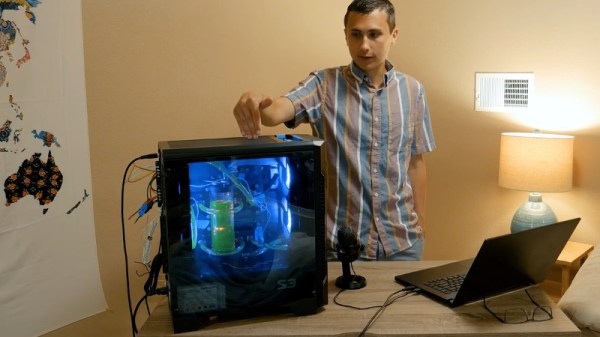
Custom Electronic Load Makes Use Of Gaming PC Tech

At first glance, you might think the piece of hardware pictured here is a modern gaming computer. It’s got water cooling, RGB LED lighting, and an ATX power supply, all of which happen to be mounted inside a flashy computer case complete with a clear window. In truth, it’s hard to see it as anything but a gaming PC.

In actuality, it’s an incredible custom electronic load that [EE for Everyone] has been developing over the last four months that’s been specifically designed to take advantage of all the cheap hardware out there intended for high-performance computers. After all, why scratch build a water cooling system or enclosure when there’s such a wide array of ready-made ones available online?

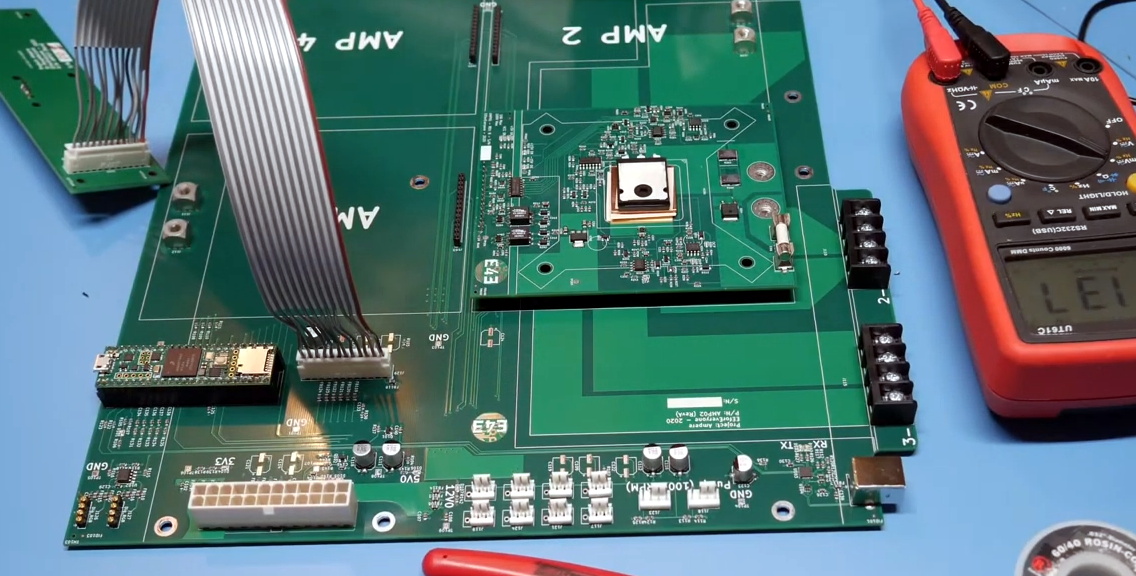
The “motherboard” with single load module installed.

Inside that fancy case is a large PCB taking the place of the original motherboard, to which four electronic load modules slot into. Each of these loads is designed to accept a standard Intel CPU cooler, be it the traditional heatsink and fan, or a water block for liquid cooling. With the current system installed [EE for Everyone] can push the individual modules up to 275 watts before the temperatures rise to unacceptable levels, though he’s hoping to push that a little higher with some future tweaks.

So what’s the end game here? Are we all expected to have a massive RGB-lit electronic load hidden under the bench? Not exactly. All of this has been part of an effort to design a highly accurate electronic load for the hobbyist which [EE for Everyone] refers to as the “Community Edition” of the project. Those smaller loads will be derived from the individual modules being used in this larger testing rig.

We’ve actually seen DIY liquid cooled electronic loads in the past, though this one certainly sets the bar quite a bit higher. For those with more meager requirements, you might consider flashing a cheap imported electronic load with an open source firmware to wring out some extra functionality.

Continue reading “Custom Electronic Load Makes Use Of Gaming PC Tech”

Precision Metal Detector Finds Needles In Haystacks

Full-size metal detectors are great for narrowing down a region to start digging through. But what if you had a smaller metal detector that could pinpoint the location? Then you could spend far less time digging and way more time sweeping for metal.

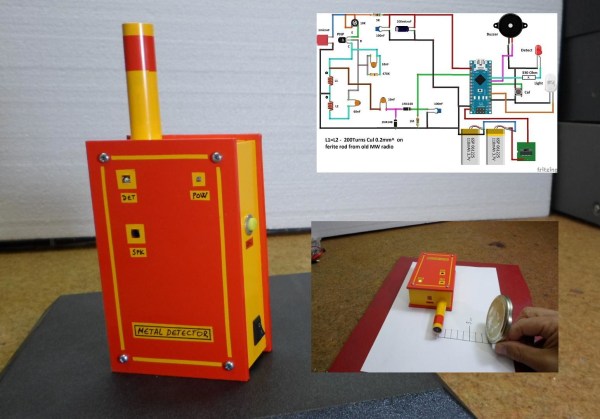
Metal detectors work because of the way metal behaves around electromagnetic fields. [mircemk] reused the ferrite core from an old MW radio to build the antenna coils. When metal objects are close enough, the induced electromagnetism changes the frequency, and the Arduino blinks an LED and beeps a buzzer in time with the new frequency.

[mircemk]’s handheld metal detector is quite sensitive, especially to smaller objects. As you can see in the demo video after the break, it can sense coins from about 4cm away, larger objects like lids from about 7 cm, and tiny things like needles from a few millimeters away. There’s also an LED for treasure hunting in low light.

Don’t want to pinpoint a bunch of useless junk? Build in some phase detection to help you discriminate.

Continue reading “Precision Metal Detector Finds Needles In Haystacks”

Worm Bot Inches Along As You’d Expect

Robot locomotion is a broad topic, and there are a multitude of choices for the budding designer. Often, nature is an inspiration, and many ‘bots have been built to explore the motion regimes of various insects and animals. Inspired himself by the common inch worm, [jegatheesan.soundarapandian] decided to build a robot that moved in a similar way.

The build consists of a series of 3D printed linkages, with servos fitted in between. This allows the robot’s body to articulate and flex in much the same way as a real inch worm. By flexing the body up, shifting along, and flexing back down, the robot can slowly make its way along a surface. An Arduino Pro Mini is the brains of the operation, being compact enough to fit on the small robot while still having enough outputs to command the multiple servos required. Control is via a smartphone app, using MIT’s AppInventor platform and the venerable HC-05 Bluetooth module.

It’s a fun build, and we’d love to see it go further with batteries replacing the tether and perhaps some sensors to enable it to further interact with its environment. We’ve seen other creative 3D-printed designs before, too – like this spherical quadruped ‘bot. Video after the break.

Continue reading “Worm Bot Inches Along As You’d Expect”

Duality Of Light Explored By Revisiting The Double-Slit Experiment

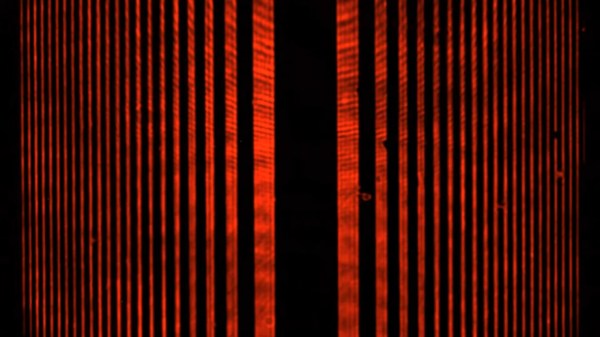
We’ve all seen recreations of the famous double-slit experiment, which showed that light can behave both as a wave and as a particle. Or rather, it’s likely that what we’ve seen is the results of the double-slit experiment, that barcode-looking pattern of light and dark stripes, accompanied by some handwaving about classical versus quantum mechanics. But if you’ve got 20 minutes to invest, this video of the whole double-slit experiment cuts through the handwaving and opens your eyes to the quantum world.

For anyone unfamiliar with the double-slit experiment,  [Huygens Optics] actually doesn’t spend that much time explaining the background. Our explainer does a great job on the topic, but suffice it to say that when coherent light passes through two closely spaced, extremely fine openings, a characteristic pattern of alternating light and dark bands can be observed. On the one hand, this demonstrates the wave nature of light, just as waves on the ocean or sound waves interfere constructively and destructively. On the other hand, the varying intensity across the interference pattern suggests a particle nature to light.

To resolve this conundrum, [Huygens] jumps right into the experiment, which he claims can be done with simple, easily sourced equipment. This is belied a little by the fact that he used photolithography to create his slits, but it should still be possible to reproduce with slits made in more traditional ways. The most fascinating bit of this for us was the demonstration of single-photon self-interference using nothing but neutral density filters and a CCD camera. The explanation that follows of how it can be that a single photon can pass through both slits at the same time is one of the most approachable expositions on quantum mechanics we’ve ever heard.

[Huygens Optics] has done some really fascinating stuff lately, from variable profile mirrors to precision spirit levels. This one, though, really helped scratch our quantum itch.

Where We’re Calculating, We Don’t Need No Seven Segments!

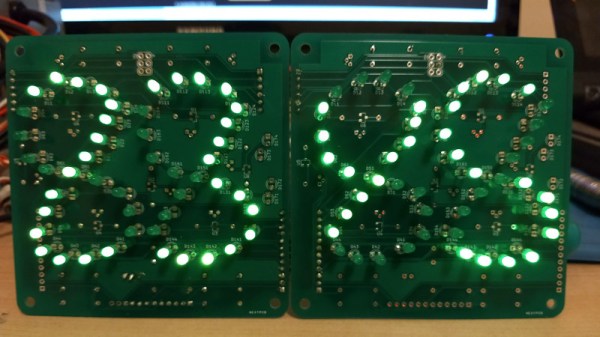
There have been many attempts at electronic numerical display technology over the decades since the first incandescent bulb or neon tube flickered into life at the command of a primordial computer, but the lowest common denominator has remained the humble seven segments. Here it might end, but for [Ken Yap] who has taken inspiration from a 1960s Sharp calculator to re-create a numerical display with only six segments.

This seemingly impossible feat is achieved by having six curved segments arranged as a figure-eight, which can render all the digits after a fashion, but which soon reveals why the extra segment made an appearance. The numbers that are made up of curves look good enough, but the straight lines in the 1, 4, and 7, are compromised by the diagonal, and the zero is curiously small at half the height.  You can read the digits, but it takes getting used to.

What made sense to reduce the complexity of 1960s electronics is only a fascinating curiosity in 2020, but we maybe won’t see these displays appearing too often. You can take a look at it in the video below the break, and if you’re curious about the Sharp calculator which inspired it then you can take a look at its page in the Vintage Calculator Museum.

Continue reading “Where We’re Calculating, We Don’t Need No Seven Segments!”

Climbing Everest One Hill At A Time – And Keeping Track Of It

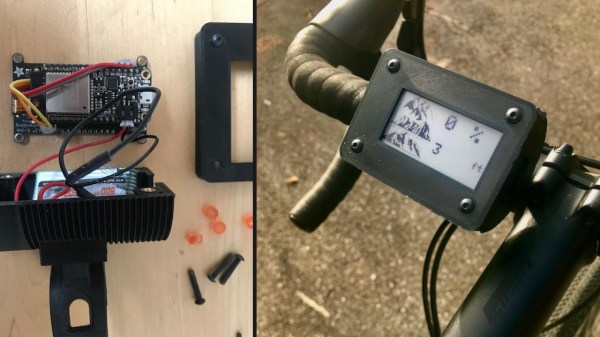
The internet is full of self-proclaimed challenges, ranging from some absolutely pointless fads to well-intended tasks with an actual purpose. In times of TikTok, the latter is of course becoming rarer, as a quick, effortless jump on the bandwagon is just easier for raising your internet points. Cyclists on the other hand love a good challenge where they compete with one another online, testing their skills and gamifying their favorite activity along the way. One option for that is Everesting, where you pick a hill of your choice, and within a single session you ride it up and down as many times as it takes until you accumulated the height of Mount Everest on it. Intrigued by the idea, but not so much its competitive aspect, [rabbitcreek] became curious how long it would take him to reach that goal with his own casual bicycle usage, so he built a bicycle computer to measure and keep track of it.

While the total distance and time factors into the actual challenge, [rabbitcreek]’s primary interest was the accumulated height, so the device’s main component is a BMP388 barometric pressure sensor attached to a battery-powered ESP32. An e-paper display shows the total height and completed percentage, along with some random Everest-related pictures. Everything is neatly packed together in a 3D-printed case that can be mounted on the bicycle’s handlebar, and the STL files are available along with the source code in his write-up.

Of course, if you’re actually interested in the challenge itself, you probably have an assortment of sports tracking equipment anyway, but this is a nice addition to keep track as you go, and has a lower risk of ransomware attacks. And in case [rabbitcreek] sounds like a familiar name to you, he’s indeed become a Hackaday regular with his environmental hacks like the tide clock, a handheld particle sniffer, or logging temperatures in the Alaskan wilderness.