The Filamentmeter: For When You Absolutely Want To Count Every Meter Used

[ArduinoNmore] took an interesting approach to designing a counter intended to accurately display how many meters of filament a 3D printer has used. The Filamentmeter looks a little bit like a 3D printed handheld tally counter (or lap counter) but instead of a button to advance each digit, the readout represents how many meters of filament have gone through the extruder.

Driving the digit rotation from the extruder motor itself means that even retractions are accounted for.

At first glance it may look like there is a motor hidden inside, or that the device is somehow sensing the filament directly. But it’s actually the movement of the extruder motor that drives the device. A small spur gear attached to the printer’s extruder drives a series of gears that advance the digits. This means that retractions  — small reverses of the extruder motor during printing — are properly accounted for in the total, which is a nice touch.

[ArduinoNmore] designed this for the Ender 3, and the Filamentmeter relies on a specific extruder design and orientation to work properly. Of course, since it’s 3D printed, modifying the design for your own purposes should be pretty straightforward.

Curious? The design is being sold for a few bucks, and there is a free test piece one can print and use to confirm whether the design will work before mashing the buy button. Non-free printable 3D models can be a world of buyer beware, but test pieces and solid documentation are good ways to give buyers confidence in your work.

The insides of the unit are really quite intricate, with a clockwork-type elegance to them. You can see it all in the short video, embedded below.

Continue reading “The Filamentmeter: For When You Absolutely Want To Count Every Meter Used”

Touch Tone MIDI Phone And Vocoder Covers Daft Punk

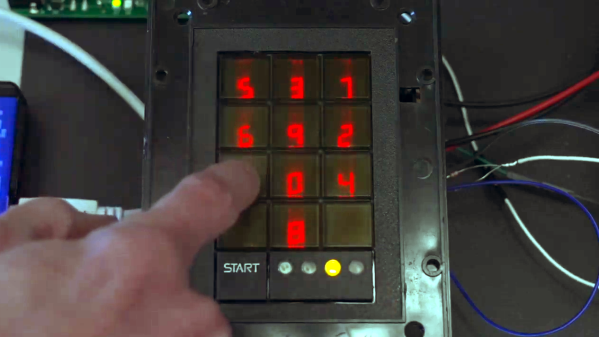
[poprhythm]’s Touch Tone MIDI Phone is a fantastic conversion of an old touch tone phone into a MIDI instrument complete with intact microphone, but this project isn’t just about showing off the result. [poprhythm] details everything about how he interfaced to the keypad, how he used that with an Arduino to create a working MIDI interface, and exactly how he decided — musically speaking — what each button should do. The LEDs on the phone are even repurposed to blink happily depending on what is going on, which is a nice touch.

Of course, it doesn’t end there. [poprhythm] also makes use of the microphone in the phone’s handset. Since the phone is now a MIDI instrument with both a microphone and note inputs, it’s possible to use them together as the inputs to vocoder software, which he demonstrates by covering Around the World by Daft Punk (video).

We love how [poprhythm] explains how he interfaced to everything because hardware work is all about such details, and finding the right resources. Here’s the GitHub repository for the Arduino code and a few links to other resources.

We have seen MIDI phone projects before, and each one is always unique in its own way: here’s a different approach to converting a keypad phone to MIDI, and this rotary pulse-dial phone went in a completely different direction with the phone itself completely unmodified, using only external interfacing.

You can admire [poprhythm]’s Touch Tone MIDI Phone in action in the short videos embedded below, with each one showing off a different aspect of the build. It’s great work!

Continue reading “Touch Tone MIDI Phone And Vocoder Covers Daft Punk”

This Vintage Alphanumeric Display Was Huge, Hot, Heavy, And Expensive

It’s easy to take display technology for granted nowadays, but the ability to display data in a human-readable way was not always easy. This is demonstrated well by the Pinlite 30003 Alphanumeric Display Module, a four-character display that was pure luxury for its time.

Each display is a rectangular vacuum tube containing 17 incandescent light filaments.

Not only were the 17 segments that make up each display capable of showing any letter or number, but they were even daylight-readable! Each of those 17 segments is an incandescent lamp filament, which is how the required brightness was achieved. The sturdy module shown here holds four such displays, each of which is on its own pluggable board with a dedicated character decoder chip directly behind it.

As [AnubisTTL] points out, the resulting unit is bulky, has terrible character spacing, and was no doubt very costly. By today’s standards, it is almost unimaginably heavy, hot, and impractical. But before high-brightness LEDs were a thing, a daylight-readable alphanumeric character display was really something special. It would absolutely have been worth the money and effort to the right people.

Before small and efficient displays were commonplace, the solution to the problem of how to display data efficiently and in an easy-to-read format took a lot of really unusual (and clever) turns as engineers worked around the limitations of the time. This resulted in oddities like the SD-11 Sphericular Display, which is mostly empty space on the inside. Another great example is the Eidophor, a projector from before projectors were even a thing.

Nevermore Is What You Get When Engineers Design Air Filters For 3D Printers

What happens when an air filter for 3D printers gets designed by engineers with a passion for function, a refusal to compromise, and a desire to do without bad smells or fumes? You get the Nevermore, a design for a recirculating active-carbon filtration system to deal with VOCs (volatile organic compounds) from 3D printing.

3D-printable parts and an easy-to-fill chamber for bulk-activated carbon make this recirculating air filter for VOCs a smart, space-saving design.

The Nevermore Micro (and larger Nevermore Max) were originally intended to complement the Voron 3D printer design, but are made such that they can be used with just about anything else. These filters use 3D-printable parts, and are designed to be easily filled (and refilled) using bulk-activated carbon instead of some kind of proprietary pre-packed filter like most commercial offerings. The Voron project is all about a printer without compromises, and the Nevermore comes from that same design ethos.

A Nevermore filter sits inside the build chamber, and works by recirculating air inside while passing it through the activated carbon. The idea is that by concentrating on dealing with the problem at the source inside a relatively small build chamber, one doesn’t need a lot of airflow. A small recirculating air filter can do the job efficiently, though for best results, the build chamber should be as sealed as possible.

One interesting caution is that it seems not all activated carbon is the same, and it is absolutely crucial to use only acid-free, steam-activated (not acid-washed) carbon in a recirculating filter like the Nevermore. There are horrifying photos of oxidized metal surfaces resulting from using acid-residue carbon, some of which took only minutes to occur. Thankfully, there are pointers to trusted sources for the known-good stuff.

It’s known that 3D printing results in chemical and particle emissions. These differ significantly depending on both material and type of printer, but it’s enough of an issue to warrant attention. One deals with particulates with something like a HEPA filter, but VOCs require a carbon filter. This is where the Nevermore comes in. Active carbon filters will wear out simply from exposure to the air, so if one is serious about cleaning VOCs when printing, it is definitely worth looking into bulk carbon with a design like the Nevermore.

Make Multi-Material Resin Prints With A Syringe (And A Bit Of Patience)

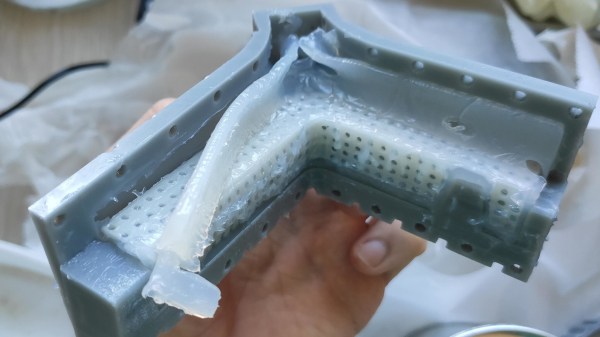
Resin printing is a fantastic way to create parts, but multi-material printing isn’t really a possibility with resin. That is, unless you use [Cameron Coward]’s method for creating multi-material resin prints.

[Cameron]’s idea relies on the fact that handling and curing UV resin can easily be done outside of the printer itself. First, one prints what we’ll call the primary object. This object has empty spaces representing the secondary object. Once the primary object is printed and finished, these voids are carefully filled with a different resin, then cured with UV light. The end result is a single multi-material object that is, effectively, made from two different resins.

Continue reading “Make Multi-Material Resin Prints With A Syringe (And A Bit Of Patience)”

Small Combat Robots Pack A Punch In Antweight Division

Two robots enter, one robot leaves! Combat robotics are a fantastic showcase of design and skill, but the mechanical contenders don’t have to be big, heavy, and expensive. There is an Antweight division for combat robots in which most contenders weigh a mere 150 grams, and [Harry Makes Things] shows off four participants for Antweight World Series (AWS) 64.

Clockwise: ReLoader, Shakma, Sad Ken, and HobGoblet antweight combat robots.

Each of them have very different designs, and there are plenty of photos as well as insightful details about what was done and how well it worked. That’s exactly the kind of detail we love to read about, so huge thanks to [Harry] for sharing!

In combat robotics, contenders generally maneuver their remote-controlled machines to pin or immobilize their opponent. This can happen as a result of damaging them to the point that they stop functioning, but it can also happen by rending them helpless by working some kind of mechanical advantage. Continue reading “Small Combat Robots Pack A Punch In Antweight Division”

Blog Title Optimizer Uses AI, But How Well Does It Work?

[Max Woolf] sometimes struggles to create ideal headlines for his blog posts, and decided to apply his experience with machine learning to the problem. He asked: could an AI be trained to optimize his blog titles? It is a fascinating application of natural language processing, and [Max] explains all about what it does and how it works.

The machine learning framework [Max] uses is GPT-3, a language model that works with natural-seeming human language that is capable of being tweaked in different ways. [Max] uses OpenAI’s GPT-3 API (which, by the way, is much easier to experiment with than one might think) and here is the basic workflow for his title optimizer:

  1. The optimizer takes as input a blog post title to optimize.
  2. OpenAI’s pre-trained GPT-3 engine is used to generate six alternate titles.
  3. For each of those alternate titles, a fine-tuned version of GPT-3 is consulted to judge how “good” they are based on custom training data. (“Good” in this context means “similar to titles of successful submissions on Hacker News“, but more on that in a moment.)
  4. Print the results.

Continue reading “Blog Title Optimizer Uses AI, But How Well Does It Work?”