Lego Microscope Aims To Discover Future Scientists

When it comes to inspiring a lifelong appreciation of science, few experiences are as powerful as that first glimpse of the world swimming in a drop of pond water as seen through a decent microscope. But sadly, access to a microscope is hardly universal, denying that life-changing view of the world to far too many people.

There have been plenty of attempts to fix this problem before, but we’re intrigued to see Legos used to build a usable microscope, primarily for STEM outreach. It’s the subject of a scholarly paper (preprint) by [Bart E. Vos], [Emil Betz Blesa], and [Timo Betz]. The build almost exclusively uses Lego parts — pretty common ones at that — and there’s a complete list of the parts needed, which can either be sourced from online suppliers, who will kit up the parts for you, or by digging through the old Lego bin. Even the illuminator is a stock part, although you’ll likely want to replace the orange LED buried within with a white one. The only major non-Lego parts are the lenses, which can either be sourced online or, for the high-power objective, pulled from an old iPhone camera. The really slick part is the build instructions (PDF), which are formatted exactly like the manual from any Lego kit, making the build process easily accessible to anyone who has built Lego before.

As for results, they’re really not bad. Images of typical samples, like salt crystal, red onion cells, and water fleas are remarkably clear and detailed. It might no be a lab-grade Lego microscope, but it looks like it’s more than up to its intended use.

Thanks for the heads up on this, [Jef].

Measuring Planck’s Constant With LEDs And A DMM

The remarkable thing about our universe is that it’s possible to explore at least some of its inner workings with very simple tools. Gravity is one example, to which [Galileo]’s inclined planes and balls bear witness. But that’s classical mechanics: surely the weirdness that is quantum mechanics requires far more sophisticated instrumentation to explore, right?

That’s true enough — if you consider a voltmeter and a Mark 1 eyeball to be sophisticated. That’s pretty much all you need for instruments to determine Planck’s constant to a decent degree of precision, the way that [poblocki1982]’s did. There’s a little more to it, of course; the method is based on measuring the voltage at which LEDs of various wavelengths start shining, so a simple circuit was built to select an LED from the somewhat grandly named “photon energy array” and provide a way to adjust and monitor the voltage and current.

By performing the experiment in a dark room with adapted eyes, or by using an opaque tube to block out stray light, it’s possible to slowly ramp the voltage up until the first glimmer of light is seen from each LED. Recording the voltage and the wavelength gives you the raw numbers to calculate the Planck constant h, as well as the Planck error Δh, with the help of a handy spreadsheet. [poblocki1982] managed to get within 11% of the published value — not too shabby at all.

Does this all still sound too complicated for you? Maybe a Watt balance made from Lego is more your speed.

Hackaday Links Column Banner

Hackaday Links: June 27, 2021

When asked why he robbed banks, career criminal Willie Sutton is reported to have said, “Because that’s where the money is.” It turns out that a reporter made up the quote, but it’s a truism that offers by extension insight into why ATMs and point-of-sale terminals are such a fat target for criminals today. There’s something far more valuable to be taken from ATMs than cash, though — data, in the form of credit and debit card numbers. And taking a look at some of the hardware used by criminals to get this information reveals some pretty sophisticated engineering. We’d heard of ATM “skimmers” before, but never the related “shimmers” that are now popping up, at least according to this interesting article on Krebs.

While skimmers target the magnetic stripe on the back of a card, simmers are aimed at reading the data from card chips instead. Shimmers are usually built on flex PCBs and are inserted into the card slot, where traces on the device make contact with the chip reader contacts. The article describes a sophisticated version of shimmer that steals power from the ATM itself, rather than requiring a separate battery. The shimmer sits inside the card slot, completely invisible to external inspection (sorry, Tom), and performs what amounts to man-in-the-middle attacks. Card numbers are either stored on the flash and read after the device is retrieved, or are read over a Bluetooth connection; PINs are stolen with the traditional hidden camera method. While we certainly don’t condone criminal behavior, sometimes you just can’t help but admire the ingenuity thieves apply to their craft.

In a bit of foreshadowing into how weird 2020 was going to be, back in January of that year we mentioned reports of swarms of mysterious UAVs moving in formation at night across the midwest United States. We never heard much else about this — attention shifted to other matters shortly thereafter — but now there are reports out of Arizona of a “super-drone” that can outrun law enforcement helicopters. The incidents allegedly occurred early this year, when a Border Patrol helicopter pilot reported almost colliding with a large unmanned aerial system (UAS) over Tucson, and then engaged them in a 70-mile chase at speeds over 100 knots. The chase was joined by a Tucson police helicopter, with the UAS reaching altitudes of 14,000 feet at one point. The pilots didn’t manage to get a good look at it, describing it only as having a single green light on its underside. The range on the drone was notable; the helicopter pilots hoped to exhaust its batteries and force it to land or return to base, but they themselves ran out of fuel long before the drone quit. We have to admit that we find it a little fishy that there’s apparently no photographic evidence to back this up, especially since law enforcement helicopters are fairly bristling with sensors, camera, and spotlights.

When is a backup not a backup? Apparently, when it’s an iCloud backup. At least that’s the experience of one iCloud user, who uses a long Twitter thread to vent about the loss of many years of drawings, sketches, and assorted files. The user, Erin Sparling, admits their situation is an edge case — he had been using an iPad to make sketches for years, backing everything up to an iCloud account. When he erased the iPad to loan it to a family member for use during the pandemic, he thought he’s be able to restore the drawings from his backups, but alas, more than six months had passed before he purchased a new iPad. Apparently iCloud just up and deletes everythign if you haven’t used the account in six months — ouch! We imagine that important little detail was somehere in the EULA fine print, but while that’s not going to help Erin, it may help you.

And less the Apple pitchfork crowd think that this is something only Cupertino could think up, know that some Western Digital external hard drive users are crying into their beer too, after a mass wiping of an unknown number of drives. The problem impacts users of the WD My Book Live storage devices, which as basically network attached storage (NAS) devices with a cloud-based interface. The data on these external drives is stored locally, but the cloud interface lets you configure the device and access the data from anywhere. You and apparently some random “threat actors”, as WD is calling them, who seem to have gotten into some devices and performed a factory reset. While we feel for the affected users, it is worth noting that WD dropped support for these devices in 2015; six years without patching makes a mighty stable codebase for attackers to work on. WD is recommending that users disconnect these devices from the internet ASAP, and while that seems like solid advice, we can think of like half a dozen other things that need to get done to secure the files that have accumulated on these things.

And finally, because we feel like we need a little palate cleanser after all that, we present this 3D-printed goat helmet for your approval. For whatever reason, the wee goat pictured was born with a hole in its skull, and some helpful humans decided to help the critter out with TPU headgear. Yes, the first picture looks like the helmet was poorly Photoshopped onto the goat, but scroll through the pics and you’ll see it’s really there. The goat looks resplendent in its new chapeau, and seems to be getting along fine in life so far. Here’s hoping that the hole in its skull fills in, but if it doesn’t, at least they can quickly print a new one as it grows.


 

Hackaday Podcast 124: Hard Drivin’ With Graphene, Fooled By Lasers, Etching With Poison Acid, And All The Linux Commands

Hackaday editors Elliot Williams and Mike Szczys marvel at the dangerous projects on display this week, including glass etching with hydrofluoric acid and pumping 200,000 A into a 5,000 A fuse. A new board that turns the Raspberry Pi into an SDR shows off the power of the secondary memory interface (SMI) present in those Broadcom chips. We also discuss the potential for graphene in hard drives, and finish up with a teardown of a very early electronic metronome.

You know you want to read the show notes!

Take a look at the links below if you want to follow along, and as always, tell us what you think about this episode in the comments!

Direct download (55 MB or so.)

Places to follow Hackaday podcasts:

Continue reading “Hackaday Podcast 124: Hard Drivin’ With Graphene, Fooled By Lasers, Etching With Poison Acid, And All The Linux Commands”

John McAfee’s Wild Ride Is Over

John McAfee, the founder of McAfee Associates and pioneer in the antivirus field, was found dead today, June 23, 2021, of an apparent suicide in a Barcelona prison cell.

Born in 1945, the term “colorful” doesn’t begin to describe the life of McAfee. His entree into the nascent computer industry began with a degree in mathematics, followed by choice assignments at places like Xerox PARC, NASA, Univac, Booz Allen Hamilton, and Lockheed. He built up an impressive resume of programming skills until serendipity struck, in the form of one of the earliest computer viruses: the Brain virus. First found in the mid-1980s, Brain infected the boot sector of floppy disks and was originally intended as a somewhat heavy-handed form of copy protection by its authors. The virus rubbed McAfee the wrong way, and he threw himself into writing software to protect PCs from such infections. These were the roots of McAfee Associates, which opened its doors in 1987.

Continue reading “John McAfee’s Wild Ride Is Over”

Piezo Pickup Makes Wax Records Easy To Digitize

Sound recording and playback have come a long way in the last century or so, but it’s fair to say there’s still a lot of interesting stuff locked away on old recordings. Not having a way to play it back is partly to blame; finding an antique phonograph that plays old-timey cylinder recordings is pretty hard. But even then, how do you digitize the output of these fragile, scratchy old recordings?

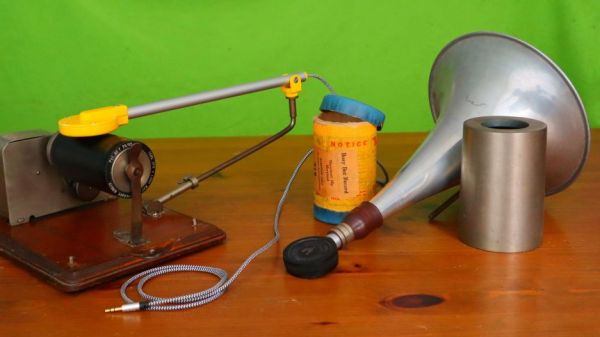
As it happens, [Jan Derogee] is in a position to answer these questions, with an antique phonograph and a bunch of Edison-style wax cylinders with voices and music from a bygone era locked away on them. It would be easy enough to just use the “reproducer” he previously built and set up a microphone to record the sound directly from the phonograph’s trumpet, but [Jan] decided to engineer a better solution. By adding the piezo element from an electronic greeting card to his reproducer, potted with liberal quantities of epoxy and padded with cotton, the piezo pickup was attached to the phonograph arm in place of the original stylus and trumpet. The signal from the piezo element was strong enough to require a shunt resistor, allowing it to be plugged directly into the audio input jack on a computer. From there it’s just an Audacity exercise, plus dealing with the occasional skipped groove.

We appreciate [Jan]’s effort to preserve these recordings, as well as the chance to hear some voices from the past. We’re actually surprised the recording sound as good as they do after all this time — they must have been well cared for.

Continue reading “Piezo Pickup Makes Wax Records Easy To Digitize”

Silicon Jumpers Make This Wire-Free Breadboard Programmable

There’s no doubting the utility of the trusty solderless breadboard, but you have to admit they’re less than perfect. They’re not ideal for certain types of circuits, of course, but that’s less of a problem than those jumper wires. The careless will end up with their components hopeless tangled in a rat’s nest of jumpers, while the fastidious will spend far more time making the jumpers neat and tidy than actually prototyping the circuit itself. What to do?

One way to crack this nut is to make the solderless breadboard jumperless, too. That’s the idea behind “breadWare” a work-in-progress undertaken by [Kevin Santo Cappuccio]. The idea is to adapt a standard breadboard so that connections between arbitrary pairs of common contact strips — plus the power rails — can be made in software. The trick behind this is a matrix of analog CMOS switch chips, specifically the MT8816AP. Each chip’s 128 crosspoint switches can handle up ± 12 volts, so there are plenty of circuits that can use these programmable silicon jumpers.

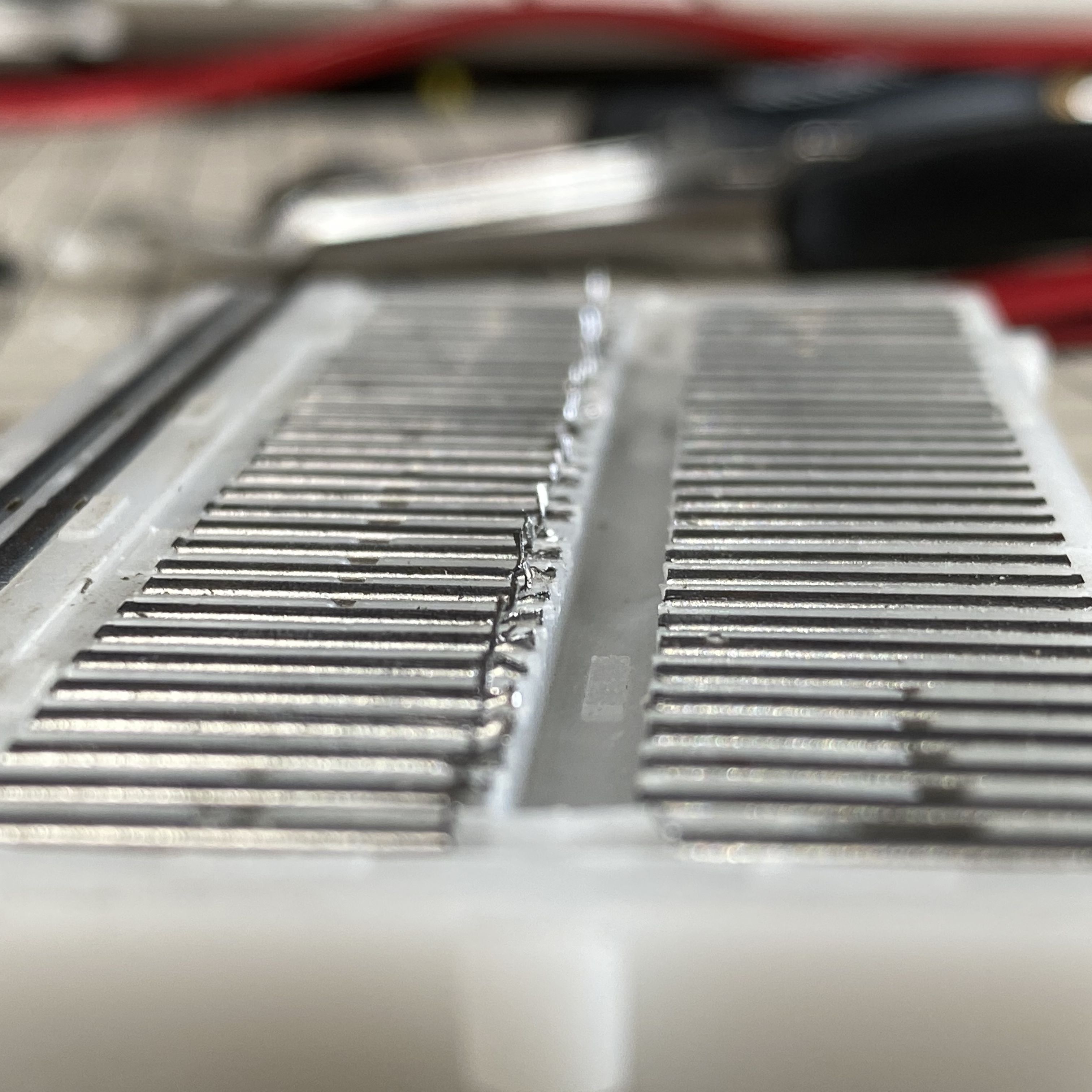
[Kevin] is currently on version 0.2, which is sized to fit under a solderless breadboard and make a compact package. He shared details on how he’s connecting to the breadboard contacts, and it looks like a painful process: pull out the contact, cut a small tab at the gutter-end, and bend it down so it forms a lead for a through-hole in the PCB. It seems like a lot of work, and there must be a better way; [Kevin] is clearly open to suggestions.

While we’ve seen crosspoint switching used to augment solderless breadboarding before, we find this project pleasing in its simplicity. The thought of tossing out all those jumpers is certainly tempting.