Console Controller Mod Gets Amputee Back In The Game

No matter how it happens, losing one or more fingers is going to change one’s life in thousands of ways. We’re a manipulative species, very much accustomed to interacting with the world through the amazing appendages at the ends of our arms. Finding ways around the problems that result from amputations is serious business, of course, even when it’s just modifying a game console controller for use with a prosthetic hand.

We’ve gotten to know [Ian Davis] quite well around these parts, at least from his videos and Instagram posts. [Ian]’s hard to miss — he’s in the “Missing Parts Club” as he puts it, consisting of those who’ve lost all or part of a limb, which he has addressed through his completely mechanical partial-hand prosthetic. As amazing as the mechanical linkages of that prosthetic are, he hasn’t regained full function, at least not to the degree required to fully use a modern game console controller, so he put a couple of servos and a Trinket to work to help.

An array of three buttons lies within easy reach of [Ian]’s OEM thumb. Button presses there are translated into servo movements that depress the original bumper buttons, which are especially unfriendly to his after-market anatomy. Everything rides in an SLA-printed case that’s glued atop the Playstation controller. [Ian] went through several design iterations and even played with the idea of supporting rapid fire at one point before settling on the final design shown in the video below.

It may not make him competitive again, but the system does let him get back in the game. And he’s quite open about his goal of getting his designs seen by people in a position to make them widely available to other amputees. Here’s hoping this helps.

Continue reading “Console Controller Mod Gets Amputee Back In The Game”
Dead Simple Time-Domain Reflectometry With Just A Battery And An Oscilloscope

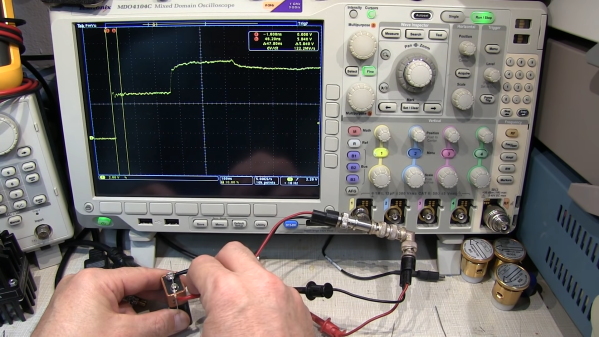
“Time-domain reflectometry” sure sounds like something that needs racks of expensive equipment to accomplish. In reality, TDR is just measuring the time between injecting a pulse into a cable and receiving its echo, either from the other end of the cable or from some fault or defect along the way. It’s a useful technique, and as [Allen Wolke (W2AEW)] shows us, it can be accomplished with little more than a battery, a resistor, and an oscilloscope. And a little math, of course.

There are, of course, dedicated time-domain reflectometers, but all of them are really just elaborations of the basic principles [W2AEW] demonstrates with his simple setup. The oscilloscope is set up with a tee connector on one channel; one side of the tee is connected to the cable under test, while the shield conductor of the other side is connected to the negative terminal of a 9V battery. A resistor connected to the center conductor is used to complete the circuit, which sends a brief pulse down the test cable. The scope is set up to capture the outgoing pulse as well as the return pulse, allowing the time between the two to be measured. Some simple math gives the length of the cable, the distance to a fault, or with a little rearrangement, the velocity factor of the cable.

The video below shows the simple method at work on coax and Cat 5e Ethernet cable. It even worked on a roll of zip cable, which was a little surprising. If this technique is too simple, you can always elaborate a bit and roll your own TDR tester. Googly eyes optional, of course, but recommended.

Continue reading “Dead Simple Time-Domain Reflectometry With Just A Battery And An Oscilloscope”

Railroad Rail Transformed Into Blacksmith’s Anvil With The Simplest Of Tools

One of the biggest challenges facing the aspiring blacksmith is procuring the tools of the trade. And that means tackling the unenviable task of finding a decent anvil. Sure, one can buy an ASO — anvil-shaped object — at Harbor Freight, but a real anvil is much harder to come by. So perhaps the beginner smith’s first build should be this railroad rail to anvil conversion.

Repurposing sections of rail into anvils is hardly a new game, but [The Other Finnish Guy]’s build shows us just how little is needed in terms of specialized tooling to pull this off. Other than a file, the bulk of the work is done by angle grinders, which are used to cut off the curved crown of the rail section, cut the shape of the heel, and rough out the horn. Removing that much metal will not be a walk in the park, so patience — and a steady supply of cutting wheels and sanding discs — is surely required. But with time and skill, the anvil hidden inside the rail can be revealed and put to use.

We have questions about the final result, like its lack of a hardy hole and the fact that the face isn’t hardened. We wonder if some kind of induction heating could be used to solve the latter problem, or if perhaps a hardened plate could be welded into the top to make a composite anvil. Still, any anvil is better than no anvil. More on the anatomy and physiology of these tools can be had in [Jenny List]’s article on anvils, and her whole excellent series on blacksmithing is highly recommended. [Jenny]’s not the only smith we have on staff, though — [Bil Herd] has been known to smite a bit too.

Continue reading “Railroad Rail Transformed Into Blacksmith’s Anvil With The Simplest Of Tools”

Join Us For The “Holiday With Hackaday And Tindie” Meet-Up

It’s a ritual in workplaces around the world this time of any other year but 2020: the office holiday party. Too much food, perhaps too much alcohol, and garish sweaters that you wouldn’t be caught dead in on any other occasion. Things are, of course, a tad different this year, which is why we’re putting our community’s party online with the Holiday with Hackaday and Tindie meet-up on Tuesday, December 15 at noon Pacific time!

Why should you come to this hangout? Because why not! This is going to be a loose, informal meet-up that will give us all a chance to get to know one another. We’ve got an amazing community here, and just putting faces to names can be really valuable. You’ll be able to connect with old friends and perhaps make new ones. It’s your chance to reach out and find someone to collaborate with, or perhaps just find an answer to a thorny problem you’ve been stuck on. Be sure to bring your latest projects to show off, and maybe even consider giving everyone a virtual tour of your shop. Ugly sweaters are optional, of course, and we don’t judge.

The Holiday with Hackaday and Tindie meet-up is being held on Remo. Those of you who joined the Friday night Bring-a-Hack session at Remoticon this year will no doubt remember the platform, which we got a lot of good feedback on. You’ll want to check browser compatibility ahead of time and reserve your spot, so head over to Remo and make it so. If you need help with timezone conversions, we’ve got you covered on that too.

We’re looking forward to seeing everyone at the Holiday with Hackaday and Tindie meet-up!

Hackaday Links Column Banner

Hackaday Links: December 13, 2020

Our Sun is getting a bit frisky these days, and has rewarded us with perhaps the best screensaver image ever taken. The incredibly detailed photo of a sunspot was actually taken back in January by the Daniel K. Inouye Solar Telescope, a 4-meter instrument with adaptive optics that can image the sun from the near-infrared to visible wavelengths and resolve surface details down to 20 km. The photo, with a distinct “Eye of Sauron” look, shows the massive convection cells surrounding the dark sunspot; an accompanying animation shows the movement of plasmas along the tortured lines of magnetic flux that cause the sunspot to form. It’s fascinating to watch, and even more interesting to mull over the technology that went into capturing it.

With the dustup surrounding the youtube-dl DCMA takedown by GitHub fresh on the open-source community’s minds, GitHub Universe 2020 had an interesting discussion about maintaining open-source software projects that’s worth watching. They focused on the challenges that youtube-dl maintainers face in keeping the tool working, and the impact their effort has on the people and groups that rely on them. To underscore that point, they featured a researcher with Human Rights Watch who depends on youtube-dl in her work, and made it quite clear that keeping up with all the API changes that constantly break open source tools like youtube-dl make the role of the maintainers that much more critical.

Speaking of GitHub, here’s a frightening and fascinating new tool: Depix, the password de-pixelizer. Developer Sipke Mellema noticed that his company often used pixelization to obscure passwords in documentation, and wondered if he could undo the process. He wrote up an article describing the pixelization process using a linear box filter and his method for attacking it, which involves generating a De Bruijn sequence in the same font, text size, and colors as the original document and feeding a screenshot of that and the pixellated password into the tool. We suspect it’ll only work for a subset of obfuscated passwords, but it’s still pretty clever.

‘Tis the season for Advent calendars, and the folks at QEMU have posted theirs. Open each of 24 doors on the calendar and you’re rewarded with a downloadable QEMU disk image that implements something fun. Minesweeper, a ray tracer that fits into a boot loader, and of course Conway’s Game of Life. The GW-BASIC image on Day 3 caught our eye — brings back some memories.

For anyone who has ever watched a Pixar film and wondered how all that animation actually works, here’s a great lesson in making art with math. The video is by Inigo Quilez and goes through the basics of rendering images using raymarching SDFs, or signed distance functions. In the beginning, it seemed like it was going to be a little bit like drawing an owl, but his descriptions of the math involved and how each element of the animation is just another formula is fascinating. What’s more, there’s a real-time rendering tool where you can inspect the code and edit it. Alas, my changes only made things worse, but it was still fun and instructive to play with. Check out the video after the break!

Continue reading “Hackaday Links: December 13, 2020”

A Pair Of Steppers Are Put To Work In This Automatic Instrument Pickup Winder

For something that’s basically a coil of wire around some magnetic pole pieces, an electric guitar pickup is a complicated bit of tech. So much about the tone of the instrument is dictated by how the pickup is wound that controlling the winding process is something best accomplished with a machine. This automatic pickup winder isn’t exactly a high-end machine, but it’s enough for the job at hand, and has some interesting possibilities for refinements.

First off, as [The Mixed Signal] points out, his pickups aren’t intended for use on a guitar. As we’ve seen before, the musical projects he has tackled are somewhat offbeat, and this single-pole pickup is destined for another unusual instrument. That’s not to say a guitar pickup couldn’t be wound on this machine, of course, as could inductors, solenoids, or Tesla coils. The running gear is built around two NEMA-17 stepper motors, one for the coil spindle and one for the winding carriage. The carriage runs on a short Acme lead screw and linear bearings, moving back and forth to wind the coil more or less evenly. An Arduino topped with a CNC shield runs the show, allowing for walk-away coil winding.

We do notice that the coil wire seems to bunch up at the ends of the coil form. We wonder if that could be cured by speeding up the carriage motor as it nears the end of the spool to spread the wire spacing out a bit. The nice thing about builds like these is the ease with which changes can be made — at the end of the day, it’s just code.

Continue reading “A Pair Of Steppers Are Put To Work In This Automatic Instrument Pickup Winder”

Hacker’s Discovery Changes Understanding Of The Antikythera Mechanism

With all the trained academics who have pored over the Antikythera mechanism in the 120 years since it was pulled from the Mediterranean Sea, you’d think all of the features of the ancient analog computer would have been discovered by now. But the mechanism still holds secrets, some of which can only be appreciated by someone in tune with the original maker of the device. At least that what appears to have happened with the recent discovery of a hitherto unknown lunar calendar in the Antikythera mechanism. (Video, embedded below.)

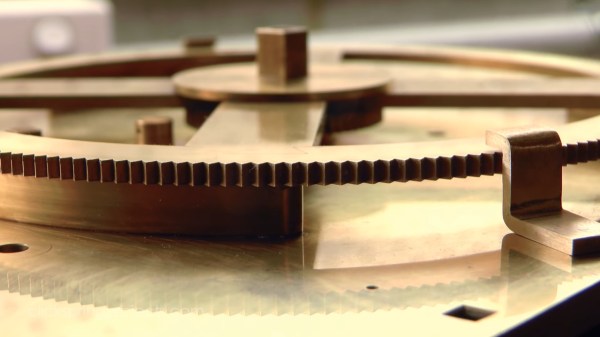
The Antikythera mechanism is fascinating in its own right, but the real treat here is that this discovery comes from one of our own community — [Chris] at Clickspring, maker of amazing clocks and other mechanical works of art. When he undertook a reproduction of the Antikythera mechanism using nothing but period-correct materials and tools four years ago, he had no idea that the effort would take the direction it has. The video below — also on Vimeo — sums up the serendipitous discovery, which is based on the unusual number of divisions etched into one of the rings of the mechanisms. Scholars had dismissed this as a mistake, but having walked a mile in the shoes of the mechanism’s creator, [Chris] knew better.

The craftsmanship and ingenuity evidenced in the original led [Chris] and his collaborators to the conclusion that the calendar ring is actually a 354-day calendar that reflects a lunar cycle rather than a solar cycle. The findings are summarized in a scholarly paper in the Horological Journal. Getting a paper accepted in a peer-reviewed journal is no mean feat, so hats off to the authors for not only finding this long-lost feature of the Antikythera mechanism and figuring out its significance, but also for persisting through the writing and publication process while putting other projects on hold. Clickspring fans have extra reason to rejoice, too — more videos are now on the way!

Continue reading “Hacker’s Discovery Changes Understanding Of The Antikythera Mechanism”