Hackaday Links Column Banner

Hackaday Links: March 22, 2020

Within the span of just two months, our world of unimaginable plenty and ready access to goods manufactured across the globe has been transformed into one where the bare essentials of life are hard to find at any price. The people on the frontline of the battle against COVID-19 are suffering supply chain pinches too, often at great risk to their health. Lack of proper personal protective equipment (PPE), especially face masks, is an acute problem, and the shortage will only exacerbate the problem as healthcare workers go down for the count. Factories are gearing up to make more masks, but in the meantime, the maker and hacker community can pitch in. FreeSewing, an open-source repository of sewing patterns, has a pattern for a simple face mask called the Fu that can be made quickly by an experienced threadworker. Efficacy of the masks made with that pattern will vary based on the materials used, obviously; a slightly less ad hoc effort is the 100 Million Mask Challenge, where volunteers are given a pattern and enough lab-tested materials to make 100 face masks. If you know how to sew, getting involved might make a difference.

As people around the world wrap their heads around the new normal of social distancing and the loss of human contact, there’s been an understandable spike in interest in amateur radio. QRZ.com reports that the FCC has recorded an uptick in the number of amateur radio licenses issued since the COVID-19 outbreak, and license test prep site HamRadioPrep.com has been swamped by new users seeking to prepare for taking the test. As we’ve discussed, the barrier for entry to ham radio is normally very low, both in terms of getting your license and getting the minimal equipment needed to get on the air. One hurdle aspiring hams might face is the cancellation of so-called VE testing, where Volunteer Examiners administer the written tests needed for each license class. Finding a face-to-face VE testing session now might be hard, but the VEs are likely to find a way to adapt. After all, hams were social distancing before social distancing was cool.

The list of public events that have been postponed or outright canceled by this pandemic is long indeed, with pretty much everything expected to draw more than a handful of people put into limbo. The hacking world is not immune, of course, with many high-profile events scuttled. But we hackers are a resourceful bunch, and the 10th annual Open Source Hardware Summit managed to go off on schedule as a virtual meeting last week. You can watch the nearly eight-hour livestream while you’re self-isolating. We’re confident that other conferences will go virtual in the near-term too rather than cancel outright.

And finally, if you’re sick of pandemic news and just want some escapist engineering eye candy, you could do worse than checking out what it takes to make a DSLR camera waterproof. We’ve honestly always numbered cameras as among the very least waterproof devices, but it turns out that photojournalists and filmmakers are pretty rough on their gear and expect it to keep working even so. The story here focuses (sorry) on Olympus cameras and lenses, which you’ll note that Takasu-san only ever refers to as “splash-proof”, and the complex system of O-rings and seals needed to keep water away from their innards. For our money, the best part was learning that lenses that have to change their internal volume, like zoom lenses, need to be vented so that air can move in and out. The engineering needed to keep water out of a vented system like that is pretty impressive.
Thermochromic Display Tells You The Temperature Despite Your Current Mood

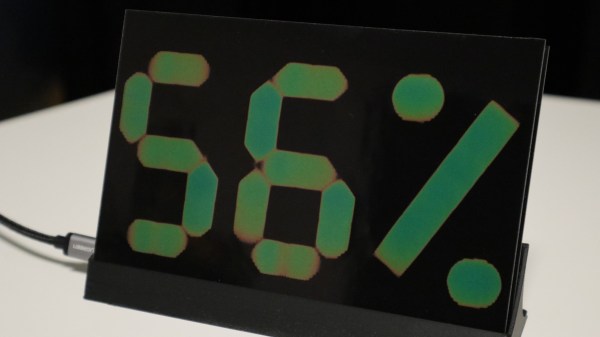
Readers who survived the 1970s will no doubt remember the “mood ring” fad, where a liquid crystal mounted to a ring would magically reveal your current emotional state to all and sundry by changing color. This nifty thermochromic display is based on the same principle, and while it might not start a new craze, it’s still pretty mesmerizing to watch.

This isn’t [Moritz v. Sivers]’ first attempt at a thermochromic display. His earlier version was far more complicated, using separate copper plates clad with thermochromic film for each segment, with Peltier devices to cool and heat them individually. Version two is much simpler, using a printed circuit board with heating elements in the shape of seven-segment displays etched into it. The thermochromic film sits directly on the heater PCB; a control PCB below has the MCU and sensors on it. The display alternates between temperature and humidity, with the segments fading in an uneven and ghostly way that really makes this fun to watch. [Moritz] has made the build files available, and there’s a detailed Instructable as well.

We’re always on the lookout for alternate display modalities, especially when they look this cool. We’ve seen other thermochromic displays before, of course, and persistence of phosphorescence looks great, too.

Continue reading “Thermochromic Display Tells You The Temperature Despite Your Current Mood”

Keep The Family At Bay While Working From Home With This WiFi Do Not Disturb Dongle

Those who have been suddenly introduced to the wonderful world of working from home over the last couple of weeks may have experienced a bit of culture shock. Even with today’s open floorplan workspaces and less-formal expectations, work isn’t home. That’s especially true with young children in the house, who’ll probably respond to seeing mommy or daddy working from home much differently than [Bob] from accounting would at the office.

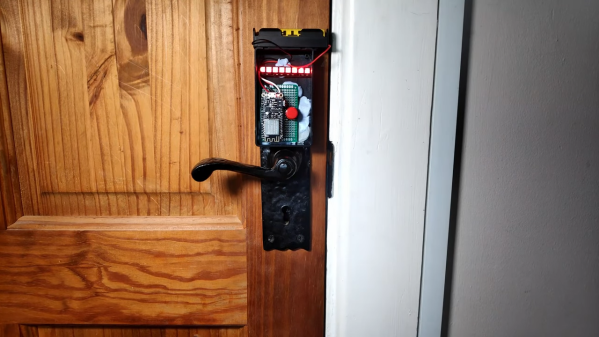
To smooth out the rough spots of transitioning to a full-time work-from-home setup, [Brian Lough] threw together this web-enabled “do not disturb” beacon for his office door. The original idea was to simply provide a red light and a green light to let the rest of the family know when [Brian] would be in a meeting, but in an example of scope creep that turned out to be useful, [Mrs. Lough] rewrote the spec to include a button on the family-facing side so that she could alert him that his presence is requested.

[Brian] went through a couple of prototype using both an ESP32 and an ESP8266. We were rooting for the ESP32, which [Brian] was leveraging for its built-in capacitive touch input. That would have eliminated a physical button, but alas, the ESP8266 made it into the final build, along with lots and lots of Blu-Tack. The video below details the build and the code, and features an adorable Irish lesson as a bonus.

Yes, a simple text message would probably have satisfied the specs, but where’s the sport in that? Then again, as [Brian] points out, this build seemed oddly familiar for a good reason.

Continue reading “Keep The Family At Bay While Working From Home With This WiFi Do Not Disturb Dongle”

“Glixie” Puts A New Spin On Glow-In-The-Dark Displays

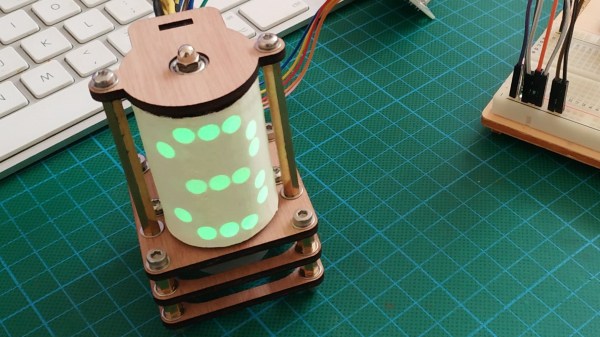
For as many projects as we see using Nixie tubes in new and unusual ways, there’s a smaller but often very interesting cohort of displays that fit into the “Nixie-like” category. These are projects where something other than the discharge of noble gasses is being used to form characters. This scrolling phosphorescent single-character display is one such project, and we think it looks fabulous.

Following the *ixie naming convention characteristic of these builds, [StephenDeVos] dubbed this the “Glixie.” This is on par with the size of a [Dalibor Farny] handmade Nixie, but not so big to be unwieldy. The display modality is glow-in-the-dark film that rotates past a vertical string of UV LEDs, which light up in turn as the cylinder rotates, building up the dot-matrix character column by column. There’s some fading of the first column by the time the whole character is built up, but not enough to be objectionable. We like the whole build, with laser-cut wood and the brass and steel hardware. Check it out in the video below.

If this phosphorescent display strategy seems familiar, it’s because we’ve seen it before. Remember this persistence of phosphorescence display? Or perhaps this time-writing robot clock? It’s not a new idea, but [Stephen]’s execution can’t be beat.

Continue reading ““Glixie” Puts A New Spin On Glow-In-The-Dark Displays”

Handwashing Timer Makes Sure The Suds Stay On Long Enough

“Twinkle, Twinkle, Little Star”? How we wonder why you’d resort to singing a ditty to time your handwashing when you can use your social isolation time to build a touch-free electronic handwash timer that the kids — and you — might actually use.

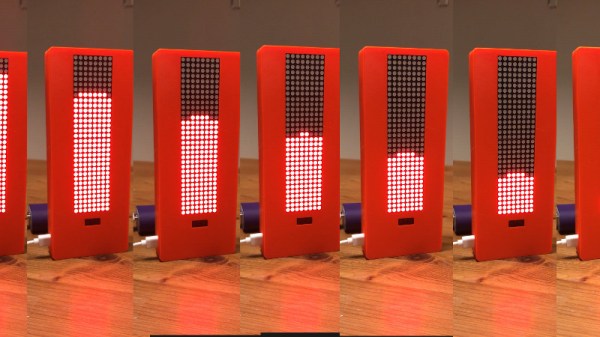
Over the last few months, pretty much everyone on the planet has been thrust into strange, new, and oftentimes scary practices to limit the spread of the SARS-CoV-2virus and the disease it causes, COVID-19. Judging by the number of people we’ve seen leaving public restrooms without a visit to the washbasin before the outbreak began — and sadly all too often since — we collectively have a lot of work to do in tightening up our handwashing regimens. Time on target and plenty of friction are the keys to that, and [Denis Hennessy]’s “WashTimer” aims to at least help you out with the former. His build is as simple as can be: an Arduino driving an LED matrix when a proximity sensor fires. Wave your dirty paws in front of the unit as you start to scrub up, and the display goes through a nicely animated 20-second countdown, at which time it’s safe to rinse off.

[Denis] purposely made this design as simple and as customizable as possible. Perhaps you’ve got a Neopixel ring lying about rather than the LED matrix, or maybe an ultrasonic sensor would work better for you. Be creative and take this design where it needs to go to suit your needs. We can’t stress enough that handwashing is your number one defense; if you don’t need to moisturize your hands at least three times a day, you’re probably not washing often or long enough. And 20 seconds is way longer than you think it is without a prompt.

Continue reading “Handwashing Timer Makes Sure The Suds Stay On Long Enough”

Can Lego Break Steel?

Betteridge’s Law of Headlines holds that any headline ending in a question mark can be answered with a resounding “No”. But as the video below shows, a Lego machine that twists steel asunder is not only possible, it’s an object lesson in metal fatigue. Touché, [Betteridge].

In pitting plastic against metal, the [Brick Experiment Channel] relied on earlier work with a machine that was able to twist a stock plastic axle from the Technics line of parts like a limp noodle. The steel axle in the current work, an aftermarket part that’s apparently no longer available, would not prove such an easy target.

Even after beefing up the test stand with extra Technics struts placed to be loaded in tension, and with gears doubled up and reinforced with extra pins, the single motor was unable to overcome the strength of the axle. It took a second motor and a complicated gear train to begin to deform the axle, but the steel eventually proved too much for the plastic to withstand. Round Two was a bit of a cheat: the same rig with a fresh axle, but this time the motor rotation was constantly switched. The accumulated metal fatigue started as a small crack which grew until the axle was twisted in two.

The [Brick Experiment Channel] is a fun one to check out, and we’ve featured them before. Along with destructive projects like this one, they’ve also got fun builds like this Lego playing card launcher, a Technic drone, and a Lego submarine.

Continue reading “Can Lego Break Steel?”