Quick-Turn PCB Fab Hack Chat

Join us on Wednesday, July 31st at noon Pacific for the Quick-Turn PCB Fab Hack Chat with Mihir Shah!

We’ve all become used to designing a PCB and having it magically appear at our doorstep – after a fashion. Modern PCB fabs rely on economies of scale to deliver your design cheaply, at the expense of time – the time it takes to put enough orders onto a panel, and the time it takes to ship the finished boards from Far, Far Away.

Not everyone has that kind of time to burn, though. That’s where quick-turn fabs come in. These manufacturers specialize in getting boards to their customers as quickly as possible, helping them deal with sudden design changes or supporting specialty applications for customers.

It’s a niche industry, but an important one, and Royal Circuits is at the forefront. Mihir Shah is Director of Special Projects there, and he’s deep into the business of getting PCBs to customers as quickly as possible. He’ll drop by the Hack Chat to answer all your questions about how the quick-turn industry fits into the electronics manufacturing ecosystem, and to show off some of the tools of the future that they’re developing and investing in to streamline PCB design and analysis – from DebuggAR to PCBLayout.com, and more.

join-hack-chatOur Hack Chats are live community events in the Hackaday.io Hack Chat group messaging. This week we’ll be sitting down on Wednesday July 31 at 12:00 PM Pacific time. If time zones have got you down, we have a handy time zone converter.

Click that speech bubble to the right, and you’ll be taken directly to the Hack Chat group on Hackaday.io. You don’t have to wait until Wednesday; join whenever you want and you can see what the community is talking about.


Fail Of The Week: The Arduino Walkie That Won’t Talkie

There’s something seriously wrong with the Arduino walkie-talkie that [GreatScott!] built.

The idea is simple: build a wireless intercom so a group of motor scooter riders can talk in real-time. Yes, such products exist commercially, but that’s no fun at all. With a little ingenuity and a well-stocked parts bin, such a device should be easy to build on the cheap, right?

Apparently not. [GreatScott!] went with an Arduino-based design, partly due to familiarity with the microcontroller but also because it made the RF part of the project seemingly easier due to cheap and easily available nRF24 2.4 GHz audio streaming modules. Everything seems straightforward enough on the breadboard – an op-amp to boost the signal from the condenser mic, a somewhat low but presumably usable 16 kHz sampling rate for the ADC. The radio modules linked up, but the audio quality was heavily distorted.

[GreatScott!] assumed that the rat’s nest of jumpers on the breadboard was to blame, so he jumped right to a PCB build. It’s a logical step, but it seems like it might be where he went wrong, because the PCB version was even worse. We’d perhaps have isolated the issue with the breadboard circuit first; did the distortion come from the audio stage? Or perhaps did the digitization inject some distortion? Or could the distortion be coming from the RF stage? We’d want to answer a few questions like that before jumping to a final design.

We love that [GreatScott!] has no issue with posting his failures – we’ve covered his suboptimal CPU handwarmer, and his 3D-printed BLDC motor stator was a flop too. It’s always nice to post mortem these things to avoid a similar fate.

Continue reading “Fail Of The Week: The Arduino Walkie That Won’t Talkie”

Hackaday Links Column Banner

Hackaday Links: July 28, 2019

It looks like Apple is interested in buying Intel’s modem chip business. Seriously interested; a deal worth $1 billion could be announced as early as this week. That might look like a small potato purchase to the world’s biggest company – at least by market capitalization – but since the technology it will be buying includes smartphone modems, it provides a look into Apple’s thinking about the near future with regard to 5G.

It turns out that Make Magazine isn’t quite dead yet. [Dale Dougherty], former CEO of Maker Media, which went under in June, has just announced that he and others have acquired the company’s assets and reformed under the name “Maker Community LLC.” Make: Magazine is set to resume publication, going back to its roots as a quarterly publication in the smaller journal format; sadly there’s no specific word about the fate of Maker Faire yet.

The hoopla over the 50th anniversary of Apollo 11 may be over, but we’d be remiss not to call out one truly epic hack related to the celebration: the full restoration of an actual Apollo Guidance Computer. The AGC was from a test model of the Lunar Module, and it ended up in the hands of a private collector. Since November of 2018 the AGC has been undergoing restoration and tests by [Ken Shirriff], [Mike Stewart], and [Carl Claunch]. The whole effort is documented in a playlist by [Marc “CuriousMarc” Verdiell] that’s worth watching to see what was needed to restore the AGC to working condition.

With the summer sun beating down on the northern hemisphere, and air conditioners at working extra hard to keep things comfortable. [How To Lou] has a quick tip to improve AC efficiency. Turns out that just spraying a fine mist of water on the condenser coils works wonders; [Lou] measured a 12% improvement in cooling. It may not be the best use of water, and it may not work as well in very humid climates, but it’s a good tip to keep in mind.

Be careful with this one; between the bent spoon, the syringe full of amber liquid, and the little candle to heat things up, this field-expedient reflow soldering setup might just get you in trouble with the local narcotics enforcement authorities. Even so, knowing that you can assemble a small SMD board without a reflow oven might prove useful someday, under admittedly bizarre circumstances.

From the “Considerably more than 8-bits music” file, check out the Hull Philharmonic Orchestra’s “8-Bit Symphony.” If your personal PC gaming history included a Commodore 64, chances are you’ll recognize songs from titles like “Monty on the Run”, “Firelord”, “Green Beret”, and “Forbidden Forest.” Sure, composers like [Ben Daglish] and [Paul Norman] worked wonders with the three-channel SID chip, but hearing those tunes rendered by a full orchestra is something else entirely. We found it to be particularly good background music to write by.

Neopixels Recreate Pinball Color Wheel That Never Was

With what pinball aficionados pay for the machines they so lovingly restore, it’s hard to imagine that these devices were once built to a price point. They had to make money, and whatever it took to attract attention and separate the customer from their hard-earned coins was usually included in the design. But only up to a point.

Take the 1967 Williams classic, “Magic City.” As pinball collector [Mark Gibson] explains it, the original design called for a rotating color filter behind a fountain motif in the back-glass, to change the color of the waters in an attractive way. Due to its cost, Williams never implemented the color wheel, so rather than settle for a boring fountain, [Mark] built a virtual color wheel with Neopixels. He went through several prototypes before settling on a pattern with even light distribution and building a PCB. The software is more complex than it might seem; it turns out to require a little color theory to get the transitions to look good, and it also provides a chance for a little razzle-dazzle. He implemented a spiral effect in code, and added a few random white sparkles to the fountain. [Mark] has a few videos of the fountain in action, and it ended up looking quite nice.

We’ve featured [Mark]’s pinball builds before, including his atomic pinball clock, We even celebrated his wizardry in song at one point.

3D Printer Meets CNC Router To Make Wood Prints

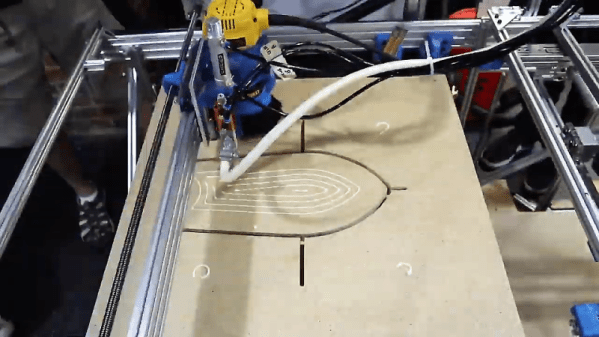
We’ve seen plenty of plywood 3D printers before; after all, many early hobbyist machines were made from laser-cut plywood. But this plywood 3D-printer isn’t made from plywood – it prints plywood. Well, sort of.

Yes, we know – that’s not plywood the printer is using, but rather particleboard, the same material that fills the flatpack warehouse of every IKEA store. And calling it a printer is a bit of a stretch, too. This creation, by [Shane Whigton] and his Formlabs Hackathon team, is more of a hybrid additive-subtractive CNC machine. A gantry-mounted router carves each layer of the print from a fresh square of material – which could just as easily be plywood as particleboard. Once a layer is cut, the gantry applies glue to it, puts a fresh sheet of material on top, and clamps it down tight. The router then carves the next layer, and so on up the stack. The layer height is limited to the thickness of the material – a nominal 3/4″ (19 mm) in this case – and there’s a remarkable amount of waste, but that’s not really the point. Check out the printer in action and the resulting giant Benchy in the video below.

Seeing all that particleboard dust and glue got us thinking: what about a 3D-printer that extrudes a paste of sawdust mixed with glue? We imagine that would be a bit like those giant printers that extrude concrete to build houses.
Continue reading “3D Printer Meets CNC Router To Make Wood Prints”

Control Your Web Browser Like It’s 1969

Imagine for a moment that you’ve been tasked with developing a device for interfacing with a global network of interconnected devices. Would you purposely design a spring-loaded dial that can do nothing but switch a single set of contacts on and off from 1 to 10 times? What kind of crazy world would we have to live in where something like that was the pinnacle of technology?

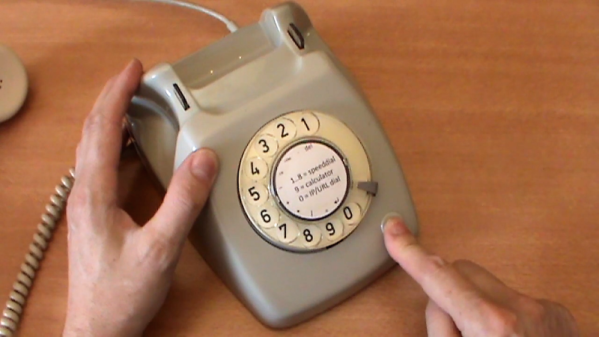
Obviously, such a world once existed, and now that we’ve rolled the calendar ahead a half-century or so, both our networks and our interfaces have gotten more complex, if arguably better. But [Jan Derogee] thinks a step backward is on order, and so he built this rotary phone web browser. The idea is simple: pick up the handset and dial the IP address of the server you want to connect to. DNS? Bah, who needs it?

Of course there is the teensy issue that most websites can’t be directly accessed via IP address anymore, but fear not – [Jan] has an incredibly obfuscated solution to that. It relies on the fact that many numbers sound like common phrases when sounded out in Chinese, so there end up being a lot of websites that have number-based URLs. He provides an example using the number 517, which sounds a bit like “I want to eat,” to access the Chinese website of McDonald’s. How the number seven sounding like both “eat” and “wife” is resolved is left as an exercise to the reader.

And here we thought [Jan]’s rotary number pad was of questionable value. Still, we appreciate this build, and putting old phones back into service in any capacity is always appreciated.

Continue reading “Control Your Web Browser Like It’s 1969”

Vacuum Sputtering With A Homemade Magnetron

“You can never be too rich or too thin,” the saying goes, and when it comes to coatings, it’s true that thinner is often better. The way to truly thin coatings, ones that are sometimes only a few atoms thick, is physical vapor deposition, or PVD, a technique where a substance is transformed into a vapor and condensed onto a substrate, sometimes using a magnetron to create a plasma.

It sounds complicated, but with a few reasonable tools and a healthy respect for high voltages, a DIY magnetron for plasma sputtering can get you started. To be fair, [Justin Atkin] worked on his setup for years, hampered initially by having to settle for found parts and general scrap for his builds. As with many things, access to a lathe and the skills to use it proved to be enabling, allowing him to make custom parts like the feedthrough for the vacuum chamber as well as a liquid-cooled base, which prevents heat from ruining the magnets that concentrate the plasma onto the target metal. Using a high-voltage DC supply made from old microwave parts, [Justin] has been able to sputter copper films onto glass slides, with limited success using other metals. He also accidentally created a couple of dichroic mirrors by sputtering with copper oxides rather than pure copper. The video below has some beautiful shots of the ghostly green and purple glow.

A rig such as this opens up a lot of possibilities, from optics to DIY semiconductors. It may not be quite as elaborate as some PVD setups we’ve seen, but we’re still pretty impressed.

Continue reading “Vacuum Sputtering With A Homemade Magnetron”