BioSentinel Mission Aims To Put Yeast Into Deep Space

It’s a truly exciting time for space enthusiasts. Humanity is finally shaking itself out of the half-century-long doldrums of deep space exploration and planning a return to the Moon and a push to Mars. Yes, exciting things have happened since the glory days of Apollo. We’ve reached out into the outer planets, drilled holes in asteroids, and made tracks across the face of Mars in an improbably durable rover. We’ve built magnificent space telescopes, created a permanent space station to replace a couple of temporary ones, and put an intricate constellation of satellites into service.

Those are all laudable achievements, but not a single living creature has intentionally achieved approached Earth escape velocity since three astronauts and five mice did it aboard Apollo 17 at 3:46 AM on December 7, 1972. Since then, we’ve all been stuck down here at the bottom of Earth’s gravity well, with only a lucky few of us getting a tease of what space travel is really like with low Earth orbit (LEO) missions.

But if NASA has its way, and certain difficulties with launch vehicles can be ironed out, in 2020 Earthlings will once again slip the surly bonds and make a trip to deep space. Of course those Earthlings will just be cultures of yeast carried into orbit around the Sun on a cubesat, but it’s a start, and it’s a good bet that more complex organisms won’t be far behind.

Continue reading “BioSentinel Mission Aims To Put Yeast Into Deep Space”
Vintage Speech Synthesizer Croons The Oldies

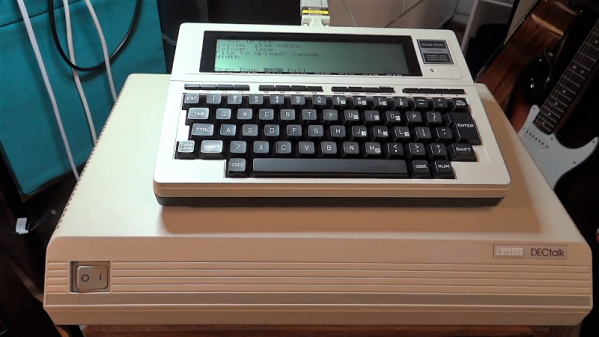
If you listened to the National Weather Service Weather Radio in the US about 25 years ago, you’ll no doubt remember [Perfect Paul], one of the synthesized voices used to read current conditions and weather forecasts. The voice came from a DECtalk DTC01, a not inexpensive voice synthesizer first made in 1984 that also gave voice to [Stephen Hawking] for many years.

Long obsolete, the DECtalk boxes have a devoted following with hobbyists who like to stretch what the device can do. Some even like to make it sing, after a fashion, and [Michael] decided that making a DECtalk sing “Xanadu”, the theme song from the 1980 [Olivia Newton-John] musical extravaganza, was a good idea. Whether it actually was is debatable, and we’ll take exception with having that particular ditty stuck in our head as a result, but we don’t judge except on the merits of the hack.

It’s actually easy if you have a DECtalk; the song is a straight ASCII file with remarkably concise instructions on which phonemes the box needs to generate. Along with inflection, tone, and timing instructions, the text file looks almost completely unlike English while still somehow being readable. The DECtalk accepts the file over RS-232, which would be easy enough to do with a modern computer, but [Michael] upped his game a bit by using a TRS-80 Model 100 computer as a serial terminal. The synthesized song is in the video below, with the original included for reference by those who didn’t experience endure the late disco-era glory days.

DECtalks seem pretty rare in the wild, so we appreciate this glimpse at what they can do. There are other retro speech synthesizer hacks, though: the simulated walnut goodness of the Votrax and the MicroVox come to mind, as does the venerable TI Speak and Spell.

Continue reading “Vintage Speech Synthesizer Croons The Oldies”

Fusion 360 For 3D-Printing Hack Chat

Join us on Wednesday 12 June 2019 at noon Pacific for the Fusion 360 for 3D-Printing Hack Chat with Vladimir Mariano!

There’s no way to overstate the importance of the design and manufacturing tools we now all use on a daily basis. What once took a well-equipped machine shop and years of experience to accomplish can now be designed using free software and built using 3D-printers and a host of other CNC tools, all right on the desktop.

The number of doors this manufacturing revolution has opened are uncountable, and through his popular Desktop Makes YouTube channel and other outlets, Vladimir’s mission is to help people navigate through this world and discover their inner maker. He co-founded the Fairfield County Maker’s Guild in Connecticut and founded the CT Robotics Academy. From 3D-printing and design to electronics and programming, Vladimir teaches it all. He’ll join us for the Hack Chat to discuss the desktop manufacturing revolution in general, plus answer your questions on his main tools, Fusion 360 and 3D-printing.

join-hack-chatOur Hack Chats are live community events in the Hackaday.io Hack Chat group messaging. This week we’ll be sitting down on Wednesday June 12 at 12:00 PM Pacific time. If time zones have got you down, we have a handy time zone converter.

Click that speech bubble to the right, and you’ll be taken directly to the Hack Chat group on Hackaday.io. You don’t have to wait until Wednesday; join whenever you want and you can see what the community is talking about.


Homebrew Laptop Makes A Statement With A Steampunk Theme

Some may argue, but your choice of computing hardware says exactly zero about you, at least when you buy off the shelf. Your laptop or PC is only one of millions, and the chances of seeing someone with the exact same machine are pretty good. If you want to be different, you really need to build something yourself.

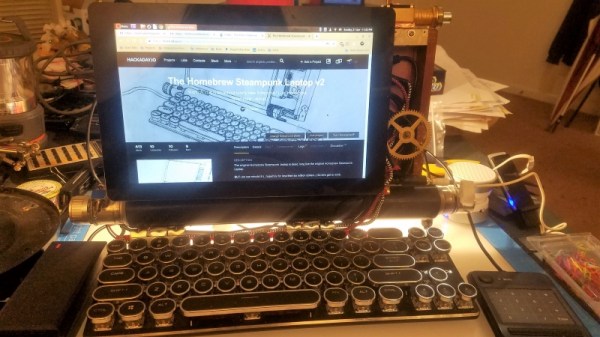
This homebrew steampunk laptop does a great job at standing out from the crowd. [Starhawk]’s build is an homage to the Steampunk genre, in a wooden case with brass bits and bobs adorning. The guts are based on an Intel motherboard, a bit dated but serviceable enough for the job. There’s a touch-capable LCD in the lid, and we absolutely love the look of the keyboard with its retro-style chrome and phenolic keycaps. Exposed USB cables run to and fro, and the braided jackets contribute to the old-timey look. The copier roller as a lid hinge is a nice touch too.

[Starhawk]’s build log is long and detailed, and covers the entire build. We’ve seen interesting builds from him before, like this junk-bin PC build for a friend in need. Looks like this one is for personal use, though, and we can’t blame him.

Unconventional Drone Uses Gas Thrusters For Control

You’ve got to hand it to [Tom Stanton] – he really thinks outside the box. And potentially outside the atmosphere, to wit: we present his reaction control gas thruster-controlled drone.

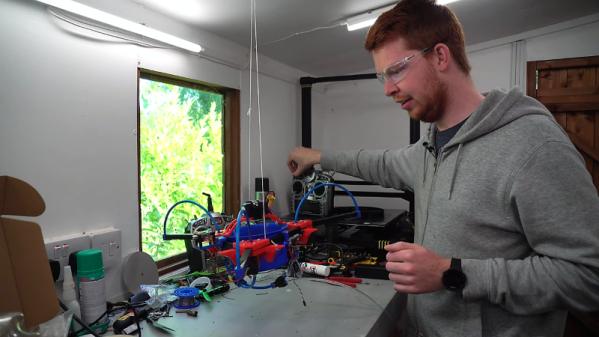
Before anyone gets too excited, [Tom] isn’t building drones for use in a vacuum, although we can certainly see a use case for such devices. This is more of a hybrid affair, with counter-rotating props mounted in a centrally located duct providing the lift and the yaw control. Flanking that is a triangular frame supporting three two-liter soda bottle air reservoirs, each of which supplies a down-firing nozzle at each apex of the triangle. Solenoid valves control the flow of compressed air from the bottles to the nozzles, providing thrust to stabilize the roll and pitch axes. As there aren’t many off-the-shelf flight control systems set up for reaction control, [Tom] had to improvise thruster control; an Arduino watches the throttle signals normally sent to a drone’s motors and fires the solenoids when they get to a preset threshold. It took some tuning, but [Tom] was eventually able to get a stable, untethered hover. And he’s right – the RCS jets do sound amazing when they’re firing, as long as the main motors are off.

This looks as though it has a lot of potential, and we’d love to see it developed more. It reminds us a bit of this ducted-prop drone, another great example of stretching conventional drone control concepts to the limit.

Continue reading “Unconventional Drone Uses Gas Thrusters For Control”

Play To The Beat Of This Robotic Drummer In A Box

No drummer? No problem! With a little ingenuity, you can stuff the essentials of a drum kit into a box, and automate your rhythm section.

Mind you, [Franco Molina]’s “DrumCube” doesn’t quite have the flash of a human drummer, but it does keep a steady beat and has a charm of its own. The drum machine is mostly mechanical, reminding us somewhat of the Wintergatan Marble Machine which is as captivating to watch as it is to hear. The DrumCube has a snare drum played by two servo-controlled sticks, a kick drum using foam waggled back and forth between two piezo transducers hooked to a low-pass filter, and a reverse-biased transistor white noise generator used for the hi-hat. Sadly, the large gear appears to be just for show. An Arduino runs everything and makes sure the mechanical drum hits are synced to the electronic cymbals, which was no mean feat.

The video below shows it in action accompanying [Franco] on his guitar, and it looks as good as it sounds. Prefer a more compact, all-electronic drum kit? Here’s one that fits in your pocket.

Continue reading “Play To The Beat Of This Robotic Drummer In A Box”

Moped Turn Signals, Now With More Cowbell

Cue up the [Christopher Walken] memes, it’s time for moped turn signals with more cowbell. Because moped turn signals with less cowbell are clearly the inferior among moped turn signals.

It seems that [Joel Creates] suffers from the same rhythm recognition disorder that we do. The slightest similarity between a rhythmic sound such as turn signals, and any song in our seemingly infinite intracranial playlist cues up that song for the rest of the day. [Joel] heard “(Don’t Fear) The Reaper” in his turn signals, and that naturally led to a need for More Cowbell. So with a car door lock actuator, a relay, an improvised clapper, and a lot of hot glue and cable ties, the front of his scooter is now adorned with a cowbell that’s synchronized to the turn signals. The video below shows that it’s of somewhat limited appeal in traffic, but at least [Joel’s dad] was tickled pink by it.

Kudos to [Joel] for marching to the beat of his own [Gene Frenkle] on this one. It may be a little weird, but not as weird as an Internet of Cowbells.

Continue reading “Moped Turn Signals, Now With More Cowbell”