Junkbox Constant Current Source Helps With Kelvin Sensing

Is it ironic when a YouTube channel named “The Current Source” needs to build a current source? Or is that not ironic and actually just coincidental?

Regardless of linguistic considerations, [Derek], proprietor of the aforementioned channel has made and disassembled a few current sources in his day. Most of those jobs were for one-off precision measurements or even to drive a string of LEDs in what he describes as a pair of migraine-inducing glasses. Thankfully, The junk box current source presented in the video below is more in service of the former than the latter, as his goal is to measure very small resistances in semiconductors using Kelvin clips.

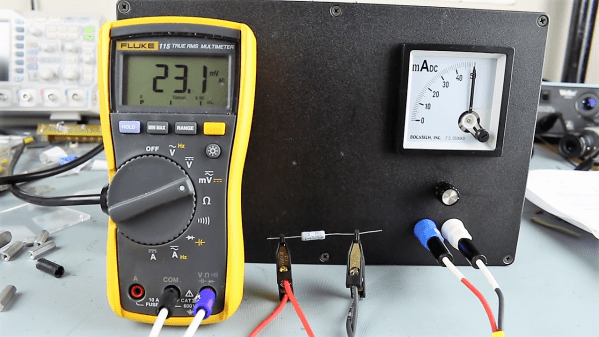
The current source uses a 24-volt switch-mode power supply and the popular LM317 adjustable voltage regulator. The ‘317 can be configured in a constant current mode by connecting the chip’s adjustment pin to the output through a series resistance. A multiturn pot provides current adjustment, although the logarithmic taper is not exactly optimal for the application. We spotted a pair of what appear to be optoisolators in the build too, but there’s no schematic and no discussion of what they do. [Derek] puts the final product to use for a Kelvin measurement of a 0.47-Ω 1% resistor at the end of the video.

We’re glad to see [Derek] in action; you may recall his earlier video about measuring his own radiation with a Geiger counter after treatment for thyroid cancer. Here’s hoping that’s behind him now.

Continue reading “Junkbox Constant Current Source Helps With Kelvin Sensing”

Tilt-Rotor Plane Needs Flight Controller Hack To Get Airborne

Part of the charm of quadcopters is the challenge that building and flying them presents. In need of complex sensors and computational power to just get off the ground and under tremendous stresses thanks to their massively powerful motors, they often seem only barely controlled in flight. Despite these challenges, quadcopter flight has been reduced to practice in many ways, leaving hobbyists in search of another challenge.

[Tom Stanton] is scratching his creative itch with this radio-controlled tilt-rotor airplane that presents some unique problems and opportunities. Tilt-rotor planes are, as the name implies, able to swivel their propellors and transition them from providing forward thrust to providing verticle lift. With the rotors providing lift, the aircraft is able to hover and perform vertical take-off and landing (VTOL); switched to thrust mode, wings provide the lift for horizontal flight.

[Tom]’s realization of this design seems simple – a spar running through the wing holding BLDC motors and props is swiveled through 90° by a servo to transition the aircraft. Standard control surfaces on the wings and tail take care of horizontal flight. Actually getting an off-the-shelf flight controller to deal with the transitions was tricky. [Tom] ended up adding an Arduino to intercept the PWM signals the flight controller normally sends directly to the servos and speed controls to provide the coordination needed for a smooth transition. Full details in the video below, and some test flights which show that an RC VTOL is anything but a beginner’s plane.

[Tom] is proving himself to be quite the Renaissance man these days. Between air-powered piston engines, over-balance trebuchets, and popping the perfect wheelie, he seems to have covered all the bases and done his best to keep our tip line stocked.

Continue reading “Tilt-Rotor Plane Needs Flight Controller Hack To Get Airborne”

Homebrew Attachment Turns Angle Grinder Into Slimline Belt Sander

If there’s a small power tool as hackable as the angle grinder, we haven’t found it yet. These versatile tools put a lot of power in the palm of your hand, and even unhacked they have a huge range of functionality, from cutting to grinding to polishing and cleaning, just by choice of what goes on the arbor.

With a simple homebrew attachment, [Darek] turned his angle grinder into a micro-belt sander that’s great for those hard-to-reach places. The attachment that clamps where the disc guard normally lives adds a drive roller to the grinder’s arbor; idler rollers ride on the end of a small pneumatic spring that keeps the belt under tension. The belts themselves are cut down from wider sanding belts, and the attachment can take belts of various widths. And best of all, he did it all without any fancy machine tools. No lathe? No problem – the drive roller was ground to the proper crowned profile needed to keep belts centered using the angle grinder itself. The only problem we see is that the attachment can’t be easily removed from the grinder, but that’s OK. Grinders are like potato chips, after all – you can’t stop at one.

This isn’t [Darek]’s first angle grinder hacking rodeo, of course. And if you’re looking for inspiration on how to hack yours, look no further: a floor sander, a precision surface grinder, or even an e-bike can be built.

Continue reading “Homebrew Attachment Turns Angle Grinder Into Slimline Belt Sander”

Stepper Motor Mods Improve CNC Flat Coil Winder

Finding just the right off-the-shelf part to complete a project is a satisfying experience – buy it, bolt it on, get on with business. Things don’t always work out so easily, though, which often requires the even more satisfying experience of modifying an existing part to do the job. Modifying a stepper motor by drilling a hole down its shaft probably qualifies for the satisfying mod of the year award.

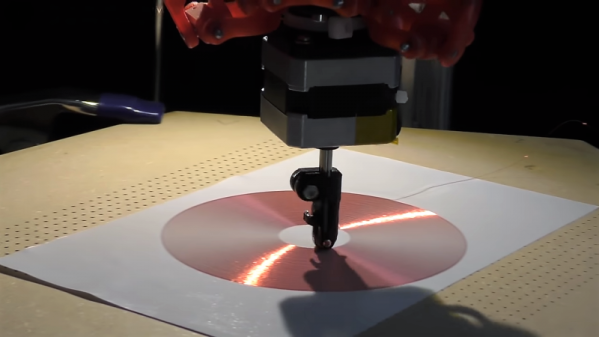
That’s what [Russ] did to make needed improvements to his CNC flat-coil winder, which uses a modified delta-style 3D-printer to roll fine magnet wire out onto adhesive paper to form beautiful coils of various sizes and shapes. [Russ] has been tweaking his design since we featured it and coming up with better and better coils. While experimenting, the passive roller at the business end proved to be a liability. The problem was that the contact point lagged behind the center axis of the delta, leading to problems with the G-code. [Russ] figured that a new tool with the contact point at the dead center would help. The downside would be having to actively swivel the tool in concert with the X- and Y-axis movements. The video below shows his mods, which include disassembling the NEMA-17 stepper and drilling out the shaft to pass the coil wire. [Russ] also spent some time reversing the rotor in the frame and provided a small preload spring to keep the coil roller in contact with the paper.

A real-time coil winding session starts at the 21:18 mark, and we’ve got to admit it’s oddly soothing to watch. We’re not sure exactly what [Russ] intends to do with these coils, and by his own admission, neither is he. But it’s still pretty cool to see, and the stepper motor mods are a neat trick to keep in mind.

Continue reading “Stepper Motor Mods Improve CNC Flat Coil Winder”

Save A Few Steps On Your Next Build With These Easy Linear Actuators

A lot of projects require linear motion, but not all of them require high-accuracy linear slides and expensive ball screws. When just a little shove for a door or the ability to pop something up out of an enclosure is all you need, finding just the right actuator can be a chore.

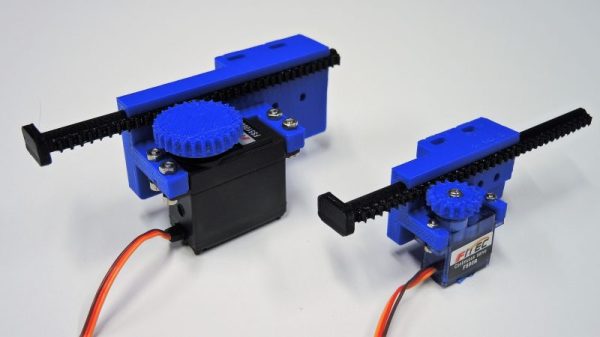
Unless someone has done the work for you, of course. That’s what [Ali] from PotentPrintables did with these 3D-printed linear actuators. It’s a simple rack-and-pinion design that’s suitable for light loads and comes in two sizes, supporting both the 9-g micro servos and the larger, more powerful version. Each design has a pinion that has to be glued to a servo horn, and a selection of rack lengths to suit your needs. The printed parts are nothing fancy, but seem to have material in the right places to bear the loads these actuators will encounter. [Ali] has included parts lists and build instructions in with the STL files, as well as sample Arduino code to get you started. The video below shows the actuators in action.

We’re heartened to learn that [Ali] was at least partly inspired to undertake this design by a previous Hackaday post. And we’re glad he decided to share his version; it might save us a few steps on our next build.

Continue reading “Save A Few Steps On Your Next Build With These Easy Linear Actuators”

Flexible Battery Meter Bends Over Backward To Work

A lithium-ion battery tester seems like a simple project, at least electrically. But when you start thinking about the physical problem of dealing with a huge range of battery sizes, things get a little more complicated. Sure, you can 3D-print adapters and jigs to accommodate the different batteries, or you can cheat a bit and put the charger and tester circuit on a flexible PCB.

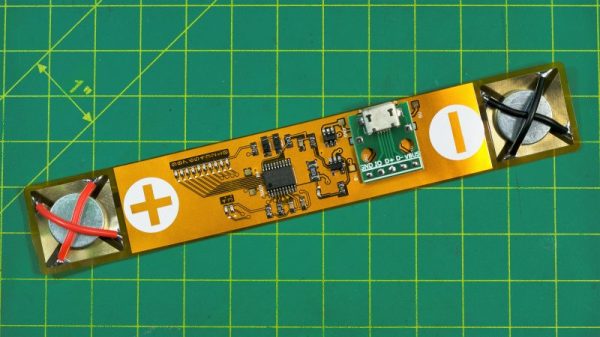
Maybe it’s the Kapton talking, but we really like the look of [Androkavo]’s project. The idea is simple – rather than use a rigid FR4 printed circuit board, a flexible polyimide film PCB a little longer than the biggest battery to be tested was fabricated. With large contacts on each end, the board can just be looped across the battery to take a reading. For charging, neodymium magnets on the other side of the board keep the charger in contact with the battery. The circuit itself is built around an STM8S003 8-bit microcontroller and a handful of discrete components. There’s a bar graph display for battery voltage that covers 2.0 to 4.9 volts, and a USB port for charging. The charger works with everything from the big 21700 cells down to the short 14500s. With the help of another magnet to keep the board from bending too sharply, even the diminutive 10180 can be charged. Check out the video below, which has some of the most relaxing music and best microscope shots of SMD soldering we’ve seen.

Flexible PCBs are versatile things. Not only can they make projects like this successful, but they can also wriggle around, swim, or even play music.

Continue reading “Flexible Battery Meter Bends Over Backward To Work”

Cooking Eggs With Magnets In Motion

It’s probably always going to be easier to just find some dry wood and make a cooking fire, but if you’re ever in a real bind and just happen to have a bunch of magnets and a treadmill motor, this DIY induction cooktop could be your key to a hot breakfast.

For those not familiar with them, induction cooktops are a real thing. The idea stretches all the way back to the turn of the last century, and involves using a strong magnetic field to induce eddy currents in the metal of a cooking vessel. As [K&J Magnetics] explains, the eddy currents are induced in a conductor by changing magnetic fields nearby. The currents create their own magnetic field which opposes the magnetic field that created it. The resulting current flows through the conductor, heating it up. For their cooktop, they chose to spin a bunch of powerful neodymium magnets with alternating polarity using an old treadmill motor. The first try heated up enough to just barely cook an egg. Adding more magnets resulted in more heat, but the breakthrough came with a smaller pan. The video below shows the cooktop in action.

It’s worth noting that commercial induction cooktops use coils and a high-frequency alternating current instead or rotating magnets. They also are notoriously fussy about cookware, too. So, kudos to [K&J] for finding success with such an expedient build. As a next step, we’d love to see the permanent magnets replaced with small coils that can be electrically commutated, perhaps with a brushless motor controller. Continue reading “Cooking Eggs With Magnets In Motion”