Hacked Heating Instruments For The DIY Biology Lab

[Justin] from The Thought Emporium takes on a common molecular biology problem with these homebrew heating instruments for the DIY biology lab.

The action at the molecular biology bench boils down to a few simple tasks: suck stuff, spit stuff, cool stuff, and heat stuff. Pipettes take care of the sucking and spitting, while ice buckets and refrigerators do the cooling. The heating, however, can be problematic; vessels of various sizes need to be accommodated at different, carefully controlled temperatures. It’s not uncommon to see dozens of different incubators, heat blocks, heat plates, and even walk-in environmental chambers in the typical lab, all acquired and maintained at great cost. It’s enough to discourage any would-be biohacker from starting a lab.

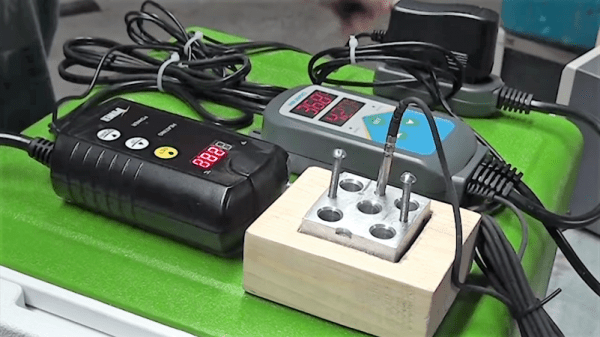
[Justin] knew It doesn’t need to be that way, though. So he tackled two common devices:  the incubator and the heating block. The build used as many off-the-shelf components as possible, keeping costs down. The incubator is dead simple: an insulated plastic picnic cooler with a thermostatically controlled reptile heating pad. That proves to be more than serviceable up to 40°, at the high end of what most yeast and bacterial cultures require.

The heat block, used to heat small plastic reaction vessels called Eppendorf tubes, was a little more complicated to construct. Scrap heat sinks yielded aluminum stock, which despite going through a bit of a machinist’s nightmare on the drill press came out surprisingly nice. Heat for the block is provided by a commercial Peltier module and controller; it looks good up to 42°, a common temperature for heat-shocking yeast and tricking them into taking up foreign DNA.

We’re impressed with how cheaply [Justin] was able to throw together these instruments, and we’re looking forward to seeing how he utilizes them. He’s already biohacked himself, so seeing what happens to yeast and bacteria in his DIY lab should be interesting.

Continue reading “Hacked Heating Instruments For The DIY Biology Lab”
Arduino Provides Hands-Free Focus For Digital Inspection Scope

With surface-mount technology pushing the size of components ever smaller, even the most eagle-eyed among us needs some kind of optical assistance to do PCB work. Lots of microscopes have digital cameras too, which can be a big help – unless the camera fights you.

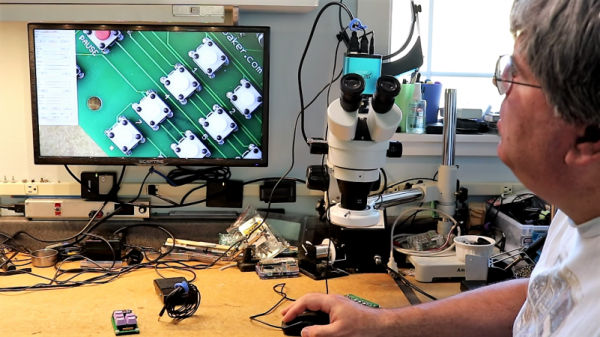
Faced with a camera whose idea of autofocus targets on didn’t quite coincide with his, [Scott M. Baker] took matters into his own hands – foot, actually – by replacing mouse inputs to the camera with an outboard controller. His particular camera’s autofocus can be turned off, but only via mouse clicks on the camera’s GUI. That’s disruptive while soldering, so [Scott] used an Arduino Pro Micro and a small keypad to mimic the mouse movements needed to control the camera.

At the press of a key, the Arduino forces the mouse cursor up to the top left corner of the screen, pulls down the camera menu, and steps down the proper distance to toggle autofocus. The controller can also run the manual focus in and out or to take a screenshot. There’s even a footswitch that forces the camera to refocus if the field of view changes. It looks really handy, and as usual [Scott] provides a great walkthrough in the video below.

Like it or not, if shrinking technology doesn’t force you into the microscope market, entropy will. If you’re looking for a buyer’s guide to microscopes, you could do worse than [Shahriar]’s roundup of digital USB scopes. Or perhaps you’d prefer to dumpster dive for yours.

Continue reading “Arduino Provides Hands-Free Focus For Digital Inspection Scope”

Fail Of The Week: Leaf Blowers Can’t Fly

Leaf blowers, the main instrument of the suburban Saturday symphony, are one of the most useful nuisances. It doesn’t take much work with a rake to convince even the most noise-averse homeowner to head to the Big Box Store to pick one up to speed lawn chores. Once you do buy one, and feel the thrust produced by these handheld banshees, you might wonder, If I let go of this thing, would it fly? 

[Peter Sripol] had that very thought and set about building a couple of leaf blower powered planes to answer the question. It’s probably not a spoiler alert to report that the answer is no, but the video below is a fun watch anyway. The surprising thing is just how close both planes came to succeeding. The first plane was a stripped-down Ryobi two-stroke leaf blower suspended from a giant wing and tail section that very nearly got off the ground. Version 1.1 gained a retractable electric boost propeller – strictly for take-offs – and lost a lot of excess weight. That plane practically leaped into the air, but alas, servo problems prevented [Peter] from shutting down the electric and flying on Ryobi alone. Even a servo fix couldn’t save the next flight, which cratered right after takeoff. A version 2.0, this time using a brutally modified electric leaf blower, was slightly more airworthy but augured in several times before becoming unflyable.

What can we learn from all this? Not much other than it would take a lot of effort to make a leaf blower fly. We appreciate all of [Peter]’s hard work here, but we think he’s better off concentrating on his beautiful homebrew ultralight instead.

Continue reading “Fail Of The Week: Leaf Blowers Can’t Fly”

3D-Printer Extrudes Paper Pulp Instead Of Plastic

We’ve seen all sorts of 3D-printers on these pages before. From the small to the large, Cartesians and deltas, and printers that can squeeze out plastic, metal, and even concrete. But this appears to be the first time we’ve ever featured a paper-pulp extruding 3D-printer.

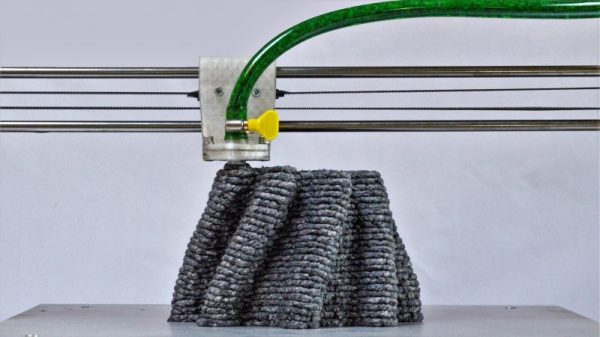
It’s fair to ask why the world would need such a thing, and its creator, [Beer Holthuis], has an obvious answer: the world has a lot of waste paper. Like 80 kg per person per year. Thankfully at least some of that is recycled, but that still leaves a lot of raw material that [Beer] wanted to put to work. Build details on the printer are sparse, but from the photos and the video below it seems clear how it all went together. A simple X-Y-Z gantry moves a nozzle over the build platform. The nozzle, an order of magnitude or two larger than the nozzles most of us are used to, is connected to an extruder by a plastic hose. The extruder appears to be tube with a stepper-driven screw that lowers a ram down onto the pulp, squeezing it into the hose. [Beer] notes that the pulp is mixed with a bit of “natural binder” to allow the extruded pulp to keep its shape. We found the extrusion process to be just a wee bit repulsive to watch, but fascinating nonetheless, and the items he’s creating are certainly striking in appearance.

This may be the first pulp printer to grace our pages, but it’s not the first pulp hack we’ve featured. Pulp turns out to be a great material to keep your neighbors happy and even makes a dandy fuel.

Continue reading “3D-Printer Extrudes Paper Pulp Instead Of Plastic”

A Fleet Of Pressure Washers Powers This Interactive Public Fountain

Public art installations can be cool. Adding in audience interactivity bumps up the coolness factor a bit. Throw civic pride, dancing jets of water, music, and lights into the project, and you get this very cool pressure washer powered musical fountain.

The exhibit that [Niklas Roy] came up with is called Wasserorgel, or “water organ”, an apt name for the creation. Built as part of a celebration of industry in Germany, the display was built in the small town of Winnenden, home to Kärcher, a cleaning equipment company best known for their line of pressure washers in the distinctive yellow cases. Eight of the company’s electric pressure washers were featured in the Wasserorgel, which shot streams of water and played notes in response to passersby tickling the sturdy and waterproof 3D-printed keyboard. The show was managed by an Arduino with a MIDI shield, which controlled the pressure washers via solid state relays and even accepted input from an anemometer to shut down the show if it got too windy, lest the nearby [Frau Dimitrakudi] be dampened.

The video below shows how engaging the Wasserorgel was during its weeks-long run in the town market square; there’s also one in German with build details. And while we can’t recall seeing pressure washers in public art before, we do remember one being used as the basis of a DIY water-jet cutter.

Continue reading “A Fleet Of Pressure Washers Powers This Interactive Public Fountain”

Rewound And Rewired BLDC Makes A Half-Decent Generator

What’s the best way to turn a high-powered brushless DC motor optimized for hobby use into a decent low-RPM generator? Do you take a purely mechanical approach and slap a gearbox on the shaft? Or do you tackle the problem electrically?

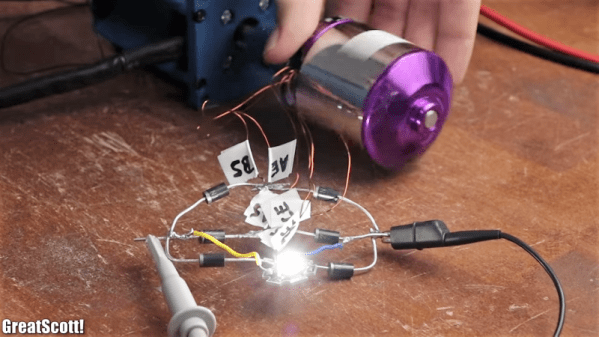
The latter approach is what [GreatScott!] settled on with his BLDC rewinding and rewiring project. Having previously explored which motors have the best potential as generators, he knew the essential problem: in rough terms, hobby BLDCs are optimized for turning volts into RPMs, and not the other way around. He started with a teardown of a small motor, to understand the mechanical challenges involved, then moved onto a larger motor. The bigger motor was stubborn, but with some elbow grease, a lot of scratches, and some destroyed bearings, the motor was relieved of both its rotor and stator. The windings were stripped off and replaced with heavier magnet wire with more turns per pole than the original. The effect of this was to drive the Kv down and allow better performance at low RPMs. Things looked even better when the windings were rewired from delta to wye configuration.

The take-home lesson is probably to use a generator where you need a generator and let motors be motors. But we appreciate [GreatScott!]’s lesson on the innards of BLDCs nonetheless, and his other work in the “DIY or buy?” vein. Whether you want to make your own inverter, turn a hard drive motor into an encoder, or roll your own lithium battery pack, he’s done a lot of the dirty work already.

Continue reading “Rewound And Rewired BLDC Makes A Half-Decent Generator”

The Dual In-Line Package And How It Got That Way

For most of human history, our inventions and innovations have been at a scale that’s literally easy to grasp. From the largest cathedral to the finest pocket watch, everything that went into our constructions has been something we could see with our own eyes and manipulate with our hands. But in the middle of the 20th century, we started making really, really small stuff: semiconductors. For the first time, we were able to create mechanisms too small to be seen with the naked eye, and too fine to handle with our comparatively huge hands. We needed a way to scale these devices up somewhat to make them useful parts. In short, they needed to be packaged.

We know that the first commercially important integrated circuits were packaged in the now-familiar dual in-line package (DIP), the little black plastic millipedes that would crawl across circuit boards for the next 50 years. As useful and versatile as the DIP was, and for as successful as the package became, its design was anything but obvious. Let’s take a look at the dual in-line package and how it got that way.

Continue reading “The Dual In-Line Package And How It Got That Way”