Servo-Controlled Eyeball Makes A Muggle Moody

Even when you bear a passing resemblance to the paranoid Auror of the Harry Potter universe, you still really need that wonky and wandering prosthetic eye to really sell that Mad-Eye Moody cosplay, and this one is pretty impressive.

Of course, there’s more to the [daronjay]’s prosthetic peeper than an eBay doll’s eye. There’s the micro-servo that swivels the orb, as well as a Trinket to send the PWM signal and a pocket full of batteries. The fit and finish really tie it together, though, especially considering that it’s made from, well, garbage — a metal food jar lid, a yogurt cup, and the tube of a roll-on antiperspirant. Some brass screws and a leather strap evoke the necessary Potter-verse look, and coupled with what we assume are prosthetic scars, [daronjay] really brings the character to life. We think it would be cool to have the servo eye somehow slaved to the movements of the real eye, with a little randomness thrown in to make it look good.

Marauder’s maps, wand duels, Weasley clocks — the wizarding world is ripe for creative hacking and prop making. What’s next — a Nimbus 2000 quadcopter? Please?

Continue reading “Servo-Controlled Eyeball Makes A Muggle Moody”

Radio Apocalypse: The Emergency Broadcast System

Some sounds are capable of evoking instant terror. It might be the shriek of a mountain lion, or a sudden clap of thunder. Whatever your trigger sound, it instantly stimulates something deep in the lizard brain that says: get ready, danger is at hand.

For my part, you can’t get much scarier than the instantly recognizable two-tone alert signal (audio link warning) from the Emergency Broadcast System (EBS). For anyone who grew up watching TV in the 60s and 70s in the US, it was something you heard on at least a weekly basis, with that awful tone followed by a grave announcement that “the broadcasters of your area, in voluntary cooperation with the FCC and other authorities, have developed this system to keep you informed in the event of an emergency.” It was a constant reminder that white-hot death could rain from the sky at any moment, and the idea that the last thing you may ever hear was that tone was sickening.

While I no longer have a five-year-old’s response to that sound, it’s still a powerful reminder of a scary time. And the fact that it’s still in use today, at least partially, seems like a good reason to look at the EBS in a little more depth, and find out the story behind the soundtrack of the end of the world.

Continue reading “Radio Apocalypse: The Emergency Broadcast System”

Automated Chamber Passes Just The Right Gas

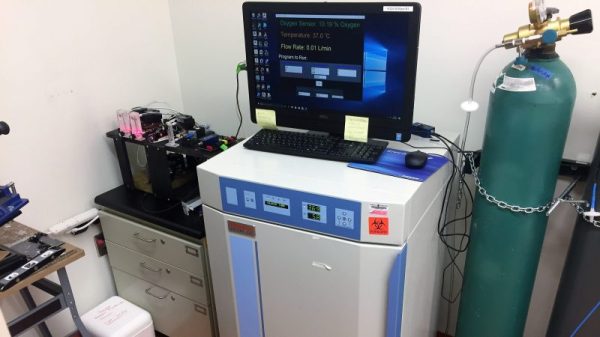
It sounds like an overly complicated method a supervillain would use to slowly and painfully eliminate enemies — a chamber with variable oxygen concentration. This automated environmental chamber isn’t for torturing suave MI6 agents, though; rather, it enables cancer research more-or-less on the cheap.

Tasked with building something to let his lab simulate the variable oxygen microenvironments found in some kinds of tumors, [RyanM415] first chose a standard lab incubator as a chamber to mix room air with bottled nitrogen. With a requirement to quickly vary the oxygen concentration from the normal 21% down to zero, he found that the large incubator took far too long to equilibrate, and so he switched to a small acrylic box. Equipped with a mixing fan, the smaller chamber quickly adjusts to setpoints, with an oxygen sensor providing feedback and controlling the gas valves via a pair of Arduinos. It’s quite a contraption, with floating ball flowmeters and stepper-actuated variable gas valves, but the results are impressive. If it weren’t for the $2000 oxygen sensor, [RyanM145] would have brought the whole project in for $500, but at least the lab can use the sensor elsewhere.

Modern biology and chemistry labs are target-rich environments for hacked instrumentation. From DIY incubators to cheap electrophoresis rigs, we’ve got you covered.

Continue reading “Automated Chamber Passes Just The Right Gas”

“Hey! Don’t Lock The Door, I’m In Here!”

Those that work in front of a computer for a living spend most of the time making very little sound. Unless you’re a member of the clicky mechanical keyboard club, your working time is a low-observables time during which people can forget about you. You can make sure you’re not overlooked with this smartphone hotspot presence detector.

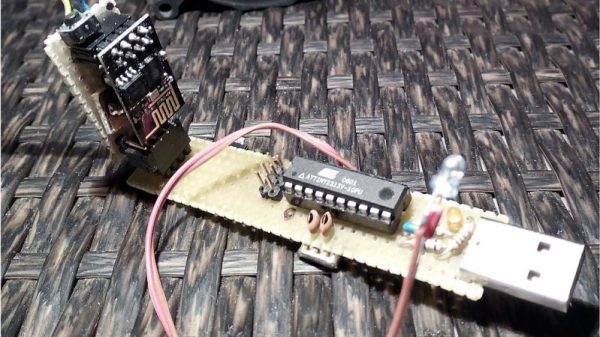
[Emilio Ficara]’s quiet work habits resulted in his housemates locking him in sometimes, to his inconvenience. PIR or microwave occupancy sensors might have worked to fix the problem, except that a few flexing fingers aren’t always enough to trigger them. Luckily, [Emilio] is also wisely distrustful of free WiFi, so his phone is always set up as a mobile hotspot, giving him the means to reliably detect his presence. An ATtiny2313 and an ESP-01 do the business of polling for the SSID of his phone and blinking a bright blue LED by his door for his housemates. It’s not perfect, of course; it could easily be spoofed by anyone else who knows his SSID. But simple works for now.

With almost everyone carrying one now, smartphone detection is a good proxy for the presence of a person. But it doesn’t work in every case, so you may want to familiarize yourself with the aforementioned PIR and microwave methods.

DIY Injection Mold Design For The Home Shop

3D printing is great for prototyping, and not bad for limited runs of parts. Unfortunately though it really doesn’t scale well beyond a few pieces, so when you’re ready for the mass market you will need to think about injection molding your parts. But something like that has to be farmed out, right? Maybe not, if you know a thing or two about designing your own injection molds.

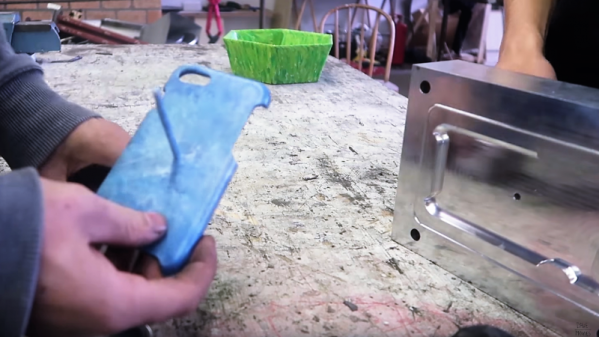
The video below comes from [Dave Hakkens] by way of his Precious Plastic project, whose mission it is to put the means of plastic recycling into the hands of individuals, rather than relying on municipal programs.  We’ve covered their work before, and it looks like they’ve come quite a way to realizing that dream. This tutorial by [Dave]’s colleague [Jerry] covers the basic elements of injection mold design, starting with 3D modeling in Solidworks. [Jerry] points out the limitations of a DIY injection molding effort, including how the thickness of parts relates to injection pressure. Also important are features like gentle curves to reduce machining effort, leaving proper draft angles on sprues, and designing the part to ease release from the mold. [Jerry] and [Dave] farmed out the machining of this mold, but there’s no reason a fairly complex mold couldn’t be produced by the home gamer.

When you’re done learning about mold design, you’ll be itching to build your own injection mold machine. Precious Plastic’s tutorial looks dead simple, but this machine looks a little more capable. And why CNC your molds when you can just 3D print them?

Continue reading “DIY Injection Mold Design For The Home Shop”

Automating A Bowl Feeder With Arduino

Search for “bowl feeder” on Hackaday and you’ll get nothing but automated cat and dog feeders. That’s a shame, because as cool as keeping your pets fed is, vibratory bowl feeders are cooler. If you’ve seen even a few episodes of “How It’s Made” you’re likely to have seen these amazing yet simple devices, used to feed and align small parts for automated assembly. They’re mesmerizing to watch, and if you’ve ever wondered how parts like the tiny pins on a header strip are handled, it’s likely a bowl feeder.

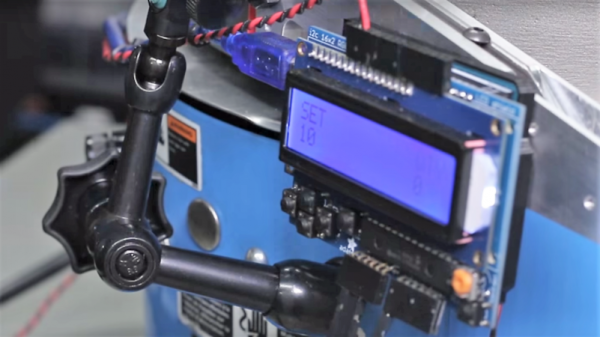
[John] at NYC CNC is building a bowl-feeder with Arduino control, and the video below takes us on a tour of the build. Fair warning that the video is heavy on the CNC aspects of milling the collating outfeed ramp, which is to be expected from [John]’s channel. We find CNC fascinating, but if you’re not so inclined, skip ahead to the last three minutes where [John] discusses control. His outfeed ramp has a slot for an optical sensor to count parts. For safety, the Arduino controls the high-draw bowl feeder through an external relay and stops the parts when the required number have been dispensed.

We know, watching someone use a $20,000 CNC milling station might seem overkill for something that could have been 3D printed, but [John] runs a job shop after all and usually takes on big industrial jobs. Or small ones, like these neat color-infill machine badges.

Continue reading “Automating A Bowl Feeder With Arduino”

Grease Gun Hydroforms Custom Motorcycle Parts

Never underestimate the power of an incompressible fluid at high pressure. Properly constrained and with a full understanding of the forces involved, hydraulic pressure can be harnessed to do some interesting things in the home shop, like hydroforming stainless steel into custom motorcycle parts.

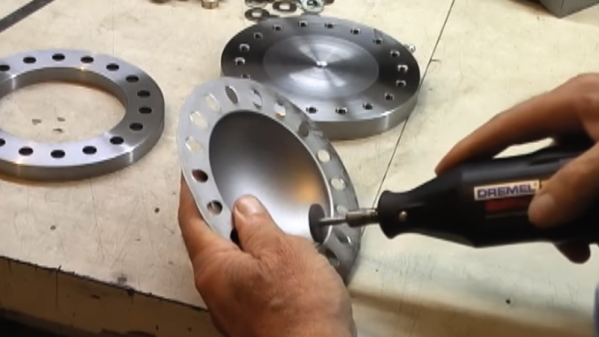
From the look of [Clarence Elias]’s video below, it seems like he has a 100% custom motorcycle build going on in his shop. That means making every part, including the reflectors for the lights. While he certainly could have used a traditional approach, like beating sheet stainless with a planishing hammer or subjecting it to the dreaded English wheel, [Clarence] built a simple yet sturdy hydroforming die for the job. A thick steel ring clamps the sheet stainless to a basal platen with an inlet from the forming fluid, which is ordinary grease. [Clarence] goes through the math and the numbers are impressive — a 1,500-psi grease gun can be mighty persuasive under such circumstances. The result is a perfectly formed dish with no tool marks, in need of only a little polishing to be put into service.

Whether by a pressure washer, a puff of air, or 20-tons of pressure on a rubber pad, hydroforming is a great method to master for making custom parts.

Continue reading “Grease Gun Hydroforms Custom Motorcycle Parts”