Two Bits A Gander: Of Premature Babies, Incubators, And Coney Island Sideshows

Newborn humans are both amazingly resilient and frighteningly fragile creatures. A child born with 40 full weeks of gestation has pretty good odds of surviving the neonatal period these days, and even if he or she comes along a few weeks early, things usually go smoothly. But those babies that can’t wait to get out and meet the world can run into trouble, and the earlier they’re born, the greater the intervention needed to save them.

We’ve all seen pictures of remarkably tiny babies in incubators, seemingly dwarfed by the gloved hands of an anxious parent who just wants that first magical touch of their baby’s skin. As common as such an intervention is now and as technologically advanced as neonatology is, care for premature infants as a medical discipline has a long and interesting history of technical and social hacks that’s worth looking at.

Continue reading “Two Bits A Gander: Of Premature Babies, Incubators, And Coney Island Sideshows”

Roam The Wastelands With This Fallout-Themed Mini Geiger Counter

For anyone who has worked with radioactive materials, there’s something that’s oddly comforting about the random clicks of a Geiger counter. And those comforting clicks are exactly why we like this simple pocket Geiger counter.

Another good reason to like [Tim]’s build is the Fallout theme of the case. While not an item from the game, the aesthetic he went for with the 3D-printed case certainly matches the Fallout universe. The counter itself is based on the popular Russian SBT-11A G-M tubes that are floating around eBay these days. You might recall them from coverage of this minimalist Geiger counter, and if you were inspired to buy a few of the tubes, here’s your chance for a more polished build. The case is stuffed with a LiPo pack, HV supply, and a small audio amp to drive the speaker. The video below shows it clicking merrily from a calibration source.

We can see how this project could be easily expanded — a small display that can show the counts per minute would be a great addition. But there’s something about how pocketable this is, and just the clicking alone is enough for us.

Continue reading “Roam The Wastelands With This Fallout-Themed Mini Geiger Counter”

Scrap Wood And Metal Combined For DIY Mecanum Wheels

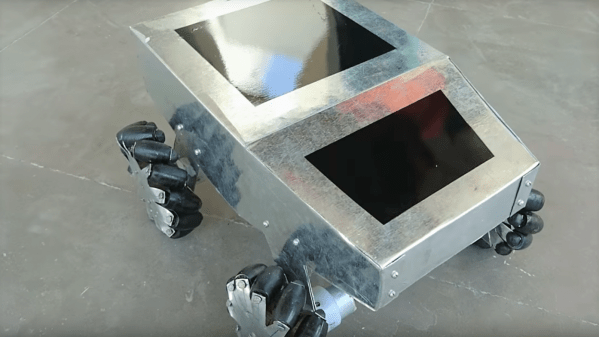
Some scrap wood, a few pieces of sheet metal, a quartet of old gear motors, and a few basic hand tools. That’s all it takes to build an omni-bot with Mecanum wheels, if you’ve got a little know-how too.

For the uninitiated, Mecanum wheels can rotate in any direction thanks to a series of tapered rollers around the circumference that are canted 45° relative to the main axle.  [Navin Khambhala]’s approach to Mecanum wheel construction is decidedly low tech and very labor intensive, but results in working wheels and a pretty agile bot. The supports for the rollers are cut from sheet steel and bent manually to hold the wooden rollers, each cut with a hole saw and tapered to a barrel shape on a makeshift lathe. Each wheel is connected directly to a gear motor shaft, and everything is mounted to a sheet steel chassis. The controls are as rudimentary as the construction methods, but the video below shows what a Mecanum-wheeled bot can do.

There’s a lot of room here for improvement, but mainly in the manufacturing methods. The entire wheel could be 3D printed, for instance, or even laser cut from MDF with a few design changes. But [Navin] scores a win for making a working wheel and a working bot from almost nothing.

Continue reading “Scrap Wood And Metal Combined For DIY Mecanum Wheels”

Wireless Wearable Watches Your Vital Signs

Is it [Dr. McCoy]’s long-awaited sickbay biobed, with wireless sensing and display of vital signs? Not quite, but this wearable patient monitor comes pretty close. And from the look of it, [Arthur]’s system might even monitor a few more parameters than [Bones]’ bleeping bed from the original series.

Starting with an automatic blood pressure cuff that [Arthur] had previously reversed engineered, he started adding sensors. Pulse, ECG, respiration rate, galvanic skin response, and body temperature are all measured from one compact, wrist-wearable device. It’s not entirely wireless – the fingertip pulse oximetry dongle and chest electrodes still need to be wired back to the central unit – but the sensors all talk to a Teensy 3.2 which then communicates to an Android app over Bluetooth, so there’s no need to be tethered to the display. And speaking of electrodes, we’re intrigued by the ADS1292 chip [Arthur] uses, which not only senses the heart’s electrical signals but also detects respirations by the change in impedance as the chest wall expands and contracts. Of course there’s also pneumography via radar that could be rolled into this sensor suite.

It’s all pretty cool, and we can easily see a modified version of this app displayed on a large tablet or monitor being both an accurate prop reconstruction and a useful medical device.

Continue reading “Wireless Wearable Watches Your Vital Signs”

Raspberry Pi Hitches Ride Inside Vintage Terminal

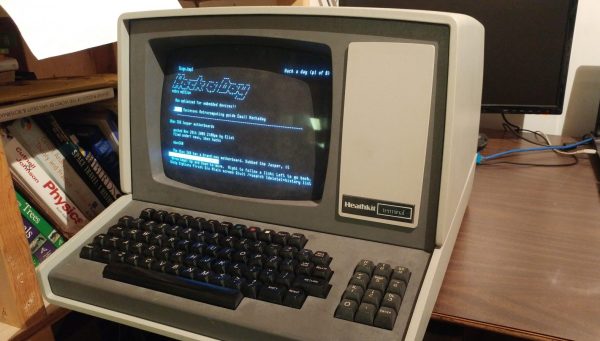
When a dumpster dive yielded a vintage video display terminal, [dennis1a4] knew just what to do — bring the Heathkit H19 back to life and stuff a Raspberry Pi inside.

The early days of the personal computer era were a time of great market diversity. Everyone was making stuff needed to cobble together your perfect computer, and terminals were among the most important pieces of gear. Lear Siegler, DEC, Wyse — everyone was in on the game. Even Heathkit competed with its H19 serial terminal, which would have set you back a thousand or so early-1980s dollars.

The terminal [dennis1a4] found was DOA, but he quickly determined that a bad cap was shorting out the -12VDC rail. A little extra detective work was needed to get the terminal to both echo characters locally and output them over the RS-232 port, and bam, working terminal. But then what? Raspberry Pi to the rescue! But those old school +/-12 volts swings would give a Pi a bad case of Blue Smoke Disease. After a little voltmeter poking, and through the magic of socketed driver chips, the Pi was talking right to the terminal at a screaming 9600 baud and accessing the Hackaday Retro site on the 80-by-24 mono display.

All in all, a nice hack on a piece of computer history. But just one question: Can it play Doom Flappy Bird?

Autonomous Delivery And The Last 100 Feet

You’ve no doubt by now seen Boston Dynamics latest “we’re living in the future” robotic creation, dubbed Handle. [Mike Szczys] recently covered the more-or-less-official company unveiling of Handle, the hybrid bipedal-wheeled robot that can handle smooth or rugged terrain and can even jump when it has to, all while remaining balanced and apparently handling up to 100 pounds of cargo with its arms. It’s absolutely sci-fi.

[Mike] closed his post with a quip about seeing “Handle wheeling down the street placing smile-adorned boxes on each stoop.” I’ve recently written about autonomous delivery, covering both autonomous freight as the ‘killer app’ for self-driving vehicles and the security issues posed by autonomous delivery. Now I want to look at where anthropoid robots might fit in the supply chain, and how likely it’ll be to see something like Handle taking over the last hundred feet from delivery truck to your door.

Continue reading “Autonomous Delivery And The Last 100 Feet”

An Ugly But Functional Pi Laptop

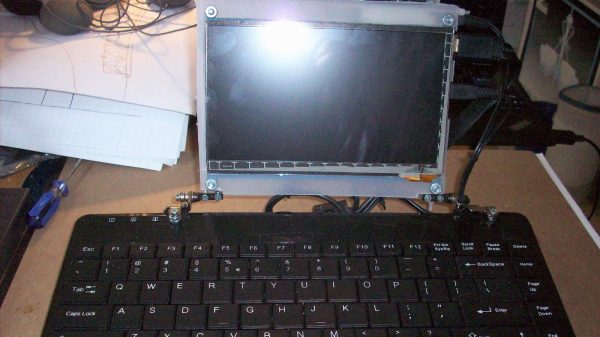
It’s got a face only its mother could love. Or a Hackaday writer, since this ugly e-waste laptop proudly sports a Jolly Wrencher on its back.

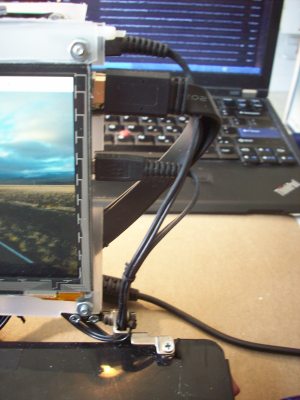
All joking aside, this is a great example of doing what you can with what you’ve got. [starhawk] is limited on funds, and a regular laptop is beyond his means. But being light in the wallet is no reason to go without when you can scrounge parts from friends and family. The base of the laptop is a mini USB keyboard, with the top formed mainly by a 7″ HDMI panel. The back of the display is adorned with a Raspberry Pi 3, a USB hub, a little sound dongle, and the aforementioned Jolly Wrencher. The whole thing is powered by a cast-off power supply brick — no exploding batteries to worry about!



Other Pi-based laptops we’ve covered may be sleeker, but we’ve got to admit that [starhawk]’s keyboard is probably the better choice for working on the next great American novel. And a Linux laptop for next to nothing? That’s a win in our book.