Paramotoring For The Paranoid: Google’s AI And Relationship Mining

My son approached me the other day with his best 17-year-old sales pitch: “Dad, I need a bucket of cash!” Given that I was elbow deep in suds doing the dishes he neglected to do the night before, I mentioned that it was a singularly bad time for him to ask for anything.

Never one to be dissuaded, he plunged ahead with the reason for the funding request. He had stumbled upon a series of YouTube videos about paramotoring, and it was love at first sight for him. He waxed eloquent about how cool it would be to strap a big fan to his back and soar with the birds on a nylon parasail wing. It was actually a pretty good pitch, complete with an exposition on the father-son bonding opportunities paramotoring presented. He kind of reminded me of the twelve-year-old version of myself trying to convince my dad to spend $600 on something called a “TRS-80” that I’d surely perish if I didn’t get.

Needless to say, the $2500 he needed for the opportunity to break his neck was not forthcoming. But what happened the next day kind of blew my mind. As I was reviewing my YouTube feed, there among the [Abom79] and [AvE] videos I normally find in my “Recommended” queue was a video about – paramotoring. Now how did that get there?

Continue reading “Paramotoring For The Paranoid: Google’s AI And Relationship Mining”

A Little IoT For Your PID Tea Kettle

For some folks, tea is a simple pleasure – boil water, steep tea, enjoy. There are those for whom tea is a sacred ritual, though, and the precise temperature control they demand requires only the finest in water heating technology. And then there are those who take things even further by making a PID-controlled electric tea kettle an IoT device with Amazon Echo integration.

Nothing worth doing isn’t worth overdoing, and [luma] scores points for that. Extra points too for prototyping an early iteration of his design on a RadioShack Electronics Learning Lab – the one with a manual written by Forrest Mims. [luma] started out using an Arduino with a Zigbee shield but realized the resulting circuit would have to live in an external enclosure. Switching to an ESP8266, the whole package – including optoisolators, relays, and a small wall-wart – is small enough to fit inside the kettle’s base. The end result is an MQTT device that publishes its status to his SmartThings home automation system, and now responds when he tells Alexa it’s time for tea.

Projects that hack the means of caffeine are no strangers to Hackaday, whether your preferred vector is tea, coffee, or even straight up.

Continue reading “A Little IoT For Your PID Tea Kettle”

Light Replaces Electrons For Giant Vector-Graphics Asteroids Game

For all its simplicity, the arcade classic Asteroids was engaging in the extreme, with the ping of the laser, the rumble of the rocket, the crash of crumbling space rocks, and that crazy warble when the damn flying saucers made an appearance. Atari estimates that the game has earned operators in excess of $500 million since it was released in 1979. That’s two billion quarters, and we’ll guess a fair percentage of those coins came from the pockets of Hackaday’s readers and staff alike.

One iconic part of Asteroids was the vector display. Each item on the field was drawn as a unit by the CRT’s electron beam dancing across the phosphor rather than raster-scanned like TV was at the time. The simple graphics were actually pretty hard to create, and with that in mind, [standupmaths] decided to take a close look at the vector display of Asteroids and try to recreate it using a laser.

To be fair, [Seb Lee-Delisle] does all the heavy lifting here, with [standupmaths] providing context on the history and mathematics of the original vector display. [Seb] is a digital artist by trade, and has at the ready a 4-watt RGB laser projector for light shows and displays. Using the laser as a replacement for the CRT’s electron beam, [Seb] was able to code a reasonably playable vector-graphic version of Asteroids on a large projections screen. Even the audio is faithful to the original. The real treat comes when the laser is slowed and a little smoke added to show us how each item is traced out in order.

All [Seb]’s code is posted on GitHub, so if you have a laser projector handy, by all means go for it. Or just whip up a custom vector display for your own tabletop version of Asteroids.

Continue reading “Light Replaces Electrons For Giant Vector-Graphics Asteroids Game”

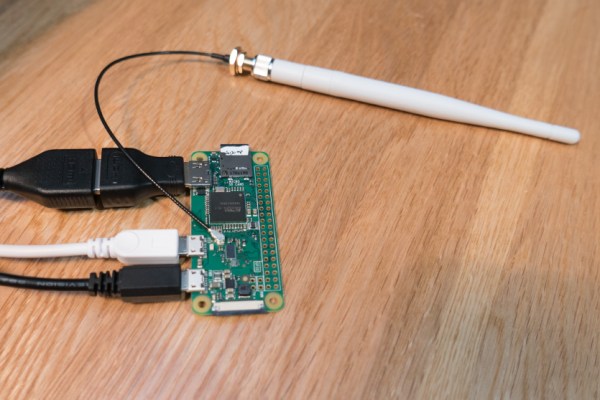
Adding An External Antenna To The Raspberry Pi Zero W

Putting a complete WiFi subsystems on a single-board computer is no mean feat, and on as compact a board as the Zero W, it’s quite an achievement. The antenna is the tricky part, since there’s only so much you can do with copper traces.

The new Raspberry Pi Zero W’s antenna is pretty innovative, but sometimes you need an external antenna to reach out and touch someone. Luckily, adding an external antenna to the Zero W isn’t that tough at all, as [Brian Dorey] shows us. The Pi Zero W’s designers thoughtfully included solder pads for an ultra-miniature surface-mount UHF jack. The jack pads are placed very close to the long, curving trace that acts as a feedline to the onboard antenna. There’s even a zero ohm SMT resistor that could be repositioned slightly to feed RF to the UHF jack. A little work with a soldering iron and [Brian]’s Pi was connected to an external antenna.

[Brian] includes test data, but aside from a few outliers, the external antenna doesn’t seem to offer a huge advantage, at least under his test conditions. This speaks to the innovative design of the antenna, which [Roger Thornton] from the Raspberry Pi Foundation discussed during last week’s last week’s Hack Chat. Check out the archive for that and more.

Thanks to [theEngineer] for the tip.

Punching It Down: Insulation Displacement Connectors

In my misspent youth I found myself doing clinical rotations at a local hospital. My fellow students and I were the lowest of the low on the hospital pecking order, being the ones doing the bulk of the work in the department and paying for the privilege to do so. As such, our locker facilities were somewhat subpar: a corner of a closet behind a door labeled “COMMS”.

In the room was a broken chair and a couple of hooks on the wall for our coats, along with an intriguing (to me) electrical panel. It had a series of rectangular blocks with pins projecting from it. Each block had a thick cable with many pairs of thin, colorful wires fanned out and neatly connected to the left side, and a rats nest of blue and white wires along the right side. We were told not to touch the board. I touched it nonetheless.

I would later learn that these were Type 66 punchdown blocks for the department’s phone system, and I’d end up using quite a few of them over my hacking life. Punchdown connectors were a staple of both private and public telco physical plants for decades, and belong to a class of electrical connections called insulation displacement connections, or IDC. We’ve recently looked at how crimp connections work, and what exactly is going on inside a solder joint. I thought it might be nice to round things out with a little bit about the workings of IDC.

Continue reading “Punching It Down: Insulation Displacement Connectors”

Ask Hackaday: How Should Hackers Handle IP Agreements?

My buddy Harold recently landed a new job at a great technology company. It came at a perfect time for him, having just been laid off from the corporate behemoth where he’d toiled away as an anonymous cog for 19 years. But the day before he was to start, the new company’s HR folks sent him some last-minute documents to sign. One was a broad and vaguely worded non-compete agreement which essentially said he was barred from working in any related industry for a year after leaving the company.

Harold was tempted not to sign, but eventually relented because one needs to put food on the table. Thankfully he’s now thriving at the new company, but his experience got me thinking about all the complications hackers face with the day jobs that so many of us need to maintain. Non-competes and non-disclosures are bad enough, but there’s one agreement that can really foul things up for a hacker: the Intellectual Property Agreement.

Continue reading “Ask Hackaday: How Should Hackers Handle IP Agreements?”

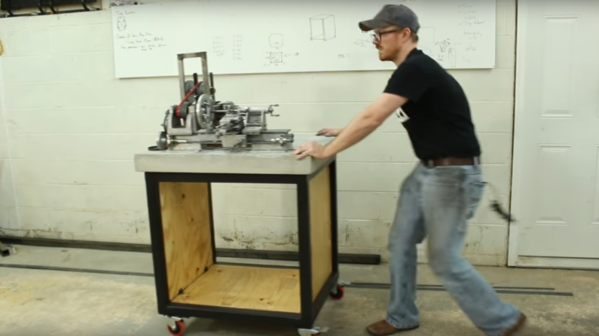
Bulking Up A Lightweight Lathe With A Concrete Cart

When it comes to machine tools, a good rule of thumb is that heavier is better. A big South Bend lathe or Bridgeport mill might tip the scales at ludicrous weight, but all that mass goes to damping vibration and improving performance. So you’d figure a lathe made of soda cans could use all the help it could get; this cast concrete machine cart ought to fit the bill nicely

Perhaps you’ve caught our recent coverage of [Makercise]’s long and detailed vlog of his Gingery lathe build. If not, you might want to watch the 5-minute condensed video of the build, which shows the entire process from melting down scrap aluminum for castings to first chips. We love the build and the videos, but the lightweight lathe on that wooden bench never really worked for us, or for [Makercise], who notes that he was never able to crank the lathe up to full speed because of the vibrations. The cart attempts to fix that problem the old fashioned way – more mass.

There are a few “measure twice, cut once” moments in the video below, as well as a high pucker-factor slab lift that could have turned into a real disaster. We might have opted for a countertop-grade concrete mix that could be dyed and polished, but that would be just for looks. When all is said and done, the cart does exactly what it was built to do, and there’s even room on it for the shaper that’s next on the build list. We’re looking forward to that.

Continue reading “Bulking Up A Lightweight Lathe With A Concrete Cart”