Alarm System Upgrade Tips The Functionality Scale

Residential-grade commercial alarm systems are good at a few things but terrible at others, like keeping pace with telephone technology. So what to do when a switch to VOIP renders your alarm system unable to call in reinforcements? Why not strip out the old system and roll your own value-added alarm and home automation system?

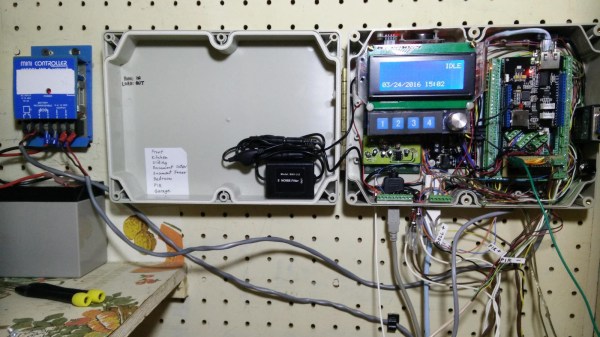
Generally, the hardest part about installing an alarm system is running the wires to connect sensors to the main panel, so [Bill Dudley] wisely chose to leverage the existing wiring and just upgrade the panel. And what an upgrade it is. [Bill]’s BOM reads like a catalog page from SparkFun or Adafruit – Arduino MEGA 2560, Ethernet shield, a sound board, stereo amplifier, X10 interface, and a host of relays, transformers, and converters. [Bill] is serious about redundancy, too – there’s an ESP8266 to back up the wired Ethernet, and a DS3231 RTC to keep the time just in case NTP goes down. The case is a bit crowded, but when closed up it’s nicely presentable, and the functionality can’t be beat.

Rehabilitating old alarm systems is a popular project that we’ve covered plenty of times, like this Arduino upgrade for a DSC 1550 panel. But we like the way [Bill] really went the extra mile to build add value to his system.


Weight Tracking, Wise Cracking IoT Bathroom Scale

For those fighting the battle of the bulge, the forced discipline of fitness bands and activity tracking software might not be enough motivation. Some who are slimming down need a little gentle encouragement to help you lose weight and keep it off. If that sounds like you, then by all means avoid building this weight-tracking IoT scale with an attitude.

Then again, if you live in fear of your scale, [Jamie Bailey]’s version is easy to hate, at least when your numbers are going in the wrong direction. Centered around a second-hand Wii Balance Board talking to a Raspberry Pi via Bluetooth, the scale really only captures your weight and sends it up to InitialState for tracking and feedback. Whether the feedback is in the form of jokes at your expense is, of course, is entirely up to you; if you’d rather get gentle nudges and daily affirmations, just edit a few files. Or if your tastes run more toward “Yo momma so fat” jokes, have at it.

Bathroom scales are a good hacking target, whether it’s reverse engineering a digital scale or eavesdropping on a smart scale. This build is snarky good fun, and if nothing else, it’s good for pranking your roommate. Unless your roommate is your husband or wife, of course. That’s just – no.

All Quiet On The West Virginia Border: The National Radio Quiet Zone

Ask a hundred people why they like to escape to the forest and you’ll probably get a hundred reasons, but chances are good that more than a few will say they seek the peace and quiet of the woods. And while the woods can be a raucous place between the wildlife and the human visitors, it is indeed a world apart from a busy city street, at least in the audio frequencies. But on the EM spectrum, most forests are nearly as noisy as your average cube farm, and that turns out to be a huge problem if you happen to run exquisitely sensitive radio receivers.  That’s the reason for the National Radio Quiet Zone, a 13,000 square mile electromagnetic safe-zone in the woods west of Washington DC. Who’s listening to what and why are a fascinating part of this story, as are the steps that are taken to keep this area as electromagnetically quiet as possible.

Continue reading “All Quiet On The West Virginia Border: The National Radio Quiet Zone”

A Developer’s Kit For Medical Ultrasound

From watching a heart valve in operation to meeting your baby before she’s born, ultrasound is one of the most valuable and least invasive imaging tools of modern medicine. You pay for the value, of course, with ultrasound machines that cost upwards of $100k, and this can put them out of reach in many developing countries. Sounds like a problem for hackers to solve, and to help that happen, this 2016 Hackaday prize entry aims to create a development kit to enable low-cost medical ultrasounds.

PhysicalSpaceDeveloped as an off-shoot from the open-source echOpen project, [kelu124]’s Murgen project aims to enable hackers to create an ultrasound stethoscope in the $500 price range. A look at the test bench reveals that not much specialized equipment is needed. Other than the Murgen development board itself, everything on the test bench is standard issue stuff. Even the test target, an ultrasound image of which leads off this article, is pretty common stuff – a condom filled with tapioca and agar. The Murgen board itself is a cape for a BeagleBone Black, and full schematics and code are available.

We’ll be paying close attention to what comes out of the ultrasound dev kit. Perhaps something as cool as this augmented reality ultrasound scope?

&nbsp

The HackadayPrize2016 is Sponsored by:

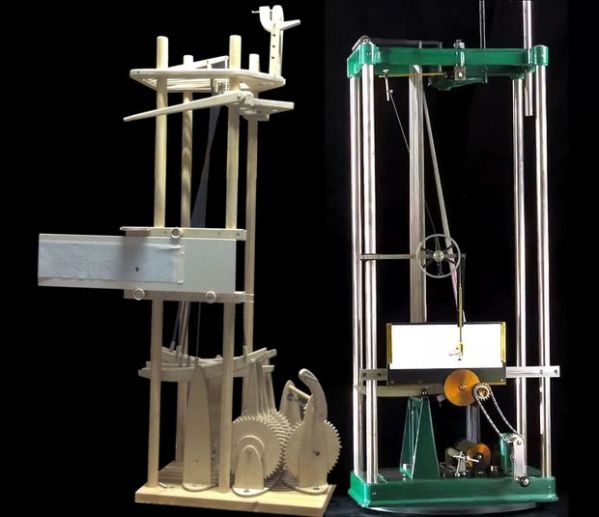
Fourier Machine Mimics Michelson Original In Plywood

It’s funny how creation and understanding interact. Sometimes the urge to create something comes from a new-found deep understanding of a concept, and sometimes the act of creation leads to that understanding. And sometimes creation and understanding are linked together in such a way as to lead in an entirely new direction, which is the story behind this plywood recreation of the Michelson Fourier analysis machine.

For those not familiar with this piece of computing history, it’s worth watching the videos in our article covering [Bill “The Engineer Guy” Hammack]’s discussion of this amazing early 20th-century analog computer. Those videos were shown to [nopvelthuizen] in a math class he took at the outset of degree work in physics education. The beauty of the sinusoids being created by the cam-operated rocker arms and summed to display the output waveforms captured his imagination and lead to an eight-channel copy of the 20-channel original.

Working with plywood and a CNC router, [nopvelthuizen]’s creation is faithful to the original if a bit limited by the smaller number of sinusoids that can be summed. A laser cutter or 3D printer would have allowed for a longer gear train, but we think the replica is great the way it is. What’s more, the real winners are [nopvelthuizen]’s eventual physics students, who will probably look with some awe at their teacher’s skills and enthusiasm.

Continue reading “Fourier Machine Mimics Michelson Original In Plywood”

Get Your Game On: Troy’s TVCoG Hosts VR And Gaming Hackathon

Troy New York’s Tech Valley Center of Gravity is following up their January IoT Hackathon with another installment. The April 16-17 event promises to be a doozy, and anyone close to the area with even a passing interest in gaming and AR/VR should really make an effort to be there.

Not content to just be a caffeine-fueled creative burst, TVCoG is raising the bar in a couple ways. First, they’re teaming up with some corporate sponsors with a strong presence in the VR and AR fields. unspecifiedDaydream.io, a new company based in the same building as the CoG, is contributing a bunch of its Daydream.VR smartphone headsets to hackathon attendees, as well as mentors to get your project up and running. Other sponsors include 1st Playable Productions and Vicarious Visions, game studios both located in the Troy area. And to draw in the hardcore game programmers, a concurrent Ludum Dare game jam will be run by the Tech Valley Game Space, with interaction and collaboration between the AR/VR hackers and the programmers encouraged. Teams will compete for $1000 in prizes and other giveaways.

This sounds like it’s going to be an amazing chance to hack, to collaborate, and to make connections in the growing AR/VR field. And did we mention the food? There was a ton of it last time, so much they were begging us to take it home on Sunday night. Go, hack, create, mingle, and eat. TVCoG knows how to hackathon, and you won’t be disappointed.

Thanks to [Duncan Crary] for the heads up on this.


Think Globally, Build Locally With These Open-Source Recycling Machines

Walk on almost any beach or look on the side of most roads and you’ll see the bottles, bags, and cast-off scraps of a polymeric alphabet soup – HDPE, PET, ABS, PP, PS. Municipal recycling programs might help, but what would really solve the problem would be decentralized recycling, and these open-source plastics recycling machines might just jump-start that effort.

We looked at [Precious Plastic] two years back, and their open-source plans for small-scale plastic recycling machines have come a long way since then. They currently include a shredder, a compression molder, an injection molder, and a filament extruder. The plans specify some parts that need to be custom fabricated, like the shredder’s laser-cut stainless steel teeth, but most can be harvested from a scrapyard. As you can see from the videos after the break, metal and electrical fabrication skills are assumed, but the builds are well within the reach of most hackers. Plans for more machines are in the works, and there’s plenty of room to expand and improve upon the designs.

We think [Precious Plastic] is onto something here. Maybe a lot of small recyclers is a better approach than huge municipal efforts, which don’t seem to be doing much to help.  Decentralized recycling can create markets that large-scale manufacturing can’t be bothered to tap, especially in the developing world. After all, we’ve already seen a plastic recycling factory built from recycled parts making cool stuff in Brazil.

Continue reading “Think Globally, Build Locally With These Open-Source Recycling Machines”