
Engineering Meets Craftsmanship In This Guitar Fretting Jig

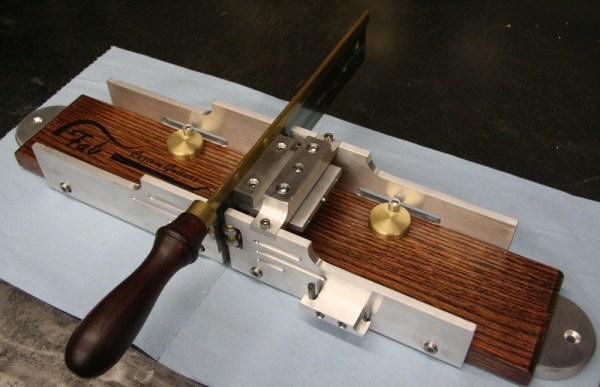
178-440Cutting the slots in a guitar’s neck for the frets requires special tooling, and [Gord]’s contribution to his friend’s recent dive into lutherie was this lovingly engineered and crafted fret mitering jig. We’d love to have a friend like [Gord].

We’ve covered a number of [Gord]’s builds before, and craftsmanship is the first thing that comes to mind whether the project is a man-cave clock or artisanal soaps. For this build, he stepped up the quality a notch – after all, if you’re going to build something you could buy for less than $200, you might as well make it a thing to behold.

There’s plenty to feast the eyes on here – an oak bed with custom logo, the aluminum jig body with brass accents, and the precision bearings that guide the pricey backsaw. Functionality abounds too – everything is adjustable, from the depth of cut to the width of the saw blade. There’s even a place to store the adjustment tool.

The result? Well, let’s just say that [Gord] and his friend [Fabrizio] are kindred spirits in the craftsmanship department. And [Fab]’s not a bad axeman either, as the video below shows.

Continue reading “Engineering Meets Craftsmanship In This Guitar Fretting Jig”

USB Soldering Iron Is Surprisingly Capable

We know what you’re thinking. There’s no way an 8 watt USB-powered soldering iron could be worth the $5 it commands on eBay. That’s what [BigClive] thought too, so he bought one, put the iron through a test and teardown, and changed his mind. Can he convince you too?

Right up front, [BigClive] finds that the iron is probably not suitable for some jobs. Aside its obvious unsuitability for connections that take a lot of heat, there’s the problem of leakage current when used with a wall-wart USB power supply. The business end of the iron ends up getting enough AC leak through the capacitors of the power supply to potentially damage MOSFETs and the like. Then again, if you’re handy to an AC outlet, wouldn’t you just use a Hakko? Seems like the iron is best powered by a USB battery pack, and [BigClive] was able to solder some surprisingly beefy connections that way. The teardown and analysis reveal a circuit that looks like it came right out of a [Forrest M. Mims III] book. We won’t spoil the surprise for you – just watch the video below.

While not truly cordless like this USB-rechargeable iron, we’d say that for the price, this is a pretty capable iron for certain use cases. Has anyone else tried one of these? Chime in on the comments and let us know what you think.

Continue reading “USB Soldering Iron Is Surprisingly Capable”

Energy Monitor Optically Couples To Smart Meter

Hackers love to monitor things. Whether it’s the outside temperature or the energy used to take a shower, building a sensor and displaying a real-time graph of the data is hacker heaven. But the most interesting graphs comes from monitoring overall power use, and that’s where this optically coupled smart-meter monitor comes in.

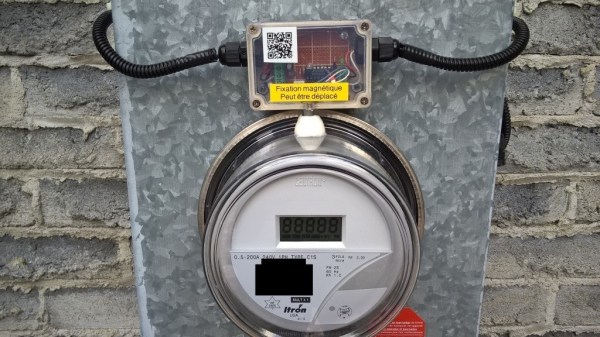
[Michel]’s meter reader is pretty straightforward. His smart wattmeter is equipped with an IR LED that pips for every watt-hour consumed, so optical coupling was a natural approach. The pulse itself is only 10 ms wide, so he built a pulse stretcher to condition the pulse for a PIC microcontroller. The PIC also reads the outside temperature with a DS18B20 and feeds everything to the central power monitor, with an LCD display and a classic Simpson meter to display current power usage. The central monitor sends the power and temperature data to Thingspeak, along with data from [Michel]’s wood-stove monitor and a yet-to-be-implemented water heater monitor.

[Michel] is building out an impressive suite of energy and environmental monitors for his Quebec base of operations. We’re looking forward to seeing how he monitors that water heater, and to see what other ideas he comes up with.

Continue reading “Energy Monitor Optically Couples To Smart Meter”

Camera Slider Helps Get The Shots With E-Waste Controller

A camera slider is an accessory that can really make a shot. But when your business is photography rather than building camera accessories, quick-and-dirty solutions often have to suffice. Thus the genesis of this camera slider controller.

The photographer in question in [Paulo Renato], and while his passion may be photography, he seems to have a flair for motorized dollies and sliders. This controller is a variable-speed, reversible, PIC-based design that drives an eBay gearmotor. The circuit lives on a scrap of perfboard, and it along with batteries and a buck converter are stuffed into the case-modded remains of an old KVM switch. Push buttons salvaged from another bit of e-waste act as limit switches, and a little code provides the magic. We like the hacked nature of the controller, but we wonder about the wisdom of using the former KVM’s USB ports to connect the controller to the drivetrain; it’s all fun and games until you plug a real USB device into it. In sum, though, a nice build with nice results. Check out his other videos for more on the mechanicals.

Camera slider rigs aplenty have graced our pages, including one made mostly of wood and one controlled by a fancy iPad app.

Continue reading “Camera Slider Helps Get The Shots With E-Waste Controller”

Nixie Timer Is Easy To Read Across The Kitchen

Nixie clocks. Nixie power meters. Nixie thermometers, speedometers, and even Nixies for personal adornment. Is there anything that hasn’t been Nixie-fied? How about a Nixie kitchen timer? Beyond the Nixie tube, this is a great build. Check out the video below the break.

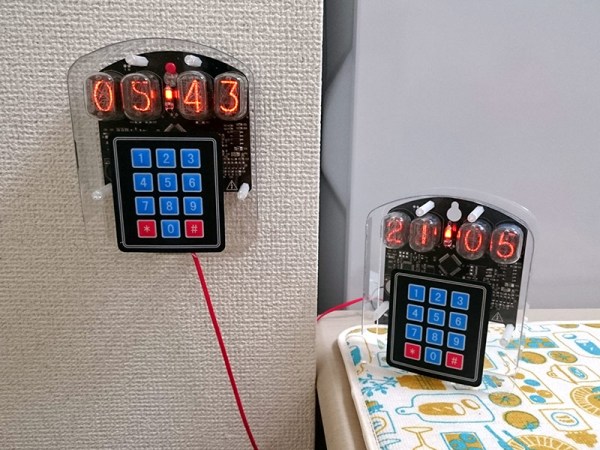
As so often happens with Nixie aficionados, [Kouichi Kuroi] started with tubes and searched for a project to use them on. A wonky kitchen timer provided the thinly veiled excuse for the build – after all, anyone can drop a couple of yen on a commercial replacement, right? The timer features four IN-12 tubes and a large numeric keypad up front on a laser-cut acrylic case. For those who quibble with the keypad’s aesthetics and the wisdom of a Nixie project in the kitchen environment, [Ko] points out that an IP65 keypad would have more than doubled the price of the build, and a little common sense goes a long way to keeping the high-voltage side from meeting anything wet. In addition to countdown capability, the timer can also act as a stopwatch and display the time of day, and the Nixie tubes provide great visibility compared to seven-segment LCD timers.

As for the aforementioned Nixie projects, here’s a clock, power meter, thermometer, speedometer and necklace that we’ve featured before. What’s next for Nixies? We don’t know, but we’re keen to see what you come up with.

Continue reading “Nixie Timer Is Easy To Read Across The Kitchen”

Hacking When It Counts: POW Canteen Radios

Of all the horrors visited upon a warrior, being captured by the enemy might count as the worst. With death in combat, the suffering is over, but with internment in a POW camp, untold agonies may await. Tales of torture, starvation, enslavement and indoctrination attend the history of every nation’s prison camps to some degree, even in the recent past with the supposedly civilizing influence of the Hague and Geneva Conventions.

But even the most humanely treated POWs universally suffer from one thing: lack of information. To not know how the war is progressing in your absence is a form of torture in itself, and POWs do whatever they can to get information. Starting in World War II, imprisoned soldiers and sailors familiar with the new field of electronics began using whatever materials they could scrounge and the abundance of time available to them to hack together solutions to the fundamental question, “How goes the war?” This is the story of the life-saving radios some POWs managed to hack together under seemingly impossible conditions.

Continue reading “Hacking When It Counts: POW Canteen Radios”

Custom Media Player Helps Hacker’s Autistic Son

Getting to play with technology is often the only justification a hacker needs to work on a build. But when your build helps someone, especially your own special-needs kid, hacking becomes a lot more that playing. That’s what’s behind this media player customized for the builder’s autistic son.

People generally know that the symptoms of autism cover a broad range of behaviors and characteristics that center around socialization and communication. But a big component of autism spectrum disorders is that kids often show very restricted interests. While [Alain Mauer] doesn’t go into his son [Scott]’s symptoms, our guess is that this media player is a way to engage his interests. The build came about when [Alain] was unable to find a commercially available media player that was simple enough for his son to operate and sturdy enough to put up with some abuse. A Raspberry Pi came to the rescue, along with the help of some custom piezo control buttons, a colorful case, and Shin Chan. The interface allows [Scott] to scroll through a menu of cartoons and get a preview before the big show. [Scott] is all smiles in the video below, and we’ll bet [Alain] is too.

Pi-based media player builds are a dime a dozen on Hackaday, but one that helps kids with autism is pretty special. The fact that we’ve only featured a few projects aimed at autistics, like this 2015 Hackaday Prize entry, is surprising. Maybe you can come up with something like [Alain]’s build for the 2016 Hackaday Prize.

Continue reading “Custom Media Player Helps Hacker’s Autistic Son”