A JavaScript OS For The ESP32

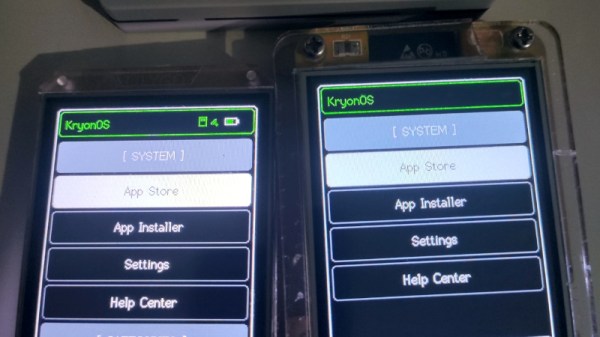
Given the incredible power of modern microcontrollers, we’ve seen quite a few attempts to turn them into more general purpose computers over the years. KryonOS from [Haris] is the latest, and it takes a slightly different path from the norm in that it’s a JavaScript based operating system for the ESP32.

It takes the form of an OS with a simple GUI and graphics library, and a built-in JavaScript runtime interpreter. It runs on a wide variety of ESP32 boards with screens, including the ubiquitous Cheap Yellow Display. It has full access to the SD card filesystem, and an API for using the hardware. Perhaps most interestingly it has an app store for downloadable software, which immediately reminds us of Europe’s Badge.Team. Their SHA2017 badge spawned a succession of devices that continues to this day, and offered a similar experience using Python.

We like this project, and think it has potential due to the ease of JavaScript development for so many people used to working with the web. There was a time when Python running on microcontrollers sounded pretty far fetched, and look where we are now.
A Computer Terminal The Old Way

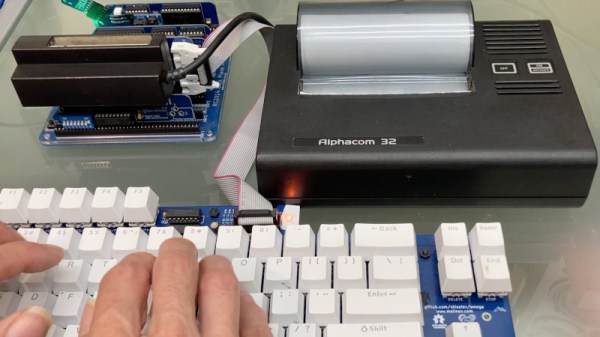
Here in 2026 if we need a terminal the chances are we fire one up on our computer and continue on our way without a thought. What we are doing of course is emulating the experience of earlier hardware terminals, ones with a serial port on the back, a keyboard, a screen, or if they are a bit older, a teletype printer. [Sheila Dixon] is recreating that experience for the RC2014 retrocomputer, and she’s using some period-appropriate hardware and techniques.

Perhaps the most obvious thing about her build is her choice of printer. Sir Clive released a notoriously bad thermal printer for the ZX81, and it wasn’t long before a third-party alternative appeared in the form of the Alphacom. This printer connected directly to the ZX’s bus via its expansion port, and like the Sinclair printer, was serviced by ROM routines linked to BASIC commands. This is joined by a keyboard, first an MSX item, and then one she’s made with some retro typewriter keycaps.

She’s interfaced her Alphacom to the RC2014’s Z80 bus in the same way as it would be with the ZX81, and with a few teething troubles created some routines in a ROM to drive it as though it was the RC2014 terminal output. The keyboard is scanned using an 8255 I/O port card, much as it might have been back in the day.

If you’re curious about the Sinclair printer, we used one (without harming it!) for an April Fools’ joke during the pandemic. Meanwhile we have reviewed more than one RC2014 model, the most recent one being in 2019.

The RP2350 Does 1080p

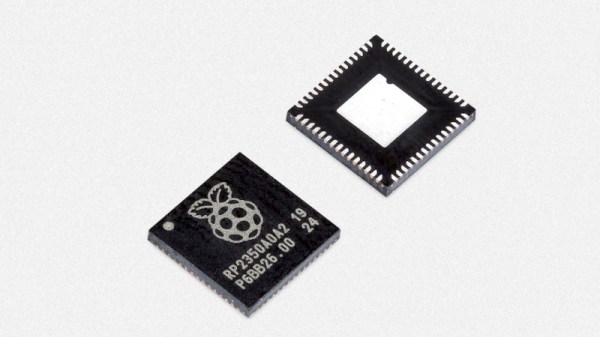
Coaxing a DVI signal out of a microcontroller to drive a DVI or HDMI screen has been possible for a while now, but limitations in what the devices can do has, in turn, placed a limit on the resolution that can be delivered. Now [Aaron Gayle] has broken through a barrier by generating 1080p video from an RP2350. The previous best from Raspberry Pi Pico-class microcontrollers was 720p, which an RP2040 could deliver. The 2350 is faster and has faster peripherals, but even then, to reach this resolution he had to overclock it to 372 MHz. For all the impressive achievement, there’s still a limitation. Lacking space for a framebuffer, he generates scanline by scanline, a technique we associate more with 8-bit computers from the 1980s.

The 1080p video code is part of a package called TVtop, a board game in which the game board is displayed on the TV and whose players interact from their phones via Wi-Fi. For that reason, there’s an ESP32 in the project too, though it has nothing to do with the video hack.

Continue reading “The RP2350 Does 1080p” →

The Sinclair Spectrum Gets A Desktop GUI

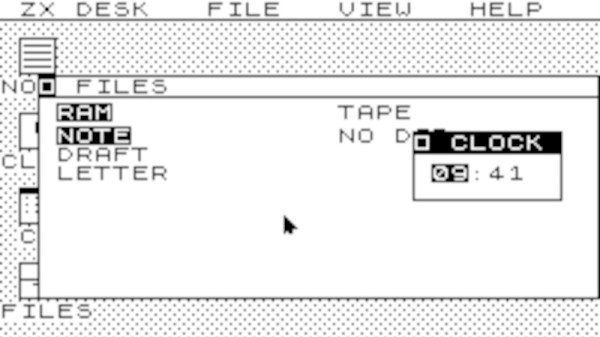
Of the popular 1980s 8-bit computers, it’s fair to say that Sinclair’s ZX Spectrum punched above its weight. Sir Clive’s love of squeezing more functionality out of less hardware meant the compromises he made left it less powerful than competitors from Apple, Commodore, or Acorn. Still, the brightest programmers of the age took the little machine to heart and made it do some very impressive things. A desktop GUI, though, surely that would be pushing things too far. Never say never because now [mindbox77] has done it.

ZXdesk is an assembly language program for the 48k Spectrum that gives you something that looks a lot like GEM. It’s got all the things you’d expect from a desktop GUI, with menus, windows, and applications, and we find ourselves suitably impressed.

Continue reading “The Sinclair Spectrum Gets A Desktop GUI” →

A Bandpass Filter Pulls In The Signals

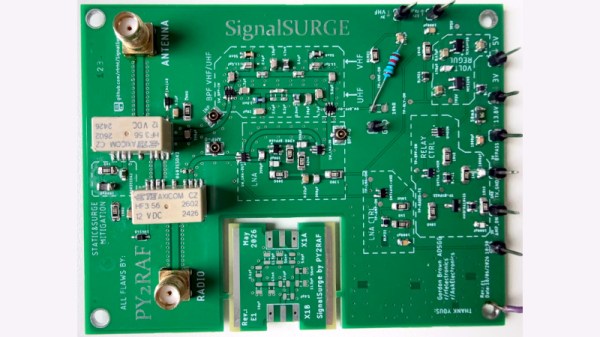
It’s an unfortunate side effect of proximity to a large transmitter that the received signal can overload a receiver’s front end even when tuned to other frequencies. [Rfrht]’s had this problem with nearby FM broadcast transmissions overloading the 2 metre and 70 centimetre amateur bands. The solution?  Design and build a bandpass filter. This allows the signals you want to pass through while rejecting or attenuating out-of-band frequencies. The resulting PCB is very nice indeed.

On board, aside from the filters themselves, are a low-noise preamplifier and relays to switch between receive and transmit. Everything is controlled by logic-level signals. All components are surface-mount, and the PCB layout clearly takes special care with RF routing.

Continue reading “A Bandpass Filter Pulls In The Signals” →

A Hotspot Becomes A Handheld

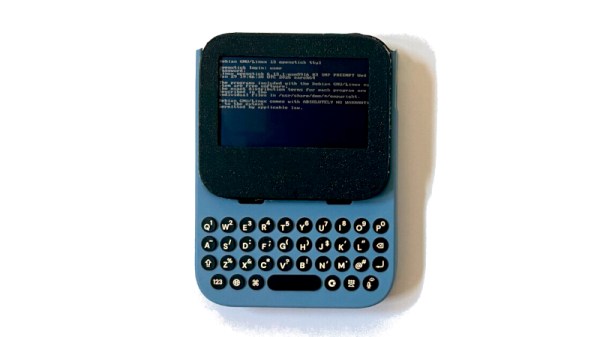
A Linux handheld computer is, in theory, easy and inexpensive given the availability of single-board computers, but in practice the budget invariably edges well into three figures. There’s an interesting alternative from [bkovac] that won’t break the bank as much, using a cheap 4G wireless hotspot, an iPhone USB keyboard case accessory, and, though a cheaper display could suffice, a fancy Adafruit Sharp memory display.

The hotspot is available from AliExpress for around 20 dollars/Euros/pounds, and it’s referred to by its model number, MF800. It’s powered by a Qualcomm MSM8916, also known as the Snapdragon 410, which you might have found in a budget cellphone early in the last decade. Importantly, though, it’s supported by mainstream Linux, and while it’s by no means the fastest on the block, it can be a poor man’s alternative to a Raspberry Pi. It comes with a small SPI display, but this project replaces it with a much bigger Sharp SPI memory display.

Continue reading “A Hotspot Becomes A Handheld” →

The Concertina Goes Electronic

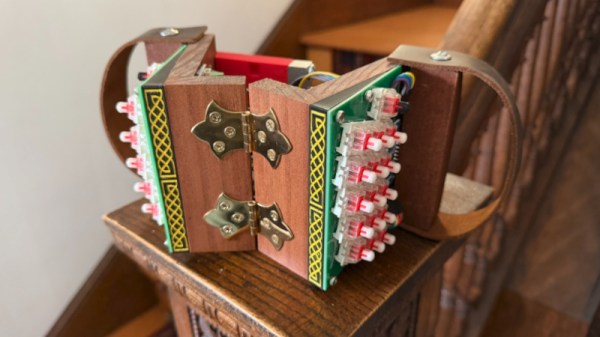
The concertina is an instrument that features heavily in European folk music, of which there are a variety of types. [Xcott Craver] has built one, an anglo concertina of the type you may recognise accompanying sea shanties, but this is no ordinary squeezebox. Instead it’s an electronic concertina, and it’s a project with a significant attention to detail.

Perhaps the most obvious thing most of us know about a concertina is that it’s an instrument with two ends separated by a set of bellows, and manipulation of the bellows lends a lot to the music it produces. This instrument doesn’t have bellows, but its innovation is to simulate them through means of a load cell. The two sides of the wooden chassis are fixed, but the force exerted on them is measured.

The keys are Cherry MX switches with custom keycaps, mounted on a pair of PCBs. Driving the whole thing is a Teensy 4.0, and to avoid unfortunate accidents with ripped-out connectors there’s a USB extension lead as a bit of strain relief. You can hear the result in the video below.

This is like no other instrument we’ve seen here, though we’ve had a few electronically enhanced conventional concertinas and accordions. We like it for its interesting design.

Continue reading “The Concertina Goes Electronic” →