A Novel 555 Circuit In 2026

The humble NE555 has been around for over five decades now, and while during that time we’ve seen a succession of better and faster versions of the original, the circuits which surround it are pretty well known. ThereĀ can’t be anything new in the world of 555s, can there? [Stephen Woodward] claims he’s made a novel 555 circuit, with his 1 MHz linear voltage to frequency converter. Since he’s been in love with the 555 since 1974, we’re inclined to trust him on this part.

It’s visibly the 555 astable oscillator we’re all familiar with, given the addition of a current source in place of the normal charging resistor. This makes for a much more linear sawtooth waveform, but it still doesn’t fix the linearity of the voltage to frequency curve. The novel bit comes in adding an extra resistor between the threshold and discharge pins, with a value calculated for a time constant with the capacitor to match the 555’s own switching delay. This provides the necessary compensation, and gives the circuit its linearity.

This is so brilliantly simple that it’s almost a shock that it’s new, but it’s also a great example of the old-school electronic engineer’s art. We can’t think of an immediate need for a 555 voltage to frequency converter on the Hackaday bench at the moment, but you can bet we’ll come back to this one if we do.

We had someone pushing a newer 555 variant to its limit, when we ran our component abuse challenge.

An Oscilloscope The Way They Used To Be

It’s likely that Hackaday has a readership with the highest percentage of oscilloscope ownership among any in the world, and we’re guessing that most of you who fit in that bracket have a modern digital instrument on your bench. It’s a computer with a very fancy analogue front end, and the traces are displayed in software. Before those were a thing though, a ‘scope was an all-analogue affair, with a vacuum-tube CRT showing the waveform in real time. [Joshua Coleman] has made one of these CRT ‘scopes from scratch, and we rather like it.

Using a vintage two inch round tube, it includes all the relevant power supplies and input amplifiers for the deflection plates. It doesn’t include the triggers and timebase circuitry you’d expect from a desktop instrument though, so unless you add a sawtooth on its X input it’s only good for some Lissajous figures. But that’s not the point of a project like this one, because it’s likely even the cheapest of modern ‘scopes way exceeds any capabilities it would have even if it were fully formed. It’s a talking point and an attractive demonstration of a bit of early-20th-century physics, which probably many of us would appreciate if it were ours.

A video of the device is below the break, meanwhile we’ve taken a look in the past at the prehistory of the oscilloscope.

Continue reading “An Oscilloscope The Way They Used To Be”

The Most Intricate Of Freeform Digital Clocks

Digital clock projects have been with us since the 1970s, when affordable LEDs and integrated circuits became available. In 2026 most of them use a microcontroller, but for the AliExpress fans there’s one that goes straight back to the ’70s with a pile of logic chips. You can make it on the supplied PCBs, but that wasn’t for [ALTco]. Instead, he made the circuit in free form, using six metres of brass wire.

The construction is anchored together by a set of busbars that carry sockets for a set of seven-segment and driver modules. The circuit is typical for the day, with a crystal oscillator and divider chain feeding the counters for the displays. There are a few clever tricks that older engineers might recognize in order to reduce the chip count. In this case that’s negated by an extra set of circuitry allowing the time to be set from a rotary encoder.

We’re impressed by the intricacy of the device, made bit by bit without a plan, it as some wires what thread their way between others. It’s a truly beautiful piece, and it reminds us of our circuit sculpture contest back in 2020.

Continue reading “The Most Intricate Of Freeform Digital Clocks”

The 3DFX Voodoo Lives Again In An FPGA

The 3DFX Voodoo was not the first dedicated 3D graphics chipset by any means, but it became the favourite for gamers among the early mass-market GPUs. It would be found on a 3D-processing-only PCI card that sat on the feature connector of your SVGA card. The Voodoo took any game that supported its Glide API into the world of (for the time) smooth and beautiful 3D. They’re worth a bit now, but if you don’t fancy forking out for mid-’90s silicon in 2026, there’s another option. [Francisco Ayala Le Brun] has implemented the 3DFX Voodoo 1 in SpinalHDL for FPGAs.

Continue reading “The 3DFX Voodoo Lives Again In An FPGA”

ESP32: When Is A P4 A P4, But Not The P4 You Thought It Was

We’re used to electronic parts of the same type staying predictably the same, sometimes over many years. An early Z80 from the mid 1970s can be exchanged with one from the end of production a few years ago, for example. This week, we’ve had DMs from several readers who’ve found that this is not always the case, and the culprit is surprising. Espressif has released a new revision of their P4 application processor, and though it’s ostensibly the same, there are a couple of changes that have been catching people out.

The changes lie in both hardware and software, in that there’s a pin that’s changed from NC to a power rail, a few extra passives are needed, and firmware must be compiled separately for either revision. The problem is that they are being sold as the same device and appear in some places under the same SKU! This is leading to uncertainty as to which P4 revision is in stock at wholesalers. We’ve been told about boards designed for the old revision being assembled with the new one, a situation difficult to rework your way out of. Designers are also left uncertain as to which firmware build is needed for boards assembled in remote factories.

The ESP32-P4 is an impressive part for its price, and we’re sure that we’ll be seeing plenty of projects using this new revision over the coming years. We’re surprised that it doesn’t have a different enough part number and that the wholesalers have seemingly been caught napping by the change. We’re told that some of the well-known Chinese assembly houses are now carrying the two chips as separate SKUs, but that’s scant consolation for a designer with a pile of boards carrying the wrong part. If you’re working with the P4, watch out, make sure your board is designed for the latest revision, and ask your supplier to check which chips you’ll get.

If the P4 is new to you, we’ve already seen a few projects using it.

Hackaday Podcast Episode 362: Compression Molding, IPv4x, And Wired Headphones

As the sun goes down on a glorious spring evening on the western edge of Europe, Elliot Williams is joined by Jenny List for a look at the week in all things Hackaday.

First up: Hackaday Europe tickets are on sale! Bad luck folks, the early bird tickets disappeared in an instant, but regular ones are still available for now. We’re really looking forward to making our way to Lecco for a weekend of hacks, and it would be great to see you there too.

Then we have a new feature for the podcast, the Hackaday Mailbag. This week’s contribution comes from [Kenny], a longtime friend of Hackaday and probably our most regular conference attendee.

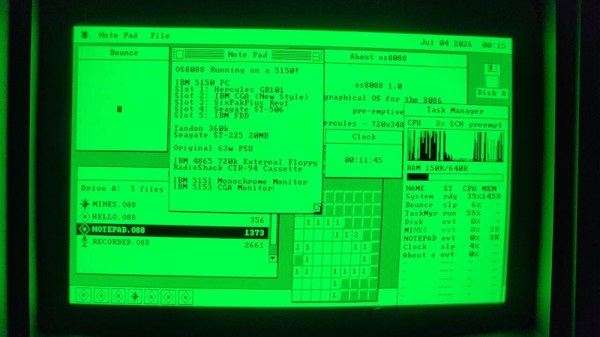
To the hacks, and we have some good ones. An air hockey robot might not seem like a challenge, but the engineering which went into [BasementBuilds’] one proves it’s not a job for the faint hearted. Then we look at compression molding of recycled plastic using 3D-printed molds, something that seems surprisingly accessible and we’d like to try, too. We’ve got a new DOS, a 3D-printed zipper repair, the IPv4 replacement we didn’t get, and the mind-bending logic of ternary computing. It’s one of those weeks where the quick hacks could all deserve their own in-depth look, but perhaps the stand-outs are and Arduino style compiler that includes the source code compressed within the binary, and a beautifully-done revival of a 1980s brick cellphone as a modern 5G unit.

Finally in the longer reads we’ve got an examination of wired versus Bluetooth headphones — we’re both in the wired camp — and a look back at the age of free dialup. As is so often the case, the experience there differed between Brits and Americans. Anyway, enjoy the episode, and we have another week to look forward to.

Download your own personal copy of the Podcast in glorious 192 kB MP3.

Continue reading “Hackaday Podcast Episode 362: Compression Molding, IPv4x, And Wired Headphones”

Reading The World’s Smallest Hard Drive

You have a tiny twenty-year-old hard drive with a weird interface. How do you read it? If you’re [Will Whang], by reverse engineering, and building an interface board.

In many of our portable, mobile, and desktop computers, we’re used to solid-state storage. It’s fast and low power, and current supply-chain price hikes notwithstanding, affordable in the grand scheme of things. It wasn’t always this way though, a couple of decades ago a large flash drive was prohibitively expensive. Hard drive manufacturers did their best to fill the gap with tiny spinning-rust storage devices which led to the smallest of them all: the Toshiba MK4001MTD. It crammed 4 GB onto a 0.85″ platter, and could be found in a few devices such as high-end Nokia phones.

Breaking out the Nokia’s hard drive interface.

The drive’s connector is a pattern of pads on a flexible PCB, one he couldn’t help noticing had a striking resemblance to an obscure SD card variant. Hooking it up to an SD reader didn’t work unfortunately, so a battered Nokia was called into service. It was found to be using something electrically similar to the SD cards, but with the ATA protocol familiar from the world of full-size hard drives.

The interface uses the PIO capability of the RP2040, and the board makes a tidy peripheral in itself. We’re guessing not many of you have one of these drives, but perhaps if you do, those early 2000s phone pics aren’t lost for good after all.

These drives are rare enough that this is the first time we’ve featured one here at Hackaday, but we’ve certainly ventured into hard drive technology before.