Writing On A Whiteboard, Performed By A Robot

For some of us here at Hackaday, school is but a very distant memory. All that teenage awkwardness we’d rather forget, synth pop, and 8-bit computers were cool the first time around, and our newer classrooms didn’t have blackboards any more. The Whiteboard Future Had Arrived, and it came with solvent-laden pens that our more rebellious classmates swore would get you high if you sniffed them for long enough. Innocent times. Kids nowadays probably get their lessons from iPads, but the whiteboard isn’t finished just yet. [f4hdk] has updated his board with Scribot, a whiteboard-writing robot arm driven by a couple of stepper motors and a nicely-engineered set of belts, that writes text from ASCII files in a custom-designed vector font.

At the end of the arm is a whiteboard marker, and in a neat twist it has an eraser on its rear end. A quick flip of the servo holding the marker, and it can rub out any of its work. Behind it all is an LPC1789 Cortex M3-based Mbed board with appropriate servo driver boards, and for those curious enough to take a second look there is a full code repository. The result as you can see in the video below the break is a very well-executed whiteboard writer. Your 1980s teacher might have grumbled at the new technology, but certainly couldn’t accuse it of doing a bad job!

Continue reading “Writing On A Whiteboard, Performed By A Robot”

First Lithographically Produced Home Made IC Announced

It is now six decades since the first prototypes of practical integrated circuits were produced. We are used to other technological inventions from the 1950s having passed down the food chain to the point at which they no longer require the budget of a huge company or a national government to achieve, but somehow producing an integrated circuit has remained out of reach. It’s the preserve of the Big Boys, move on, there’s nothing to see here.

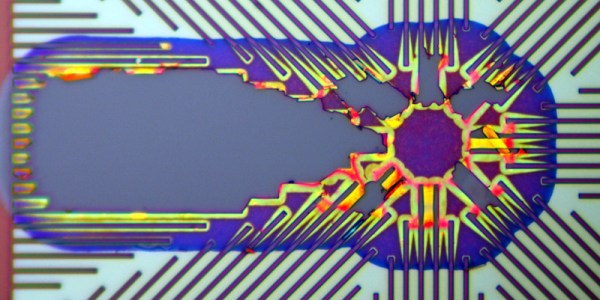
Happily for us there exists a dedicated band of experimenters keen to break that six-decade dearth of home-made ICs. And now one of them, [Sam Zeloof], has made an announcement on Twitter that he has succeeded in making a dual differential amplifier IC using a fully lithographic process in his lab. We’ve seen [Jeri Ellsworth] create transistors and integrated circuits a few years ago and he is at pains to credit her work, but her interconnects were not created lithographically, instead being created with conductive epoxy.

For now, all we have is a Twitter announcement, a promise of a write-up to come, and full details of the lead-up to this momentous event on [Sam]’s blog. He describes both UV lithography using a converted DLP projector and electron beam lithography using his electron microscope, as well as sputtering to deposit aluminium for on-chip interconnects. We’ve had an eye on his work for a while, though his progress has been impressively quick given that he only started amassing everything in 2016. We look forward to greater things from this particular garage.

An FM Transceiver From An Unexpected Chip

The Si47xx series of integrated circuits from Silicon Labs is a fascinating series of consumer broadcast radio products, chips that apply SDR technologies to deliver a range of functions that were once significantly more complex, with minimal external components and RF design trickery.  [Kodera2t] was attracted to one of them, the Si4720, which boasts the unusual function of containing both a receiver and a transmitter for the FM broadcast band and is aimed at mobile phones and similar devices that send audio to an FM car radio. The result is a PCB with a complete transceiver controlled by an ATmega328 and sporting an OLED display, and an interesting introduction to these devices.

The Si4720 internal block diagram, from its data sheet.

A look at the block diagram from the Si4720 reveals why it and its siblings are such intriguing devices. On-chip is an SDR complete in all respects including an antenna, which might set the radio enthusiasts among the Hackaday readership salivating were it not that the onboard DSP is not reprogrammable for any other purpose than the mode for which the chip is designed. The local oscillator also holds a disappointment, being limited only to the worldwide FM broadcast bands and not some of the more useful or interesting frequencies. There are however a host of other similar Silicon Labs receiver chips covering every conceivable broadcast band, so the experimenter at least has a good choice of receivers to work with.

If you need a small FM transmitter and have a cavalier attitude to spectral purity then it’s easy enough to use a Raspberry Pi or just build an FM bug. But this project opens up another option and gives a chance to experiment with a fascinating chip.

Got A Burning Idea For An EMF Camp Presentation? Now’s Your Chance!

Sometimes the world of tech conference presentations can seem impossibly opaque, a place in which there appears to be an untouchable upper echelon of the same speakers who pop up at conference after conference. Mere mortals can never aspire to join them and are destined to forever lurk in the shadows, their killer talk undelivered.

Thankfully, our community is not like that. There is a rich tradition of events having open calls for participation, and the latest we’d like to bring to your attention comes from the British EMF Camp, to be held at the end of August. EMF, (standing for ElectroMagnetic Field) is a 3-day festival that bills itself as “for those with an inquisitive mind or an interest in making things“. In their call for participation, they are seeking installations and performances as well as talks and workshops, and it’s worth saying given the very quick uptake of their early ticket sales, that a couple of tickets will be reserved for purchase by each person with proposals that are accepted.

EMF Camp like other hacker camps is an extraordinary coming together of people from all conceivable backgrounds and interest groups to share a field for three days. It doesn’t matter how experienced you are, what the subject is that you would like to present, or what installation or workshop you would like to bring, there will be a section of the EMF audience who would be very interested to see it. They list a few previous topics, from genetic modification to electronics, blacksmithing to high-energy physics, reverse engineering to lock picking, computer security to crocheting, and quadcopters to brewing. Assuming that certain submissions are accepted, you may also see a Hackaday scribe delivering a talk.

While you’re thinking of what to submit for 2018, whet your appetite with a look at the goings-on from EMF 2016.

Image: Nottingham Hackspace [CC BY-SA 2.0].

Fast LED Matrix Graphics For The ESP32

Many of you will have experimented with driving displays from your microcontroller projects, and for most people that will mean pretty simple status information for which you’d use standard libraries and not care much about their performance. If however any of you have had the need for quickly-updating graphics such as video or game content, you may have found that simpler software solutions aren’t fast enough. If you are an ESP32 user then, [Louis Beaudoin] may have some good news for you, because he has ported the SmartMatrix library to that platform. We’ve seen his demo in action, and the results as can be seen in the video below the break are certainly impressive.

In case you are wondering what the SmartMatrix library is, it’s an LED matrix library for the Teensy. [Louis]’s port can be found on GitHub, and as he was explaining to us over a beer at our Cambridge bring-a-hack, it takes extensive advantage of the ESP32’s DMA capabilities. Making microcontrollers talk with any sort of speed to a display is evidently a hot topic at the moment, [Radomir Dopieralski]’s talk at our Dublin Unconference a few weeks ago addressed the same topic.

We have to admit a soft spot for LED panels here at Hackaday, and given the ESP32’s power we look forward to writing up the expected projects that will come our way using this library.

Continue reading “Fast LED Matrix Graphics For The ESP32”

This Vapour Deposition Chamber Isn’t Vapourware

If you are an astronomer with an optical reflecting telescope, the quality of your mirror is one of your most significant concerns. Large observatories will therefore often have on-site vapour deposition plants to revitalise their reflectors by depositing a fresh layer of aluminium upon them. You might think that such a device would be the preserve only of such well-funded sites, but perhaps [Michael Koch]’s work will prove you wrong. He’s created his own vapour deposition system (Google Translate link of the German original) from scratch, and while it might be smaller than the institutional equivalents it is no less effective in its task.

At the heart of it is a stainless steel vacuum vessel with a two stage vacuum pump system to evacuate it. The mirror to be silvered is suspended in the vessel, and a piece of aluminium is suspended over a coil of tungsten wire that his electrically heated to melt it. The molten aluminium is described as “wetting” the tungsten wire in the same manner as we’ll be used to solder working on copper, but in the vacuum it vaporizes and deposits itself upon the mirror. Such a simple description glosses over the impressive work that went into it.

This is a long-running project that isn’t entirely new, but very much worth a look if only for its introduction to this fascinating field. If you are new to vacuum work, how about looking at a Superconference presentation introducing vacuum technology?

Thanks [Paul Bauer] for the tip.

When Hackerspace Directors Burn Out

A friend of mine once suggested that there should be a support group for burned-out former hackerspace directors. We could have our own Village of the Damned at summer camps, where we’d sit moodily in the gathering twilight sipping our bourbon and Club Mate and decrying whatever misfortunes came to our space to leave such visible mental scars, or gazing hollow-eyed into the laser-tinged haze and moving gently to the pulse of the chiptune music. “See that’s Jenny over there, she don’t say much“. Hackerspace noir, where the only entry criterion is being crazy enough to stand for election to your space’s board.

You can tell [Dr. Seuss] is thinking about his next volume: <em>How The Grinch Stole Whoville Hackspace</em>. Al Ravenna, World Telegram [Public domain].
You can tell [Dr. Seuss] is thinking about his next volume: How The Grinch Stole Whoville Hackspace. Al Ravenna, World Telegram [Public domain].
There must be spaces somewhere that live in such perfect harmony, in which a happy membership support a board for whom everything falls into place. Maybe the makerspace in [Dr. Seuss]’s Whoville would have that kind of atmosphere, but the reality of life is that every group is made up of both Grinch and Who. Keeping a diverse group of people harmonious is a huge challenge, but that’s what hackerspaces are really about — the people make the space.

There are several defined periods in the gestation of a hackerspace, and at least from where I’m sitting they relate to its member count. Some spaces pass through them all as they grow, while others are lucky enough to reach an equilibrium and spare themselves some of the drama.

If you recognise yourselves in some of the following then you have my commiserations, while if your space hasn’t got there yet or has managed to dodge some of the bullets then consider yourselves lucky.

Continue reading “When Hackerspace Directors Burn Out”