Talk Like A Game Boy, Sting Like A Beep

Have you ever listened to a song and wondered how they created the robotic-sounding vocals? There’s a huge variety of ways to do so. [scythe1005] decided to take their inspiration from rock history, creating a Game Boy powered talkbox (Japanese, Google Translate recommended for those that don’t speak the language).

Human speech is generated when vibrations from the vocal chords are shaped into intelligible sounds by the motion of the mouth, tongue, and other body parts known as “articulators”. A talkbox creates robotic speech sounds by using the articulators while replacing the vibrations from the vocal chords with alternative source.

A talkbox is a device most typically used with the electric guitar. The signal from the electric guitar is amplified and played through a speaker or transducer connected to a tube that is placed in the user’s mouth. The user then proceeds to mouth the desired words they wish to say, with the vibrations provided by the guitar’s signal instead of the vocal chords. A popular example of this is Peter Frampton’s use of the talkbox in Do You Feel Like We Do.

[scythe1005] used the same basic bones in their design, using a Game Boy to feed sound into a basic audio amplifier kit and a transducer connected to a tube. This gives a very 1980s synth sound to the vocals. It’s a simple build in concept but one we haven’t seen a whole lot of before. Using off-the-shelf modules, you could build something similar in a weekend. Also featured in the video is an ArduinoBoy — a useful way of controlling a Game Boy over MIDI. It’s used here to interface the keyboard to the handheld console. Video below the break.

As we’ve seen before, the Game Boy is an incredibly popular platform for music — chiptune artists regularly modify the device for better sound.

Continue reading “Talk Like A Game Boy, Sting Like A Beep”

How To Telepathically Tell A Robot It Screwed Up

Training machines to effectively complete tasks is an ongoing area of research. This can be done in a variety of ways, from complex programming interfaces, to systems that understand commands in natural langauge. A team from MIT’s Computer Science and Artificial Intelligence Laboratory (CSAIL) wanted to see if it was possible for humans to communicate more directly when training a robot. Their system allows a user to correct a robot’s actions using only their brain.

The concept is simple – using an EEG cap to detect brainwaves, the system measures a special type of brain signals called “error-related potentials”. Simply noticing the robot making a mistake allows the robot to correct itself, and for a nice extra touch – blush in embarassment.

This interface allows for a very intuitive way of working with a robot – upon noticing a mistake, the robot is able to automatically stop or correct its behaviour. Currently the system is only capable of being used for very simple tasks – the video shows the robot sorting objects of two types into corresponding bins. The robot knows that if the human has detected an error, it must simply place the object in the other bin. Further research seeks to expand the possibilities of using this automatic brainwave feedback to train robots for more complex tasks. You can read the research paper here.

MIT’s CSAIL work on lots of exciting projects – their video microphone technology is truly astounding.

[Thanks to Adam Connor-Simmons for the tip!]

Reverse Engineering The Smart ForTwo CAN Bus

The CAN bus has become a defacto standard in modern cars. Just about everything electronic in a car these days talks over this bus, which makes it fertile ground for aspiring hackers. [Daniel Velazquez] is striking out in this area, attempting to decode the messages on the CAN bus of his Smart ForTwo.

[Daniel] has had some pitfalls – first attempts with a Beaglebone Black were somewhat successful in reading messages, but led to strange activity of the car and indicators. This is par for the course in any hack that wires into an existing system – there’s a high chance of disrupting what’s going on leading to unintended consequences.

Further work using an Arduino with the MCP_CAN library netted [Daniel] better results, but  it would be great to understand precisely why the BeagleBone was causing a disturbance to the bus. Safety is highly important when you’re hacking on a speeding one-ton metal death cart, so it pays to double and triple check everything you’re doing.

Thus far, [Daniel] is part way through documenting the messages on the bus, finding registers that cover the ignition and turn signals, among others. Share your CAN hacking tips in the comments. For those interested in more on the CAN bus, check out [Eric]’s great primer on CAN hacking – and keep those car hacking projects flowing to the tip line!

Printer Scrap Becomes FPGA Devboard

These days, if you want to start learning about FPGAs, it can be a daunting experience. There’s a huge variety of different platforms and devboards and it can be difficult to know where to start. [RoGeorge] decided to take a different tack. Like a 16-year-old drag racer, he decided to run what he brung – a printer control panel cum FPGA development board (Romanian, get your Google Translate on).

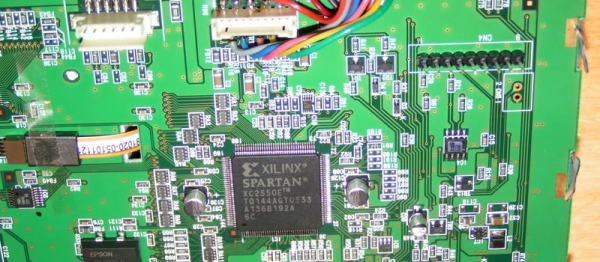
[RoGeorge] was lucky enough to score a couple of seemingly defective control panels from HP Laserjets discarded by his workplace. Seeing potentially good parts going to waste, like keypads and LCDs, he decided to investigate them further – finding a 50,000 gate Xilinx Spartan IIE running the show. Never one to say no to opportunity, [RoGeorge] dived in to learning how to work with FPGAs.

The forum posts are a great crash course in working with this sort of embedded FPGA platform. [RoGeorge] covers initial mapping of the peripherals on the board & finding a JTAG connector and programming solution, before moving on to basic FPGA programming and even covers the differences between sequential programming on microcontrollers and the parallel operation of FPGAs. Even if you don’t intend to get down and dirty with the technology, spend half an hour reading these posts and you’ll be far more knowledgeable about how they work!

In the end, [RoGeorge] showed how to teach yourself to work with FPGAs for the price of a couple of programming cables – not a mean feat by any means. It’s a testament to the hacker spirit, and reminds us of [SpriteTM]’s efforts in hacking hard drive controllers.

What Does A Hacker Do With A Photocopier?

The year is 2016. Driving home from a day’s work in the engineering office, I am greeted with a sight familiar to any suburban dwelling Australian — hard rubbish. It’s a time when local councils arrange a pickup service for anything large you don’t want anymore — think sofas, old computers, televisions, and the like. It’s a great way to make any residential area temporarily look like a garbage dump, but there are often diamonds in the rough. That day, I found mine: the Ricoh Aficio 2027 photocopier.

It had spent its days in a local primary school, and had survived fairly well. It looked largely intact with no obvious major damage, and still had its plug attached. Now I needed to get it home. This is where the problems began.

Continue reading “What Does A Hacker Do With A Photocopier?”

Knives Hewn From Brake Discs Past

Knives are tools that rely heavily on material quality to do their job right. A knife made of cheap steel won’t hold an edge well, and blunt knives are more likely to cause injury, or at the least, be more difficult to use. The trick to making a good knife is to start with good material. Disc brakes just so happen to be a great source of cast iron, and are readily available, so [Diesineveryfilm Customs] has machined a knife out of a brake disc.

The first step is to roughly cut out the knife’s form from the disc. It’s easy enough to cut out with an angle grinder, following up with a belt sander to finish up the grip. After sharpening, the sharp blade is taped off for safety while a wooden grip is added. Holes are drilled in the brake rotor, allowing the wooden parts to be pinned and glued together before a trip to the belt sander for shaping. A string and dye are added to the handle as finishing touches.

It’s a great use of high-quality scrap material to produce a useful tool. An earlier disc brake knife video shares some useful techniques of its own – we liked the shortcut of measuring the disc thickness, then using a matching drillbit to mark the centerline for sharpening.

Perhaps your own knives aren’t sharp enough – check out this home-built adjustable sharpening rig.

God Of Papercraft Builds Working Organ Used For Own Adulation

There’s a wide world to explore when it comes to papercraft, but we reserve special praise for fully functional builds. [Aliaksei Zholner’s] working papercraft organ is a stunning example of what can be achieved with skill and perseverance.

The video is short but covers some finer touches – the folded concertinas of paper acting as springs to return the keys, for example. Air is supplied by a balloon, and the organ has a tone similar to other toy organs of comparable size.

The builder has declined to share templates at this stage, due to the complexity of the model and the fact that apparently even the thickness of the paper used can affect the function. This is not surprising — to get any sort of pipe organ to play in tune requires finesse and careful fine tuning. The build thread sheds some further light on the build (in Russian) if you’re curious to know more.

Perhaps the one thing we find surprising is that we haven’t seen something similar that’s 3D printed. If you’ve done it, smash it through on the tip line! Else, if you’re thirsty for more functional papercraft, you can’t go past the fantastic papercraft strandbeest build we covered back in 2011.