Meticulous Bionic Hand

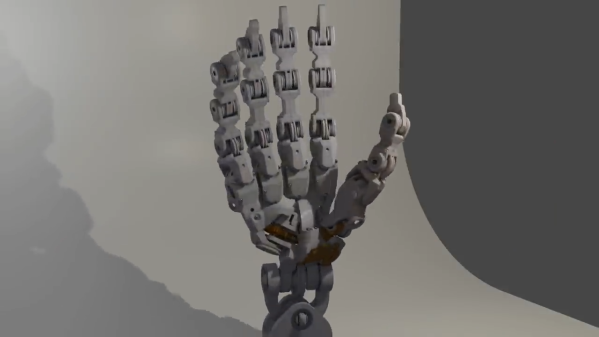
[Will Cogley] is slowly but surely crafting a beautiful bionic hand. (Video, embedded below.) The sheer amount of engineering and thought that went into the design is incredible. Those who take their hands for granted often don’t consider the different ways that their digits can move. There is lateral movement, rotation, flexion, and extension. Generally, [Will] tries to design mechanisms with parts that can be 3D printed or sourced easily. This constrains the hand to things like servos, cable actuation, or direct drive.

However, the thumb has a particularly tricky range of motion. So for the thumb [Will] designed to use a worm geared approach to produce the flexing and extension motion of the thumb. These gears need to be machined in order to stand up to the load. A small side 3d printed gear that connects to the main worm gear is connected to a potentiometer to form the feedback loop. Since it isn’t bearing any load, it can be 3d printed. While there are hundreds of little tiny problems still left to fix, the big problems left are wire management, finalizing the IP (Interphalangeal) joints, and attaching the whole assembly to the forearm.

All the step files, significants amounts of research, and definitions are all on [Will’s] GitHub. If you’re looking into creating any sort of hand prosthetic, the research and attention [Will] has put into this is work incorporating into your project. We’ve seen bionic hands before as well as aluminum finger replacements, but this is a whole hand with fantastic range and fidelity.
Continue reading “Meticulous Bionic Hand”

Hello From The NearSpace

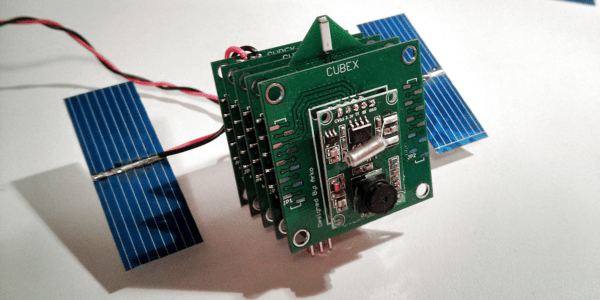
A key challenge for any system headed up into the upper-atmosphere region sometimes called near space is communicating back down to the ground. The sensors and cameras onboard many high altitude balloons and satellites aren’t useful if the data they collect can’t be retrieved. Often times, custom antennas or beacons are added to help. Looking at the cost and difficulty of the problem, [arko] and [upaut] teamed up to try and make a turn-key solution for any near-space enthusiast by building CUBEX, a wonderful little module with sensors and clever radio that can be easily reused and repurposed.

CUBEX is meant as a payload for a high-altitude balloon with a camera, GPS, small battery, solar cell, and the accompanying power management circuits. The clever bit comes in the radio back down. By using the 434.460 Mhz band, it can broadcast around a hundred miles at 10mW. The only hardware to receive is a radio listener (a cheap RTL USB stick works nicely). Pictures and GPS coordinates stream down at 300 baud.

Their launch was quite successful and while they didn’t catch a solar eclipse, their balloon reached an impressive 33698m (110,560ft) while taking pictures. Even though it did eventually splashdown in the Pacific Ocean, they were able to enjoy a plethora of gorgeous photos thanks to their easy and cost-effective data link.

Continue reading “Hello From The NearSpace”

Robots Can Finally Answer, Are You Talking To Me?

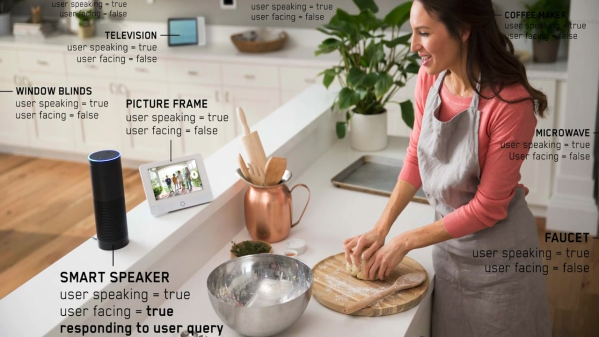
Voice Assistants, love them, or hate them, are becoming more and more commonplace. One problem for voice assistants is the situation of multiple devices listening in the same place. When a command is given, which device should answer? Researchers at CMU’s Future Interfaces Group [Karan Ahuja], [Andy Kong], [Mayank Goel], and [Chris Harrison] have an answer; smart assistants should try to infer if the user is facing the device they want to talk to. They call it direction-of-voice or DoV.

Currently, smart assistants use a simple race to see who heard it first. The reasoning is that the device you are closest to will likely hear it first. However, in situations with echos or when you’re equidistant from multiple devices, the outcome can seem arbitrary to a user.

The implementation of DoV uses an Extra-Trees Classifier from the python sklearn toolkit. Several other machine learning algorithms were considered, but ultimately efficiency won out and Extra-Trees was selected. Another interesting facet of the research was determining what facing really means. The team had humans ‘listeners’ stand in for smart assistants.  A ‘talker’ would speak the key phrase while the ‘listener’ determined if the talker was facing them or not. Based on their definition of facing, the system can determine if someone is facing the device with 90% accuracy that rises to 93% with per-room calibration.

Their algorithm as well as the data they collected has been open-sourced on GitHub. Perhaps when you’re building your own voice assistant, you can incorporate DoV to improve wake-word accuracy.

Continue reading “Robots Can Finally Answer, Are You Talking To Me?”

Procedurally Generated Retrocomputer Emulators

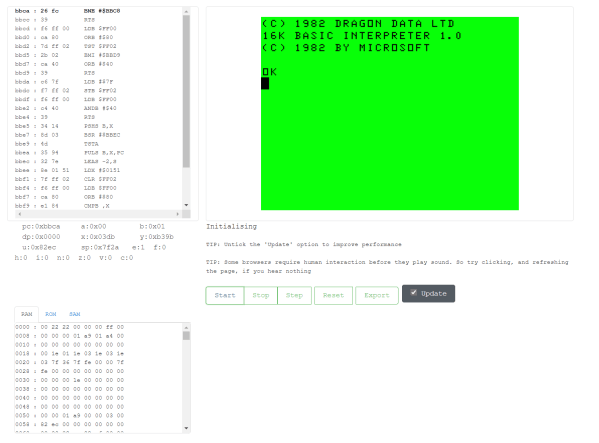
[Marquis de Geek] has a profound love of old systems. Tired of writing new emulators from scratch for each project, his newest project EMF generates the emulator for him. An XML document describes the layout of the memory, CPU description, and screen handler. The output is currently a single-page Javascript emulator application with an assembly and a dissembler. However, but that backend can easily be swapped to another language such as Rust or C++.

Since EMF is a framework that provides a common way to describe the emulated machine, you get a common emulator user interface for free. There’s a lot of flexibility offered here as well. Opcodes can be implemented as a large switch statement or individual functions, depending on the target language’s performance. Self-modifying code can be detected and handled separately. Custom features or hardware can be injected easily by writing a module in the target language.

While the source code for the EMF hasn’t been released yet, several of the machines that [Marquis de Geek] has built with EMF are open-source on GitHub. So far the list includes Dragon32, Sinclair ZX80, Sinclair ZX81, Sinclair ZX Spectrum, Elliott 903, Chip8, Cosmac VIP, and the MegaProcessor. Each has a live emulator that runs in your browser.

While [Marquis de Geek] hopes to release a binary version of the EMF soon, we’re very much looking forward to the EMF source coming out once the code has been cleaned up. We love the trend towards creating easier and more accessible emulators, such as this Twitter bot that runs Atari programs.

Continue reading “Procedurally Generated Retrocomputer Emulators”

Lunar Ark Boldly Goes

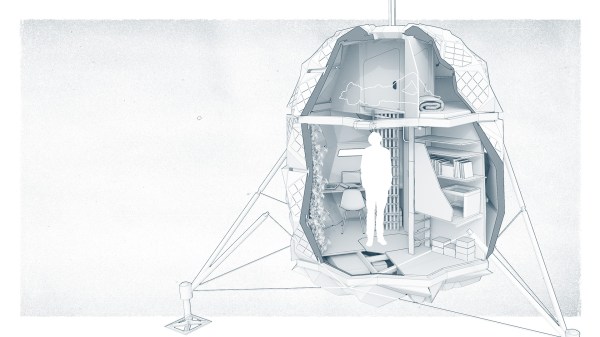
[Sebastian and Karl-Johan] are two award-winning Danish Space Architects who are subjecting themselves to harsh, seemingly uninhabitable conditions, for science. The pair set out to build a lunar base that could land with the manned Moon missions in 2024. Like any good engineering problem, what good is a solution without testing? So the pair have placed their habitat in a Moon Analogue habitat and are staying in their habitat for two months. They want to really feel the remoteness, the bitter cold, and the fatigue of actually being on the moon. So far they are about halfway through their journey and expect to return home in December 2020.

When asking themselves where on Earth is it most like the Moon, they came up with Moriusaq, Greenland. It’s cold, remote, in constant sunlight this time of year, and it is a vast white monochrome landscape just like the moon. The first moon settlement missions are expected to be at the South Pole of the Moon, as known as the Peak of Eternal Light.
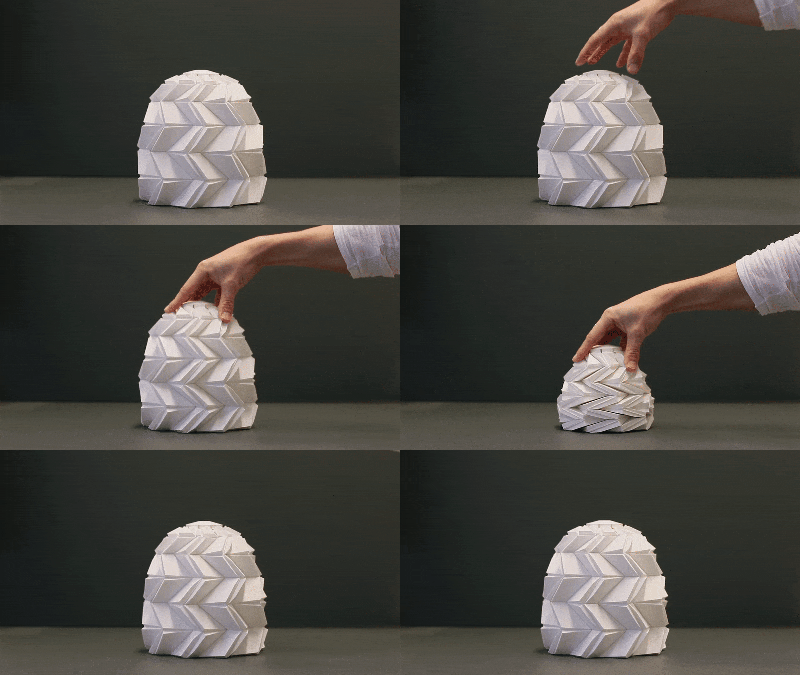
The habitat itself is a testament to the duo’s ingenuity. The whole structure folds to fit the tight space and weight requirements of rockets. Taking 2.9m3 (102 ft3) when stored, it expands 560% in volume to 17.2m3 (607 ft3). In Greenland, the structure needs to withstand -30ºC (-22ºF) and 90 km/h winds.


Because the South Pole is in constant sunlight, the temperature varies much less there than on the rest of the Moon, which makes Greenland a very good analogue temperature-wise. The foldable skin is covered in solar panels, both on the top of the bottom. The highly reflective nature of the Moon’s surface makes it easy to capture the light bouncing up onto the bottom of the habitat.

Several other bits of technology have been included onboard, like a 3D printer, a circadian light stimulation system, an algae reactor, and a weather simulation. Since both the Moon and Greenland are in constant sunlight, the pod helps regulate the circadian rhythms of the occupants by changing the hue and brightness throughout the day. The weather simulation tries to break up the monotony of space by introducing weather like a stormy day or rainbow colours.

Their expedition is still ongoing and they post daily mission updates. While some might call their foray into the unknown madness, we call it bold. Currently, NASA is planning its Artemis mission in 2024 and we hope that the lessons learning from the Lunark and other experiments culminate in a better experience for all astronauts.

Wheels Or Legs? Why Not Both?

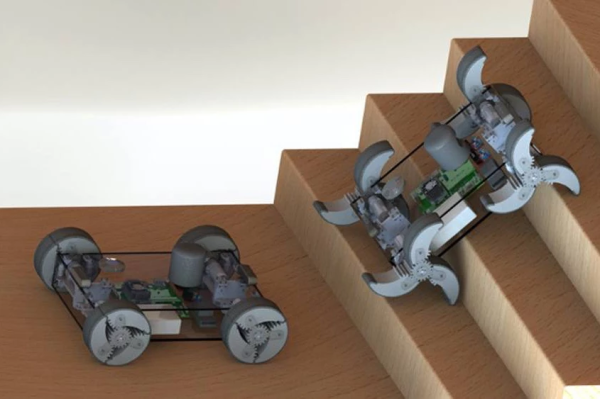
Out of the thousands of constraints and design decisions to consider when building a robot, the way it moves is perhaps one of the most fundamental. The method of movement constrains the design and use case for the robot perhaps more than any other parameter. A team of researchers at Texas A&M led by [Kiju Lee] is trying to have their cake and eat it too by building a robot with wheels that transform into legs, known as a-WaLTR (Adaptable Wheel-and-Leg Transformable Robot).

a-WaLTR was designed to conquer one of wheeled robots’ biggest obstacles: stairs. By adding a bit of smarts to determine whether a given terrain is better handled by wheels or legs, a-WaLTR can convert its segmented wheels into simple legs. Rather than implemented complex and error-prone articulated legs, the team stuck with robust appendages that remind us a little of whegs.

The team will show off their prototype at DARPA OFFSET Sprint-5 in February 2021, which is a program focused on building robots that can form adaptive human-swarm teams.

Thanks to the rise of 3D printers and hobbyist electronics there are more open-source experimental robot designs than ever. We’ve seen smaller versions of the famous Boston Dynamics’ Spot as well as simpler quadruped bots with more servos. a-WaLTR isn’t the first transforming robot we’ve seen, but we’re looking forward to seeing more unique takes on robotic locomotion in the future.

Thanks to [Qes] for sending this one in!

Projecting Halloween Peril

Every holiday has a few, dedicated individuals committed to “going all out.” Whether they’re trying to show up the neighbors, love the look, or just want to put a smile on the faces of those passing by; the results are often spectacular. A recent trend in decorations has been away from analog lights and ornaments and towards digital light shows via a projector. [Georgia Clegg] and [Luma Bakery] have written up a fantastic guide detailing the involved process of house projection for those feeling the holiday spirit.

There is more to the effect than simply pointing a projector at a home and running a video clip. The good displays make use of the geometry of the home and the various depths of the walls don’t distort the picture. The house itself is mapped into the image being displayed.

There are generally two approaches to mapping: point of view mapping and neutral/orthographic mapping. The first is just setting the projector in a fixed position and designing the graphics in such a way that they will look correct. The downside is that if there are multiple projectors, each projector will need to be separately designed for and they cannot be moved or adjusted. The second maps the house in an actual 3d sense and figures out how to display the content according to the viewpoint that the projector is currently at. This means you can create one source content and simply export it for the various projectors.

As you can imagine, the second is much more involved and this is where [Georgia Clegg] has stepped in. There’s a whole series that covers creating your house in MeshRoom, cleaning it up in Blender, creating the videos in After Effects, and setting up your projector to keep it running through the season.

We’ve seen other amazing projector mapping displays with lasers here at Hackaday. Now you can make one yourself. Just don’t get bogged down refurbishing your vector projector along the way.
Continue reading “Projecting Halloween Peril”