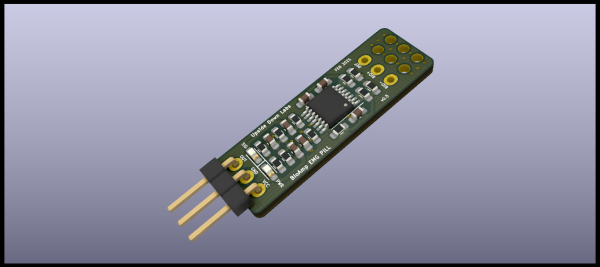
Listening In On Muscles With The BioAmp EMG Pill

Ever felt like what your MCU of choice misses is a way to read the electrical signals from your muscles? In that case [Deepak Khatri] over at Upside Down Labs has got your back with the BioAmp EMG Pill. Described as an affordable, open source electromyography (EMG) module, based around a TL074 quad low-noise JFET-input opamp. At just over 32×10 millimeters, it’s pretty compact as well.

The onboard opamp ensures that the weak electrical signals captured from the muscles when they move are amplified sufficiently that the ADC of any microcontroller or similar can capture the signal for further processing. Some knowledge of how to set up an EMG is required to use the module, of course, and the TL074 opamp prefers an input voltage between 7-30 V. Even so, it has all the basics onboard, and the KiCad project is freely available via the above linked GitHub project.

In addition, [Deepak] also tweeted about working on an affordable, open source active prosthetics controller (and human augmentation device), which has us very much interested in what other projects may come out of Upside Down Labs before long. After, all we’re no strangers to hacking with biosignals.
Ghidra Used To Patch Fahrenheit Into An Air Quality Meter

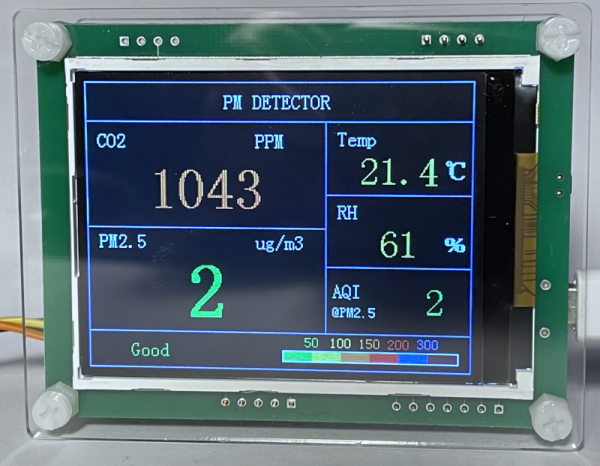
Even though most of the world population couldn’t tell you what room or body temperature is in Fahrenheit, there are some places on this globe where this unit is still in common use. For people in those areas, it’s therefore a real hassle when, say, a cheap Chinese air quality measurement systems only reports in degrees Celsius. Fortunately, [BSilverEagle] managed to patch such a unit to make it display temperature in Fahrenheit.

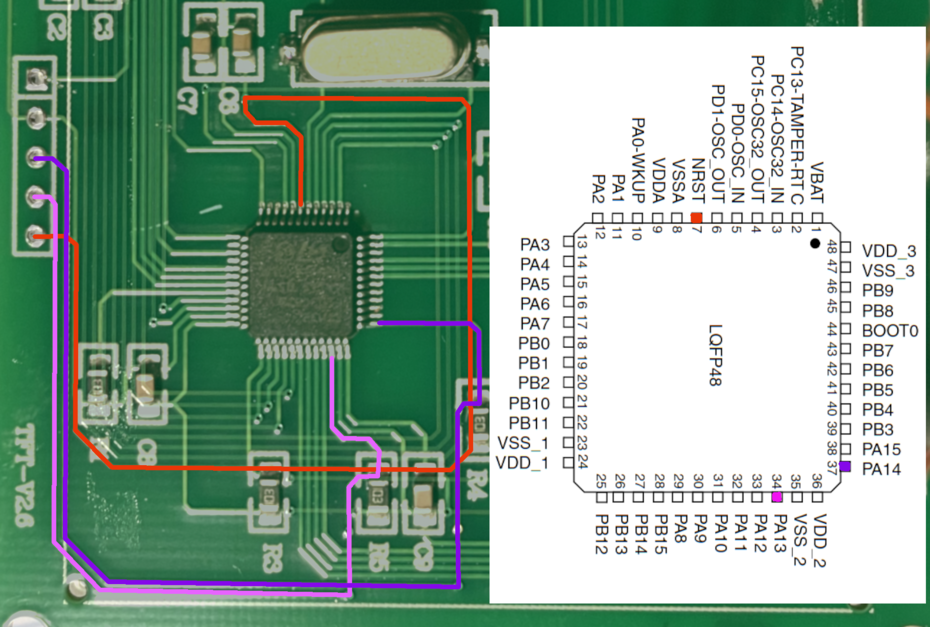
The reverse engineering begins by finding a way to dump the firmware. It’s nice to hear that [BSilverEagle] used some the skills demonstrated in [Eric Shlaepfer’s] PCB reverse engineering workshop from Hackaday Remoticon last November to trace out the debug header and the SWD pins of STM32F103C8 MCU. After that, OpenOCD could be used to dump the firmware image, with no read protection encountered. The firmware was then reverse-engineered using Ghidra, so that [BSilverEagle] could figure out where the temperature was being calculated and where the glyph for the Celsius symbol was stored. From there this it was a straight-forward rewrite of those two parts of the original firmware to calculate the temperature value in Fahrenheit, change the glyph and reflash the MCU.

So why buy this thing in the first place if it didn’t spit out units useful for your current locale? Cost. Buying this consumer(ish) device was about the same cost as buying the individual parts, designing and manufacturing the PCB, and writing the firmware for it. The only downside for their use case was the lack of Fahrenheit. Not a problem for those who demand full control of the hardware they own.

Need a boot camp for using Ghidra? Matthew Alt put together a spectacular video series on Reverse Engineering with Ghidra.

The Bus That’s Not A Bus: The Joys Of Hacking PCI Express

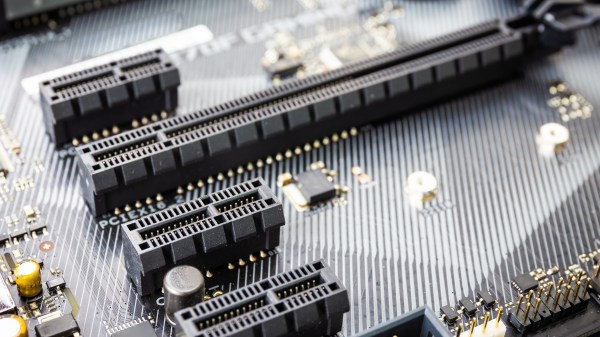
PCI Express (PCIe) has been around since 2003, and in that time it has managed to become the primary data interconnect for not only expansion cards, but also high-speed external devices. What also makes PCIe interesting is that it replaces the widespread use of parallel buses with serial links. Instead of having a bus with a common medium (traces) to which multiple devices connect, PCIe uses a root complex that directly connects to PCIe end points.

This is similar to how Ethernet originally used a bus configuration, with a common backbone (coax cable), but modern Ethernet (starting in the 90s) moved to a point-to-point configuration, assisted by switches to allow for dynamic switching between which points (devices) are connected. PCIe also offers the ability to add switches which allows more than one PCIe end point (a device or part of a device) to share a PCIe link (called a ‘lane’).

This change from a parallel bus to serial links simplifies the topology a lot compared to ISA or PCI where communication time had to be shared with other PCI devices on the bus and only half-duplex operation was possible. The ability to bundle multiple lanes to provide less or more bandwidth to specific ports or devices has meant that there was no need for a specialized graphics card slot, using e.g. an x16 PCIe slot with 16 lanes. It does however mean we’re using serial links that run at many GHz and must be implemented as differential pairs to protect signal integrity.

This all may seem a bit beyond the means of the average hobbyist, but there are still ways to have fun with PCIe hacking even if they do not involve breadboarding 7400-logic chips and debugging with a 100 MHz budget oscilloscope, like with ISA buses.

Continue reading “The Bus That’s Not A Bus: The Joys Of Hacking PCI Express”

Google Loon’s Internet Balloons Come Back To Earth After A Decade In The Stratosphere

After a journey of a decade, what started as Project Loon by Google is no more. Promoted as a way to bring communications to the most remote parts of the globe, it used gigantic, high-altitude balloons equipped with communication hardware for air to ground, as well as air to air communication, between individual balloons. Based around LTE technology, it would bring multiple megabit per second data links to both remote areas and disaster zones.

Seven years into its development, Loon became its own company (Loon LLC), and would provide communications to some areas of Kenya, in addition to Sri Lanka in 2015 and Puerto Rico in 2017 after Hurricane Maria. Three years later, in January of 2021, it was announced that Loon LLC would be shutting down operations. By that point it had become apparent that the technology would not be commercially viable, with alternatives including wired internet access having reduced the target market.

While the idea behind Loon sounds simple in theory, it turns out that it was more complicated than just floating up some weather balloon with LTE base stations strapped to them.

Continue reading “Google Loon’s Internet Balloons Come Back To Earth After A Decade In The Stratosphere”

Reconstructing Data From A Corrupt Apple ][ Floppy Disk

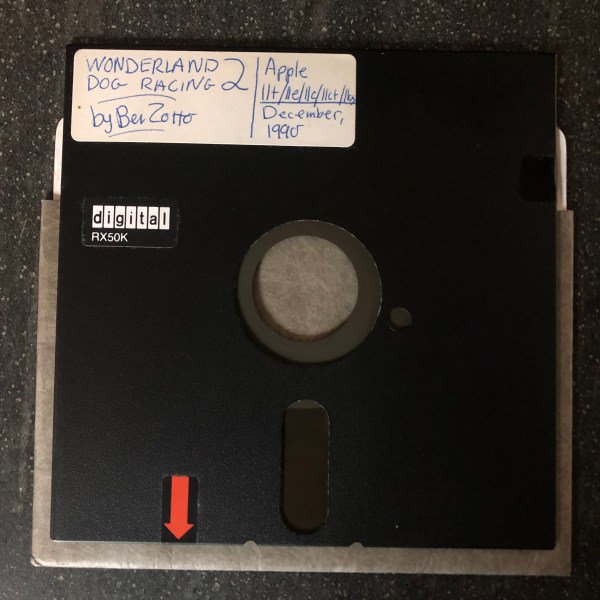
Back in 1990 [Benjamin Zotto] wrote – while in elementary school – a dog racing game called Wonderland 2. The BASIC source code and images for the game were stored on a single ProDOS formatted, soft-sectored 5.25″ floppy disk. Fast-forward thirty years to today and [Benjamin] found to his dismay that ProDOS could no longer read the floppy, giving an I/O error. Not deterred, he set about to recover the data, as documented in this Twitter thread.

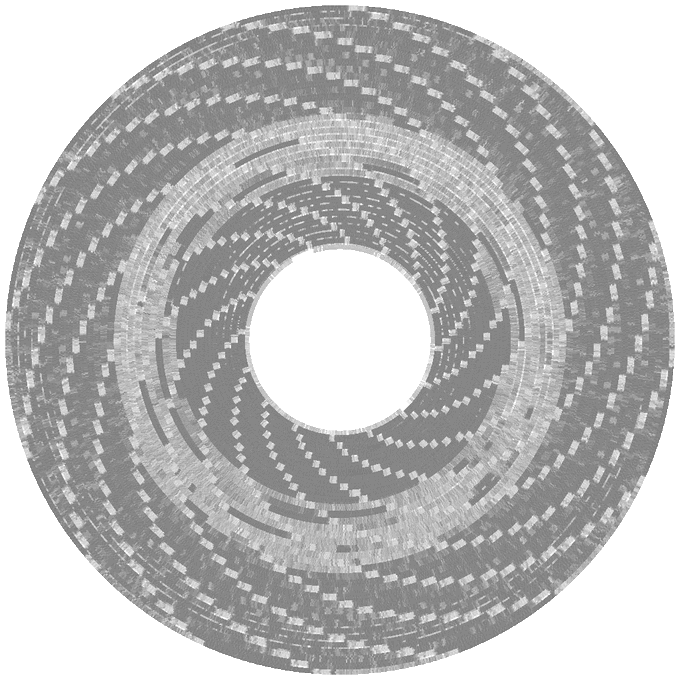
Applesauce visualization of the patterns on the corrupted disk, with soft-sectoring spiral arms.

The gist of the story is that the floppy disk’s surface could still be scanned with help from the aptly named Applesauce Floppy Drive Controller, which got the following visualization of the magnetic patterns on the disk surface:

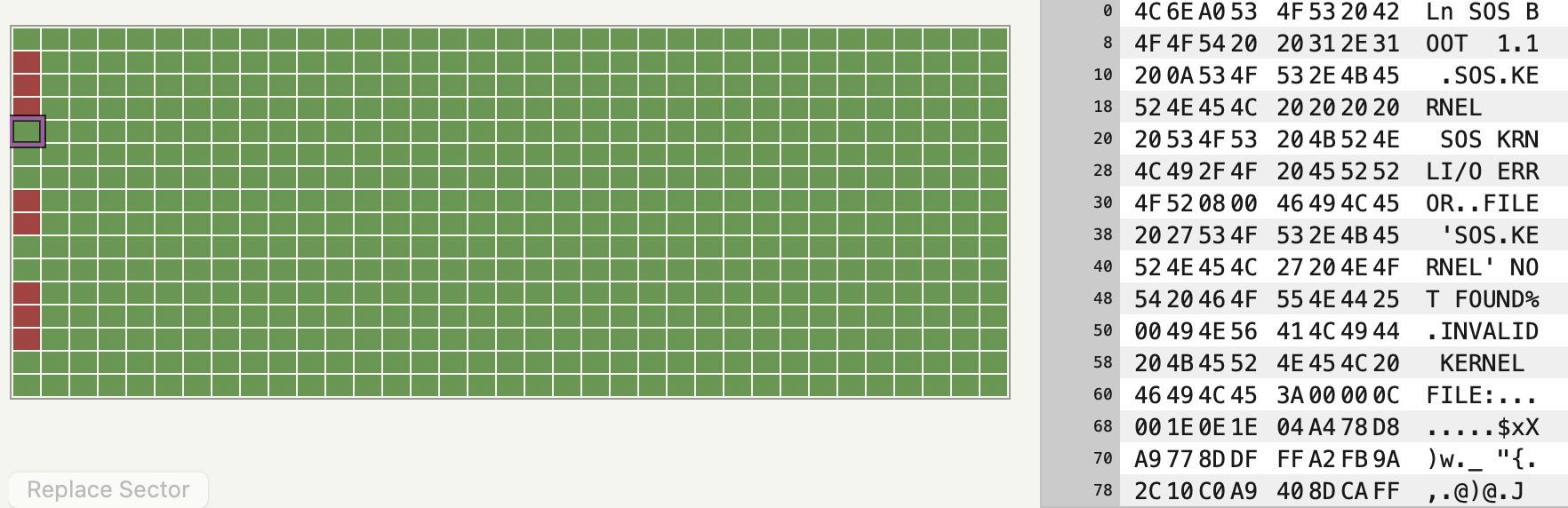
This data could then be analyzed sector by sector, with the bad sectors and the cause for ProDOS flaking out with its reading attempts here marked in red.

Checking the data recovered so far confirmed that it was a ProDOS disk. It also confirmed that the sector containing the directory listing was shot. This required diving into the technical reference manual for ProDOS and its filesystem to figure out how to reconstruct the directory layout. This required figuring out the offsets and sizes of the files, assisted by knowing what was likely on the disk, and having some bits and pieces of the original volume listing still intact. This allowed for the directory volume to be rebuilt, one byte at a time.

Sectors on the disk, with bad sectors in red.

At the end of that arduous and highly educational journey success waited, and [Benjamin] was once again able to relive his memories of 1990s BASIC and hand-drawn bitmap graphics.

NASA Challenge Offers Prizes For Sprouting Astronaut Food Systems

Humans have unfortunately not yet evolved the ability to photosynthesize or recharge from an electricity source, which is why astronauts well into the future of spaceflight will need to have access to food sources. Developing ways to grow food in space is the focus of the new Deep Space Food Challenge that was just launched by NASA and Canada’s Space Agency (CSA).

With a total of twenty $25,000 USD prizes for US contestants and ten $30,000 CAD prizes for the Canucks in Phase 1 of the challenge, there’s some financial incentive as well. In Phase 2, the winning teams of the concept phase have to show off their kitchen skills, and in the final Phase 3 (deadline by Fall 2023) the full food growing system has to be demonstrated.

The possible systems here would likely involve some kind of hydroponics, aeroponics or even aquaponics, to save the weight of lugging kilograms of soil into space. None of this is truly new technology, but cramming it into a package that would be able to supply a crew of four with enough food during a three-year mission does seem fairly challenging.

The NASA rules are covered in their Phase 1 Rules PDF document. While international teams are also welcome to compete, they cannot receive any prizes beyond recognition, and Chinese citizens or companies with links to China are not to allowed to compete at all.

Porting Firefox To Apple Silicon: Tales From The Trenches

For any smaller and larger software product that aims to be compatible with Apple’s MacOS, the recent introduction of its ARM-based Apple Silicon processors and MacBooks to go with them came as a bit of a shock. Suddenly one of the major desktop platforms was going to shift processor architectures, and with it likely abandon and change a number of APIs. Over at Mozilla HQ, they assumed that based on past experiences, Apple’s announcement of ‘first Apple Silicon hardware’ would also mean that those systems would be available for sale.

Indeed, one week after the November 10th announcement Apple did in fact do so. By then, Mozilla had worked to ensure that the Firefox codebase could be built for Apple Silicon-based MacOS. Fortunately, through the experiences of running Firefox on Windows-on-ARM, they already had gained a codebase that was compatible with 64-bit ARM. Ultimately, the biggest snag here was the immature Rust language and dependency support for Apple Silicon, which set back the first release.

When it came to the distributing of Firefox on Intel- and ARM-based Macs, the decision was made to package both versions of the application into a so-called Universal Binary. While this pads out the size of the installer, it also means easier distribution and would not affect the built-in updater in Firefox. This also allowed for an easy fix for the Google Widevine DRM module, for which no Apple Silicon version was available at first, allowing the same module for Intel to be used with either Firefox version via the Rosetta 2 binary translator in MacOS (as we covered previously).

After this it was more or less smooth sailing, with some Rosetta 2-based glitches and MacOS Big Sur-related bugs that spoiled some of the fun. What this experience shows is that porting even a big codebase like Firefox to Apple’s new platform is fairly straightforward, with lack of support from toolchains and other dependencies the most likely things that may trip one up.

The Rosetta 2 feature, while helpful, also comes with its share of gotchas as the Firefox developers found out, and of course there is a lot more optimization that can (and should) be done for such a new platform.