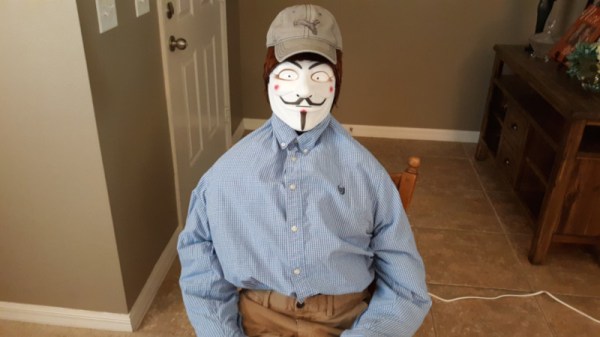
No, despite what it might look like, this isn’t some early Halloween project. The creepy creation before you is actually a tongue-in-cheek “robot” created by the prolific [Nick Bild], a topical statement about companies asking their remote workers to come back into the office now that COVID-19 restrictions are being lifted. Why commute every day when this ultra realistic avatar can sit in for you?
OK, so maybe it’s not the most impressive humanoid creation to ever grace the pages of Hackaday. But if you’re looking to spin up a simple telepresence system, you could do worse than browsing through the Python source code [Nick] has provided. Using a Raspberry Pi 4, a webcam, and a microphone, his client-server architecture combines everything the bot sees and hears into a simple page that can be remotely accessed with a web browser.
Naturally this work from home (WFH) bot wouldn’t be much good if it was just a one-way street, so [Nick] has also added a loudspeaker that replays whatever he says on the client side. To prevent a feedback loop, his software includes a function that toggles which direction the audio stream goes in by passing the appropriate commands to the bot over SSH; a neat trick to keep in mind for your own, less nightmarish, creations.
If you’re looking for something a bit more capable and have some cardboard laying around, this DIY telepresence mount for your phone might be a good place to start.
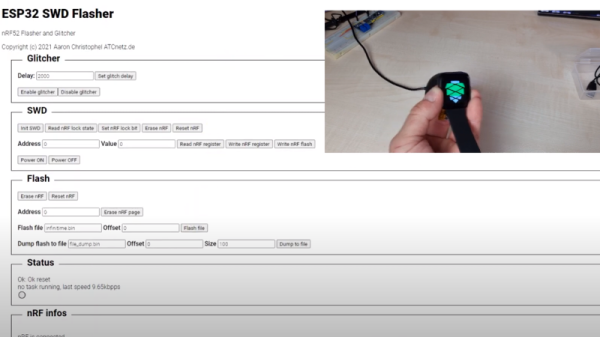
Got an nRF52 or nRF51 device you need to flash? Got an ESP32 laying around collecting dust? If so, then firmware hacking extraordinaire [Aaron Christophel] has the open source code you need. His new project allows the affordable WiFi-enabled microcontroller to read and write to the internal flash of Nordic nRF52 series chips via their SWD interface. As long as you’ve got some jumper wires and a web browser, you’re good to go.
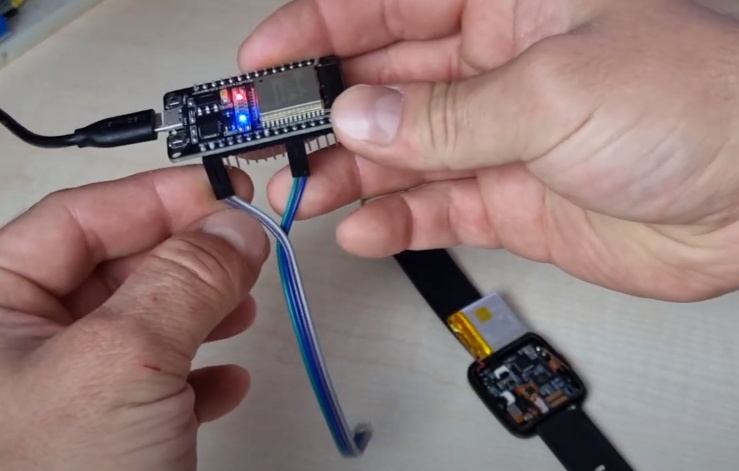
In the first video below [Aaron] demonstrates the technique with the PineTime smartwatch, but the process will be more or less the same regardless of what your target device is. Just connect the CLK and DIO lines to pins GPIO 21 and GPIO 19 of the ESP32, point your web browser to its address on the local network, and you’ll be presented with a straightforward user interface for reading and writing the chip’s flash.
As demonstrated in the second video, with a few more wires and a MOSFET, the ESP32 firmware is also able to perform a power glitch exploit on the chip that will allow you to read the contents of its flash even if the APPROTECT feature has been enabled. [Aaron] isn’t taking any credit for this technique though, pointing instead to the research performed by [LimitedResults] to explain the nuts and bolts of the attack.
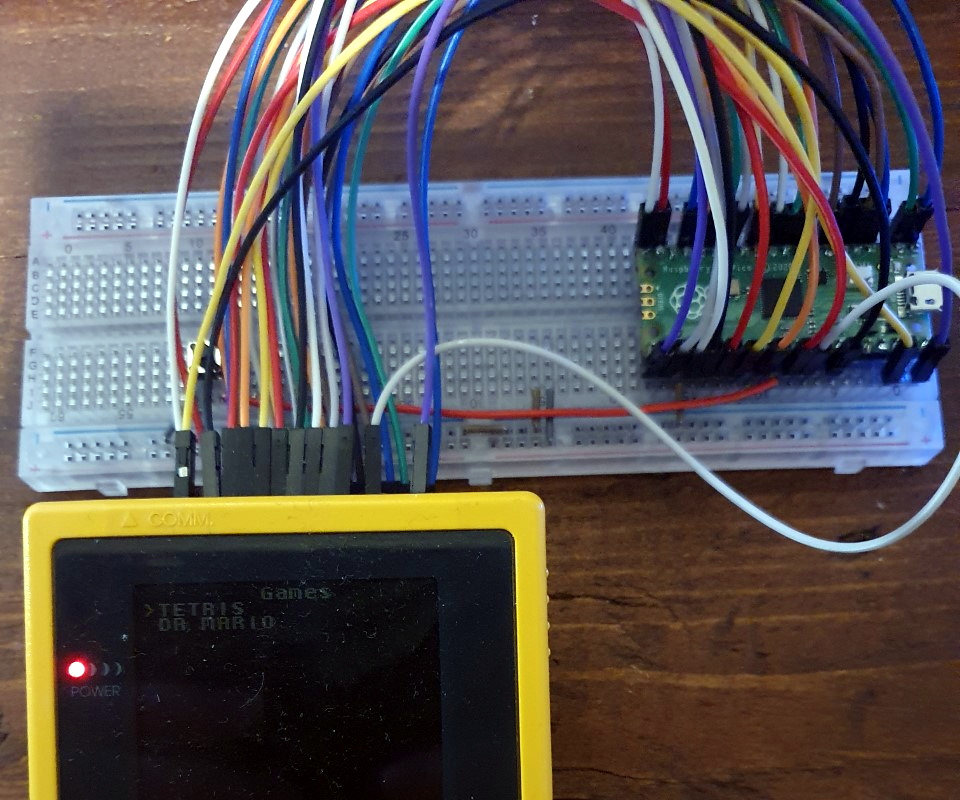
The story for this one starts a few months ago, when [John Green] released his PICO-GB project. His code allowed the Raspberry Pi Pico to stand in for a Game Boy cartridge, complete with a simple text menu that let the user select between ROMs that had been baked into the microcontroller’s firmware. The project was particularly notable for the fact that it was entirely a software solution; while a custom breakout cartridge made for a handy temporary solution, you could have permanently wired the Pico’s pins directly to the Game Boy’s cartridge connector if you wanted to.
PICO-GB running on the full-size Pi Pico
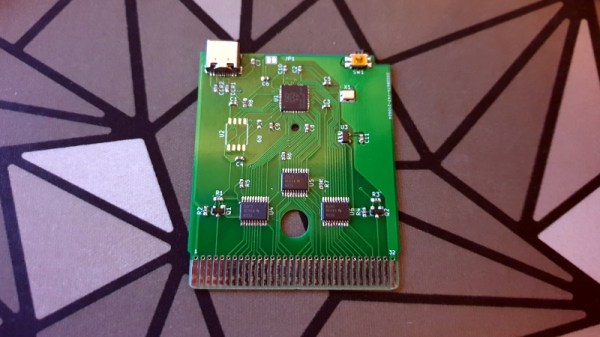
Then in early June, the RP2040 chip that powers the Pi Pico went up for sale in single unit quantities. That opened up the possibility of building the PICO-GB functionality into a cartridge small enough to actually fit inside the Game Boy. So [Martin “HDR” Refseth] got to work creating the slick cartridge PCB you’re seeing now.
The RP2040 is joined by a trio of Texas Instruments TXB0108 level shifters, and there’s a spot for adding a SPI flash chip. The RP2040 supports a maximum of 16 MB of external flash, but given the size of Game Boy games were generally measured in kilobytes, that shouldn’t pose much of a problem.
Looking ahead, the original PICO-GB documentation mentions enhancements like loading ROMs from SD card, as well as hardware additions like a real-time-clock for the more advanced games that supported it. We assume those concepts will become part of [Martin]’s PCB eventually, but these are still early days.
We’ve seen a huge influx of bespoke portable computers over the last couple of years thanks to availability of increasingly powerful single-board computers. The vast majority of these have been ARM powered using something like the Raspberry Pi 4, and naturally, run Linux. Only a handful have run on x86 hardware, usually because whoever built it wanted to be able to run Windows.
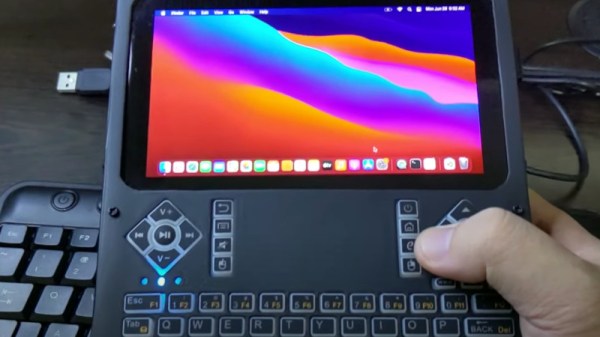
But this handheld x86 Hackintosh running the latest Mac OS on the LattePanda Alpha is truly something unique. Creator [iketsj] claims it to be a world’s first, and after a bit of searching, we’re inclined to agree. While others have installed Mac OS on the LattePanda to create Hackintosh laptops, this would indeed appear to be the first handheld computer to utilize this particular hardware and software blend.
Like other custom portables we’be seen, this one starts with a 3D printed enclosure. The overall design reminds us a bit of the YARH.IO we covered last year, and even borrows the trick of reusing the membrane and PCB of one of those miniature keyboard/pointer combos. Which in this case ends up being especially important, as in keeping with Apple’s own portable Mac OS machines, the screen on this handheld doesn’t support touch.
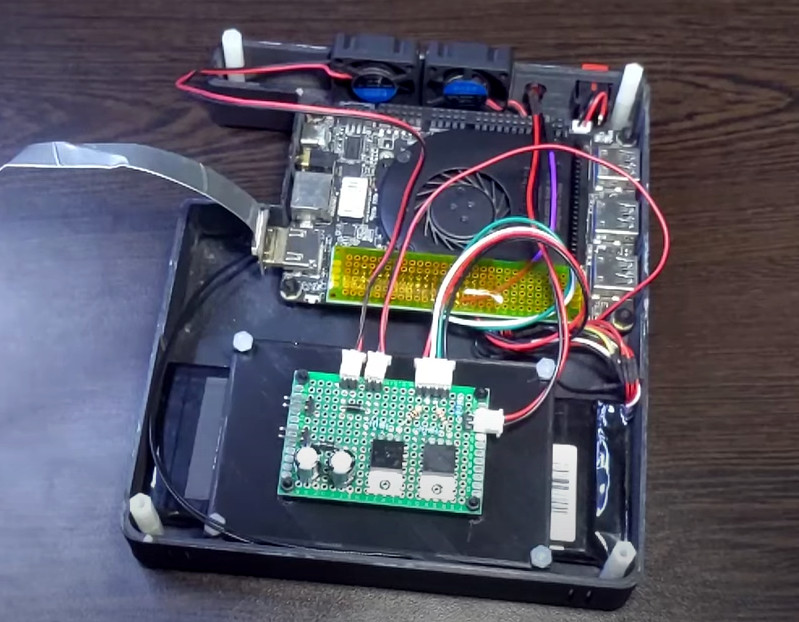
We especially like how the integrated Arduino on the LattePanda is being used in conjunction with some MOSFETs to control power to the handheld’s LCD, keyboard, and fans. While it sounds like the fans are currently running at full throttle, [iketsj] mentions he does intend on adding automatic speed control in the future. A dedicated “chassis controller” like this makes a lot of sense, and is something we imagine will only become more common as these portable builds become increasingly complex.
Now that we’ve seen a custom portable computer running Mac OS, are we due to see a whole new wave of cyberdecks sporting Cupertino’s software in the future? Maybe not. As [iketsj] points out at the end of this video, Apple’s switch from x86 to their own in-house silicon will almost certainly mean the death of the Hackintosh project within the next few years, bringing a fascinating era of computer hacking to a close.
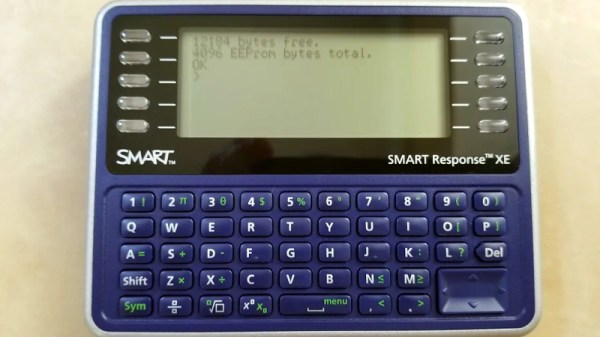
Ever since the SMART Response XE was brought to our attention back in 2018, we’ve been keeping a close lookout for projects that make use of the Arduino-compatible educational gadget. Admittedly it’s taken a bit longer than we’d expected for the community to really start digging into the capabilities of the QWERTY handheld, but occasionally we see an effort like this port of BASIC to the SMART Response XE by [Dan Geiger] that reminds us of why we were so excited by this device to begin with.
This project combines the SMART Response XE support library by [Larry Bank] with Tiny BASIC Plus, which itself is an update of the Arduino BASIC port by [Michael Field]. The end result is a fun little BASIC handheld that has all the features and capabilities you’d expect, plus several device-specific commands that [Dan] has added such as BATT to check the battery voltage and MSAVE/MLOAD which will save and load BASIC programs to EEPROM.
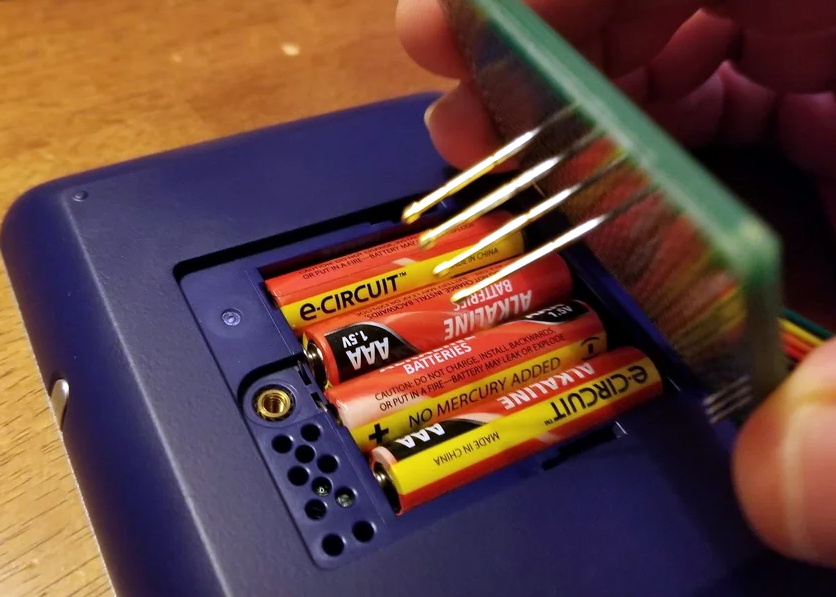
To install the BASIC interpreter to your own SMART Response XE, [Dan] goes over the process of flashing it to the hardware using an AVR ISP MkII and a few pogo pins soldered to a bit of perboard. There are holes under the battery door of the device that exposes the programming pads on the PCB, so you don’t even need to crack open the case. Although if you are willing to crack open the case, you might as well add in a CC1101 transceiver so the handy little device can double as a spectrum analyzer.
Back before the industry agreed on the now ubiquitous clamshell form factor of portable computers, there were a class of not-quite-desktop computers that the community affectionately refers to as “luggable” PCs. These machines, from companies like Kaypro and Osborne, were only portable in the sense that their integrated design made it relatively easy to move them. Things we take for granted today, like the ability to run on battery power or being light enough to actually place in your lap, wouldn’t come until later.
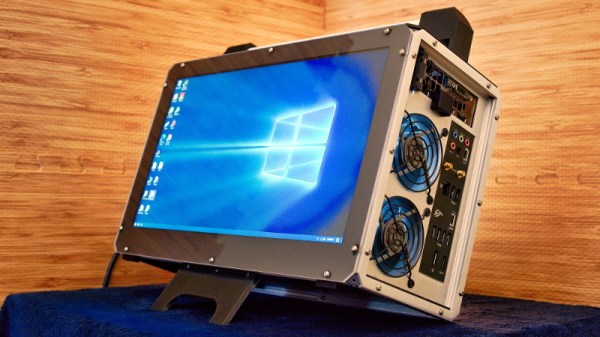
For a contemporary take on this decades old concept, take a look at this fantastic build by [Ragnar84]. It packs a modern desktop computer and a 15.6 inch laptop display into a custom designed case, but like so many other projects, the devil is truly in the details for this one. Little touches such as the kickstand on the bottom, the removable handle on the top, and the right angle adapter that takes the HDMI output from the GeForce GTX 1060 video card and redirects it back into the case really add up to create a surprisingly practical computer that’s more than the sum of its parts.
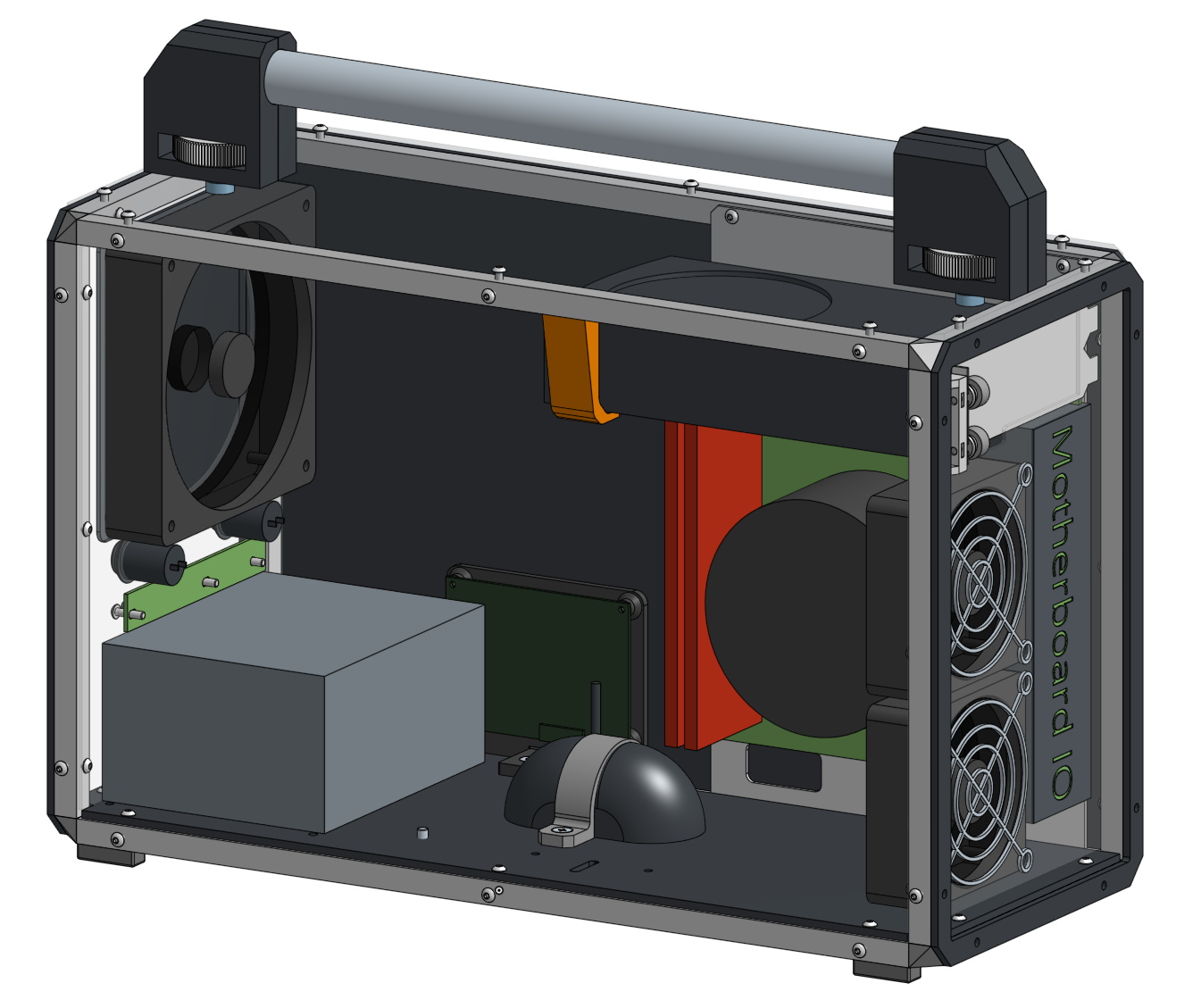
While the case might look like your standard gamer fare, [Ragnar84] built the whole thing out of miniature T-Slot extrusion and custom-cut aluminum and acrylic panels. But not before modelling the whole thing in 3D to make sure all of his selected components would fit. For the most part the internals aren’t unlike a standard Mini-ITX build, though he did need to make a few special additions like a shelf to mount the driver board for the N156H LCD panel, and a clever clamp to hold down the rounded USB speakers.
Back in September of 2019, I had the opportunity to climb aboard the restored B-17G bomber Nine-O-Nine as part of a national “Wings of Freedom” airport tour operated by the Collings Foundation. I was excited to get up close and personal with such an iconic aircraft, particularity since Hackaday gave me a platform to share the experience with a global audience. With fewer than 50 B-17s left in the world, and most of those in the United States, taking this sort of “virtual tour” was as close as most people would ever get to seeing what it was really like for the crews who operated these machines over the skies of Europe more than 75 years ago.
Tragically, just a week after the article was published, the Nine-O-Ninecrashed during a visit to Bradley International Airport in Connecticut. The pilot, co-pilot, and five paying passengers were all killed in either the initial impact or the subsequent fire. When crews were finally able to extinguish the flames, the left wing and tail were all that remained of the once mighty bomber. In a twist of fate, some of the images I took for the Hackaday article ended up being included in the National Transportation Safety Board (NTSB) accident report, as they represented perhaps the most detailed photographic record of the aircraft’s condition before the crash.
Wreckage of the Nine-O-Nine.
In the weeks and months that followed, many voiced their concerns over what the Federal Aviation Administration (FAA) calls “Living History Flight Experience” aircraft such as those operated by the Collings Foundation. The main point of contention was whether or not these planes were too old to safely carry passengers, and by extension, whether continuing to fly them around the country presented a menace to the national airspace. Critics argued that whatever cultural benefit offered by the chance for the public to tour or ride these antique aircraft was not worth anyone losing their lives over; a line of logic that’s difficult to find fault in.
Then came COVID-19. By March of 2020, individual states had already started going into lockdown, and suddenly there were far more pressing matters to address than the fate of a few dozen teetering WWII aircraft. It was around this time that the FAA pulled the Collings Foundation’s license to conduct any more paid flights, but since outdoor gatherings such as airshows were being put on hold for the foreseeable future, the measure had little immediate impact. It was clear these airborne museum pieces were going to spend most of 2020 in their hangers anyway.
Now, thankfully, the pall of COVID-19 is finally beginning to lift over the United States. In response to widespread vaccine availability, most states are ending or at least reducing their restrictions on outdoor events. With major airshows like the “World War II Weekend” in Reading, Pennsylvania given the green light to proceed, these legendary aircraft are being awakened from their long slumber and making their first tentative flights of the post-pandemic era.