SpaceX Drops The Ball On Catching Fairings

You don’t have to look very hard to find another rousing success by SpaceX. It’s a company defined by big and bold moves, and when something goes right, they make sure you know about it. From launching a Tesla into deep space to the captivating test flights of their next-generation Starship spacecraft, the private company has turned high-stakes aerospace research and development into a public event. A cult of personality has developed around SpaceX’s outlandish CEO Elon Musk, and so long as he’s at the helm, we can expect bigger and brighter spectacles as he directs the company towards its ultimate goal of putting humans on Mars.

Of course, things don’t always go right for SpaceX. While setbacks are inevitable in aerospace, the company has had a few particularly embarrassing failures that could be directly attributed to their rapid development pace or even operational inexperience. A perfect example is the loss of the Israeli AMOS-6 satellite during a static fire of the Falcon 9’s engines on the launch pad in 2016, as industry experts questioned why the spacecraft had even been mounted to the rocket before it had passed its pre-flight checks. Since that costly mistake, the company has waited until all engine tests have been completed before attaching the customer’s payload.

SpaceX’s concept art for propulsive landing

But sometimes the failure isn’t so much a technical problem as an inability for the company to achieve their own lofty goals. Occasionally one of Musk’s grand ideas ends up being too complex, dangerous, or expensive to put into practice. For instance, despite spending several years and untold amounts of money perfecting the technology involved, propulsive landings for the Crew Dragon were nixed before the idea could ever fully be tested. NASA was reportedly uncomfortable with what they saw as an unnecessary risk compared to the more traditional ocean splashdown under parachutes; it would have been an impressive sight to be sure, but it didn’t offer a substantive benefit over the simpler approach.

A similar fate recently befell SpaceX’s twin fairing recovery ships Ms. Tree and Ms. Chief, which were quietly retired in April. These vessels were designed to catch the Falcon’s school bus sized payload fairings as they drifted down back to Earth using massive nets suspended over their decks, but in the end, the process turned out to be more difficult than expected. More importantly, it apparently wasn’t even necessary in the first place.

Continue reading “SpaceX Drops The Ball On Catching Fairings”

Putting An Ultra-Tiny Linux Board In A Phone Charger…Eventually

Among security professionals, a “drop box” is a device that can be covertly installed at a target location and phone home over the Internet, providing a back door into what might be an otherwise secure network. We’ve seen both commercial and DIY versions of this concept, and as you might expect, one of the main goals is to make the device look as inconspicuous as possible. Which is why [Walker] is hoping to build one into a standard USB wall charger.

This project is still in the early stages, but we like what we see so far. [Walker] aims to make this a 100% free and open source device, starting from the tools he’s using to produce the CAD files all the way up to the firmware the final hardware will run. With none of the currently available single-board computers (SBCs) meeting his list of requirements, the first step is to build a miniature Linux machine that’s got enough processing power to run useful security tools locally. Obviously such a board would be of great interest to the larger hacker and maker community.

The RTL8188CUS is likely to get integrated later on.

So far, [Walker] has decided on his primary components and is working on a larger development board before really going all-in on the miniaturization process. As of right now he’s planning on using the Allwinner A33 to power the board, a sub-$10 USD chipset most commonly seen in low-cost Android tablets.

The A33 boasts a quad-core Cortex-A7 clocked at 1.2 GHz, and offers USB, I2C, and SPI interfaces for expansion. It will be paired with 1 GB of DDR3 RAM, and an SD card to hold the operating system. Naturally a device like this will need WiFi, but until [Walker] can decide on which chip to use, the plan is to just use a USB wireless adapter. The Realtek RTL8188CUS is a strong contender, as the fact that it comes in both USB and module versions should make its eventual integration seamless.

Even if you’re not interested in the idea of hiding security appliances inside of everyday objects, this project is a fascinating glimpse into the process of creating your own custom Linux board. Whether you’re looking to put into a wall wart or a drone, it’s pretty incredible to think we’ve reached the point where an individual can spin up their own miniature SBC.

Modified Microwave Cures Resin Parts With Style

Once you make the leap to resin-based 3D printing, you’ll quickly find that putting parts out in the sun to cure isn’t always a viable solution. The best way to get consistent results is with a dedicated curing chamber that not only rotates the parts so they’re evenly exposed to the light, but allows you to dial in a specific curing time. A beeper that goes off when the part is done would be handy as well. Wait, this is starting to sound kind of familiar…

As you might expect, [Stynus] isn’t the first person to notice the similarities between an ideal UV curing machine and the lowly microwave oven. But his conversion is certainly one of the slickest we’ve ever seen. The final product doesn’t look like a hacked microwave so much as a purpose-built curing machine, thanks in large part to the fact that all of the original controls are still functional.

The big break there came when [Stynus] noticed that the control panel was powered by a one-time programmable PIC16C65B microcontroller. Swapping that out for the pin-compatible PIC16F877A opened up the possibility of writing custom firmware to interface with all the microwave’s original hardware, he just needed to reverse engineer how it was all wired up. It took some time to figure out how the limited pins on the microcontroller ran the LED display and read the buttons and switches at the same time, but we’d say the final result is more than worth the work.

With full control over the microwave’s hardware, all [Stynus] had to do was strip out all the scary high voltage bits (which were no longer functional to begin with) and install an array of UV LEDs. Now he can just toss a part on the plate, spin the dial to the desired curing time, and press a button. In the video below, you can see he’s even repurposed some of the buttons on the control panel to let him do things like set a new default “cook” time to EEPROM.

Compared to the more traditional fused deposition modeling (FDM) 3D printers, resin printing requires a lot of additional post-processing and equipment. You don’t necessarily have to gut your microwave just to cure your prints, but you’d be wise to fully consider your workflow will look like before pulling the trigger on that shiny new printer.

Continue reading “Modified Microwave Cures Resin Parts With Style”

Soviet Super 8 Camera Hides Raspberry Pi Zero

A few years ago [Xabier Zubizarreta] got it into his head that he wanted to put a modern digital image sensor into a classic Super 8 camera, but he didn’t want to ruin a gorgeous piece of vintage hardware in the process. After a bit of research, he discovered an export version of the Avrora camera made for the 1980 Summer Olympic Games in Moscow that could be had for cheap. Figuring nobody would miss a camera built with the utilitarian aesthetics you’d expect of a Soviet-era piece of consumer tech, he set off to cram a Raspberry Pi into its film compartment.

On the Hackaday.io page for this project, [Xabier] explains a bit about the optical properties that make this project challenging. Specifically, the miniature sensor used by the official Raspberry Pi camera module is far smaller than the 8 mm film the camera was designed for. So when the sensor placed at the appropriate focal length for the original film, the image will be cropped considerably. As you can see in the video below, this gives the impression of everything being filmed with a fairly tight zoom.

To perform this modification, [Xabier] first had to liberate the sensor of the Pi Camera from the original optics, and then carefully install it in proper position on the Avrora. To make sure he had it aligned, he watched a live feed from the camera while the epoxy holding the sensor down was curing. This allowed him to make slight adjustments before everything was solidified. With the sensor in place, he only had to stuff the Pi Zero and battery pack into the film compartment, and wire the original camera trigger to the GPIO pins so he could read it in software.

Considering the incredible amount of effort some photographers have put in to adapt their vintage cameras to digital, it’s refreshing to see such a straightforward approach. The resulting video might not be up to modern standards, but with projects like this, that’s sort of the point.

Continue reading “Soviet Super 8 Camera Hides Raspberry Pi Zero”

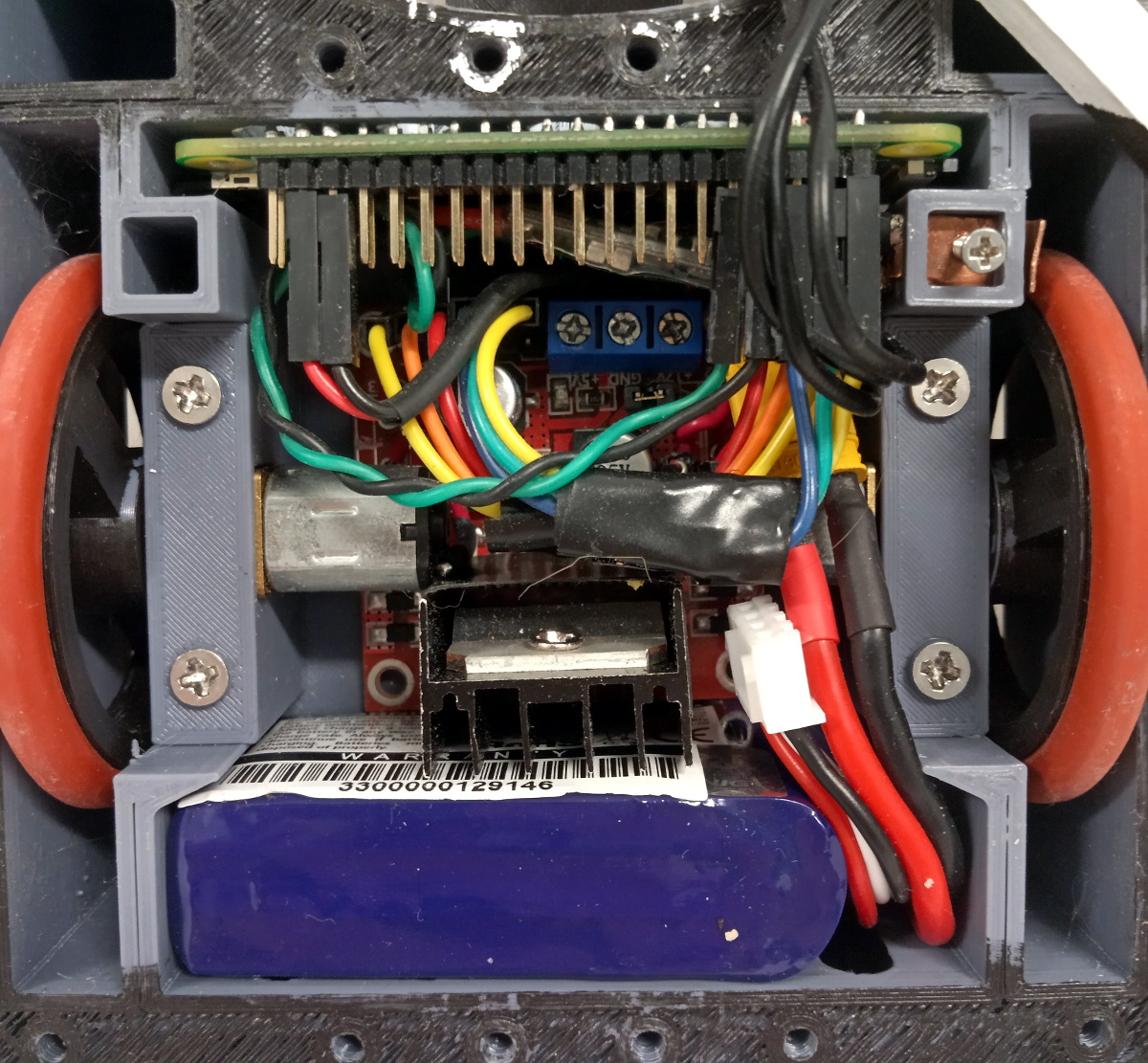
Hoverboard Turned Heavy Duty Remote Control Rover

They might not be the hoverboards we were promised in Back to the Future II, but the popular electric scooters that have commandeered the name are exciting pieces of tech in their own way. Not because we’re looking to make a fool of ourselves by actually riding one, but because they’re packed full of useful hardware that’s available for dirt cheap thanks to the economies of scale and the second-hand market.

In his latest video, the ever resourceful [MakerMan] turns a pair of hoverboards into a capable remote controlled mobile platform perfect for…well, whatever you want to move around. Its welded steel construction is certainly up for some heavy duty tasks, and while we can’t say we’d ever tow a SUV with it as shown in the video below, it’s nice to know we’d have the option.

The project starts by liberating the four wheel motors from the scooters and carefully cutting down the frame to preserve the mounting hardware. These mounts are ultimately welded to the frame of the rover, with a piece of diamond plate screwed down on top. On the bottom, [MakerMan] mounts the two control boards and a custom fabricated 36 V battery pack.

He doesn’t go into any detail on how he’s interfacing the RC hardware with the motor controllers, but as we’ve seen with past hacks, there’s open source firmware replacements for these boards that allow them to be controlled by external inputs. Presumably something similar is being used here, but we’d be interested to hear otherwise. Of course you could swap the RC hardware out for a microcontroller or Raspberry Pi if you were looking to make some kind of autonomous rover.

Don’t have a welder or convenient collection of scrap steel laying around? No worries. Prolific tinkerer [Aaron Christophel] put something very similar together using bolted aluminum extrusion.

Continue reading “Hoverboard Turned Heavy Duty Remote Control Rover”

After Years Of Uncertainty, Stratolaunch Flies Again

When Paul Allen founded Stratolaunch in 2011, the hope was to make access to space cheaper and faster. The company’s massive carrier aircraft, the largest plane by wingspan ever to be built, would be able to carry rocket-powered vehicles up into the thin upper atmosphere on short notice under the power of its conventional jet engines. The smaller vehicle, free of the drag it would incur in the denser atmosphere closer to the ground, could then be released and continue its journey to space using smaller engines and less propellant than would have been required for a conventional launch.

But Allen, who died in October of 2018, never got to see his gigantic plane fly. It wasn’t until April 13th, 2019 that the prototype carrier aircraft, nicknamed Roc, finally got to stretch its 117 meter (385 feet) wings and soar over the Mojave Desert. By that time, the nature of spaceflight had changed completely. Commercial companies were putting payloads into orbit on their own rockets, and SpaceX was regularly recovering and reusing their first stage boosters. Facing a very different market, and without Allen at the helm, Stratolaunch ceased operations the following month. By June the company’s assets, including Roc, went on the market for $400 million.

Finally, after years of rumors that it was to be scrapped, Allen’s mega-plane has flown for the second time. With new ownership and a new mission, Stratolaunch is poised to reinvent itself as a major player in the emerging field of hypersonic flight.

Continue reading “After Years Of Uncertainty, Stratolaunch Flies Again”

Soundbar Bested By Virtual Android Bluetooth Sniffer

Out of the box, the Yamaha YAS-207 soundbar can be remotely controlled over Bluetooth, but only when using a dedicated application on iOS or Android. Users who want to command their hardware with their computer, or any other Bluetooth device for that matter, are left out in the cold. Or at least they were, before [Wejn] got on the case.

To capture the communication between the soundbar and the application, [Wejn] first installed Android-x86 in a virtual machine on his computer and then enabled the “Bluetooth HCI snoop log” within Developer Settings. From there, a netcat command running on the virtual Android device continually sent the contents of the btsnoop_hci.log file out to Wireshark on his Linux desktop. As he hit buttons in the Yamaha application, he could watch the data come in live. We’ve seen plenty of people use Android’s integrated Bluetooth packet capture in the past, but never quite like this. It’s certainly a tip worth mentally filing away for the future.

The Pi can now control the TOSLINK connected speakers.

From there, things move pretty quickly. [Wejn] is able to determine that the devices are communicating over a virtual serial port, and starts identifying individual command and response packets. It turns out the commands closely mirror the NEC IR codes that he’d previously decoded on a whim, which helped clear things up. Once the checksum was sorted out, writing some code that can talk to the soundbar from his Raspberry Pi media player was the next logical step.

[Wejn] combined this with the Shairport Sync project, which lets the Raspberry Pi turn on the speaker and switch the input over when he wants to stream AirPlay from his phone. But of course, the same technique could be applied to whatever source of digital audio captures your fancy.

This is one of those posts you should really read in its entirety to truly appreciate. While every device is going to be different, the basic principles and workflow that [Wejn] demonstrates in this project will absolutely be useful in your own reverse engineering adventures. If you’re more of a visual learner, we recently covered a series of YouTube tutorials that cover sniffing BLE devices that’s not to be missed as well.