Incredible Soldering In The Name Of Hardware Support

If you’re developing a performant IP-KVM based on the Raspberry Pi, an HDMI capture device that plugs into the board’s CSI port would certainly be pretty high on your list of dream peripherals. Turns out such devices actually exist, and somewhat surprisingly, are being sold for reasonable prices. Unfortunately the documentation for the chipset they use is a bit lacking, which is a problem if you’re trying to wring as much performance out of them as possible.

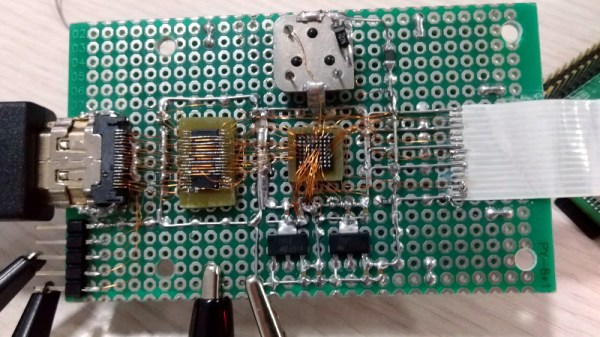
As the creator of Pi-KVM, [Maxim Devaev] needed to truly understand how the Toshiba TC358743 chip used in these capture devices worked, so he decided to build his own version from scratch. In the name of expediency, he didn’t have a proper breakout board made and instead decided to hand-solder the tiny BGA chip directly to some parts bin finds. The resulting perfboard capture device is equal parts art and madness, but more importantly, actually works as expected even with 1080p video signals.

Ultimately, the lessons learned during this experiment will lead to a dedicated KVM board that will plug into the Pi’s expansion header and provide all the necessary hardware in one shot. As [Maxim] explains in the Pi-KVM docs, the move to the CSI connected Toshiba TC358743 cuts latency in half compared to using a USB capture device. That said, USB capture devices will remain fully supported for anyone who just needs a quick way to get things working.

This DIY capture card is a perfect example of how the skills demonstrated while working on a project can be just as impressive as the end result. [Maxim] didn’t set out to hand-solder a BGA HDMI capture chip, it was merely one step in the process towards creating something better. Those intermediary achievements are often lost in the rush to document the final project, so we’re always glad when folks take the time to share them.

[Thanks to Eric for the tip.]
An Arduino Controller For Hot Air Handles

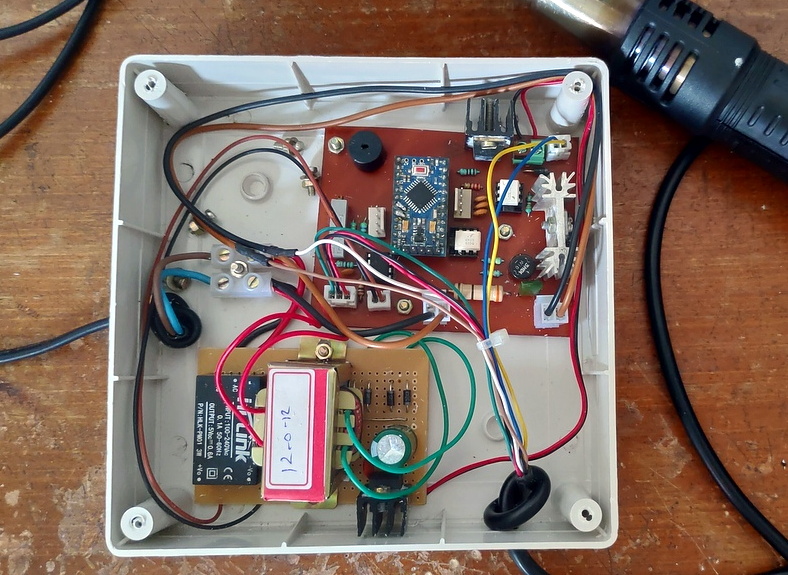
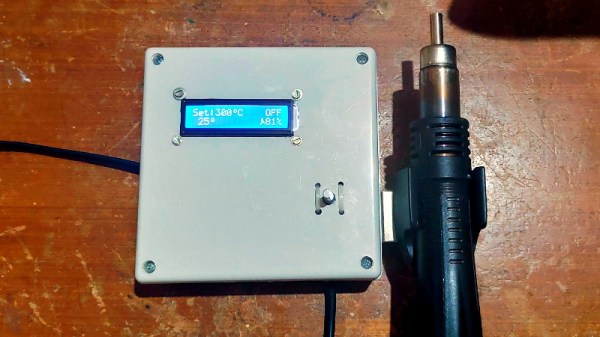
In general, the cost of electronic components and the tools used to fiddle with them have been dropping steadily over the last decade or so. But there will always be bargain-hunting hackers who are looking to get things even cheaper. Case in point, hot air rework stations. You can pick up one of the common 858D stations for as little as $40 USD, but that didn’t keep [MakerBR] from creating an Arduino controller that can be used with its spare handles.

Now to be fair, it doesn’t sound like price was the only factor here. After all, a spare 858D handle costs about half as much as the whole station, so there’s not a lot of room for improvement cost-wise. Rather, [MakerBR] says the Arduino version is designed to be more efficient and reliable than the stock hardware.

The seven wires in the handle connector have already been mapped out by previous efforts, though [MakerBR] does go over the need to verify everything matches the provided circuit diagrams as some vendors might have fiddled with the pinout. All the real magic happens in the handle itself, the controller just needs to keep an eye on the various sensors and provide the fan and heating element with appropriate control signals. An Arduino Pro Mini is more than up to the task, and a custom PCB makes for a fairly neat installation.

This isn’t the first time we’ve seen somebody replace the controller on one of these entry-level hot air stations, but because there are so many different versions floating around, you should do some careful research before cracking yours open and performing a brain transplant.

Continue reading “An Arduino Controller For Hot Air Handles”

Autonomous Off-Road Food Delivery With Pixhawk

It should come as no surprise that the COVID-19 pandemic has sparked renewed interest in robotic deliveries. Amazon saying they would some day land Prime orders in your backyard with a drone sounded pretty fanciful a few years ago, but now that traditional delivery services are under enormous strain and people are looking to avoid as much human contact as possible, it’s starting to make a lot more sense.

Pro Tip: Avoid drifting while towing seafood.

Now to be clear, we don’t think you’ll be seeing this modified RC truck rolling up your driveway with a pizza in tow anytime soon. But the experiments that [Sean] has been doing with it are certainly interesting, and show just how far autonomous rover technology has progressed at the hobbyist level. Whether you need to move some sushi or a sensor package, his build is a great starting point for anyone interested in DIY robotic ground vehicles.

Especially if you want to take things off the beaten path once and awhile. By combining the Pixhawk autopilot system with an off-road RC truck by Traxxas, [Sean] has created a delivery bot that’s not afraid of a little mud. Or even the occasional jump, should the need arise. Just don’t expect your shrimp cocktail and champagne to arrive in one piece after they’ve been given the Dukes of Hazzard treatment.

In the video after the break [Sean] goes over some of the lessons learned on this build, including how he managed to keep the electronics from cooking themselves in the Texas heat. He also goes over the realities of building an autonomous driving system that doesn’t actually have a camera onboard; sure you can plan a route for it in advance, but all bets are off if an unexpected obstacle blocks the path. It’s a pretty serious shortcoming he’s looking to address in the future, as well as upgrading to a far more accurate RTK-GPS receiver.

Continue reading “Autonomous Off-Road Food Delivery With Pixhawk”

YARH.IO Is The Hackable Pi Portable Of Our Dreams

Less than a decade ago, building a completely custom portable computer was more or less out of the question. Sure you could have cobbled something together with a Gumstix board and the dinky NTSC/PAL screen pulled from a portable DVD player, but it wouldn’t exactly have been a daily driver. But now we have cheap high definition LCD panels, desktop 3D printers, and of course, the Raspberry Pi.

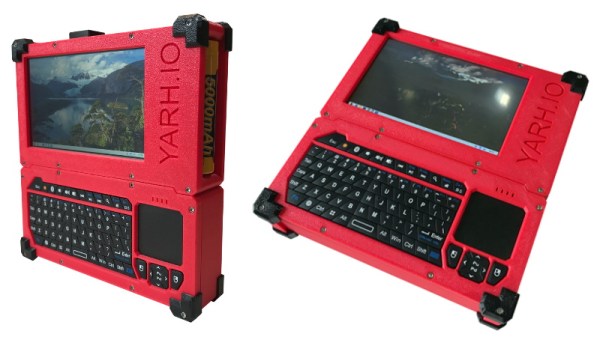
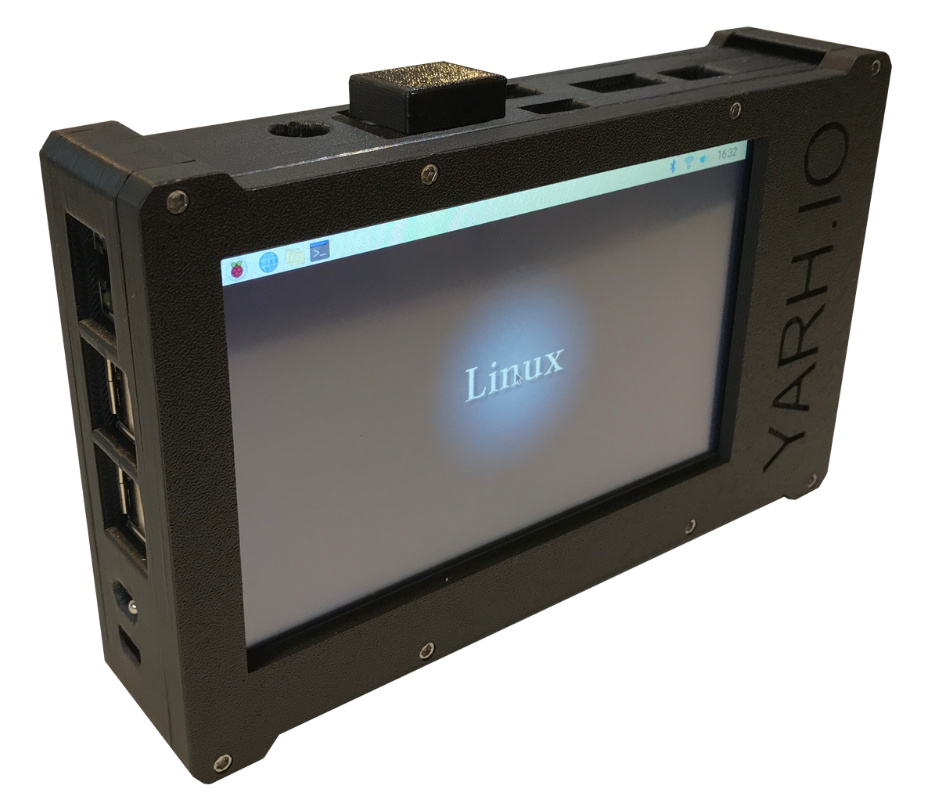
We’ve seen these elements combined into bespoke personal computing devices too many times to count now, but very few of them can compare to the incredible YARH.IO. It’s been designed from the ground up for easy assembly and customization; you don’t have to worry about getting custom PCBs made or tracking down some piece of unobtanium hardware. Everything inside of the 3D printed enclosure is an off-the-shelf module, needing little more than the occasional scrap of protoboard to tie them all together.

YARH.IO in tablet mode.

One glance at the rugged design of the YARH.IO, and it’s clear this device wasn’t meant to live on a shelf. Whether it’s getting tossed around the workbench or thrown into a bag on the way to a hacker con, the militarized design of this portable is ready for action. Using appropriately strong materials such as PETG and ABS, we have no doubt the enclosure will survive whatever the on-the-go hacker can throw at it.

But what’s arguably the best feature of the YARH.IO also happens to be the least obvious: the modular design of the enclosure allows you to remove the lower keyboard section and use it as a battery powered Linux tablet (albeit a rather chunky one). Whether the keyboard is attached or not, you still have access to the Pi’s expansion header thanks to a clever pass-through.

Like with the Mil-Plastic that [Jay Doscher] released recently, we know these 3D printed kits will never be as strong as the real military gear they’re emulating. But let’s be realistic, none of us keyboard warriors will be taking them into an actual battlefield anytime soon. What’s more important is that their modular construction allows them to be easily modified for whatever the user’s needs might be. With as far as the state-of-the-art in DIY bespoke computing as come in the last decade, we can’t wait to see what the future holds.

World’s Only Flying Twin Mustang Goes On Sale

Given the incredible success of the P-51 Mustang during the Second World War, it’s perhaps no surprise that the United States entertained the idea of combining two of the iconic fighters on the same wing to create a long-range fighter that could escort bombers into Japan. But the war ended before the F-82 “Twin Mustang” became operational, and the advent of jet fighters ultimately made the idea obsolete. Just five examples of this unique piece of history are known to exist, and the only one in airworthy condition can now be yours.

Assuming you’ve got $12 million laying around, anyway. Even for a flyable WWII fighter, that’s a record setting price tag. But on the other hand, you’d certainly be getting your money’s worth. It took over a decade for legendary restoration expert [Tom Reilly] and his team to piece the plane, which is actually a prototype XP-82 variant, together from junkyard finds. Even then, many of the parts necessary to get this one-of-a-kind aircraft back in the sky simply no longer existed. The team had to turn to modern techniques like CNC machining and additive manufacturing to produce the necessary components, in some cases literally mirroring the design in software so it could be produced in left and right hand versions.

Recovering half of the Twin Mustang in 2008.

We first covered this incredible restoration project back in 2018, before the reborn XP-82 had actually taken its first flight. Since then the plane has gone on to delight crowds with the sound of two counter-rotating Merlin V-12 engines and win several awards at the Oshkosh airshow. The listing for the aircraft indicates it only has 25 hours on the clock, but given its rarity, we can’t blame [Tom] and his crew for keeping the joyrides to a minimum.

As important as it is to make sure these incredible pieces of engineering aren’t lost to history, the recent crash of the B-17G Nine-O-Nine was a heartbreaking reminder that there’s an inherent element of risk to flying these 70+ year old aircraft. A world-class restoration and newly manufactured parts doesn’t remove the possibility of human error or freak weather. While we’d love to see and hear this beauty taxiing around our local airport, it’s a warbird that should probably stay safely in the roost. Hopefully the $12 million price tag will insure whoever takes ownership of the world’s only flying F-82 treats it with the respect it’s due.

Flipper Zero Blasts Past Funding Goal And Into Our Hearts

There’s never been a better time to be a hardware hacker: the tools are cheap, the information is free, and the possibilities are nearly endless. But that doesn’t mean there isn’t room for improvement. The Flipper Zero was developed to make the world of hardware hacking even more accessible, and as of this writing, has officially ended its Kickstarter campaign after raising a staggering $4.8 million. To say the community is excited about this little gadget is perhaps an understatement.

So what does the Flipper Zero do that’s gotten everyone so worked up? Well, for one, it’s not so much what it can do as how it does them. Taking inspiration from the already popular pwnagotchi project, the Flipper Zero gamifies the normally rather mundane tasks of sniffing for 433 MHz signals and flashing EEPROMs with the addition of an animated dolphin that’s sustained by your hacking. If you want the little fellow to grow and be happy, you need to keep poking and prodding around at any piece of hardware you come across.

If you’re looking for a comprehensive list of features, that’s a little harder to nail down. Partially because the device has picked up a number of new tricks (such as support for Bluetooth and NFC) thanks to the fact it made better than 8,000% of its original funding goal, but also because it can be expanded with additional hardware and software which obviously won’t get developed until the community gets their hands on the core device.

But even the core functionality, demonstrated in the video after the break, is quite compelling. The Flipper Zero’s CC1101 transceiver chip (anyone else thinking of the IM-ME right now?) allows it to record, analyze, and play back RF signals from 300 to 928 MHz, meaning you can instantly take over remote control systems that aren’t using a rolling code for authentication. It can also read and emulate many different RFID cards, record and transmit IR signals, emulate a USB HID device and run programmable payloads, and act as a USB to UART/SPI/I2C adapter. All contained in a sleek and pocket-sized enclosure that looks like a proper cyberpunk hacking gadget.

We’re extremely interested in seeing what the community can do with the Flipper Zero, especially now that the extra windfall has allowed the team to create a formal Developer Program for people who want to help work on the core platform or produce add-on modules. After banking nearly $5 million, this will be the yardstick by which all other crowd sourced hacking gadgets are measured for years to come; let’s hope they make it count.

Continue reading “Flipper Zero Blasts Past Funding Goal And Into Our Hearts”

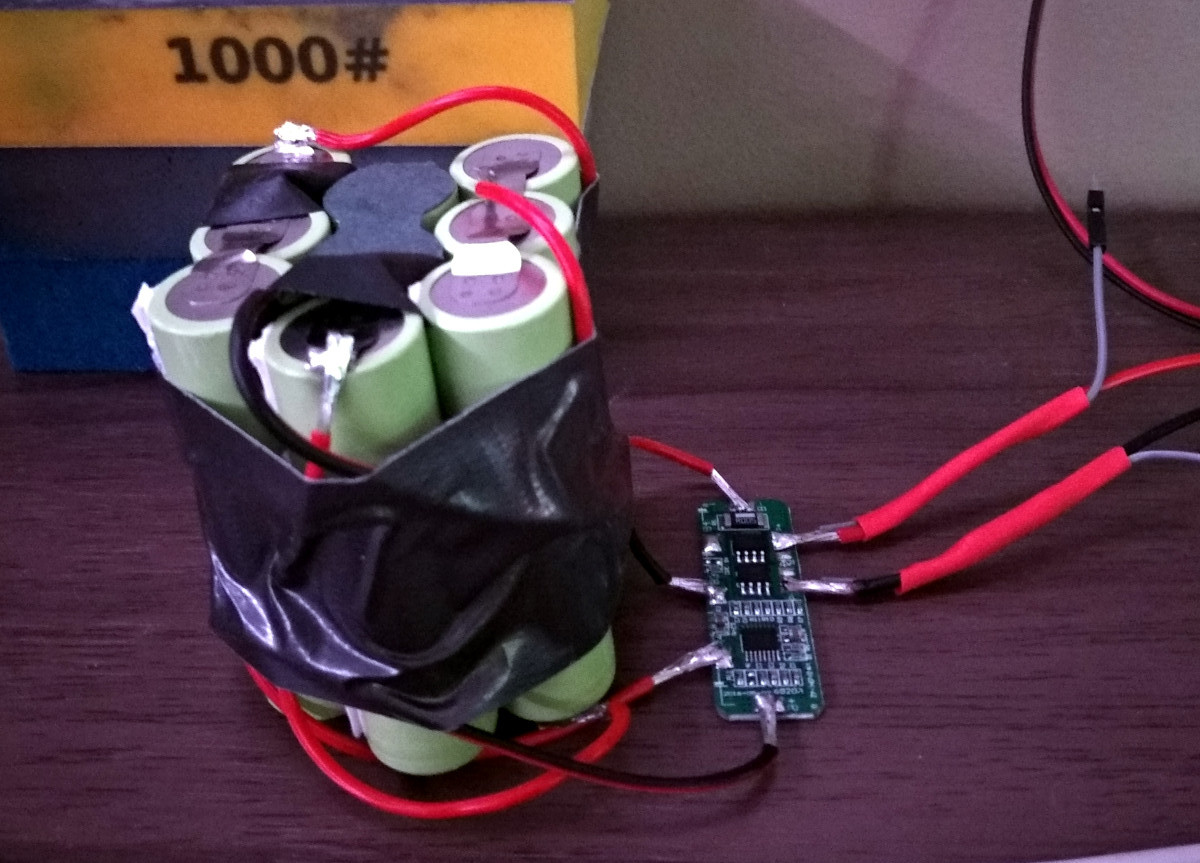
Building An Open Source ThinkPad Battery

If you own a laptop that’s got a few years on the clock, you’ve probably contemplated getting a replacement battery for it. Which means you also know how much legitimate OEM packs cost compared to the shady eBay clones. You can often get two or three of the knock-offs for the same price as a single real battery, but they never last as long as the originals. If they even work properly at all.

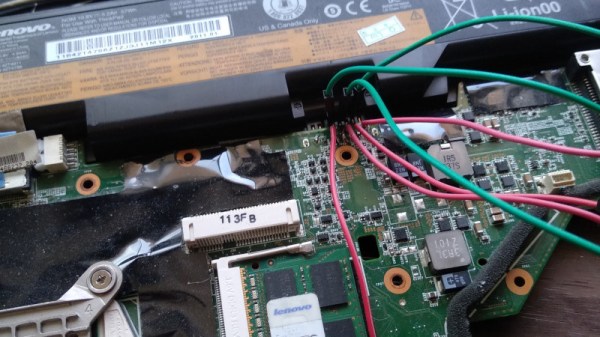
Which is why [Alexander Parent] decided to take the road less traveled and scratch built a custom battery for his ThinkPad T420. By reverse engineering how the battery pack communicated with the computer, he reasoned he would be able to come up with an open source firmware that worked at least as well as what the the third party ones are running. Which from the sounds of it, wasn’t a very high bar. From a more practical standpoint, it also meant he’d be able to create a higher capacity battery pack than what was commercially available should he chose to.

A logic analyzer wired in between one of the third party batteries and a spare T420 motherboard allowed [Alexander] to capture all the SMBus chatter between the two. From there he wrote some Arduino code that would mimic a battery as a proof of concept. He was slowed down a bit by an undocumented CRC check, but in the end he was able to come up with a fairly mature firmware that even allows you to provide a custom vendor name and model number for your pack.

The code was shifted over to an ATtiny85, with a voltage divider wired up to one of the pins so it can read the pack voltage. [Alexander] says his firmware still doesn’t do a great job of reporting the actual battery capacity remaining, but it’s close enough for his purposes. He came up with a simple PCB design to hold the MCU and support components, which eventually he plans on putting inside of a 3D printed case that actually plugs into the back of his T420.

This project is obviously still in a relatively early stage, but we’re very interested to see [Alexander] take it all the way. The ThinkPad has long been the hacker’s favorite laptop, and we can think of no machine more worthy of a fully open hardware and software battery pack.