Modernizing A Soviet-era LED Matrix

Used in everything from calculators to military hardware, the 3LS363A is an interesting piece of vintage hardware. With a resolution of 5 x 7 (plus a decimal point), the Soviet-made displays contain no electronics and are simply an array of 36 green LEDs. It’s not hard to drive one of them in a pinch, but [Dmitry Grinberg] thought this classic device deserved a bit better than the minimum.

He’s developed a small board that sits behind the 3LS363A and allows you to control it over I2C for a much more modern experience when working with these vintage displays. Powered by the ATtiny406, his adapter board makes it easy to chain the modules together and even handles niceties like flipping the displayed image to account for different mounting positions. While most of us probably won’t have the chance to play around with these relatively rare displays, there’s still plenty of useful information here if you’re thinking of creating your own I2C gadgets.

In his write-up, [Dmitry] explains his rationale behind the design and some of the quirks of working with the display. For example he explains how he gave each column of the display its own FET, but to save space on the board ended up running the single decimal point (technically its own column) directly off of a spare GPIO pin. Relying on the low duty cycle, he even left current limiting resistors off the design. The end result is a tiny board that keeps the same footprint of the 3LS363A itself.

[Dmitry] went all out with developing the firmware for his new “smart” 3LS363A displays, and has written up documentation for the different commands he has implemented. From re-configuring the I2C address to updating the firmware, he’s made sure no stone was left unturned for this project. We’re not ones to shy away from a quick and dirty code, but it’s always nice to see when somebody has really put some thought into the software side of a project.

We’ve seen our fair share of oddball Soviet displays here at Hackaday, utilizing everything from heavy duty incandescent bulbs to remarkably tiny “intelligent” LEDs. While it’s unlikely any of them will dethrone the nixie as king of the retro display devices, it’s always interesting to see unusual hardware being used in the wild.


Operation Backfire: Witness To The Rocket Age

As the prospects for Germany during the Second World War began to look increasingly grim, the Nazi war machine largely pinned their hopes on a number of high-tech “superweapons” they had in development. Ranging from upgraded versions of their already devastatingly effective U-Boats to tanks large enough to rival small ships, the projects ran the gamut from practical to fanciful. After the fall of Berlin there was a mad scramble by the Allied forces to get into what was left of Germany’s secretive development facilities, with each country hoping to recover as much of this revolutionary technology for themselves as possible.

V-2 launch during Operation Backfire

One of the most coveted prizes was the Aggregat 4 (A4) rocket. Better known to the Allies as the V-2, it was the world’s first liquid fueled guided ballistic missile and the first man-made object to reach space. Most of this technology, and a large number of the engineers who designed it, ended up in the hands of the United States as part of Operation Paperclip. This influx of practical rocketry experience helped kick start the US space program, and its influence could be seen all the way up to the Apollo program. The Soviet Union also captured V-2 hardware and production facilities, which subsequently influenced the design of their early rocket designs as well. In many ways, the V-2 rocket was the spark that started the Space Race between the two countries.

With the United States and Soviet Union taking the majority of V-2 hardware and personnel, little was left for the British. Accordingly their program, known as Operation Backfire, ended up being much smaller in scope. Rather than trying to bring V-2 hardware back to Britain, they decided to learn as much as they could about it in Germany from the men who used it in combat. This study of the rocket and the soldiers who operated it remains the most detailed account of how the weapon functioned, and provides a fascinating look at the incredible effort Germany was willing to expend for just one of their “superweapons”.

In addition to a five volume written report on the V-2 rocket, the British Army Kinematograph Service produced “The German A.4 Rocket”, a 40 minute film which shows how a V-2 was assembled, transported, and ultimately launched. Though they are operating under the direction of the British government, the German soldiers appear in the film wearing their own uniforms, which gives the documentary a surreal feeling. It could easily be mistaken for actual wartime footage, but these rockets weren’t aimed at London. They were being fired to serve as a historical record of the birth of modern rocketry.

Continue reading “Operation Backfire: Witness To The Rocket Age”

ESP8266 And Alexa Team Up To Tend Bar

After a hard day of soldering and posting memes online, sometimes you just want to yell at the blinking hockey puck in the corner and have it pour you out a perfectly measured shot of your favorite libation. It might not be the multi-purpose robot servant we were all hoping to have by the 21st century, but [Jake Lee] figures it’s about as close as we’re likely to get for under fifty bucks or so (Jake’s security certificate seems to have expired a few days ago so your browser may warn you, here’s an archived version).

From the hardware to the software, his Alexa-enabled drink pouring machine is an exercise in minimalism. Not that there’s anything wrong with that, of course. The easiest solutions are sometimes the best ones, and we think the choices [Jake] made here strike a perfect balance between keeping things simple and getting the job done. It’s by no means the most complete or capable robotic bartender we’ve ever seen, but it’s perhaps the one most likely to be duplicated by others looking to get in on the voice-controlled drinking game.

So how does it work? For one, [Jake] didn’t go through the trouble of creating a “proper” Alexa skill, that’s quite a bit of work just to pour a shot of rum. Instead, he took the easy way out and used the FauxMo library on his ESP8266 to emulate a few WeMo smart switches. Alexa (and pretty much every other home automation product) has native support for turning these on and off, so with the proper code you can leverage it as an easy way to toggle the chip’s digital pins.

Using the Alexa’s “Routines” capability, these simple toggles can be chained together and associated with specific phrases to create more complex actions. For example, you could chain the dispensing alcohol, lowering the room lighting, and playing music all to a single voice command. Something like “I give up”, perhaps.

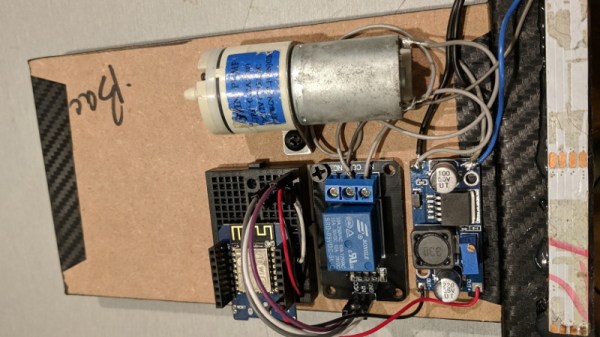
When Alexa tells the drink dispenser to turn on, the ESP8266 fires a relay which starts up a small 12 V air pump. This is connected to the bottle of rum though a glass tube that [Jake] bent with a blow torch, and starts to pressurize it. With the air at the top of the bottle pushing down on it, a second glass tube gives the liquid a way to escape. This method of dispensing liquid is not only easy to implement, but saves you from having to drink something that’s passed through some crusty eBay pump.

If you prefer the “right” way of getting your device talking to Amazon’s popular home surveillance system, our very own [Al Williams] can get you headed in the right direction. On the other hand, if the flowing alcohol is the part of this project that caught your attention, well we’ve got more than a few projects that cover that topic as well.

The Thrill Of Building Space Hardware To Exceptionally High Standards

It’s fair to say that the majority of Hackaday readers have not built any hardware that’s slipped the surly bonds of Earth and ventured out into space proper. Sure we might see the occasional high altitude balloon go up under the control of some particularly enterprising hackers, but that’s still a far cry from a window seat on the International Space Station. Granted the rapid commercialization of space has certainly added to that exclusive group of space engineers over the last decade or so, but something tells us it’s still going to be quite some time before we’re running space-themed hacks with the regularity of Arduino projects.

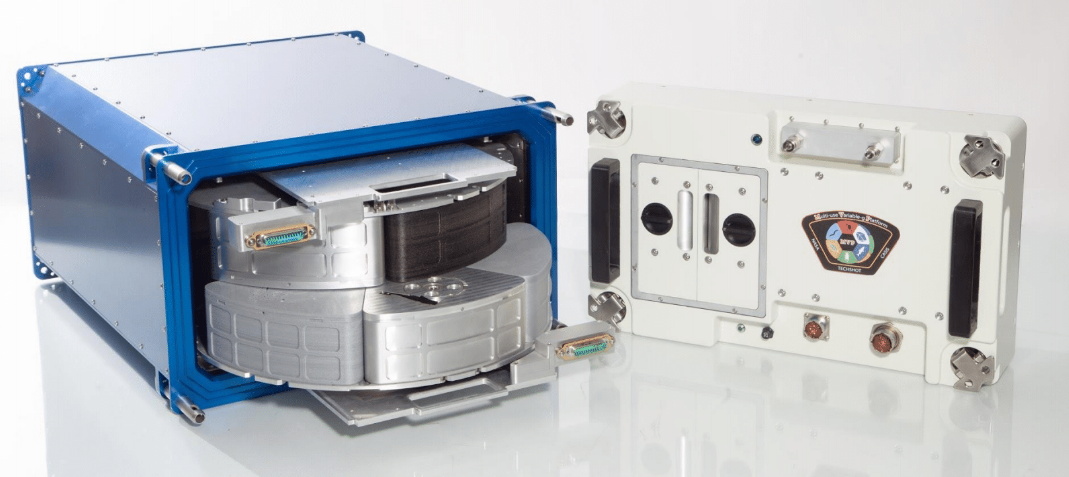
Multi-use Variable-G Platform

That being the case, you might assume the protocols and methods used to develop a scientific payload for the ISS must seem like Latin to us lowly hackers. Surely any hardware that could potentially endanger an orbiting outpost worth 100+ billion dollars, to say nothing of the human lives aboard it, would utilize technologies we can hardly dream of. It’s probably an alphabet soup of unfamiliar acronyms up there. After all, this is rocket science, right?

There’s certainly an element of truth in there someplace, as hardware that gets installed on the Space Station is obviously held to exceptionally high standards. But Brad Luyster is here to tell you that not everything up there is so far removed from our Earthly engineering. In fact, while watching his 2018 Hackaday Superconference talk “Communication, Architecture, and Building Complex Systems for SPAAACE”, you might be surprised just how familiar it all sounds. Detailing some of the engineering that went into developing the Multi-use Variable-G Platform (MVP), the only centrifuge that’s able to expose samples to gravitational forces between 0 and 1 g, his talk goes over the design considerations that go into a piece of hardware for which failure isn’t an option; and how these lessons can help us with our somewhat less critically important projects down here.

Check out Brad’s newly published talk video below, and then join me after the break for a look at the challenges of designing hardware that will live in space.

Continue reading “The Thrill Of Building Space Hardware To Exceptionally High Standards”

FAA Proposes Refined Drone Regulations

The wheels of government move slowly, far slower than the pace at which modern technology is evolving. So it’s not uncommon for laws and regulations to significantly lag behind the technology they’re aimed at reigning in. This can lead to something of a “Wild West” situation, which could either be seen as a good or bad thing depending on what side of the fence you’re on.

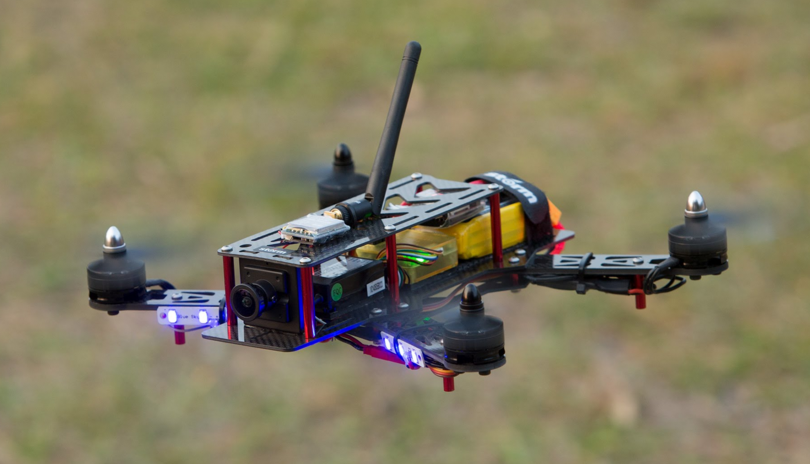
In the United States, it’s fair to say that we’ve officially moved past the “Wild West” stage when it comes to drone regulations. Which is not to say that remotely controlled (RC) aircraft were unregulated previously, but that the rules which governed them simply couldn’t keep up with the rapid evolution of the technology we’ve seen over the last few years. The previous FAA regulations for remotely operated aircraft were written in an era where RC flights were lower and slower, and long before remote video technology moved the operator out of the line of sight of their craft.

To address the spike in not only the capability of RC aircraft but their popularity, the Federal Aviation Administration was finally given the authority to oversee what are officially known as Unmanned Aerial Systems (UAS) with the repeal of Section 336 in the FAA Reauthorization Act of 2018. Section 336, known as the “Special Rule for Model Aircraft” was previously put in place to ensure the FAA’s authority was limited to “real” aircraft, and that small hobby RC aircraft would not be subject to the same scrutiny as their full-size counterparts. With Section 336 gone, one could interpret the new FAA directives as holding manned and unmanned aircraft and their operators to the same standards; an unreasonable position that many in the hobby strongly rejected.

At the time, the FAA argued that the repealing Section 336 would allow them to create new UAS regulations from a position of strength. In other words, start with harsh limits and regulations, and begin to whittle them down until a balance is found that everyone is happy with. U.S. Secretary of Transportation Elaine L. Chao has revealed the first of these refined rules are being worked on, and while they aren’t yet official, it seems like the FAA is keeping to their word of trying to find a reasonable middle ground for hobby fliers.

Continue reading “FAA Proposes Refined Drone Regulations”

Open Source Biological Gear For The Masses

At the risk of putting too fine a point on it, Hackaday exists because people are out there building and documenting open source gadgets. If the person who built a particular gizmo is willing to show the world how they did it, consider us interested. Since you’re reading this, we’ll assume you are as well. Over the years, this mentality has been spreading out from the relatively niche hacker community into the greater engineering world, and we couldn’t be happier.

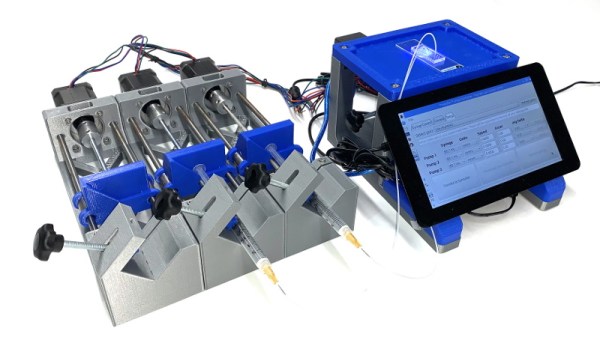
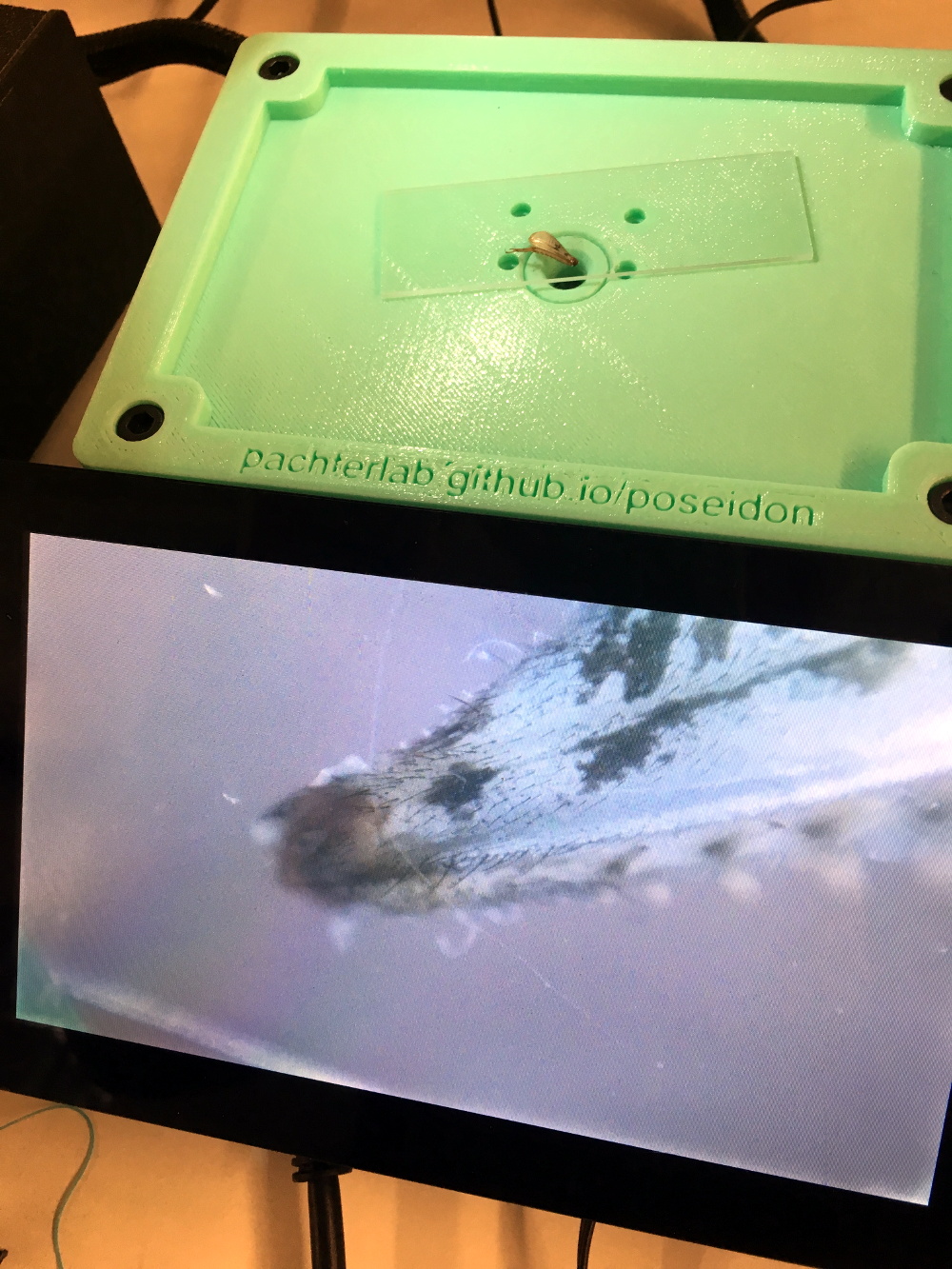
Case in point, the Poseidon project created at the California Institute of Technology. Developed by students [Sina Booeshaghi], [Eduardo Beltrame], and [Dylan Bannon], along with researcher [Jase Gehring] and professor [Lior Pachter], Poseidon consists of an open source digital microscope and syringe pump which can be used for microfluidics experiments. The system is not only much cheaper than commercial offerings, but is free from the draconian modification and usage restrictions that such hardware often comes with.

Of course, one could argue that major labs have sufficient funding to purchase this kind of gear without having to take the DIY route. That’s true enough, but what benefit is there to limiting such equipment to only the established institutions? As in any other field, making the tools available to a wider array of individuals (from professionals to hobbyists alike) can only serve to accelerate progress and move the state of the art forward.

The Poseidon microscope consists of a Raspberry Pi, touch screen module, and commercially available digital microscope housed in a 3D printed stage. This device offers a large and clear view of the object under the microscope, and by itself makes an excellent educational tool. But when running the provided Python software, it doubles as a controller for the syringe pumps which make up the other half of the Poseidon system.

Almost entirely 3D printed, the pumps use commonly available components such as NEMA 17 stepper motors, linear bearings, and threaded rods to move the plunger on a syringe held in the integrated clamp. Controlled by an Arduino and CNC shield, these pumps are able to deliver extremely precise amounts of liquid which is critical for operations such as Single-cell RNA sequencing. All told a three pump system can be built for less than $400 USD, compared to the tens of thousands one might pay for commercially available alternatives.

The Poseidon project joins a relatively small, but very exciting, list of DIY biology projects that we’ve seen over the years. From the impressive open source CO2 incubator we saw a few years ago to the quick and dirty device for performing polymerase chain reaction experiments, there’s little doubt about it: biohacking is slowly becoming a reality.

Continue reading “Open Source Biological Gear For The Masses”

A 3D Printed Robotic Chariot For Your Phone

As we’ve said many times in the past, the wide availability of low-cost modular components has really lowered the barrier to entry for many complex projects which previously would have been nigh-on impossible for the hobbyist to tackle. The field of robotics has especially exploded over the last few years, as now even $100 can put together a robust robotics experimentation platform which a decade ago might have been the subject of a DARPA grant.

But what if you want to go even lower? What’s the cheapest and easiest way to put together something like a telepresence robot? That’s exactly what [Advance Robotics] set out to determine with their latest project, and the gadget’s final form might be somewhat surprising. Leveraging the fact that nearly everyone has a device capable of video calls in their pocket, the kit uses simple hardware and 3D printed components to produce a vehicle that can carry around a smartphone. With the phone providing the audio and video link, the robot only needs to handle rolling around in accordance with the operators commands.

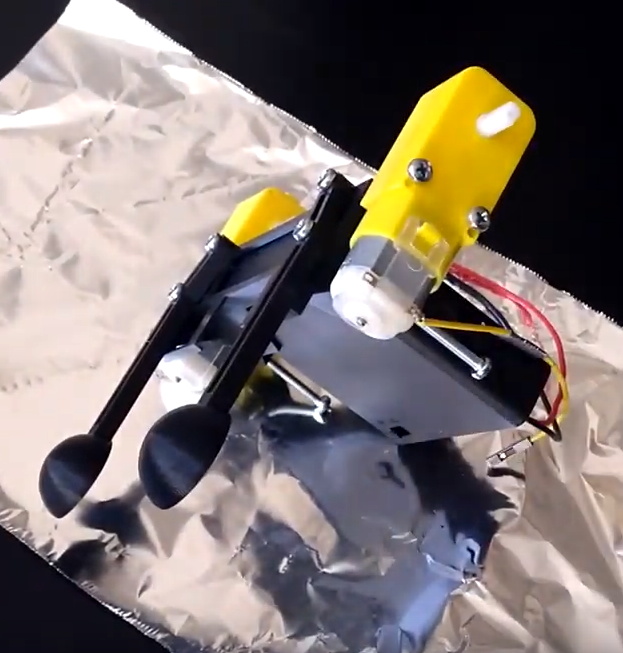
The robot chassis consists of a few simple 3D printed components, including the base which holds the phone and electronics, the wheels, and the two rear “spoons” which are used to provide a low-friction way of keeping the two-wheeled device vertical. To get it rolling, two standard DC gear motors are bolted to the sides. With the low cost of printer filament and the fact that these motors can be had for as little as $2 online, it’s hard to imagine a cheaper way to get your electronics moving.

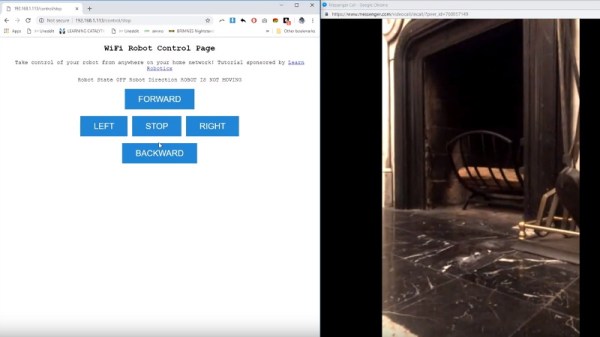
As for the electronics, [Advance Robotics] is using the Wemos D1 Mini ESP8266 development board along with L298N motor controller, another very low-cost solution. The provided source code pulls together a few open source libraries and examples to provide a simple web-based user interface which allows the operator to connect to the bot from their browser and move it around with just a few clicks of the mouse.

If you like the idea of printing a rover to explore your living room but want something a bit more advanced, we’ve seen printable robotics platforms that are sure to meet your needs, no matter what your skill level is.

Continue reading “A 3D Printed Robotic Chariot For Your Phone”