There’s More To Global Positioning Than Just GPS

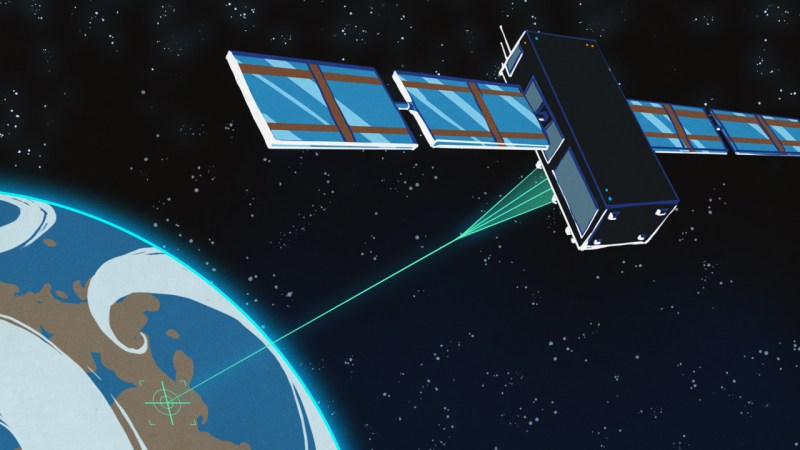
The Global Positioning System (GPS) was developed by the United States military in the 1970s, but it wasn’t long before civilians all over the planet started using it. By the early 2000s the technology was popping up in consumer devices such as mobile phones, and since then its become absolutely integral to our modern way of life.

But although support for GPS in our gadgets is nearly ubiquitous, it’s not the only option when it comes to figuring out where you are on the globe. As you might imagine, not everyone was thrilled with building their infrastructure around one of Uncle Sam’s pet projects, and so today there are several homegrown regional and global satellite navigation systems in operation.

As a follow-up to our recent dive into the ongoing GPS upgrades, let’s take a look at some of the other satellite positioning systems and who operates them.

Continue reading “There’s More To Global Positioning Than Just GPS”

Hackaday Links Column Banner

Hackaday Links: May 3, 2026

Software that collects public data from the Internet and uses it to provide half-assed answers to your questions might seem like a modern craze, but today we bid farewell to a website that helped pioneer pretend conversations all the way back in 1997 — as of May 1st, Ask Jeeves is no more.

Well, technically they dropped the “Jeeves” part back in 2006. Since then it’s just been Ask.com, but as the name implies the idea was more or less the same. Rather than the relatively rigid parameters and keywords required by traditional search engines, you could ask Jeeves questions about the world using natural language. Early advertisements showed the virtual valet answering arbitrary questions like “How many calories in a banana?,” which of course today seems commonplace and utterly unimpressive, but was a pretty wild for the 1990s.

It might seem surprising that a site designed from day one to offer a human-like Q&A experience should fold right as such technology is becoming commonplace. But of course, that commonality is the problem. When Google can answer your questions just as well (or poorly…) as Jeeves or anyone else, what’s the benefit for the average Internet user to seek out another service? But it’s still somewhat ironic, which is probably why the farewell message on Ask.com ends with the line “Jeeves’ spirit endures.”

Continue reading “Hackaday Links: May 3, 2026”

The GPS III Rollout Is Almost Complete, But What Is It?

Considering how integral it is to our modern way of life, you could be excused for thinking that the Global Positioning System (GPS) is a product of the smartphone era. But the first satellites actually came online back in 1978, although the system didn’t reach full operational status until April of 1995. While none of the active GPS satellites currently in orbit are quite that old, several of them were launched in the early 2000s — and despite a few tweaks and upgrades, their core technology isn’t far removed from their 1990s era predecessors.

But in the coming years, that’s finally going to change. Just last week, the tenth GPS III satellite was placed in orbit by a SpaceX Falcon 9 rocket. Once it’s properly configured and operational, it will join its peers to form the first complete “block” of third-generation GPS satellites. Over the next decade, as many as 22 revised GPS III satellites are slated to take their position over the Earth, eventually replacing all of the aging satellites that billions of people currently rely on.

So what new capabilities do these third-generation GPS satellites offer, and why has it taken so long to implement needed upgrades in such a critical system?

Continue reading “The GPS III Rollout Is Almost Complete, But What Is It?”

Hackaday Links Column Banner

Hackaday Links: April 26, 2026

It’s been three weeks since the Artemis II crew returned to Earth, and while the mission might be over for Reid Wiseman, Victor Glover, Christina Hammock Koch, and Jeremy Hansen, the work is only just beginning for engineers back at NASA. In a blog post earlier this week, the space agency went over the preliminary post-mission assessments of the spacecraft and its ground support equipment, and detailed some of the work that’s currently taking place as preparations begin for Artemis III.

During Artemis I, higher than expected damage was noted on both the Orion’s heat shield and the Space Launch System (SLS) launch pad. But according to NASA, the changes implemented after that first mission seem to have prevented similar issues this time around. The post also explains that reusable components of the Orion spacecraft, such as the avionics and the crew seats, are already in the process of being removed from Integrity so they can be installed in the next capsule on the production line.

While watching the live stream of the Artemis mission is the closest most of us will ever get to experiencing spaceflight, that doesn’t mean you can’t explore the solar system from the comfort of your own home — or more specifically, your browser. [Sani Huttunen] has created an incredible web-based solar system simulator that lets you explore our celestial neighborhood throughout different periods of time. You can tour the moons of Jupiter, see how the planets aligned on the date of your birth, and even check in on the Voyager probes. There are some very valid reasons to be skeptical about software moving to the web, but we’ve got to admit, this is a very slick demonstration of just how far modern browsers have come.

Continue reading “Hackaday Links: April 26, 2026”

VCF East And Maker Faire Make For A Busy Weekend

For those of us with an interest in hacking and making, events where we can meet up with like minded folks and check out the projects they’re working on don’t exactly happen every day. Unless you’re able to travel around the country (or even better, the world), you usually have to make do with the handful of annual events that are within a reasonable distance of your home. If you’re lucky that may give you two or three opportunities during the year to look forward to, generally spaced out enough that you’ve got adequate time to prepare ahead of the event and decompress afterwards.

But occasionally, the planets and geekdoms align. Such was the case this past weekend in the Northeastern United States, with Vintage Computer Festival East and the Philadelphia Maker Faire taking place simultaneously. Both are established must-see events for their respective communities and cover roughly the same geographical area, so if you happened to have a foot in each camp, this presented quite a difficult decision.

That is unless you took the third option. As the Philly Maker Faire was on Sunday and VCF took place over the span of the whole weekend, there was a narrow path to attend both events. It wouldn’t be ideal, of course. For one thing it would mean speed running VCF East, and there was a couple hundred miles of travel to contend with. We won’t even talk about the physical toll incurred — while there doesn’t appear to be any official dosage recommendation from the Surgeon General, surely this level of exposure to non-conforming technologists carries with it some risks.

But sometimes such sacrifices must be made, especially if you’re being paid to make them. So I packed up twice the normal number of Wrencher stickers, and hit the road in an effort to deliver a condensed version of my experience at these two fantastic events.

Continue reading “VCF East And Maker Faire Make For A Busy Weekend”

Hackaday Links Column Banner

Hackaday Links: April 19, 2026

We’ll start things off this week with a story that’s developing more than 25 billion kilometers from Earth — on Friday, NASA announced that the command had been sent to shut down Voyager 1’s Low-energy Charged Particles (LECP) instrument. As the power produced by the spacecraft’s aging radioisotope thermoelectric generator (RTG) continues to dwindle, engineers at the Jet Propulsion Laboratory have been systematically turning off various systems to extend the mission for as long as possible. It’s believed that deactivating LECP should buy them another year, during which engineers hope to implement a more ambitious power-saving routine. If this sounds a bit familiar, you’re probably thinking of Voyager 2. The plug was pulled on its LECP instrument back in March of 2025.

The JPL engineers hope that their new plan may allow them to reactivate previously disabled systems on the twin space probes, but even if everything goes according to plan, there’s no fighting the inevitable. At some point, there simply won’t be enough juice in the RTGs to keep the lights on. Although it’s going to be a sad day when we have to bring you that news, surviving a half-century in space is one hell of a run.

Speaking of ending a run, just a week after Amazon announced that pre-2012 Kindles would no longer be supported, the company is letting users know that the Kindle software for PCs will be discontinued in June. In its current form, at least. As Good e-Reader reports, Amazon is developing a new client for users who want to access the Kindle ecosystem from their computers, but it will only run on Windows 11. Since older software could be used to strip DRM from purchased ebooks, it seems likely this is another attempt to lock the platform down.

Continue reading “Hackaday Links: April 19, 2026”

Desktop Digitizer Makes Note Capture A Breeze

While it might seem quaint these days, we’ve met many makers and hackers who reach for a pen and a pad when learning something new or working their way through some technical problem. But even if you’re the type of person who thinks best when writing something out on paper, there’s still a good chance that you’ll eventually want to bring those notes and sketches into the digital realm. That’s where things can get a little tricky.

[Spencer Adams-Rand] recently wrote in with his clever solution for capturing written notes and pushing them into Notion, but the hardware design and digitization workflow is flexible enough that it could be adapted to your specific needs — especially since he was good enough to release all the files required to build your own version.
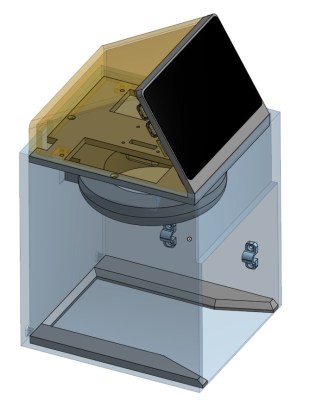
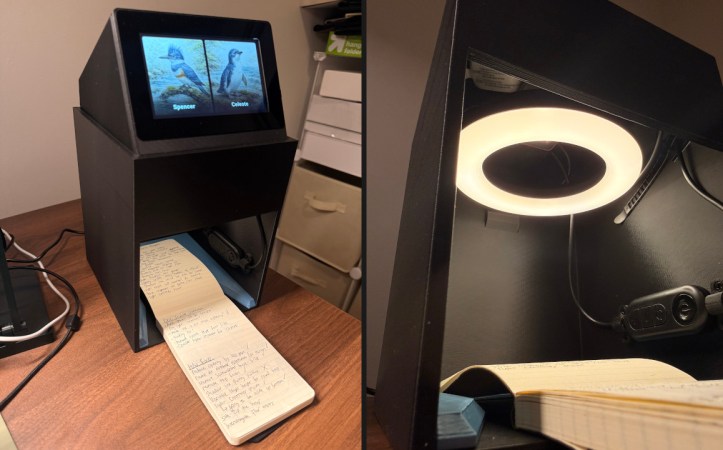
Whether they are hand-written notes, old photographs, or legal documents, digitization boils down to taking a high resolution digital photo of the object and running it through the appropriate software. But getting good and consistent photos is the key, especially when you’re working your way through a lot of pages. [Spencer] started out just snapping pictures with his phone, but quickly found the process was less than ideal.

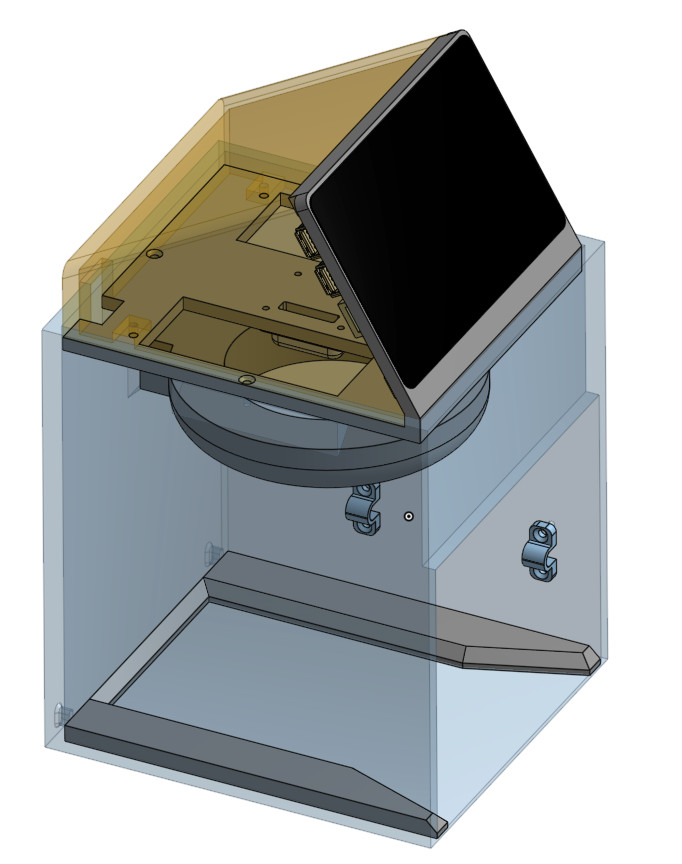
His custom scanning station addresses that first part of the problem: getting consistent shots. The images are captured using a Raspberry Pi 5 with attached Camera Module 3, while the 3D printed structure of the device makes sure that the camera and integrated lighting system are always in the same position. All he needs to do is place his notepad inside the cavity, hit the button, and it produces a perfect shot of the page.

Using a dedicated digitizing station like this would already provide better results than trying to freehand it with your phone or camera, but [Spencer] took things quite a bit farther. The software side of the project puts a handy user interface on the 5 inch touch screen built into the top of the scanner, while also providing niceties like a REST API and integration with the OpenAI Vision API for optical character recognition (OCR).

Those with an aversion to AI could certainly swap this out for something open source like Tesseract, but [Spencer] notes that not only is OpenAI’s OCR better at reading his handwriting, it spits out structured markdown-like data that’s easier to parse. From there it goes into the Notion API, but again, this could be replaced with whatever you use to collect your digital thoughts.

A device like this would go a long way towards answering a question we posed to the community back in January about the best way to digitize your documents.