For those of us who like to crawl over complex systems, spending hours or even days getting hardware and software to work in concert, working at places like NASA or CERN seems like a dream job. Imagine having the opportunity to turn a wrench on the Space Shuttle or the Large Hadron Collider (LHC) — not only do you get to spend some quality time with some of the most advanced machines ever produced, you can be secure in the knowledge that your work will further humanity’s scientific understanding of the universe around us.
Or at least, that’s what we assume it must feel like as outsiders. But what about somebody who’s actually lived it? What does an actual employee, somebody who’s had to wake up in the middle of the night because some obscure system has gone haywire and stalled a machine that cost taxpayers $4.75 billion to build, think about working at the European Organization for Nuclear Research? Continue reading “Daniel Valuch Chats About CERN’s High Caliber Hacking”→
We’ve said many times that while woodworking is a bit outside our wheelhouse, we have immense respect for those with the skill and patience to turn dead trees into practical objects. Among such artisans, few are better known than the legendary Norm Abram — host of The New Yankee Workshop from 1989 to 2009 on PBS.
So we were pleased when the official YouTube channel for The New Yankee Workshop started uploading full episodes of the classic DIY show a few months back for a whole new generation to enjoy. The online availability of this valuable resource is noteworthy enough, but we were particularly impressed to see the channel start experimenting with AI enhanced versions of the program recently.
Note AI Norm’s somewhat cartoon-like appearance.
Originally broadcast in January of 1992, the “Child’s Wagon” episode of Yankee Workshop was previously only available in standard definition. Further, as it was a relatively low-budget PBS production, it would have been taped rather than filmed — meaning there’s no negative to go back and digitize at a higher resolution. But thanks to modern image enhancement techniques, the original video could be sharpened and scaled up to 1080p with fairly impressive results.
That said, the technology isn’t perfect, and the new HD release isn’t without a few “uncanny valley” moments. It’s particularly noticeable with human faces, but as the camera almost exclusively focuses on the work, this doesn’t come up often. There’s also a tendency for surfaces to look smoother and more uniform than they should, and reflective objects can exhibit some unusual visual artifacts.
Even with these quirks, this version makes for a far more comfortable viewing experience on today’s devices. It’s worth noting that so far only a couple episodes have been enhanced, each with an “AI HD” icon on the thumbnail image to denote them as such. Given the computational demands of this kind of enhancement, we expect it will be used only on a case-by-case basis for now. Still, it’s exciting to see this technology enter the mainstream, especially when its used on such culturally valuable content. Continue reading “Norm Abram Is Back, And Thanks To AI, Now In HD”→
There were some that doubted the day would ever come, but we’re happy to report that the ambitious self-destructing USB drive that security researcher [Walker] has been working on for the last 6+ months has finally stopped working. Which in this case, is a good thing.
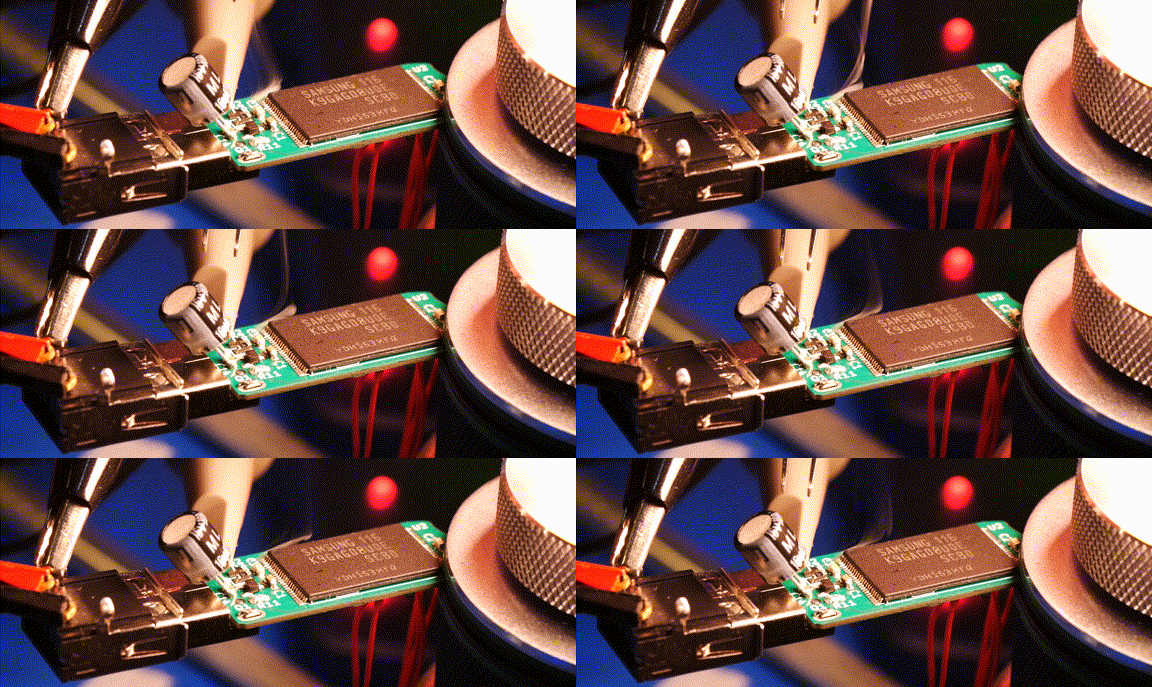
Readers may recall that the goal of the Ovrdrive project was to create a standard-looking flash drive that didn’t just hide or erase its contents when accessed by an unauthorized user, but actively damaged itself to try and prevent any forensic recovery of the data in question. To achieve this, [Walker] built a voltage doubler circuit into the drive that produces 10 volts from the nominal 5 VDC coming from the USB port. At the command of an onboard microcontroller, that 10 V is connected to the circuit’s 3.3 V rail to set off the fireworks.
Early attempts only corrupted some of the data, so [Walker] added some more capacitance to the circuit to build up more of a charge. With the revised circuit the USB controller IC visibly popped, but even after it was replaced, the NAND flash was still unresponsive. Sounds pretty dead to us.
Too user friendly, needs more buttons
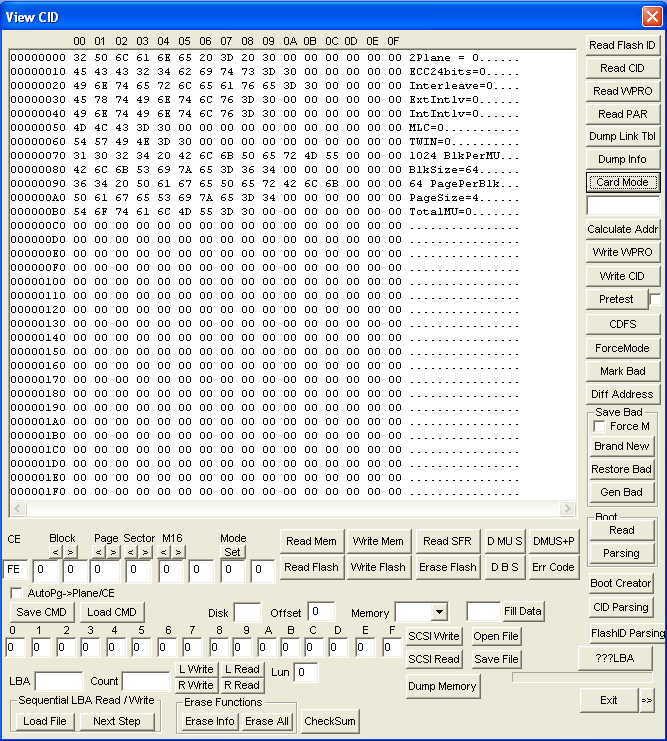
Unfortunately, there’s still at least one issue that’s holding back the design. As we mentioned previously, [Walker] was having trouble getting the computer to actually acknowledge his homebrew drive had any free space available. It turns out that the SM3257EN USB controller IC he’s using needs to be initialized by some poorly documented Windows XP software, which might not be such a big deal if the goal was just to build one of them, but could obviously be a hindrance when going into production.
He hopes further reverse engineering will allow him to determine which commands the XP software is giving to the IC so that he can duplicate them in a less ancient environment. Sounds like a job for Wireshark to us — with any luck he should be able to capture the commands being sent to the hardware and replay them.
While we can understand some readers may have lingering doubts about the drive’s spit-detection authentication system, it’s clear [Walker] has made some incredible progress here. This project demonstrates that not only can an individual spin up their own sold state storage, but that should they ever need to, they can also destroy it in an instant.
Join Editor-in-Chief Elliot Williams and Managing Editor Tom Nardi as they explore the best and most interesting stories from the last week. The top story if of course the possibility that at least some of the unidentified flying objects the US Air Force valiantly shot down were in fact the work of amateur radio enthusiasts, but a quantitative comparison of NASA’s SLS mega-rocket to that of popular breakfast cereals is certainly worth a mention as well.
Afterwards the discussion will range from modular home furnishings to the possibility of using YouTube (or maybe VHS tapes) to backup your data and AI-generated Pong. Also up for debate are cheap CO2 monitors which may or may not be CO2 monitors, prosthetic limbs made from locally recycled plastic, and an answer to Jenny’s Linux audio challenge from earlier this month.
Check out the links below if you want to follow along, and as always, tell us what you think about this episode in the comments!
For those who have a passion for vintage hardware, whether it be a classic computer or a war-surplus ham radio rig, finding the things without resorting to paying shipping fees on eBay can sometimes be tricky. Your best bet is to find a local fair or swap event, but it always seems they’re the kind of thing you find out about the weekend after they were held.
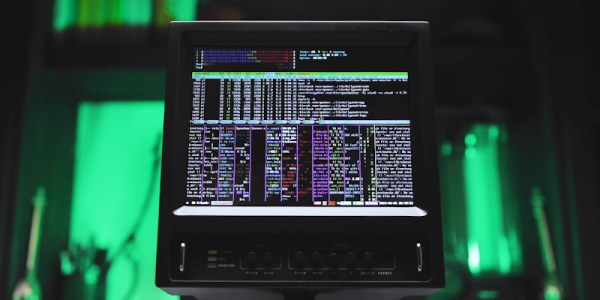
A quick glance at the “Pi Terminal” built by [Salim Benbouziyane], and you might think he pulled an old CRT monitor out of a video editing bay and gutted it. Which, of course, is the point. But what you’re actually looking at is a completely new construction, featuring a fully 3D printed enclosure, a clever PCB control panel, and some very slick internal engineering.
[Salim] started the design by recreating the principle components of the build, namely the 8 inch 4:3 IPS LCD panel and Raspberry Pi 4, digitally in CAD. This let him design the enclosure around the parts, rather than trying to cram everything in after the fact. After printing the case, which clearly took considerable inspiration from broadcast video monitors of the early 2000s, he then painstakingly post-processed the parts using tips and techniques picked up from prop builders. To really finish things off, he designed his control panel as a PCB so he could have it professionally fabricated, and used heat set inserts to hold everything tight. Continue reading “This CRT-Style Pi Portable Gets All The Details Right”→
Anyone who’s owned a game console from the last couple of generations will tell you that the machines are becoming increasingly like set-top computers — equipped with USB ports, Bluetooth, removable hard drives, and their own online software repositories. But while this overlap theoretically offers considerable benefits, such as the ability to use your own USB controller rather than being stuck with the system’s default, the manufacturers haven’t always been so accommodating.
Take for example the removable hard drive of the Xbox 360. It was a bog standard 2.5″ SATA drive inside a fancy enclosure, but as explained by [Eaton], Microsoft went to considerable lengths to prevent the user from upgrading it themselves. Which wouldn’t have been such a big deal, if the Redmond giant wasn’t putting a huge markup on the things; even in 2005, $99 USD for 20 GBs was highway robbery. Continue reading “A Look Back At The Xbox 360’s Hard Drive Security”→