Hacker Challenge: Sail The Atlantic

We found it incredible that — apparently — no one has sailed an autonomous sailboat across the Atlantic successfully. Compared to an electric craft, sail-powered platforms ought to reduce having to carry batteries or other fuel and enable long-duration missions. The problem, of course, is the sailing conditions in the Atlantic.

The challenge is the focus of the Microtranssat challenge which started in 2010. You can think of the challenge as a race, but not in the conventional sense. Participants can launch their 8 foot (or less) craft any time between July and December, and it doesn’t matter which direction they go. They simply have to cross the Atlantic. If more than one boat makes it, the fastest is the winner.

The current leader is the SailBuoy. This Norwegian entry has made it halfway, but no further. However, it has sailed quite a distance in other places, so perhaps it will make it soon. You can see SailBuoy afloat in the video below.

Continue reading “Hacker Challenge: Sail The Atlantic”

Finally, A Fidget Spinner We Can Love

We’ve been frankly mystified at the popularity of fidget spinners. After all, we can flip an ink pen around just fine. However, [MakersBox] just sold us on what he calls the geek spinner. The fact that the spinner is actually a PCB and has parts on it, would probably have been cool enough. However, the spinner also has a persistence of vision LED set up and can display 12 characters of text as it spins. Because the board is simple and uses through hole components, it would be a great project for a budding young hacker. You can see a video below.

The instructions are geared towards someone attempting their first project, too. If you know how to solder and insert a DIP IC, you might find you’ll skim them, but it is pretty straightforward. The 8 LEDs on one side operate from an ATTiny CPU, which you can program with an Arduino. The spinner has a hall effect sensor and a magnet to figure out the index position of the spin — crucial for displaying text.

Although the board attempts to balance the components, the battery side is apparently a little heavy. The suggestion is to add some weight using some hardware or solder to that side. Speaking of solder, the bearing in the center solders to the PCB. That’s going to take a lot of heat, so maybe you can finally use Dad’s soldering gun that has been gathering dust under your bench.

We liked the polar graph provided to help you set up the code for your own messages. The text implies there is a picture of one of these graphs filled out, but we think he forgot to include that picture. However, it is clear enough how to use it, and it would make it very easy to make your own text or any design that the spinner could produce.

This isn’t the first POV spinner, by the way. [MakersBox] has a nice set of acknowledgments for projects he’s seen or borrowed from, but the other one he mentions uses surface mount. Granted, surface mount isn’t a problem for most people these days, but starting out, it might be nice to stick with a through-hole design. If you want a more useful spinner, you can always make some music.

Continue reading “Finally, A Fidget Spinner We Can Love”

Mission Impossible: Infiltrating Furby

Long before things “went viral” there was always a few “must have” toys each year that were in high demand. Cabbage Patch Kids, Transformers, or Teddy Ruxpin would cause virtual hysteria in parents trying to score a toy for a holiday gift. In 1998, that toy was a Furby — a sort of talking robot pet. You can still buy Furby, and as you might expect a modern one — a Furby Connect — is Internet-enabled and much smarter than previous versions. While the Furby has always been a target for good hacking, anything Internet-enabled can be a target for malicious hacking, as well. [Context Information Security] decided to see if they could take control of your kid’s robotic pet.

Thet Furby Connect’s path to the Internet is via BLE to a companion phone device. The phone, in turn, talks back to Hasbro’s (the toy’s maker) Amazon Web Service servers. The company sends out new songs, games, and dances. Because BLE is slow, the transfers occur in the background during normal toy operation.

Continue reading “Mission Impossible: Infiltrating Furby”

Tensorflow Tutorial Uses Python

Around the Hackaday secret bunker, we’ve been talking quite a bit about machine learning and neural networks. There’s been a lot of renewed interest in the topic recently because of the success of TensorFlow. If you are adept at Python and remember your high school algebra, you might enjoy [Oliver Holloway’s] tutorial on getting started with Tensorflow in Python.

[Oliver] gives links on how to do the setup with notes on Python versions. Then he shows some basic setup operations. From there, he has the software “learn” how to classify random points that either fall into a circle or don’t. Granted, this is easy enough to do with traditional programming, so it isn’t a great practical example, but it is illustrative for learning purposes.

Given that it is easy to algorithmically decide which points are in the circle and which are not, it is simple to develop training data. It is also easy to look at the result and see how close it is to the actual circle. You’ll see that it takes a lot of slow learning before the result space looks like a circle and not a triangle or some other odd shape.

Continue reading “Tensorflow Tutorial Uses Python”

Students Build Electromagnetic Egg Drop Stand

The Egg Drop is a classic way to get students into engineering, fabrication, and experimentation. It’s a challenge to build a container to protect a raw egg from cracking when dropped from various heights.

Here’s a way to add some extra hardware to use when testing each entry. It’s an  electromagnetic drop stand built by several students along with [Tom Jenkins]. The stand doesn’t require anything too exotic, and it allows students to drop their eggs in a controlled manner for a fair competition. Along the way, they learn about circuits, electromagnets, and some other electronic concepts.

If this sounds familiar, it is because it builds on the egg drop project from the Teaching Channel we talked about before. The materials for that lesson have the basic outline of the drop stand, but the video really helps kids visualize it and build it.

Continue reading “Students Build Electromagnetic Egg Drop Stand”

Bringing MATLAB To A Vacuum Near You

The essence of hacking is modifying something to do a different function. Many of us learned as kids, though, that turning the family TV into an oscilloscope often got you into trouble.

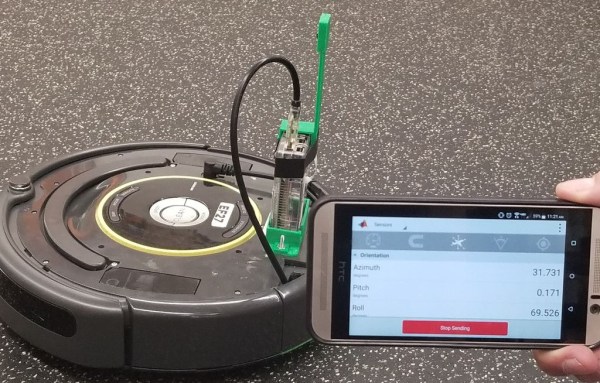
These days, TVs are flat and don’t have high voltage inside, but there’s always the family robot, often known as a Roomba. Besides providing feline transportation, these little pancake-shaped robots also clean floors.

If you don’t want to evict the cat and still get a robust domestic robot platform for experimentation, about $200 will get you a Roomba made to be hacked — the iRobot Create 2. [Gstatum] has a tutorial for using a Raspberry Pi and MATLAB to get one quickly running and even doing basic object recognition using the Pi’s camera.

The code even interfaces with Twitter. The impressive part is the code fits on about a page. This isn’t, however, completely autonomous. It uses a connected phone’s sensor’s so that the phone’s orientation controls the robot’s motion, but the robot does use sensors to prevent driving into walls or falling off a cliff. It also can detect being picked up and uses the Pi’s camera to detect a green flag.

Continue reading “Bringing MATLAB To A Vacuum Near You”

Digital Panel Meter Tear Down

[Big Clive] had some 22mm digital AC voltmeters, made to put in a panel. There was a time when this would have been a significant pain, since it required you to make a large square hole. Of course, in a world of CNC and 3D printers that isn’t as big a deal as it used to be, but the ones [Clive] has are nice because having a round footprint you can drill a hole for them with a hole saw or a stepped bit. Of course, he wasn’t satisfied to just use these inexpensive meters. He had to tear one apart to look inside. You can see his review and teardown in the video below. The meters are available in a range of AC voltages, although [Clive] didn’t think the ones he had would safely handle their rated maximum.

Inside, the modules reminded us of cordwood construction in a way. Most of the electronics are on a small round board. But several components connect to the board and the bottom cap in a vertical orientation. The meters are available in several colors, but [Clive] likes the red ones as they appear brighter than the others. The voltage reading compared favorably to a Fluke meter.

Continue reading “Digital Panel Meter Tear Down”