It’s A Bird, It’s A Plane, No… It’s High Voltage EPROM Man!

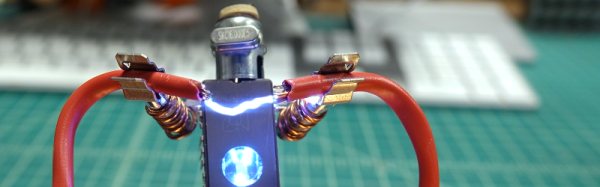
At Hackaday, we cover some pretty high-tech builds. Sometimes, though, you see something simple, but it still makes you feel happy to see it. That’s pretty much the case with [ProtoG’s] High Voltage EPROM Man.

The parts probably came out of a junk box, but the good news is that they don’t have to work, and you can freely substitute anything you have. According to [ProtoG], the “robot” head is a bulb socket with a crystal for the visor. The arms are fuses with fuse clips for the hands. The knees are adjustable caps, and the feet are TO-220 transistors.

Continue reading “It’s A Bird, It’s A Plane, No… It’s High Voltage EPROM Man!” →

Don’t Shovel Snow; Build An Epic Melt System!

When [Ronald Walters] was building a new house, he decided he didn’t want to shovel snow anymore. So he built a snow melt system under his new driveway. He knew the system would be expensive to operate, but he reasoned it was cheaper than back surgery and much cheaper than having a heart attack.

The system uses PEX pipe on rebar and insulation that is all set down before the concrete in the driveway. An instant-on water heater produces the heat that melts the snow and ice off [Ronald’s] driveway with no shoveling required. The working fluid includes anti-freeze, of course, and there is a set of pumps, flow valves, and flow meters to keep everything flowing when the system is in operation.

Continue reading “Don’t Shovel Snow; Build An Epic Melt System!” →

Misleading Tech: Kickstarter, Bomb Sights, And Medical Rejuvinators

Every generation thinks it has unique problems and, I suppose, sometimes it is true. My great-grandfather didn’t have to pick a cell phone plan. However, a lot of things you think are modern problems go back much further than you might think. Consider Kickstarter. Sure, there have been plenty of successful products on Kickstarter. There have also been some misleading duds. I don’t mean the stupid ones like the guy who wants to make a cake or potato salad. I mean the ones that are almost certainly vaporware like the induced dream headgear or the Bluetooth tag with no batteries.

Overpromising and underdelivering is hardly a new problem. In the 30’s The McGregor Rejuvenator promised to reverse aging with magnetism, radio waves, infrared and ultraviolet light. Presumably, this didn’t work. Sometimes products do work, but they don’t live up to their marketing hype. The Segway comes to mind. Despite the hype that it would revolutionize transportation, the scooter is now a vehicle for tourists and mall cops.

One of my favorite examples of an overhyped product comes from World War II: The Norden Bomb Sight. What makes the Norden especially interesting is that even today it has a reputation for being highly accurate. However, if you look into it, the Norden–although a marvel for its day–didn’t always live up to its press.

Continue reading “Misleading Tech: Kickstarter, Bomb Sights, And Medical Rejuvinators” →

Giant Mersenne Prime Found

Ever hear of a Mersenne prime? These are prime numbers that are one less than a power of two. Named after Marin Mersenne, a French Minim friar, who studied them in the early 17th century, there is a distributed computing project on the Internet to find Mersenne primes called GIMPS (Great Internet Mersenne Prime Search). The project recently announced they have found the largest known prime.

Continue reading “Giant Mersenne Prime Found” →

ESP-Micro Is A Tiny Development Board

The ESP-8266 packs a lot of networking power into a small package. Some would say too small, which is why they often come on a slightly larger carrier PCB. The PCB is usually little more than a breakout with an optional 3.3V regulator. [Frazer Barnes] went one step further: he put an equally tiny USB to serial bridge, an oscillator, and some power management on an ESP-8266 breakout board.

You can program the ESP-8266 via the serial port, so having a built-in USB port is handy. Of course, you might not need it in the final product, but with the board being 25x30mm, you can probably cram it into most projects. [Frazer] posted a bit about the project on Hackaday.io, and has a GitHub project, although right now the upload of the design files is pending.

There’s no shortage of ESP-8266 projects. We saw a small Zigbee to ESP8266 board last year, and also the antidote for a tiny carrier board that includes an LCD, switches, and more. We also have tons of breakouts on Hackaday.io: here’s one with all the bells and whistles, and a similar, stripped-down version. All open-everything, and ready to go.

Kids And Hacking: Electromagnetic Eggs

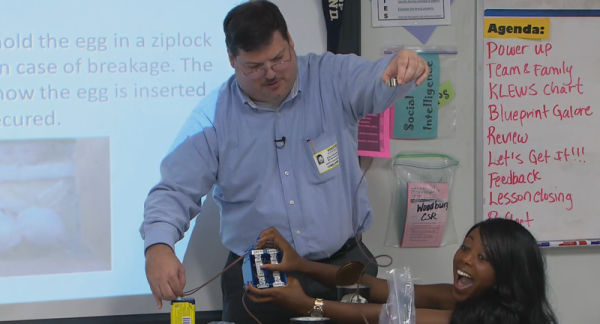
One of my favorite things to do is visit with school kids who are interested in engineering or science. However, realistically, there is a limit to what you can do in a single class that might last 30 to 90 minutes. I recently had the chance to work with a former colleague, a schoolteacher, and The Teaching Channel to create an engineering unit for classroom use that lasts two weeks.

This new unit focuses on an egg drop. That’s not an original idea, but we did add an interesting twist: the project develops a “space capsule” to protect the egg, but also an electromagnetic drop system to test the capsules. The drop system allows for a consistent test with the egg capsule releasing cleanly from a fixed height. So in addition to the classic egg drop capsule, the kids have to build an electromagnet, a safe switching circuit, and a test structure. Better still, teams of kids can do different parts and integrate them into a final product, closely mimicking how real engineering projects work.

There are a few reasons for the complexity. First, given ten class sessions, you can do a lot more than you can in a single day. Second, I always think it is good if you can find exercises that will appeal to lots of different interests. In the past, I’ve used robots and 3D printers for that reason. Some students will be interested in the electronics, others in the mechanics, and still others will be interested in the programming. Some kids will engage in 3D modeling (robot simulation or 3D objects). The point is there is something for everyone.

Continue reading “Kids And Hacking: Electromagnetic Eggs” →

Robots And Crickets

If you watch science fiction movies, the robots of the future look like us. The truth is, though, many tasks go better when robots don’t look like us. Sometimes they are unique to a particular job or sometimes it is useful to draw inspiration from something other than a human being. One professor at Johns Hopkins along with some students decided to look at spider crickets as an inspiration for a new breed of jumping robots.

Continue reading “Robots And Crickets” →