Your First GNU Radio Receiver With SDRPlay

Although GRC (the GNU Radio Companion) uses the word radio, it is really a graphical tool for building DSP applications. In the last post, I showed you how you could experiment with it just by using a sound card (or even less). However, who can resist the lure of building an actual radio by dragging blocks around on a computer screen?

For this post and the accompanying video, I used an SDRPlay. This little black box has an antenna jack on one end and a USB port on the other. You can ask it to give you data about a certain area of the RF spectrum and it will send complex (IQ) data out in a form that GRC (or other DSP tools) can process.

The SDRPlay is a great deal (about $150) but if you don’t want to invest in one there are other options. Some are about the same price (like the HackRF or AirSpy) and have different features. However, you can also use cheap TV dongles, with some limitations. The repurposed dongles are not as sensitive and won’t work at lower frequencies without some external help. On the other hand, they are dirt cheap, so you can overlook a few little wrinkles. You just can’t expect the performance you’ll get out of a more expensive SDR box. Some people add amplifiers and converters to overcome these problems, but at some point it would be more cost effective to just spring for a more expensive converter.

Continue reading “Your First GNU Radio Receiver With SDRPlay”
Improving WiFi Throughput With FM Radio

WiFi networking is one of those things that is reasonably simple to use, but has a lot of complex hidden features (dare we say, hacks) that make it work, or work better. For example, consider the Distributed Coordination Function (DCF) specified in the standard. Before a station can send, it has to listen for a certain time period. If the channel is clear, the station sends. If not, it has to delay a random amount of time before trying again. This is a form of Carrier Sense Multiple Access (CSMA) channel management.

Unfortunately, listening time is dead time when–at least potentially–there is no data transmitted on the network. DCF allows you to use various handshaking packets to do virtual carrier detection and ready/clear to send, but these are also less efficient use of bandwidth. There are other optional coordination functions available in the WiFi standard, but they all have their drawbacks.

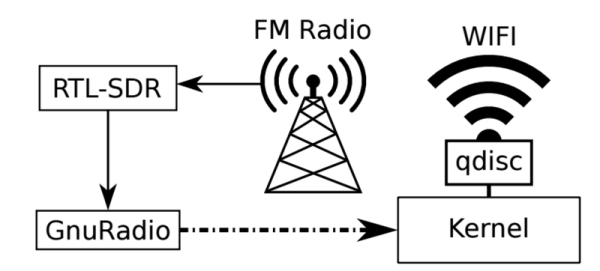
[Aleksandar Kuzmanovic] at Northwestern University and two of his students have recently published a paper with a new way to coordinate multiple unrelated wireless networks using ubiquitous FM broadcast radio signals called WiFM. Instead of trying to synchronize to the WiFi data channel, this new scheme selects a strong FM radio station that broadcasts Radio Data Service (RDS) data (the data that populates the song titles and other information on modern radios).

Continue reading “Improving WiFi Throughput With FM Radio”

Getting Started With GNU Radio

Software Defined Radio (SDR)–the ability to process radio signals using software instead of electronics–is undeniably fascinating. However, there is a big gap from being able to use off-the-shelf SDR software and writing your own. After all, SDRs require lots of digital signal processing (DSP) at high speeds.

Not many people could build a modern PC from scratch, but nearly anyone can get a motherboard, some I/O cards, a power supply, and a case and put together a custom system. That’s the idea behind GNU Radio and SDR. GNU Radio provides a wealth of Python functions that you can use to create sophisticated SDR application (or, indeed, any DSP application).

If Python is still not up your alley (or even if it is), there’s an even easier way to use GNU Radio: The GNU Radio Companion (GRC). This is a mostly graphical approach, allowing you to thread together modules graphically and build simple GUIs to control you new radio.

Even though you usually think of GRC as being about radios, it is actually a good framework for building any kind of DSP application, and that’s what I’ll show you in the video below. GRC has a signal generator block and interfaces to your sound card. It even has the ability to read and write data to the file system, so you can use it to do many DSP applications or simulations with no additional hardware.

UPDATE: Don’t miss the follow-up post that uses SDRPlay to build a GNU Radio based receiver.

Continue reading “Getting Started With GNU Radio”

The Simplest Smart Glasses Concept

Google Glass kind of came and went, leaving one significant addition to the English language. Even Google itself used the term “glasshole” for people who used the product in a creepy way. We can’t decide if wearing an obviously homemade set of glasses like the ones made by [Jordan Fung] are more creepy, give you more hacker cred, or just make you look like a Borg. Maybe some combination of all of those. While the cost and complexity of developing for Google Glass was certainly a barrier for hacking on that hardware, this project is just begging for you to build your own and run with the concept.

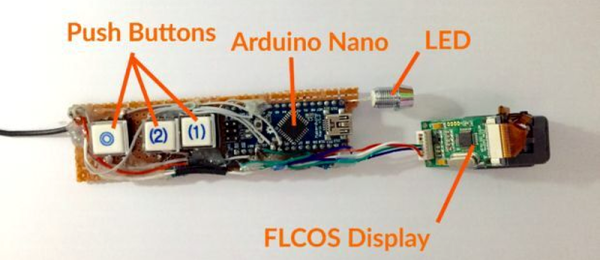
[Jordan’s] build, called Pedosa Glass, really is pretty respectable for a self-built set up. The Arduino Nano is a bit bulky, and the three push buttons take up some room, but it doesn’t kill the ability to mount them in a glasses form-factor. An FLCoS display lets you see the output of the software which [Jordan] is still developing. Right now features include a timer and a flashlight that uses the head-mounted white LED. Not much, we admit, but enough to prove out the hardware and the whole point would be to add software you wanted.

Admittedly, it isn’t exactly like Google Glass. Although both use FLCoS displays, Pedosa Glass uses a display meant for a camera viewfinder, so you don’t really see through it. Still, there might be some practical use for a little display mounted in your field of vision. The system will improve with a better CPU that is easier to connect to the network with sensors like an accelerometer — there’s plenty of room to iterate on this project. Then again, you do have an entire second ear piece to work with if you wanted to expand the system.

Check out the video demo after the break.

Continue reading “The Simplest Smart Glasses Concept”

Slide Rules Were The Original Personal Computers

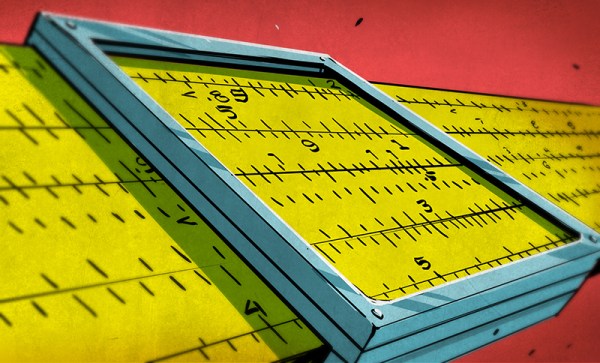
Unless you are above a certain age, the only time you may have seen a slide rule (or a slip stick, as we sometimes called them) is in the movies. You might have missed it, but slide rules show up in Titanic, This Island Earth, and Apollo 13. If you are a fan of the original Star Trek, Mr. Spock was seen using Jeppesen CSG-1 and B-1 slide rules in several episodes. But there was a time that it was common to see an engineer with a stick hanging from his belt, instead of a calculator or a cell phone. A Pickett brand slide rule flew to the moon with the astronauts and a K&E made the atomic bomb possible.

Slide rules are a neat piece of math and history. They aren’t prone to destruction by EMP in the upcoming apocalypse (which may or may not include zombies). Like a lot of things in life, when it comes to slide rules bigger is definitely better, but before I tell you about the 5 foot slide rule in my collection, let’s talk about slide rules in general.
Continue reading “Slide Rules Were The Original Personal Computers”

Tracking The Hamster Marathon

[Michelle Leonhart] has two Roborovski hamsters (which, despite the name, are organic animals and not mechanical). She discovered that they seem to run on the hamster wheel all the time. A little Wikipedia research turned up an interesting factoid: This particular breed of hamster is among the most active and runs the equivalent of four human marathons a night. Of course, we always believe everything we read on Wikipedia, but not [Michelle]. She set out to determine if this was an accurate statement.

She had already added a ball bearing to the critters’ wheel to silence it by cannibalizing an old VCR. What she needed was the equivalent of a hamster pedometer. A Raspberry Pi and a Hall effect sensor did the trick. At least for the raw measurement. But it still left the question: how much distance is a hamster marathon?

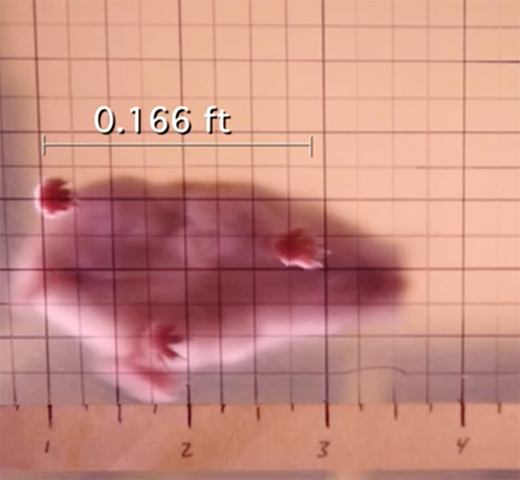
01_hamster_stride_measurement[Michelle] went all scientific method on the question. She determined that an average human female’s stride is 2.2 feet which works out to 2400 strides per mile. A marathon is 26.2 miles (based on the distance Pheidippides supposedly ran to inform Athens of victory after the battle of Marathon). This still left the question of the length of a hamster’s stride. Surprisingly, there was no definitive answer, and [Michelle] proposed letting them run through ink and then tracking their footsteps. Luckily, [Zed Shaw] heard about her plan on Twitter and suggested pointing a webcam up through the plastic bottom of the cage along with a scale. That did the trick and [Michelle] measured her hamster’s stride at about 0.166 feet (see right).

Now it was a simple matter of math to determine that a hamster marathon is just under 10,500 steps. Logging the data to SQLite via ThingSpeak for a month led [Michelle] to the conclusion: her hamsters didn’t run 4 marathon’s worth of steps in a night. In fact, they never really got much over 2 marathons.

Does [Michelle] have lazy hamsters, or did she just add to our body of scientific knowledge about rodents? We don’t know. But we couldn’t help but admire her methods and her open source data logging code would probably be useful for some non-hamster activities.

If you are super competitive, you could use [Michelle’s] data to handicap yourself and challenge your pets to a race. But it would probably be cooler to build them their own Starship Trooper-style walkers. Either way, you can check out [Michelle’s] little marathon runners in the video below.

https://vine.co/v/enpFetTQD75

Is It A Haunted House Or A Video Game?

[Rich Fiore] didn’t want just another set of spooky decorations for his house. He wanted something interactive. By combining a projector and some IR sensing, he turned his whole house into a Halloween-themed shooter.

Technical details are sparse, although some other sites are reporting that a projector and a camera take care of the graphics, while a modified Wii remote and an IR gun handle the crosshairs and the targeting.

Continue reading “Is It A Haunted House Or A Video Game?”