Buttons, Sliders, And Touchpads All 3D Printed With PrintPut

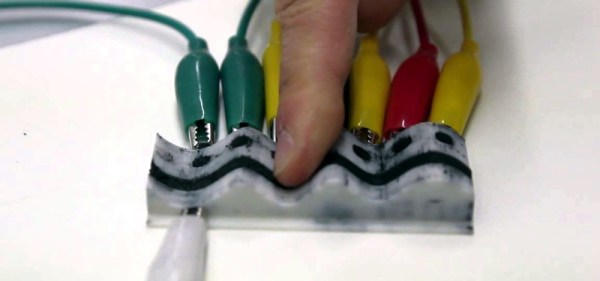
[Jesse Burstyn] and some colleagues at Queen’s University and Carleton University (both in Canada) are delivering a paper at the INTERACT 2015 about PrintPut, their system for printing sensors directly into 3D printed objects. Using a printer with dual extrusion and conductive ABS filament, they have successfully formed capacitive touch sensors, digital resistive sensors, and analog resistive sensors.

In practice, this means they can print buttons, sliders, and even touch pads directly into objects. They also have a design for several pressure sensors and a flex sensor. The system includes scripts for the Rhinoceros 3D CAD package. Designers can create a model in any CAD package they want (including Rhinoceros) and then use these scripts to define the interactive areas.

Continue reading “Buttons, Sliders, And Touchpads All 3D Printed With PrintPut”

DisplayPort With An FPGA

One of the challenges with display technology is the huge increase in bandwidth that has occurred since LCD panels took over from Cathode Ray Tubes. Low end laptops have a million pixels, UHD (“4K”) displays
have 8 million and the latest Full Ultra HD (“8k”) displays have over 33 million pixels. Updating all those pixels takes a lot of bandwidth – to update a 4k display at 60 Hz refresh rates takes close to a gigabyte per second. 8 billion bits – that is a lot of bits! That’s why VGA ports and even DVI ports are starting to vanish in favor of standards like HDMI and DisplayPort.

The current release of HDMI is 2.0, and is tightly licensed with NDAs and licensing fees. VESA, who created the DisplayPort standard, states the standard is royalty-free to implement, but since January 2010, all new DisplayPort related standards issued by VESA are no longer available to non-members.

So after receiving a new Digilent Nexys Video FPGA development board, Hackaday regular [Hamster] purchased a UHD monitor, scoured the internet for an old DisplayPort 1.1 standard, and started hacking.

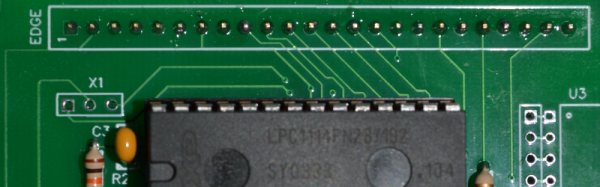
A couple of months and 10,000 lines of VHDL code later what may be the first working Open Source DisplayPort
implementation is available. The design includes a 16-bit scrambler, an 8b/10b encoder, and multichannel support.

Continue reading “DisplayPort With An FPGA”

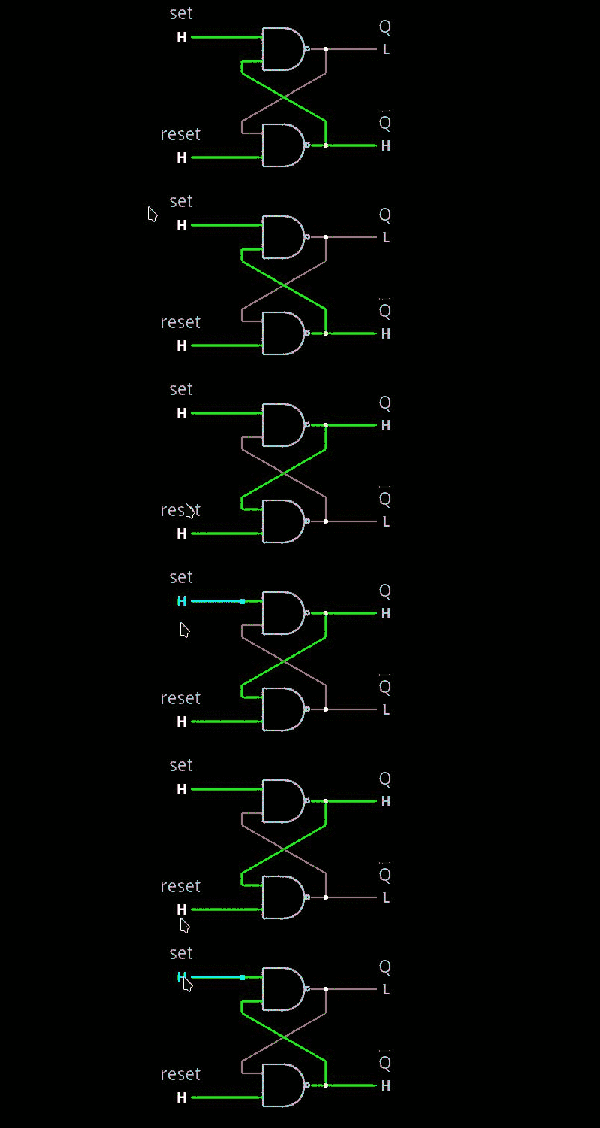
Learn Flip Flops With Simulation

Digital design with combinatorial gates like AND, OR, and NOT gates is relatively straightforward. In particular, when you use these gates to form combinatorial logic, the outputs only depend on the inputs. The previous state of the outputs isn’t important in combinatorial logic. While this is simple, it also prevents you from building things like state machines, counters, and even CPUs.

Circuits that use their own outputs as inputs are known as sequential circuits. It is true that at the fundamental level, sequential circuits use conventional logic gates. However, you usually won’t deal with them as gates, but will deal with abstractions like latches, flip flops, and even higher level constructs. Learning about these higher level constructs will allow you to make more advanced digital designs that are robust. In fact, if you are using an FPGA, building blocks like flip flops are essential since a large portion of the chip will be made up of some kind of flip flop.

Continue reading “Learn Flip Flops With Simulation”

Echo, Meet Mycroft

The Amazon Echo is an attempt to usher in a new product category. A box that listens to you and obeys your wishes. Sort of like Siri or Google Now for your house. Kickstarter creator [Joshua Montgomery] likes the idea, but he wants to do it all Open Source with a Raspberry Pi and an Arduino.

The Kickstarter (which reached its funding goal earlier this month) claims the device will use natural language to access media, control IoT devices, and will be open both for hardware and software hacking. The Kickstarter page says that Mycroft has partnerships with Lucid and Canonical (the people behind Ubuntu). In addition, they have added stretch goals to add computer vision and Linux desktop control to Mycroft.

Continue reading “Echo, Meet Mycroft”

Why Are You Still Making PCBs?

Few things have had the impact on electronics that printed circuit boards (PCBs) have had. Cheap consumer electronics would not be as cheap if someone still had to wire everything (although by now we’d be seeing wiring robots, I’m sure). Between removing the human from the wiring process and providing many excellent electrical properties (at least, on a well-designed board), it isn’t surprising that even the cheapest examples of electronics now use PCBs.

For many years, the hallmark of being a big-time electronic hacker was the ability to make your own PCBs. There have been many ways that people have tried to bring PCB manufacturing into the hacker’s garage: stick on decals, light-sensitive blank PCBs, and even using laser printer toner (that last one spurred me to write a book on PCB layout many years back). You also see a lot of people using 3D printers or CNC mills to create PCBs. Hardly a week goes by that someone doesn’t ask me how to make a PCB in a home or small business lab.

Continue reading “Why Are You Still Making PCBs?”

FPGA CNC

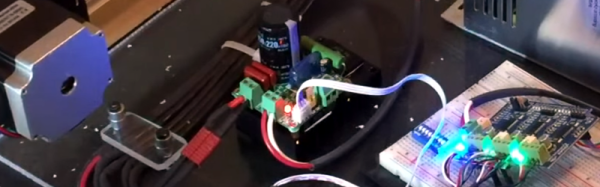
When you think of a CNC controller you probably think of a PC with a parallel port or some microcontroller-based solution like a Smoothie Board. [Mhouse1] has a different idea: use FPGAs as CNC controllers.

FPGAs inherently handle things in parallel, so processing G code, computing curves and accelerations, and driving multiple stepper motors at one time would not be an issue at all for an FPGA. Most computer-based designs will have slight delays when trying to drive everything at once and this introduces some mechanical jitter. Even worse jitter occurs when you have an old PC trying to run everything when some other task takes over the CPU.

Continue reading “FPGA CNC”

Hacking 2.4GHz Radio Control

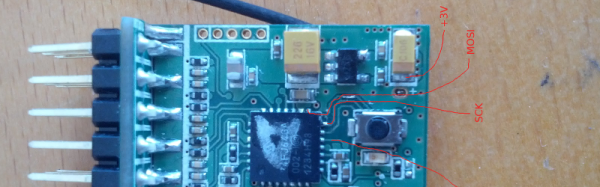
Many modern radio control (RC) systems use frequency hopping to prevent interference. Unfortunately, hopping all over the 2.4GHz band can interfere with video or WiFi using the same frequency band. [Befinitiv] was trying to solve this problem when he realized that most of the systems used a TI CC2500 chip and a microcontroller. The microcontroller commands the chip via SPI and controls the frequency by writing into a frequency register.

Updating the microcontroller firmware was impractical. The firmware is encrypted, for one thing. In addition, the change would have to be reinserted on any future updates and repeated for every RC vendor. So [Befinitiv] took a different approach. He did a classic man in the middle attack by inserting an CPLD in between the controller and the CC2500.

Continue reading “Hacking 2.4GHz Radio Control”