$40 Antenna Analyzer With Arduino And AD9850

If you are a hacker, you might consider ham radio operators as innovative. Most people, however, just see them as cheap. So it is no surprise that hams like [jmharvey] will build an antenna analyzer from a DDS module and an Arduino instead of dropping a few hundred dollars on a commercial unit. As he points out, you probably only need an analyzer for a day or two while you set up an antenna. Unless you are a big time antenna builder, the unit will then sit idle on the shelf (or will wind up on loan to hams even cheaper than you are).

The design is rooted in another proven design, but changed to take advantage of parts he happened to have on hand. Although the build is on a universal circuit board, [jmharvey] used Eagle to lay out the circuit as though it were a PCB. Since placement can be important with an RF circuit, this isn’t a bad idea. It’s always easier to move stuff around on the screen than on the perf board.

Since this is a no frills, unit, you are expected to grab the output from the Arduino and manually put it in a spreadsheet to plot the results. There is another version of the Arduino code that drives an OLED screen, although you still need a PC to kick the process off. One interesting feature of the Arduino code is how it deals with the nonlinear nature of the diodes used in the circuit. After plotting the values with known loads, [jmharvey] broke the diode operation into three regions and used different equations for each region. Even so, he warns that readings higher than 1:1 VSWR are only accurate to 10% or 20% – still good enough for ham shack use.

If you want an antenna analyzer for $40 (or less, if you have a good stock of parts) this looks like a worthwhile project. If, however, you want to repurpose it to Rickroll your neighbor’s AM radio, you might want to go with the commercial unit.

Click past the break to see the analyzer in action.

Continue reading “$40 Antenna Analyzer With Arduino And AD9850”

Hacking A Universal Assembler

I have always laughed at people who keep multitools–those modern Swiss army knives–in their toolbox. To me, the whole premise of a multitool is that they keep me from going to the toolbox. If I’ve got time to go to the garage, I’m going to get the right tool for the job.

Not that I don’t like a good multitool. They are expedient and great to get a job done. That’s kind of the way I feel about axasm — a universal assembler I’ve been hacking together. To call it a cross assembler hack doesn’t do it justice. It is a huge and ugly hack, but it does get the job done. If I needed something serious, I’d go to the tool box and get a real assembler, but sometimes you just want to use what’s in your pocket.

Continue reading “Hacking A Universal Assembler”

Build A Baby Plasma Cutter–Right Now!

What hacker doesn’t want a plasma cutter? Even if you aren’t MacGyver, you can probably build this one in a few minutes using things you have on hand. The catch? You probably can’t cut anything more than tin foil with it, and it is probably more a carbon-air arc gouger (which uses plasma) than a true plasma cutter. Still, as [Little Shop of Physics] shows on the video, it does a fine job of slicing right through foil.

If you are like us, you are back now after getting four 9V batteries, some tin foil, a pencil lead, and some clip leads and trying it. If you have more self-restraint than we do, you might want to think about what you are going to put the tin foil over. In the video, they used a laundry basket and a rubber band, but anything that keeps the foil suspended would do the trick.

Although it isn’t really a practical plasma cutter, we were thinking about strapping something like this to a 3D printer and cutting foil stencils. The jagged edges on the video are, hopefully, more from being operated by hand and less from the jagged mini-lightning bolt vaporizing the foil.

Continue reading “Build A Baby Plasma Cutter–Right Now!”

Hack Your C++ With LLVM

Have you ever wanted to analyze or mutate some C or C++ code? You can do some simple pattern matching with regular expressions, but there’s always some special case or another that will break your logic. To do it right, you need to develop an entire parser, perhaps using a formal grammar and a tool like Yacc. That’s a big job, though, just to change all the floats to doubles.

[Adrian Sampson] wrote a blog entry to make you go from “mostly uninterested in compilers to excited to use LLVM to do great work.” LLVM – the Low Level Virtual Machine compiler infrastructure — provides tools for a lot of languages, including CLANG for C and C++. [Adrian] points out a few key differences between LLVM and other compilers and tools you might use for a similar purpose:

  • LLVM uses a consistent intermediate representation that is human-readable
  • It is extremely modular
  • It is both highly hackable and an industrial-strength, well-supported compiler

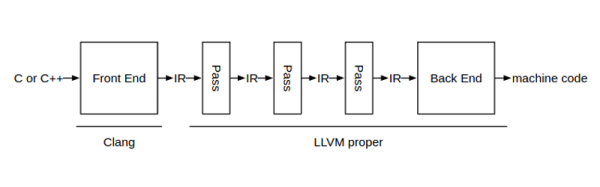
He points out that compiler tools aren’t just for compiling. You can use them to analyze source code, build simulators, and inject code for security or testing, among other things (speaking of security testing, check out the use of LLVM to analyze binaries for security issues in the video after the break). The high hackability of LLVM is due to its modular nature. By default, a front end chews up the C or C++ code into the intermediate representation. Then multiple passes can modify the representation before handing it off for the next pass. The final pass does actual code generation for the target processor.

Continue reading “Hack Your C++ With LLVM”

Robot On Rails For Time Lapse Photography

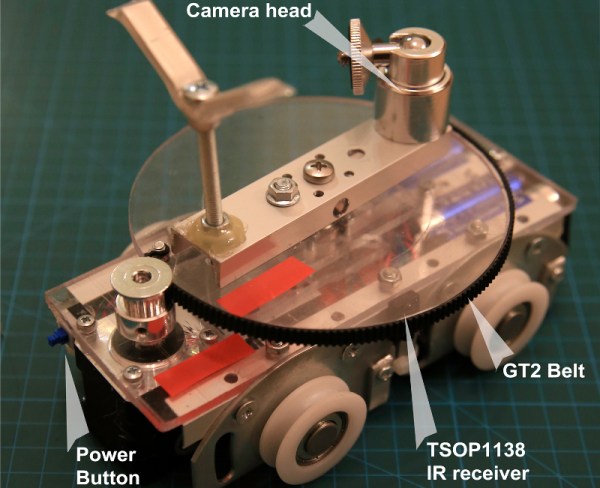
What do you get when you cross a photographer with an Arduino hacker? If the cross in question is [nukevoid], you wind up with a clever camera rail that can smoothly move with both shift and rotation capability. The impressive build uses an Arduino Pro Mini board and two stepper motors. One stepper moves the device on rails using some Delrin pulleys as wheels that roll on an extruded aluminum track. The other stepper rotates the camera platform.

The rotating platform is very cool. It’s a plastic disk with a GT2 motion belt affixed to the edge. The stepper motor has a matching pulley and can rotate the platform easily. The GT2 belt only goes around half of the disk, and presumably the software knows when to stop on either edge based on step counts. There’s even a support to steady the camera’s lens when in operation.

Continue reading “Robot On Rails For Time Lapse Photography”

Clocking (or Overclocking) An AVR

Some guys build hot rods in their garage. Some guys overclock their PCs to ridiculously high clock frequencies (ahem… we might occasionally be guilty of this). [Nerd Ralph] decided to push an ATTiny13a to over twice its rated frequency.

It didn’t seem very difficult. [Ralph] used a 44.2 MHz can oscillator and set the device to use an external clock. He tested with a bit-banged UART and it worked as long as he kept the supply voltage at 5V. He also talks about some other ways to hack out an external oscillator to get higher than stock frequencies.

We wouldn’t suggest depending on an overclock on an important or commercial project. There could be long term effects or subtle issues. Naturally, you can’t depend on every part working the same at an untested frequency, either. But we’d be really interested in hear how you would test this overclocked chip for adverse effects.

Now, if you are just doing this for sport, a little liquid nitrogen will push your Arduino to 65 MHz (see the video after the break). We’ve covered pushing a 20MHz AVR to 30MHz before, but that’s a little less ratio than [Ralph] achieved.

Continue reading “Clocking (or Overclocking) An AVR”

Building A Battery From Molten Salt

During World War II a scientist named Georg Otto Erb developed the molten salt battery for use in military applications. The war ended before Erb’s batteries found any real use, but British Intelligence wrote a report about the technology and the United States adopted the technology for artillery fuses.

Molten salt batteries have two main advantages. First, you can store them for a long time (50 years or more) with no problems. Once the salt melts (usually from a pyrotechnic charge), the battery can produce a lot of energy for a relatively short period of time thanks to the high ionic conductivity of the electrolyte (about three times that of sulfuric acid).

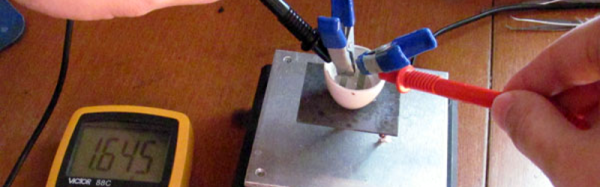
[OrbitalDesigns] couldn’t find a DIY version of a molten salt battery so he decided to make one himself. Although he didn’t get the amount of power you’d find in a commercial design, it did provide 1.6V and enough power to light an LED.

The electrolyte was a mixture of potassium chloride and lithium chloride and melts at about 350 to 400 degrees Celsius. He used nickel and magnesium for electrodes. Potassium chloride is used as a salt substitute, so it isn’t dangerous to handle (at least, no more dangerous than anything else heated to 400 degrees Celsius). The lithium compound, however, is slightly toxic (even though it was briefly sold as a salt substitute, also). If you try to replicate the battery, be sure you read the MSDS for all the materials.

Continue reading “Building A Battery From Molten Salt”