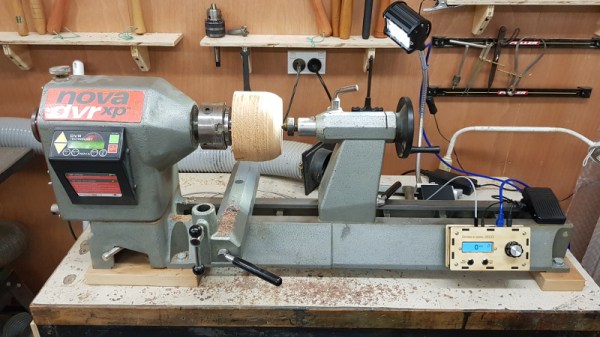
Strobe For Wood Turning Makes Inspection Easy

The lathe is a simple enough tool to understand, but requires much practice to truly master. During the turning process, it’s often necessary to inspect the workpiece. This generally necessitates stopping the lathe, waiting for everything to spin down, and then starting again. This can be a major time sink when added up across the full scope of a project. However, the magic of strobes can help.

The basics of [Darcy]’s project will be familiar to any hacker who has worked with rotating machinery before. The rotational speed of the lathe is measured, in this case using a reed switch and a magnet. This signal is fed to a microcontroller, which controls the strobing of an LED lamp. By synchronizing the flashes to the speed of the lathe, it’s possible to view the workpiece as if it were standing still. By adjusting the offset of the flashes to the position of the lathe, it’s also possible to rotate this view to see the entire workpiece – all while the lathe remains spinning.

Further photos and videos are available in the Reddit thread. [Darcy] reports that despite his best efforts, he couldn’t quite find a business case for producing the hardware commercially, but the idea was too useful to leave languishing in a notebook. We’d love to hear your ideas on how this could improve turning projects, so be sure to let us know in the comments. If you’re just getting started with turning, it might be worth cutting a test bar to make sure your rig is up to snuff.
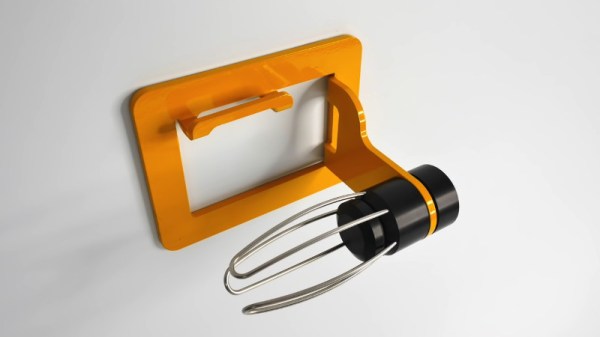

Designing A Toilet Roll Holder

Everything needs to be designed, at one point or another. There are jobs for those who design kitchens, and stadiums, and interplanetary spacecraft. However, there are also jobs for those who design cutlery, hose fittings, and even toilet roll holders. [Eric Strebel] is here to share just such a story.

[Eric] covers the whole process from start to finish. In the beginning, a wide variety of concepts are drawn up and explored on paper. Various ideas are evaluated against each other and whittled down to a small handful. Then, cardboard models are created and the concepts further refined. This continues through several further phases until it gets down to the fun part of choosing colours and materials for the final product.

Watching the effects of cost and manufacturing process shape the finished item is instructive as to how the design process works in the real world. The toilet paper holder itself is an interesting unit, too – using adjustable magnetic detents to enable one-handed use, as well as including a cell phone holder.

We’ve seen [Eric]’s work before – such as his primer on the value of cardboard in design. Video after the break.

Continue reading “Designing A Toilet Roll Holder” →

Breakfast Bot Does Eggs To Perfection

Breakfast is a meal fraught with paradoxes. It’s important to start the day with a hearty meal full of energy and nutrition, but it’s also difficult to cook when you’re still bleary-eyed and half asleep. As with many problems in life, automation is the answer. [James Bruton] has the rig that will boil your egg and get your day off to a good start.

The basic apparatus uses a thermostatically controlled hotplate to heat a pot of water. [James] then employs an encoder-controlled linear actuator from a previous project to raise and lower a mesh colander into the pot, carrying the egg. An Arduino is used to measure the water temperature, only beginning the cooking process once the temperature is over 90 degrees Celsius. At this point, a 6-minute timer starts, with the egg being removed from the water and dumped out by a servo-controlled twist mechanism.

Future work will include servo control of the hotplate’s knob and building a chute to catch the egg to further reduce the need for human intervention. While there’s some danger in having an automated hotplate on in the house, this could be synchronized with an RTC to ensure your boiled egg is ready on time, every day.

Breakfast machines are a grand tradition around these parts, and we’ve seen a few in our time. Video after the break.

[Thanks to Baldpower for the tip!]

Continue reading “Breakfast Bot Does Eggs To Perfection” →

This Monowheel Is Bright Orange, And We Want One

Monowheels are a singular form of transport. Like electric scooters and the Segway, they are remarkably impractical for getting from point A to point B, are expensive to build or buy, and make you look faintly silly as you ride them down the street. However, we’d be hard pressed to find a member of the Hackaday team that wouldn’t at least want a go on one for half an hour. [MakeItExtreme] felt the same way, and built one of their own.

The build starts with a tube bender, used to form 40mm tubing into a continuous circle to form the main wheel. Teflon is then turned to produce several rollers that interface the main wheel to the inner frame. Several small motorbike tyres were cut apart to create the tread to provide some decent grip. Power comes courtesy of a 110cc four stroke engine, allowing this thing to go just fast enough to get the rider seriously injured in the event of an accident. The team reports stability is poor at low speed, but remarkably good once above 30 km/h.

The team did a great job, and we particularly enjoy the bright orange paint scheme and fetching decals that really finish it off well. The monowheel concept is remarkably similar to the diwheel, which we’ve seen applied to old Fords with somewhat terrifying results. Video after the break.

Continue reading “This Monowheel Is Bright Orange, And We Want One” →

Arduino RC Transmitter For Homebrew Projects

The field of radio control has benefited much from the onward march of technology. Where a basic 2-channel setup would once have cost hundreds of dollars, it’s now possible to get a high-end 2.4GHz 9-channel rig for well under $100, shipped to your door. However, the vast majority of these systems are closed-source and built for purpose. Sometimes, there are benefits to doing things your own way, and that’s precisely what this project does.

At its heart, it’s a simple combination. An Arduino Pro Mini talks to a NRF24L01 which handles the wireless communication. At that point, it’s up to you – throw in as few or as many controls as you like. For this build, [HowToMechatronics] has gone with a twin-stick setup, with a pair of potentiometers and twin toggle switches to round out the options.

The build comes in handy, as it’s possible to program in whatever features you may need for a given project. [HowToMechatronics] has used it to control a hexapod robot, among other projects. It’s a build that shows that with cheap and readily available parts, it’s possible to whip up a custom solution to suit your needs.

If this topic interests you.it’s worth saying that even those closed source radio control products can sometimes be hacked.

[Thanks to Baldpower for the tip!]

Radio Control Buggy Gets V10 Power

Amongst the more difficult machining tasks in the world are those involved in the production of internal combustion engines. Thanks to the Internet, it’s now possible to watch detailed videos of master craftsmen assembling tiny desktop V8 and V12 engines in home workshops with barely a CNC in sight. However, up until now, most of these builds have been left on the test stand to bark and wail away. No longer – [Keith] has decided that needs to change.

We’ve seen [Keith]’s work before – particularly, his 125cc V10 build, featuring fuel injection, dual overhead cams, and even a supercharger. With several micro engines under his belt now, it was time to put them to work – the V10 is getting a new home in a 1/3rd scale RC buggy.

We’re not sure [Keith] has heard the phrase “off the shelf” – even the suspension dampers on this build are custom machined. Currently up to part 5, the chassis is coming together and there are plans for a hybrid powertrain, too. Carbon fiber and anodized parts are in abundance – this build is truly a work of art.

We can’t wait to see this V10 monster tearing up the dirt – It’s an ambitious build, but if anyone can pull it off, it’s [Keith]. Video after the break.

Continue reading “Radio Control Buggy Gets V10 Power” →

Cyberpunk Jacket Is The Garment Of Choice For The Streets Of 2019

Fans of science fiction and related genres have always been disappointed by real life. The future holds so much promise on paper, yet millions were disappointed upon reaching 2015 to find that hoverboard technology still eluded us. It’s not all bad, though – [abetusk] has developed a cyberpunk jacket so you can live out your grungy hacker fantasies in real life.

The effect is achieved with specially designed jacket patches. Nylon fabric is lasercut with artwork or lettering, and then placed over an electroluminescent panel. The fabric acts as a mask and is glued onto the EL panel, and the assembly is then attached to the back of the jacket with velcro.

It’s a build that focuses on more than just a cool visual effect. The attention to detail pays off in robustness and usability – wires are neatly fed through the lining of the jacket, and special strain relief devices are used to avoid wires breaking off the EL panels. The extra effort means this is a jacket that can withstand real-world use, rather than falling apart in the middle of a posed photo shoot.

Everything is well documented, from artwork creation to final assembly, so there’s no reason you can’t replicate this at home – and the final results are stunning. Our take is that electroluminescent technology is the way to go for retro and cyberpunk looks, but LEDs can be fun too – like in this high-powered Burning Man build.

Continue reading “Cyberpunk Jacket Is The Garment Of Choice For The Streets Of 2019” →