A Turntable For Model Railroads

Way back when, before diesel-electric locomotives were a thing, trains weren’t really able to go backwards too well. Also it’s sometimes necessary to turn carriages around in a small space. For that, the railway turntable was invented. If you want to implement one on a model layout, this project from DIY & Digital Railworld is for you.

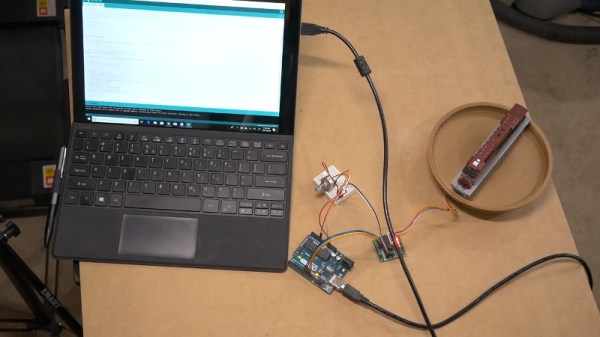
The project is at an early stage – thus far, laying out how to set up an Arduino Uno using a potentiometer to control the speed of a stepper motor, which rotates the turntable. The turntable itself is a 3D printed part sourced from Thingiverse, designed to suit the specific stepper motor used.

This has the easy part sorted – rotating a piece of track through 360 degrees to orient a train properly. However, there’s significant work ahead. Power needs to be hooked up to the rails, and a system for accurately aligning the turntable with outgoing tracks needs to be devised. This is particularly relevant for N-gauge setups, where tolerances are everything.

We’d love to know how you’d tackle the various issues to build a working model turntable in the comments. We’ve seen some serious model railroad builds before around these parts. Video after the break.
Continue reading “A Turntable For Model Railroads” →

Nintendo 64 Homebrew Via Game Shark

The Nintendo 64 is a classic console now, and much loved, despite losing in commercial stakes to the dominating PlayStation from Sony. It’s one that doesn’t always get as much attention in the homebrew and hacker scene, compared to platforms like the NES and Game Boy. This means the tools required to work with the console aren’t as well-known. However, there’s a remarkably easy way to load homebrew on to the Nintendo 64, if you’ve got the right hardware.

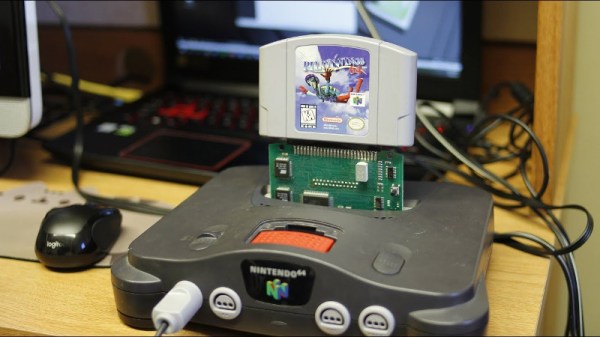
To pull this off, you’ll need a N64 Gameshark, particularly a version higher than 3.0. These included a parallel port and the relevant onboard logic to allow the console to receive data and commands from an attached computer. [Nathan] demonstrates using the gs_libusb utility to deliver homebrew code to the console, using a USB to parallel adapter to make it easy from a modern computer.

The tools are available on github if you wish to try the hack for yourself. Most hacks we see of the platform are of the portable variety, but if you’ve got something fresh, you know who to call.

Continue reading “Nintendo 64 Homebrew Via Game Shark” →

State Machine Controls Garage Door Over The Internet

Home automation has been a hot-button topic time and again since the dawn of the personal computer age. These days, thanks to modern communications technology, it’s possible to do some pretty cool stuff. [Brad Harbert] decided to automate his garage door, controlling it over the Internet.

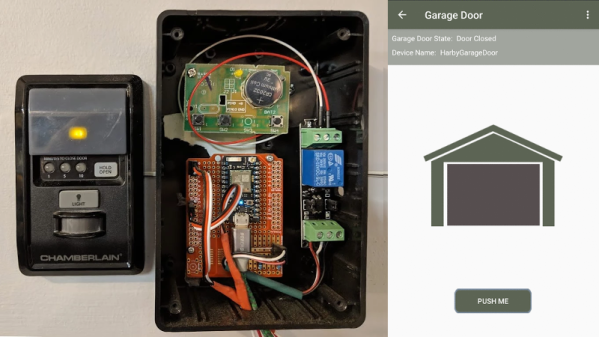
The build relies on a Particle Photon to do the heavy lifting of connecting the door to the Internet. Particle offer a cloud service that makes setting up such a project easy for the first timer, and [Brad] was able to get things working quickly. A relay is used to activate the garage door remote button, as it was desired to leave the main control board of the garage door opener untouched. Reed switches are used to sense the position of the door, and [Brad] coded a state machine to ensure the door’s current state is always known.

It’s a simple project, but [Brad]’s use of state machine techniques and position sensing mean it’s less likely he’ll get home to find his garage open and his possessions missing. If you’re new to programming simple physical devices, you could take a page out of his logbook. Of course we’ve seen similar builds before, like this one from parts from the scrapbin.

Transistor Tester Becomes Car Display

These days, the electronics hobbyist is lucky to have access to a wide range of ready-made modules that enable sensors, screens, and microcontrollers to all be linked up with ease. However, this manner of working generally ends up with a project that becomes more of a PCB salad than a finished product. Oftentimes, it’s possible to find something off the shelf that’s close to your requirements, and repurpose it to work. That’s exactly what [Aaron] did.

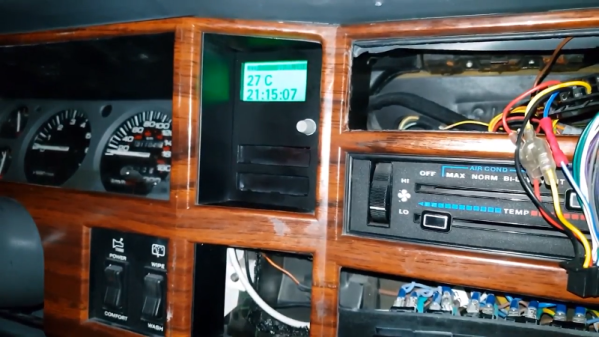
[Aaron] wanted to install a display in his classic Jeep to display the time and some basic parameters. A screen and a microcontroller were called for, and a cheap open-source transistor tester had exactly that already. Consisting of an ATmega-328P linked up to an 128 x 64 graphic LCD module, it had most of what [Aaron] needed from the get go.

To repurpose the device, [Aaron] started by swapping the 8 MHz crystal for a 16 MHz one to make it more easily programmable through the Arduino IDE. Then, a custom firmware was written, which communicates with a DS3232 real time clock, temperature and pressure sensors, and also monitors battery voltage. It’s all neatly installed in the vehicle behind a 3D printed faceplate, and the graphic LCD is clear and easy to read – if you speak German.

[Aaron] has helpfully outlined the various online resources that helped with the hack, including the transistor tester schematic. Our very own [Adam Fabio] reviewed these units in 2015.

If you’ve cleverly reused some existing hardware yourself, be sure to let us know on the tip line. Video after the break.

Continue reading “Transistor Tester Becomes Car Display” →

Glasses Frames Crafted Out Of Wood

Most glasses and sunglasses on the market make use of metal or plastic frames. It’s relatively easy to create all manner of interesting frame geometries, tolerances can be easily controlled for fitting optical elements, and they’re robust materials that can withstand daily use. Wood falls short on all of these measures, but that doesn’t mean you can’t use it to make a beautiful pair of glasses.

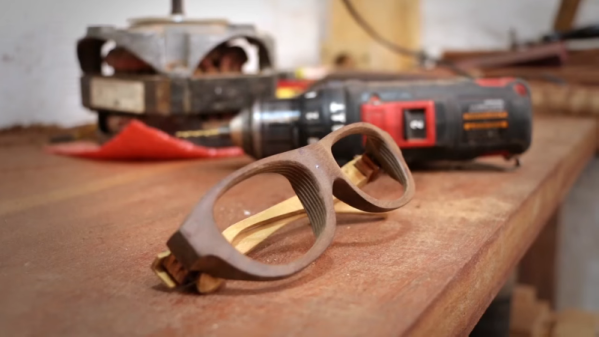
ZYLO is a company making wooden eyewear, and this video from [Paide] shows the build process in detail. Modern tools are used to make things as efficient as possible. Parts are lasercut and engraved to form the main part of the frames as well as the temples (the arms that sit over the ears to hold them on your face). A special jig is used to impart a curve on the laminated wood parts before further assembly is undertaken. Metal pre-fabricated hinges and screws are used to bolt everything together like most other modern sunglasses, but there’s significant hand finishing involved, including delicate inlays and highlighting logo features.

In contrast, Manuel Arroyave works very differently in the creation of his Cedoro glasses. Sheets are first laminated together, before the shape is roughed out by a special horizontal axis milling setup. Even small details like the hinges are delicately hand-crafted out of wood and fitted with tiny wooden dowels.

It goes to show that there’s always more than one way to get a job done. We’re tempted to break out the laser cutter and get started on some custom shades ourselves. Perhaps though, you’re too tired to put your sunglasses on by yourself? Nevermind, there’s a solution for that, too. Video after the break.

Continue reading “Glasses Frames Crafted Out Of Wood” →

The T-Pain Toy Is Now A Guitar Effect

T-Pain is rapper hailing from Florida, who made his name through creative use of the Autotune effect. Nobody quite does it like T-Pain to this day, but kids the world over got the chance with the release of the “I Am T-Pain” microphone, which puts effects on the user’s vocal to make them sound as fly as possible, batteries not included. In the spirit of musical exploration, [Simon] decided it would be interesting to turn the effect into a guitar pedal.

Initial plans were to wire the microphone to an input jack, and the speaker to an output jack, but things didn’t remain so simple. The toy comes with a line-in and a headphone jack already, but the wiring scheme is strange and one of the inputs can also act as an output under certain conditions. [Simon] took the kitchen sink approach, throwing a bunch of jacks at the circuit and putting it all in a pedal case with some knobs to twiddle some parameters.

The final result is a warbly, lo-fi vibrato when a guitar signal is fed in. It’s quite different from how the original toy sounds, but recalls us somewhat of the Anti-nautilus pedal when used in conjunction with a looper. Video after the break.  Continue reading “The T-Pain Toy Is Now A Guitar Effect” →

Delta Robot Is Sorting Golf Balls And Taking Names

It’s a common situation faced by every hard-working American – you get home after a long day at the calcium mines, and find yourself stuck with a pile of colored golf balls that simply aren’t going to sort themselves. Finally, you can put away your sorting funnels and ball-handling gloves – [Anthony] has the solution.

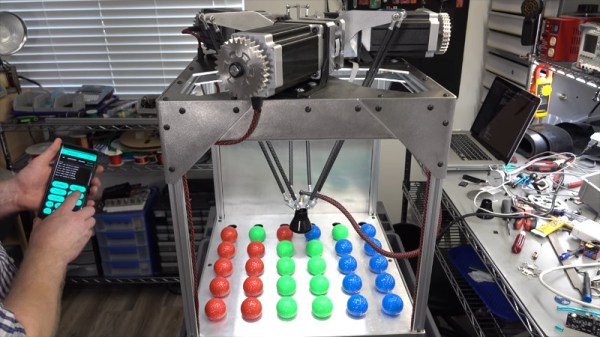
That’s right – it’s a delta robot, tasked with the job of sorting golf balls by color. A Pixy2 object tracking camera is used to survey the table, with the delta arms twitching around to allow the camera to get an unobstructed view. Once the position of the balls is known, a bubble sort is run and the balls rearranged into their correct color order.

[Anthony] readily admits the bubble sort is very inefficient at this task; it was an intentional choice so it could be later compared with other sorting methods. [Anthony] also goes into detail, sharing the development process of the suction gripper as well as discussing damping methods to reduce noise.

Delta machines are always fun to watch, and are a good choice for sorting machines. We’ve seen some really tiny ones, too. Video after the break.

Continue reading “Delta Robot Is Sorting Golf Balls And Taking Names” →