Message In A Bottle: Bicycle Trailer On A Mission

Graffiti is a controversial subject, and whether you see it as art or vandalism usually depends where and how you come across it. From the scribbled tag on a house wall, to highly sophisticated murals, they tend to have one thing in common though: making a statement — whether that’s political, showing appreciation, or a simple “I was here”. [Sagarrabanana] had his own statement to make, but chose a less permanent way to express himself with his type of graffiti.

Unhappy about the lack of dedicated cycle lanes in his area, he built an automatic, Arduino-controlled water dispensing bicycle trailer, writing his message on every street he rides on. The build is documented in a video, and shown in action in another one — which are both in Spanish (and also embedded after the break), but pictures are worth their thousand words in any language.

Inspired by persistence of vision (POV), where moving LEDs sync up their blinking to give the illusion of a static image, [Sagarrabanana] transformed the concept to water on a road using an array of solenoids attached to a water tank. Each solenoid is controlled by a relay, and a predefined font determines when to switch each relay — the same way pixels on a display would be set on or off, except small amounts of water are squirted out as the bicycle is moving along. The message itself is received via serial Bluetooth module, and can be easily modified for example from a phone. To adjust the water dispensing to the cycling speed, the whole system is synced to a magnetic switch mounted to one of the trailer’s wheels, so you could theoretically take it also with you on a run.

Time will tell if [Sagarrabanana]’s mission has the success he hopes for, but there’s no doubt the trailer will attract attention anywhere he goes. Well, we wish him all the best to get the message through without requiring a too drastic alternative as writing medium. Although, we’ve seen a graffiti robot that uses chalk spray in the past, so there’s certainly room for a not-too-permanent upgrade if needed.

Continue reading “Message In A Bottle: Bicycle Trailer On A Mission”

Loading Coils, The Heaviside Condition, And Pupin Coils

When we draw schematics, we have the luxury of pretending that wire is free. There are only a few cases where you have to account for the electrical characteristics of wire: when the wire is very long or the frequency on the wire is relatively high.

This became apparent after the first transatlantic cable went into service for telegraph communications. Even though the wire was linear, there was still distortion on the line so severe that dots and dashes would overlap each other. The temporary solution was to limit speeds so slow that operators had trouble sending and receiving at those speeds. How slow? An average character took two minutes to send! That’s not a typo. Two minutes per character. By custom, Morse code assumes a word is five characters, so you could send a word every 10 minutes.

The first transatlantic cable went into service in 1858 and was virtually the moon landing of its day. Frustrated with how slow the communications were, an electrician by the name of Whitehouse decided to crank up the voltage to over 1,000 volts which caused the cable to fail after only three weeks in service. Whoops. Later analysis showed the cable was probably going to fail quickly anyway, but Whitehouse took the public blame.

The wire back then wasn’t as good as what we have today, which led to some of the problems. The insulation was made from multiple coats of a natural latex, gutta percha, which is what dentists use to fill root canals. The jackets were made from tarred hemp and bound with iron wire. There was no way to build an underwater amplifier in 1858, so the cables were just tremendous wires laying on the ocean floor between Newfoundland and Ireland.

Continue reading “Loading Coils, The Heaviside Condition, And Pupin Coils”

Hackaday Podcast 072: Robo Golf Clubs, Plastic Speedboats, No-Juice Flipdots, And Super Soakers

With Editor-in-Chief Mike Szczys on a well-earned vacation, Staff Writer Dan Maloney sits in with Managing Editor Elliot Williams to run us through the week’s most amazing hacks and answer your burning questions. What do you do when you can’t hit a golf ball to save your life? Build a better club, of course, preferably one that does the thinking for you. Why would you overclock a graphing calculator? Why wouldn’t you! Will an origami boat actually float? If you use the right material, it just might. And what’s the fastest way to the hearts of millions of kids? With a Super Soaker and a side-trip through NASA.

Take a look at the links below if you want to follow along, and as always, tell us what you think about this episode in the comments!

Take a look at the links below if you want to follow along, and as always, tell us what you think about this episode in the comments!

Direct download (60 MB or so.)

Continue reading “Hackaday Podcast 072: Robo Golf Clubs, Plastic Speedboats, No-Juice Flipdots, And Super Soakers”

3D Printed DIY Neuralyzer

We agree with you. We can never have enough cosplay hacks. And the ones that include some electronics element definitely have a special place in our hearts. That’s why when we ran across [Maddogg0’s] 3D printed Neuralyzer on Instructables, we knew we had to share.

You may recall [How to make’s] DIY Neuralyzer that we featured a few weeks ago which required more of a metal-working approach. [Maddogg0’s] design might be a bit more convenient for those of you that have a 3D printer, but no machine shop.

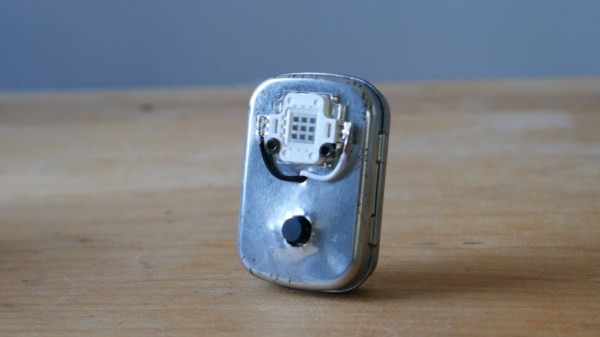
We love the elegant simplicity of [Maddogg0’s] design. The entire enclosure is printed in two halves that are held together by magnets. One half of the enclosure houses a single coin cell battery and a tiny circuit board for holding the LEDs in place, really giving the Neuralyzer some shine. In true maker fashion, [Maddogg0] released the necessary design files on TinkerCAD so anyone can reuse, remix, and reshare.

Whichever design you fancy, [Maddogg0’s] or [How to make’s], be careful not to point the Neuralyzer at yourself and always remember to wear your sunglasses!


This Week In Security: HaveIBeenPwned And Facebook Attack Their Customers

We’re fans of haveibeenpwned.com around here, but a weird story came across my proverbial desk this week — [Troy Hunt] wrote a malicious SQL injection into one of their emails! That attack string was a simple ';--

Wait, doesn’t that look familiar? You remember the header on the haveibeenpwned web page? Yeah, it’s ';--have i been pwned?. It’s a clever in-joke about SQL injection that’s part of the company’s brand. An automated announcement was sent out to a company that happened to use the GLPI service desk software. That company, which shall not be named for reasons that are about to become obvious, was running a slightly out-of-date install of GLPI. That email generated an automated support ticket, which started out with the magic collection of symbols. When a tech self-assigned the ticket, the SQL injection bug was triggered, and their entire ticket database was wiped out. The story ends happily, thanks to a good backup, and the company learned a valuable lesson. Continue reading “This Week In Security: HaveIBeenPwned And Facebook Attack Their Customers”

Up Your Home Network Performance – Build Your Own Router!

Internet connections continue to increase in speed, and for a lucky few, it’s possible to get a Gigabit fibre connection at home. However, if you’re intending to use this connection to its fullest, you might find that your off-the-shelf router has become a bit of a bottleneck. [Wes Fenlon] of PC Gamer had this very problem, and found the perfect workaround – building a custom router instead!

The main problem with commodity routers is a lack of processing power. With networks growing ever faster, the hardware in routers hasn’t kept up with the needs of demanding power users. To solve this, [Wes] grabbed an old PC he had lying around, packing a quad-core i5 CPU and 16 GB of RAM. Fitted with an enterprise-grade 4-port Gigabit LAN card, and running Netgear’s  (Sorry commenteers!) Netgate’s pfSense routing software, the old machine has enough power to be complete overkill for the application.

The side benefit of this method is configurability. pfSense has a far more powerful set of options than most common routers. It’s config page also runs far more smoothly, too. There’s also the possibility to run all sorts of useful plugins, like router-level ad blockers and traffic monitoring utilities.

Overall, it’s a great way to repurpose a surplus machine and improve your network performance on the cheap. Others have tried similar builds, too. It has us contemplating the possibilities for our own networks at home!

Strike A Solder Joint Behind Enemy Lines

Imagine you’re out behind enemy lines in WW2, setting up demolition charges that may save the lives of your fellow soldiers. How do we make a solid connection between wires that will last? One of the solutions that were used by the OSS and SOE, the predecessors to the CIA and British Secret Service, were self soldering sleeves that could be lit like a match. [ElementalMaker] managed to get his hands on a box of these sleeves, and found that they work incredibly well, even after more than half a century.

The sleeves consist of a copper tube with solder and flux inside, and wax-covered pyrotechnic compound around the outside. A small blob of striker compound similar to a match head is used to set the soldering process in motion, using the striker surface on the outside of the oversize matchbox that the sleeves are packed in. The pack that the [ElementalMaker] got was made in 1964, but is supposedly no different from those used in WW2.

When lit, the pyrotechnic compound does not create any flame, it only smolders, probably to make it safer to use, and avoid detection at night. As the solder inside the sleeve melts, the operator is supposed to push the wires further into the tube to make them overlap. Although [ElementalMaker] didn’t cut open the sleeves, it definitely looks like a good joint, with solder oozing from the ends. Check out the video after the break! If you want to get your hands on a pack of these sleeves, it looks like a military surplus store in the UK managed to source some.

As horrible as war is, it’s undeniable that it inspires some creative innovations. Like soldiers hacking together parts from multiple guns to serve their immediate needs, or making guns shoot through spinning propellers without damaging them. Continue reading “Strike A Solder Joint Behind Enemy Lines”