Robot Dog In Browser

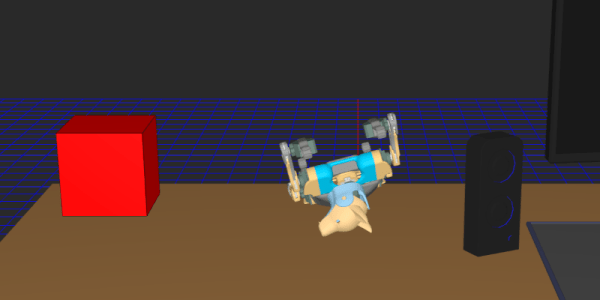
You’ve doubtlessly seen the current crop of robot dogs and, if you are like us, thought about getting one to play with. The problem is that the cheap ones are toys, and the serious ones cost serious money. But now you can experiment with a mid-range cost one for free in your browser. The sponsor will be happy to sell you a robot in kit or assembled form, although it is the OpenCat robot (we’ve covered it before), so you could simply build a real one yourself if you wanted to.

The code is all in a Web-based IDE, and the main file is deceptively simple. However, the real work is in read_serial (in the src/moduleManager.h file, for some reason) and reaction in the aptly-named src/reaction.h file. If you just want to play, you can use the buttons in the simulator or enter serial commands (documented elsewhere). For example, ksit will make the dog sit down.

Continue reading “Robot Dog In Browser”

Hackaday Podcast Episode Ep 377: Parallel Pixels, Wiggly Consoles, And Seven Segments

This week’s podcast sees Elliot joined by Jenny List, as both suffer silently in the European summer heat because the sound of a desk fan would come over on the recording.

A stand-out hack of the week comes from [Bitluni], whose GPU made from thousands of cheap microcontrollers is on a scale we’ve never seen before. It’s an amazing project in itself, but the manufacturing and power consumption issues of so many processors running at the same time make for a discussion of their own.

Otherwise, we have diecasting on the bench, an impressive achievement by any measure, a Raman spectrometer, and an open source take on something like a Kei truck. In quick hacks there’s a dicussion of soldering versus crimping for high current connectors, and neon tubes used as digital logic in an organ. The recording finishes with a discussion of 7-segment display history, and whether an engineering education teaches design for manufacture.

Or download it yourself, in glorious 192-bit MP3.

Continue reading “Hackaday Podcast Episode Ep 377: Parallel Pixels, Wiggly Consoles, And Seven Segments”

3D Printed Scooter Fits In Your Luggage, Some Assembly Required

Though [Ivan Miranda] calls the 3D printed vehicle in his recent video a motorbike, what he ultimately pulls out of his suitcase is clearly a scooter. Linguistic confusion aside, the “Mirandetta” looks like an awesome build and pulling a scooter out of your suitcase and whizzing past everyone in the taxi line just sounds amazing, especially knowing you made it yourself.

Aside from a whole lot of filament, he’s got a couple of tool batteries for hot-swappable energy that Airport security shouldn’t mind too much — provided you carry them with you, anyway — plus the usual e-bike motor and electronic speed control you might expect, and lawnmower tires which you might not. The narrow 3D printed rims round over the normally-flat tires to make them usable for this application. He seems particularly taken with the bi-stable mechanism he built for the kickstand, and we can’t blame him as we love seeing that kind of thing ourselves. The TPU seat is also a nice touch to keep with ‘everything printed’ vibe.

Now while the finished product does indeed fit into his suitcase, it needs to be completely disassembled. Well, unless you have an over-sized suitcase, perhaps. So our dreams of zooming away from the luggage line from the first paragraph were perhaps a bit premature. Still, from the footage at Prague Maker Faire at the end of the video, it looks like it was a fun enough ride that we can forgive [Ivan] for our overactive imaginations.

If you want an open-source e-bike, we’ve seen those too — but that won’t fit in any kind of suitcase.

Continue reading “3D Printed Scooter Fits In Your Luggage, Some Assembly Required”

This Week In Security: Escaping Linux VMs, Vulnerable Solar, Confusing AI (Again), And Confusing NPM Malware

The Januscape vulnerability allows a user in a guest VM managed by the Linux Kernel Virtual Machine (KVM) to corrupt memory in the host system and break out of isolation.

KVM virtualization is used by major hosting platforms like Amazon AWS, Google GCP, Digital Ocean, and many more. All of the shared hosting platforms count on virtualization to isolate untrusted guest systems from the physical hardware and each other; being able to corrupt memory for all guests or break isolation presents a major threat.

The bug report says the error has been present for 16 years, which is nearly the entire lifetime of the KVM subsystem in Linux. Fixes are available in mainline, and major hosting providers who count on KVM are likely already updating.

Vulnerabilities In Balcony Solar

Micro solar, or “balcony solar”, installs have been gaining traction in Europe as a way to offset rising electrical costs by connecting solar and battery systems to a house or apartment power system.

Vulnerabilities have been found in the popular Hoymiles micro-inverter, which uses a proprietary RF radio protocol to manage the devices. Unfortunately, it looks like this protocol has no encryption or authentication beyond validating the serial number, and the serial number is also available over a wireless probe command.

Armed with a Nordic nRF radio researchers were able to discover nearby inverters in the wild and collect the serial numbers, though of course they stopped short of issuing commands to random users.

The wireless management control allows controlling the device power and output levels, as well as setting a lockout PIN, which the researchers suspect could be used to disable devices and lock the legitimate owners out completely.

There are an estimated 500,000 units in use, and currently the only known mitigation is to unplug the device entirely and disconnect the solar panels, though the team suggests that setting an anti-theft PIN may also help – or at least prevent an unknown PIN being set.

Be sure to check out the link for an in-depth analysis of the protocol and the surprising lack of protection.

Continue reading “This Week In Security: Escaping Linux VMs, Vulnerable Solar, Confusing AI (Again), And Confusing NPM Malware”

Browser-Based Image Inpainting Runs Locally, If One Doesn’t Mind A Big Download

[Simon Willison] ported the Moebuis 0.2B image inpainting model to run locally in a web browser.  The web tool simply requires a user to provide an image, mark a section of it to be removed, and the model will do it’s best to patch up the missing area. The project was handled by Claude Code as an experiment in how things in the AI coding world have evolved, but more on that in a moment.

The existence of this tool shows that it’s possible for this kind of image editing to be done on the client side, running entirely locally with no reliance on remote services or server-side GPU resources. The online demo (GitHub repository here) is available if you want to try it out, but be warned it triggers a 1.27 gigabyte download of the required model on the first run.

What’s also interesting is [Simon]’s write-up, because he used the project as an opportunity to learn what has changed in the realm of AI coding agents. [Simon] is a software developer but in this project he didn’t personally write any of the code. One may think that means he didn’t learn anything other than how to use the tools, but that’s not quite true.

He learned it’s possible to convert a PyTorch-based model to ONXX, that the converted model can run in supported browsers using local WebGPU acceleration, and that the CacheStorage API will work on large files. Last but not least, he learned Claude Opus 4.8 is capable of handling such a project pretty much autonomously, and even created an informative document explaining the underlying architecture.

One may consider AI coding agents to be disasters waiting to happen, but it’s also true that the landscape is changing quickly, and write-ups like [Simon]’s give a helpful peek at those developments.

A Super Cheap Desk Toy Becomes A Hackable Desktop Notifier

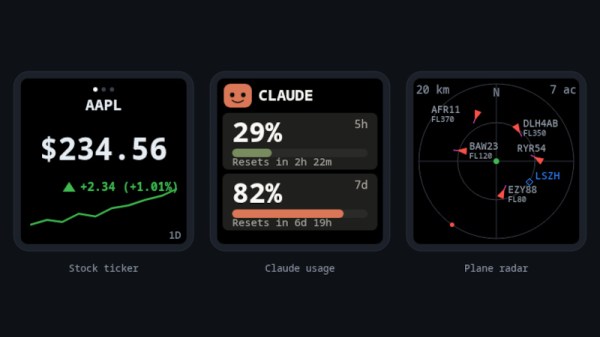
The GeekMagic SmallTV is as its name suggests, a tiny, vaguely TV-styled, device with a screen, that’s sold as a desktop notifier. Depending on the firmware running on the device it can display various pieces of information, ranging from the time and weather to the current price of Bitcoin. What makes it interesting is that it supports software updates over WiFi, so [Giovi321] has made a new firmware package for it.

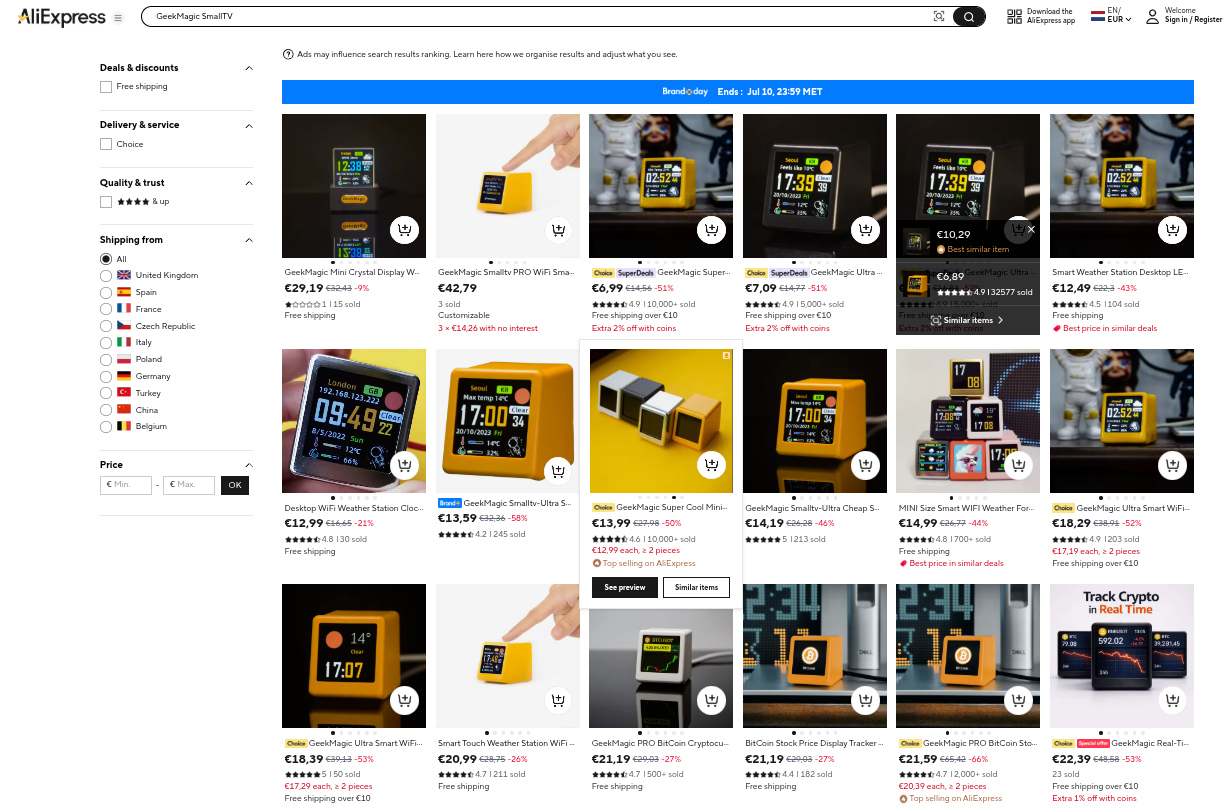
A screenshot of AliExpress showing a range of the devices for sale.
These things are readily available from AliExpress.

It seems there are several versions of this device, something which appears to be reflected in the prices they sell for on AliExpress. The older version runs on the ESP8266, and there’s also a ESP32-C2 variant in the wild. The firmware supports both flavors, providing stock and crypto tickers, an ADS-B tracker, and a Claude AI token usage gauge.

What gives this potential is that the various functions are clearly split out in the code, and there’s nothing to stop you pointing it at a data source of your choosing. This makes it more than a bit of cheap e-waste novelty, and we hope that others will take up the baton and do interesting things with it.

The ESSP8266 is a chip we don’t see too much of these days, having been surpassed by its ESP32 siblings. Still, someone recently gave it a simple OS.

Three Different Digital Counters To Remind Us How Good We Have It

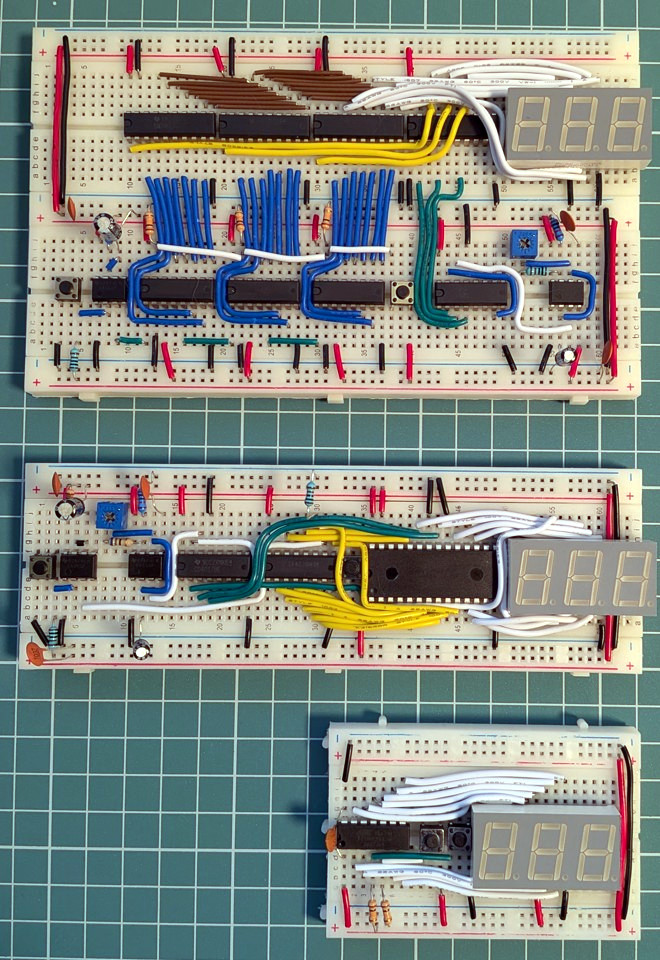
Integrated electronic modules like counters and displays are convenient and space-saving, which may also make them easy to take for granted. [Nagy Krisztián] demonstrates this by making three very different digital counter designs, each breadboarded with a 7-segment LED display. Push a button, and the displayed number increments by one for each press. It was a personal project that ended up educational in more ways than one.

The progressively-integrated designs shrink in part count and board space, but the complexity doesn’t disappear. It just moves into software.

The first version uses discrete components only, and even though it handles the counting with CD4026B decade counter ICs instead of building counters from scratch with NAND gates, it’s still by far the largest of the three. The second version simplifies driving the display with an AT28C64B EEPROM acting as a sort of hardware lookup table translating binary counts into 7-segment digit display patterns. The third uses an ATtiny24A microcontroller, and unsurprisingly has the smallest footprint.

All of this highlights two things. One is that implementing even a simple counter and 7-segment LED readout is a nontrivial affair when one gets right down to it, even when taking advantage of purpose-built ICs. The second is that the complexity that is on full display in the first version doesn’t simply disappear as the footprint and component count goes down. Rather, it moves into software and other infrastructure, like the need for compilers and chip programmers.

The whole thing is both educational and a reminder of how good the average hardware hacker has it today. There are so many effective electronic assemblies, available to just about anyone at low cost, that it can be very easy to take it all for granted and forget just how much breadboard space and wires were needed for even simple-seeming things.

[Nagy] is certainly no stranger to dealing with a lot of wires, as we’ve seen when he fooled a 286 processor into thinking it was plugged into a functioning vintage motherboard.