Building An Energy-Harvesting Business Card

The hope is always that a good business card will leave a good impression. For those in the electronics field, they also serve as an opportunity to showcase creative design skills. [Wilson Harper] demonstrates that ably with a rather nifty energy-harvesting build.

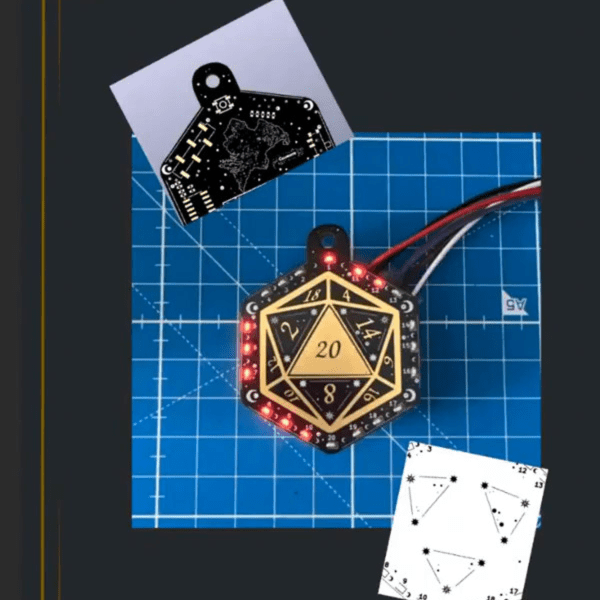
The card is based around a thin PCB in the typical business card size. It’s populated by 21 Charlieplexed LEDs, a small microcontroller, and some supporting components. Now, this is normally where you might expect the device to be powered by a small coin cell, maybe deftly integrated into the PCB thickness itself to make the card less cumbersome. But no—[Wilson] went a different route. The thing is that in 2026, most of us are carrying phones with NFC readers built in. Thus, the card was built to harvest this source of energy with a PCB trace antenna, designed with the aid of STM’s antenna inductance tools and an LLM script lobbed into KiCad. All one needs to do is to pop the card on the back of a phone and the LEDs animate joyfully.

Design files are on Github for the curious. You might also like to check out some of the fancy business cards we’ve featured in the past. Of course, if you’re working on just such a project yourself, you’re more than welcome to send it in to the tipsline!

Simulating UAVs In Unreal Engine

When it comes to building real-world flying vehicles, testing can be arduous and expensive. You have to find somewhere to fly, then you have to contend with environmental conditions and the possibility of damaging your craft if things go wrong. Simulation is a great solution to this, allowing testing without so much risk. To that end, [AlexanderRex] whipped up a platform for testing UAVs from the comfort of your computer desk.

PteroSim is intended as a comprehensive test bench for simulating autonomous aerial vehicles. It can run PX4, ArduPilot, and Betaflight binaries right in the simulator. The autopilot code is given simulated sensor data, and in turn responds with actuator commands, just as it would in a real craft. The simulator runs the flight dynamics using JSBSim, and the resulting scene is rendered in Unreal Engine 5.

If you’ve ever wanted to quickly road test different autopilot settings without heading out to the field or risking hardware, this is a great way to do so. It’s hard to beat the speed of iteration that is possible when testing on the computer on your desk. We’ve featured similar work before, too.

Continue reading “Simulating UAVs In Unreal Engine”

Defeating Bacteria In Hot Water Systems With A Heat Exchanger

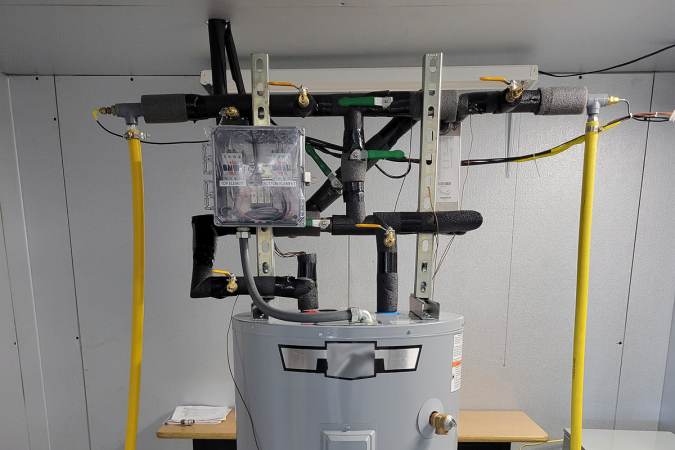
The average hot water is a relatively simple appliance to understand. It uses gas or electricity to dump energy into water in the form of heat, keeping it at a pleasant temperature for uses like bathing and cleaning. Basic mechanisms are in place to ensure the water stays at a relatively constant temperature, neither too hot where it could cause burns, nor too cold such that it wouldn’t be fit for purpose.

One of the problems, though, is that sometimes storing water at the desired temperature can create the perfect breeding ground for bacteria. However, a neat little trick developed by NIST could solve that problem rather elegantly.

Continue reading “Defeating Bacteria In Hot Water Systems With A Heat Exchanger”

USB-C Adapted For Legacy Sprinkler Systems

In the modern world USB has become a truly universal connector, with its inclusion on almost every major piece of consumer electronics. It has even expanded well beyond things that we’d think of as consumer electronics, like the solenoids on automatic sprinkler systems.

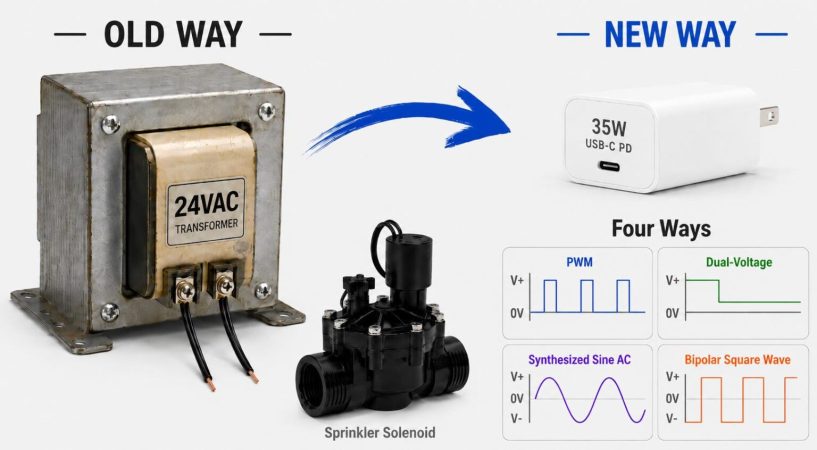
This project comes to us from [Ray Wang] at opensprinkler.org who has been working on various ways of controlling the old sprinkler standards, which generally rely on a 24 VAC power supply to drive solenoids. This tests uses the power available from USB-PD and closely examines four methods of energizing the solenoids: unipolar PWM, dual voltage, synthesizing an AC wave from a DC supply, and producing a bipolar square wave. The bipolar square wave had some interesting results, being able to get pretty close to the behavior of a true sine wave while minimizing the dedrmand on power electronics.

For those working on old sprinkler systems, or many other antiquated systems that still rely on 24 VAC, this project shows that USB can deliver a surprising amount of power in unique ways, and the fact that it’s near-ubiquitous and affordable makes it that much easier to adapt into situations it was never really designed for.

These old sprinkler systems have other ways of working on modern systems as well, like this one which replaces the AC source for a DC one, but with a few caveats.

What’s Mu Metal?

If you tear into old TVs or recording equipment, you may see shields made from some exotic-looking metal. Old timers will tell you it’s called mu metal, and its purpose is to — sort of — shield things from magnetic fields. The qualification is important. Unlike a conductive RF shield, mu metal doesn’t really stop a magnetic field. Instead, it gives magnetic flux an easier path to follow around whatever you’re trying to protect.

What’s In The Metal?

Mu metal belongs to a family of soft magnetic nickel-iron alloys. A typical modern formulation is about 80% nickel and 15% iron, with molybdenum and a few other elements making up most of the remainder. What makes it useful is its extremely high magnetic permeability. Commercial material can have relative permeability around 100,000 or more, and some specialty alloys can reach even higher.

You can think about reluctance as the magnetic equivalent of resistance. Put a high-permeability shell around something sensitive, and magnetic flux would much rather travel through the shell than through the space inside it, just like current tends to take the path of least resistance.

This works particularly well for DC and low-frequency fields, exactly where your usual copper or aluminum EMI shield isn’t much help.

Continue reading “What’s Mu Metal?”

Digital “Film” For Your Pi Camera

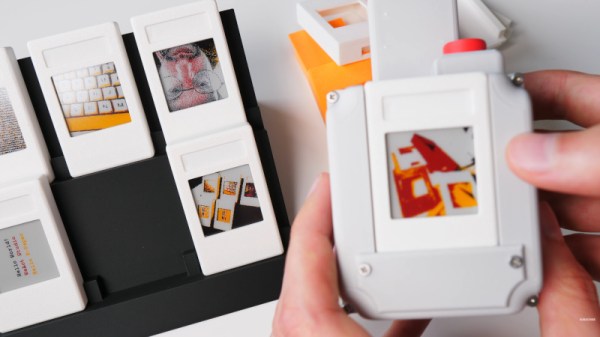
The formula of a Raspberry Pi camera is such that it’s almost a self-assembly kit of parts. Over the years we’ve seen a lot of attempts to make one that’s more impressive, usually due to a different take on a case design. It’s not often we see something genuinely out of the ordinary, and perhaps [Strange Inventions] has made one. He’s produced an instant camera where the “film” is a removable cartridge containing a color e-paper display.

It’s a straightforward enough idea: the camera writes the image to the display, and since these displays are persistent, there it stays. The displays connect via headers, and the cartridge slips in in a similar manner to a console game cartridge. They’re not cheap, but at least unlike a Polaroid or Instax cartridge, they are reusable.

You’ll have to pay up if you want to download the files, but it’s not outrageously expensive if you really want to build one. But perhaps the key here is that it’s not something beyond the abilities of the average Hackaday reader to make their own. We’re sure this idea will be expanded upon by others in due course.

Meanwhile, if it’s simpler instant photography you crave, you can always print the real thing.

Continue reading “Digital “Film” For Your Pi Camera”

A Flip Disc Display That Does It Slow And Steady

Flip disc displays can be quite a task to drive, what with having some sort of actuator mechanism for each and every dot in the display. [Zimm] has built an altogether different kind of flip disc display, though, which gets around this with a complexity all its own.

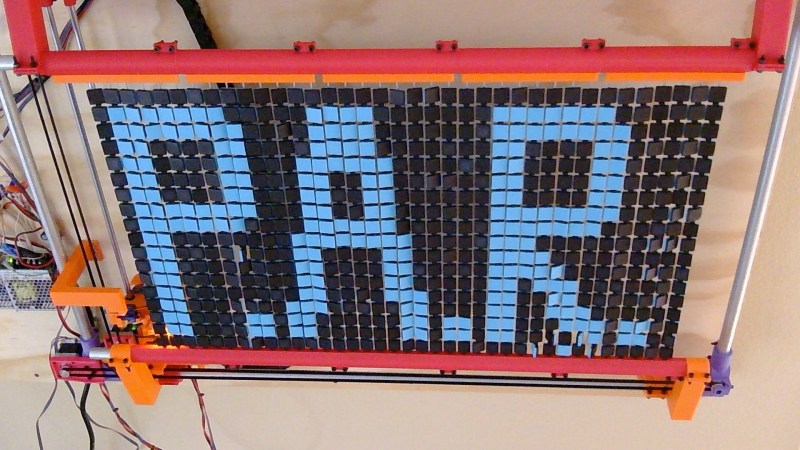
The idea behind the build is simple. There is still an array of discs, in this case, 37 x 18 square discs that are black on one side and blue on the other. However, they’re not actuated by magnets or any kind of per-disc flipper. Instead, a CNC machine is charged with flipping them one at a time. There’s a tool head that scans through the array, and uses a color sensor and LIDAR to identify which pixels to flip and how far to push them. It’s not fast, by any means, but it’s a perfectly cromulent way to build a flip disc display, as it turns out.

If you so desire, you can draw or upload images to be displayed on PAR yourself, right from your browser. The project reminds us quite a lot of various plotters we’ve covered over the years, perhaps more than a traditional flip disc display, even.

Continue reading “A Flip Disc Display That Does It Slow And Steady”