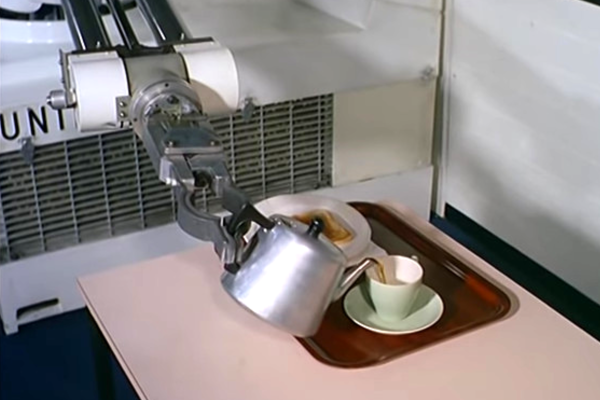
Do you know the name [George Devol]? Probably not. In 1961 he received a patent for “Programmed Article Transfer.” We’d call his invention the first robot arm, and its name was the Unimate. Unlike some inventors, this wasn’t some unrealized dream. [Devol’s] arm went to work in New Jersey at a GM plant. The 4,000 pound arm cost $25,000 and stacked hot metal parts. With tubes and hydraulics, we imagine it was a lot of work to keep it working. On the other hand, about 450 of the arms eventually went to work somewhere.
The Unimate became a celebrity with an appearance in at least one newsreel — see below — and the Johnny Carson show. Predictably, the robot in the newsreel was pouring drinks.
Anyone who’s looked into high-voltage experiments is likely familiar with ion lifters — spindly contraptions made of wire and aluminum foil that are able to float above the workbench on a column of ionized air. It’s an impressive trick that’s been around since the 1950s, but the concept has yet to show any practical application as the thrust generated isn’t nearly enough to lift a more substantial vehicle.
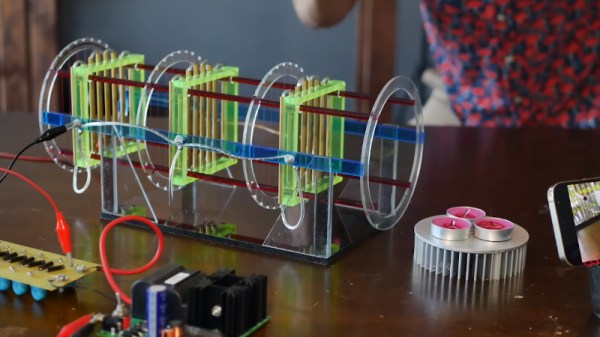
It’s a bit early to suggest that [Jay Bowles] of Plasma Channel has finally found the solution to this fundamental shortcoming of electrostatic propulsion, but his recently completed multi-stage ion thruster certainly represents something of a generational leap for the technology. By combining multiple pairs of electrodes and experimentally determining the optimal values for their spacing and operational voltage, he’s been able to achieve a sustained exhaust velocity of 2.3 meters per second.
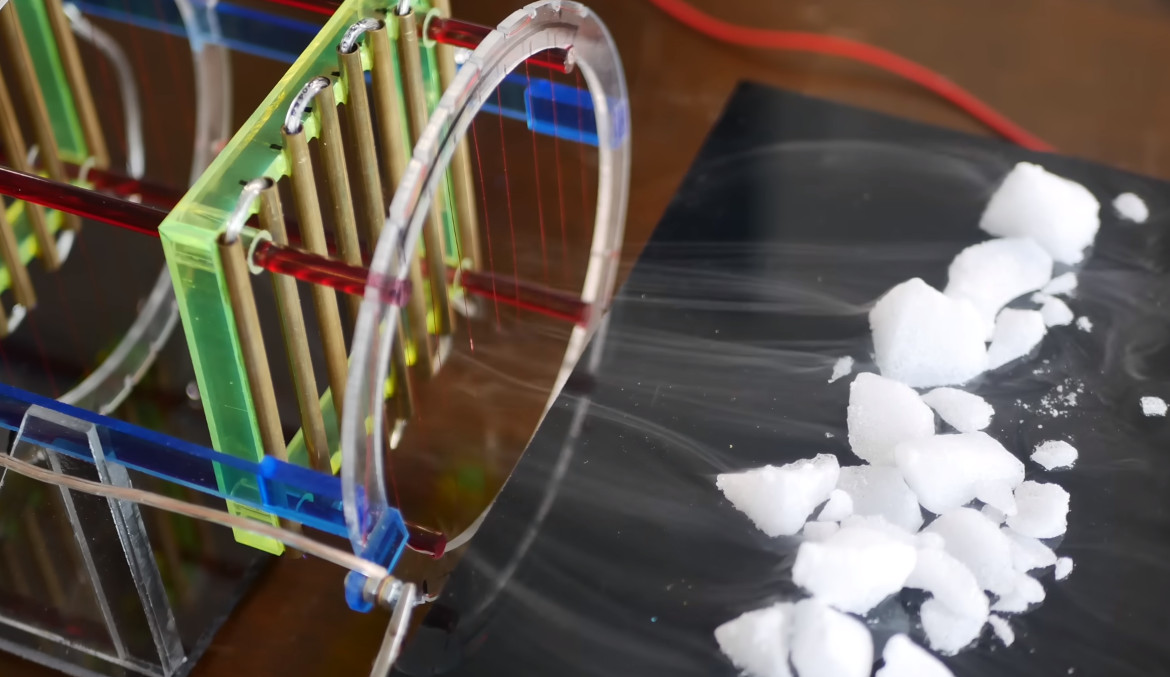
Dry ice was used to visualize airflow through the thruster.
While most ion thrusters are lucky to get a piece of paper fluttering for their trouble, [Jay] demonstrates his creation blowing out candles at a distance of a meter or more. But perhaps the most impressive quality of this build is the sound — unlike most of the experimental ion thrusters we’ve seen, the air flowing through this contraption actually makes an audible roaring sound. When the 45 kilovolt supply voltage kicks in it sounds like a hair drier, except here there’s no moving parts involved.
In addition to providing graphs that show how air velocity was impacted by input voltage and the number and spacing of the electrode pairs, [Jay] also pops the thruster on a scale to show that there is indeed a measurable thrust being produced. Admittedly the 22 grams of thrust being generated isn’t much compared to the contraption’s own mass of 490 grams, but in the world of electrostatic propulsion, those are pretty impressive numbers.
[Jay] says he has some improvements in mind that he believes will significantly improve the device’s performance as he works towards his ultimate goal of actually flying an ion-propelled aircraft. We saw MIT do it back in 2018, and it would be great to see an individual experimenter pull off a similar feat. Obviously, there’s still a long way to go before this thing takes to the skies, but if anyone can pull it off, it’s [Jay Bowles].
Long after the enemy forces have laid down their arms, peace accords have been signed and victories celebrated, there is still a heavy toll to be paid. Most of this comes in the form of unexploded ordnance, including landmines and the severe pollution from heavy metals and other contaminants that can make large areas risky to lethal to enter. Perhaps the most extreme example of this lasting effect is the Zone Rouge (Red Zone) in France, which immediately after the First World War came to a close comprised 1,200 square kilometers.
Within this zone, contamination with heavy metals is so heavy that some areas do not support life, while unexploded shells – some containing lethal gases – and other unexploded ordnance is found throughout the soil. To this day much of the original area remains off-limits, though injuries from old, but still very potent ordnance are common around its borders. Clean-up of the Zone Rouge is expected to take hundreds of years. Sadly, this a pattern that is repeated throughout much of the world. While European nations stumble over ordnance from its two world wars, nations in Africa, Asia and elsewhere struggle with the legacy from much more recent conflicts.
Currently, in Europe’s most recent battlefield, more mines are being laid, booby traps set and unexploded shells and other ordnance scattered where people used to live. Clearing these areas, to make them safe for a return of their inhabitants has already begun in Ukraine, but just like elsewhere in the world, it is an arduous and highly dangerous process with all too often lethal outcomes.
There was a time when street lighting means someone had to go light the lamps. Electricity changed that, but street and outdoor lighting has been quietly going through a new revolution: LEDs. The problem, though, is that LEDs provide what scientists call “broad white” light and there are concerns about the impact the unnatural lighting will have on ecosystems, including people and animals.
Of course, the first step in worrying about something is to measure it. You would think that satellites would have a bird’s-eye view of the nighttime lighting landscape, and, of course, they do. But most of the imagery isn’t suitable for looking at the spectrum of wavelength data scientists need to quantify what they call ALAN — Artificial Light at Night.
The ISS imaging is, however, sufficient. Using special data techniques, they were able to track the adoption of LEDs over sodium lights and other technologies between 2012-2013 and 2014-2020 across Europe. For example, in the title image, you can see Belgium with an orange tint indicating low-pressure sodium lights. The Netherlands, France, and the UK have a more yellow hue, indicating high-pressure sodium lamps. Germany is more of a blue color due to fluorescent and mercury vapor bulbs.
For most hackers and makers, building a clock is a rite of passage. Few, though, will be as unusual and engaging as this design by [TerraG2].
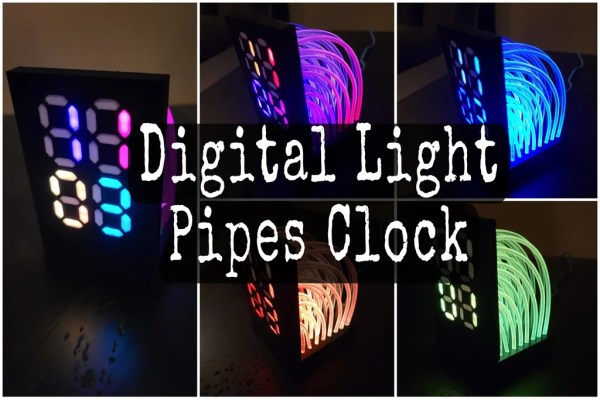
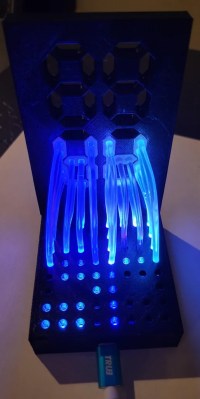
By combining addressable LEDs, light pipes and 7-segment displays, [TerraG2] has built a timepiece that looks great and will surely be a great conversation starter as well. It’s packed full of features such as automatic brightness control, an accelerometer controlled user interface, and WiFi to make sure it’s always accurate.
Partial rear view of the clock showing illuminated light pipes
The decision to leave the light pipes visible behind the main display really makes the project stand out from other clock builds, and the methods [TerraG2] has used to achieve this look will no doubt be transferable to a host of other projects.
The LEDs are courtesy of a standard 8×8 RGB matrix, with a custom 3D-printed shroud to hold the light pipes in place and a clever connector at the other end to illuminate the segments. With two LEDs per segment, seven segments per digit, and four digits, there’s even room for some extra features down the line if you can think of a use for those eight spare LEDs.
The brain of the project is an ESP8266 D1 with an MPU6050 inertial measurement unit (IMU) to detect when it’s flipped over to change the color scheme.
Light pipes have been used to great effect in some other clock projects we’ve seen, such as this modern Nixie clock and this “clock of clocks”, as well as in this light organ that we showed recently.
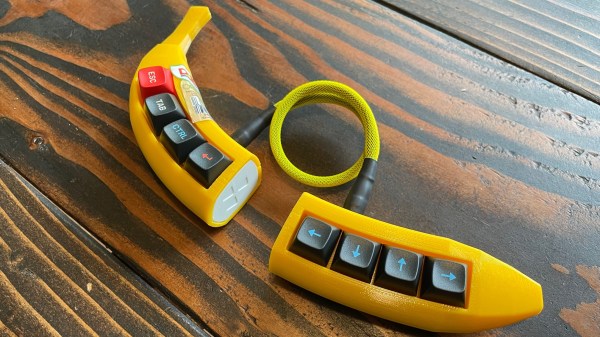
Once again, [Dan Bostian] is ahead of the curve when it comes to bringing bunches of banana puns to the table, but we think you’ll find this banana split macropad quite appealing nonetheless. Does this tasty thing look familiar? It ought to — we discovered, plucked, and uncovered the one-piece version last summer, and this time, [Dan] simply made our two-piece, wireless dreams come true.
Peel back the — oh, forget it. Inside, you’ll find a nice!nano running the show from the right-hand board using ZMK firmware, and a banana-shaped chalk outline on the left-hand silkscreen that represents how completely [Dan] killed it with this build. You can use any switches you want, as long as they’re Cherry MX-compatible in the shoe footprint department.
The PCBs are open source, of course, and so are the printed parts — it’s all there in the repo. As for the stickers, well, you’ll have to produce those yourself.
When working with grain-of-dust surface-mount components, one of the tools which makes a huge difference is a vacuum pickup pen. Instead of trying to move the part with tweezers and succeeding only in flicking it into the middle distance, a tiny rubber suction cup with a vacuum feed allows you to pick it up and place it exactly where it is required. Unfortunately, good vacuum pickup tools come at a price, and very cheap ones aren’t worth the expenditure.
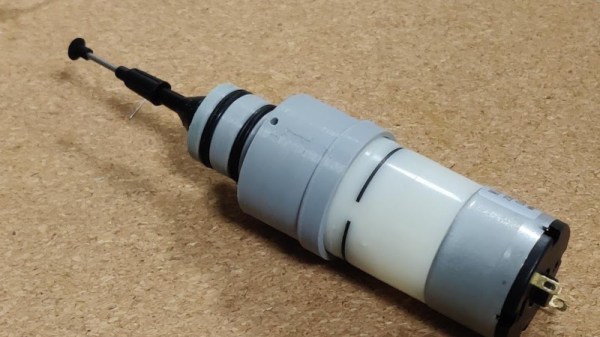
This is where [TDG (Béla)]’s SMD vacuum pickup tool comes in. The problem with the cheap tools is only that their manual vacuum is ineffectual, they come with the required array of probes with the suction cups. The solution is to take a small vacuum pump with a low voltage motor and attach it with a 3D printed adapter to the business end of a cheap vacuum tool and make a useful tool the result.
There’s a short video of the tool in action that we’ve placed below the break. It’s a bit noisy, but it’s obvious that it performs well. Control is via an air hole in the side of the 3D print, place a finger over it and the full suction is directed to the tip. The result is simpler and cheaper than previous contenders in the budget vacuum pickup stakes.